Friday, May 30, 2008

Punakaiki

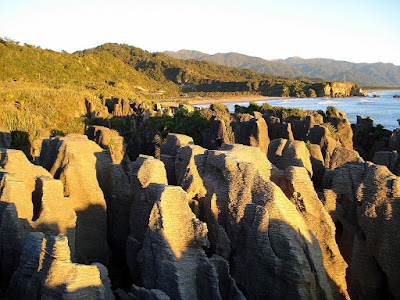
We packed our gold mining gains, and a souvenir pan (you never know) from Shantytown into the car, and continued northwards towards Greymouth and ultimately Punakaiki. This place is famous for its pancake rocks and its blowholes. The pancake rocks are a cliff formation peculiar to the area, formed underwater by marine animals obligingly turning into layers of limestone, sequentially and over a period of tens of millions of years. The finished product was thrust out of the sea by an earthquake, to form cliffs. The blowholes are holes (unsurprisingly) in the pancakes through which large volumes of liquid (maple syrup say, or perhaps just seawater) are squeezed at high tide. You can just see why people flock here. Just.

Punakaiki was the only other stop off on the West Coast that we thought was within easy striking distance and even vaguely interesting. Our expectations weren't high, and in one important way they were met: The food west of the Alps continued to disappoint. Had we eaten some of the pancake rocks themselves, rather than the disagreeable stodge for which we exchanged perfectly good real money in Punakaiki's only tavern, we would have been no worse off. If this is what the locals themselves regularly eat then clearly there is another variety of blowhole here whose eruptions are independent of the tide.

But all that was to come later.

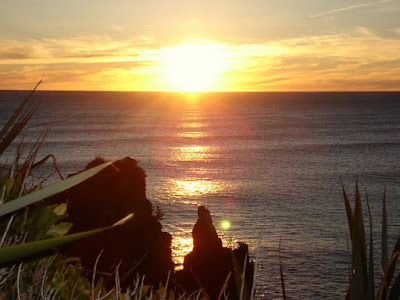
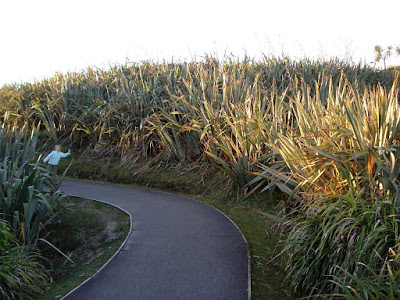
When we first arrived, we went straight to the rocks, and took the path that led in a circuit from the main road to the cliffs, through abundant flax growth, and back. It was close to sunset and Letizia started snapping away in light that perfectly displayed the strange formations. There was something strange in the atmosphere that at first I put down to the rocks themselves, the noise of the waves' impact underneath us, and to the isolation lent by the surrounding flax.


But after the light had faded and we had found our motel - situated on a tiny sliver of land with the darkened beach on one side and an even darker enormous cliff on the other - I realised what it was that had struck me as odd earlier on. Since leaving Cork, we've either travelled inland, or on the eastern seaboards of enormous landmasses. This family of islanders had just seen a sunset over the sea for the first time in 5 months.

Wednesday, May 28, 2008

MTV (Maori Television)

[Updated May 30th to sort out cut&paste problems in first paragraph]

When you switch on the telly for the first time in New Zealand, you'll find that one of your viewing choices will be in a language that you have probably only heard before on the rugby pitch, when the All-Blacks perform their famous haka. The Maori language is like nothing I've ever heard before, and strange to a European ear. But when James Cook (there he is again) made contact with the people of New Zealand in 1769, he had on board somebody who could understand these men, and could make himself understood. That man was called Tupaia, a Tahitian chief picked up during the first part of the Endeavour's voyage. The reason that Tupaia understood the Maori is because the Maori, like Tahitians, are Polynesians, and speak languages that come from the same sub-family of Austronesian. The Polynesian people swept eastwards across the Pacific from 1200BC until 1000AD, starting from Taiwan and inhabiting island after empty island, eventually doubling back to find Earth's last big true Terra Nullius, New Zealand. And they did it a good six to eight hundred years before Cook passed by.

When you first enter the country, even at the airport, you see the Maori language all around you. Like Ireland, official signage is always bilingual. Like Ireland, certain terms in the one language have found their way into the other. Most white Kiwis will know what mana is or what whakapapa means - not just words but even Maori concepts form part of New Zealand's shared vocabulary. The cross-fertilization works both ways. After Cook had moved on, and traders and whalers moved in, the Maori needed to expand their own language to deal with things they had never seen before, and they used transliterations, just like we've heard in the Chinese language a few months ago. For example hipi renders the idea of the then-unknown sheep and pata sounds like the foodstuff that the Maori had never know, due to the lack of large mammals on the islands: butter. (I have no idea where Lake Wanaka got it's name...)

Take all these things together - Maori Television, a single Maori language respected with dual signage, a keen sense from white New Zealanders (Pakeha) of Maori culture - and you get an outsider's feel for the difference between the situation of the Australian aboriginal and the New Zealand Maori. The Maori suffered under colonization, make no mistake. At one stage during the late 1800s most whites believed - many with regret - that this was a people doomed to extinction. But they survived conquest better than the Australian peoples, and adjusted with greater ease into an essentially European political framework.

Why?

At the moment, I'm reading another, older Jared Diamond book called Guns, Germs and Steel. Diamond offers an explanation for what he describes as the "broad pattern of history": how Europeans (or at least Eurasians) came to conquer the rest of the planet, rather than Africans, Native Americans, or Australians. I'll wait till I finish the book before trying to summarize it on this blog, why the fates of the Maori and the Australian First Owners have differed so much.

For now, let's look at another related New Zealand story that Guns, Germs, and Steel relates. The book starts with a discussion on the spread of the Polynesians across the Pacific. This is because that movement serves as a kind of Human History in a Nutshell, a small isolated example of what happened globally when anatomically modern Man spread from Africa to almost every corner of Earth. The islands that they conquered or filled varied enormously in climate, size, isolation and domesticatable plants and animals. Over the two millennia of exploration, the inhabitants of each of these islands tended to lose their cultural memory, forgetting where they had come from and simply adapting to conditions on each of the islands. The starkest lesson that can be gleaned from these adaptations lies in the story of the Moriori people of the Chatham Islands.

When they settled in New Zealand, the people who came to be known as the Maori brought with them some domesticated crops (the earliest Polynesians were already farmers). Some of the crops they had didn't thrive in the colder climate even on the North Island, but others did and the Maori people came to depend on agriculture more and more, especially after they hunted the larger flightless birds on New Zealand to extinction (the Moa being the most well-known example). By the time New Zealand was fully colonized by the Maori, they were organized into territorial tribes. At any moment in time, some tribes were at war with each other, while others cooperated (a perfectly normal state of human affairs). Some time before 1500, a group of Maori left NZ and settled the Chatham Islands, 800km East of where I'm sitting now in Christchurch. Life on the Chathams was not the same as where they had come from - it was too cold even for the few crops that remained to the Maori. But it was abundant in seafood. The Chatham Islanders reverted to a hunter-gatherer way of life and while this was the right choice (indeed their only choice) for survival in these conditions, it was the wrong choice geopolitically and it sealed the Moriori's fate.

In order to survive on an island that could support no more than 2000 people, they developed a strategy for dealing with conflict that excluded outright war. It wasn't strictly pacifist - you could still take a stick to your neighbour in a ritual fight. But once you drew blood, that was as far as you were allowed to go. There was no food surplus, nor way of storing it, that would in any case have provided for maintaining even temporary armies. There were precious few natural resources that could have provided for weapons. If the Chatham Islanders had kept up their Maori ways, they would have wasted what the islands had to offer, and died out.

When contact was next made with the Moriori people, by whaling and sealing ships around 1800, the word was brought back to the Maori in New Zealand of islands that were bountiful and inhabited only by a group of people who had no concept of weapons or war, and simply no idea how to defend themselves against outside aggression. A total of around 800 Maori chartered a European ship, and went to settle the Chathams. Those of the unfortunate Moriori who escaped slaughter tried repeatedly to negotiate their way to peace (it was all they knew) but merely ended up as the slaves of the Maori. The consequent genocide was practically complete in 1933 when the last full-blooded Moriori died.

By recounting this story I am not criticizing the Maori - what they did was in complete accordance with what they would have expected to suffer if they were defeated in war themselves. Nor am I saying that the Moriori are to be commended for their pacifism - their lack of defence was not a principled stand as such, but simply due to the fact that as a people they had forgotten how to fight. The real tragedy as I read it, is the fact that neither side understood that they were brothers, separated by just a few hundred years. And the immediate lesson that I take from it is that, if you extrapolate out the 2000 years of Polynesian colonization to the 40,000 years of the movement of modern Man, you are left with the similar conclusion that every one of the current wars raging on the planet right now is a war between brothers. That is not a liberal, bleeding-heart opinion. It is, to steal a phrase from Stephen Jay Gould, a contingent fact of history.
Selling up to travel

Just to put our own little trip into perspective, check out this family from Florida. They're selling the family home, and embarking on a round-the-world trip for a year with their three teenaged sons. The have a blog too, which I will definitely be subscribing to.

Tuesday, May 27, 2008

Flash in the Pan

We stayed a second night in the Glowworm cottages, and already traumatized by the truely awful food available in the local pubs, we decided to play it safe and 'take the soup' on offer from our hosts, and hang out in the lounge for the evening. The next morning we headed back north again on our way to Punakaiki - home of pancake rocks and blow holes (what now?)

But before arriving there, we stopped off in a place called Shantytown, just outside of Greymouth. Shantytown is a reconstruction of a goldmining town. So much of white New Zealand history is bound up with this metal. It's discovery secured the future of the then-colony, attracting tens of thousands of prospectors from all over the world. The most exciting activity in Shantytown by far (even more exciting than the ham and cheese sandwiches) was panning for gold. Here, you are guaranteed a find. You're given a pan with stone and a very small amount of real gold, and instructions on how to pan. I was helping Nina and Sara (by edging them out of the way in order to make sure that they didn't lose whatever miniscule amount was in the pan) and discovering how unnervingly addictive it could be to stare into a pan of gravel, looking for flashes of gold.

The place was very quiet - it is off season - and felt all the more twee for the lack of crowds. There was a ride on a steam train which went all of 100 meters in one direction, before reversing back again.

I'd like to say that 5 months on the road has raised Nina and Sara's expectations and standards when it comes to entertainment. But it hasn't - they loved this place. To be fair to them, they loved the fact that the found gold and got to take it away with them. And I suppose to be even fairer to them, deep down I really like that they can enjoy a place like this without turning their noses up at it.

Interestingly enough, when we were there we met a lady from Clare (where my dad is from) who lived in the UK now but who had a niece in Carrigaline (where we call home). So if you're from Carrigaline, and you have an auntie Bridie (who's married to a kiwi) - she says to say hello!

Monday, May 26, 2008

Walking on Water

We shouldn't be let mind a dog, never mind two children. The night before our planned excursion on Fox Glacier, Sara gave her unsolicited opinion on the food in Arthur's Pass in the direct and physical way that we are used to from the girl: she barfed it all back up before bedtime. It wasn't looking good for the hike. To make matters worse - much worse - the following morning as we got up early and started to prepare ourselves the same child pointed out, again in the most direct way possible, that her stomach was empty and her sugars were low, by fainting in the bathroom. She didn't black out, but she ended up on her arse, murmuring slowly to herself, until we set her on the bed and put her head between her knees. Really - if anyone feels like reporting us, I'd almost encourage them.

But it gets worse again. Sara recovered quickly, and protested our decision to call off the glacier trip. She insisted that she wanted to do the hike and that she was fine now. We weren't buying it but set off to Fox Glacier (half an hour's drive from Franz Josef) to see if we could get a refund of the $100 deposit. When we got there, and explained Sara's alternating puking and swooning, Malcolm our guide-to-be told us that she'd be fine (these Kiwis are as good as the Aussies at shrugging off illness, danger and common-sense).

So, responsible parents that we are, we continued to increase Sara's sugar levels using fruit sweets and juice, fitted herself and Nina out with boots, and got on the bus with the guides that led to the start of the trail.

What's a glacier anyway?, I hear you ask (admittedly over the noise of those baying for our children to be removed for their own safetly). It's a river, really, that moves 100,000 times slower than normal rivers. Instead of water, flows ice. Instead of a spring, there's a snow-collecting basin (called a neve) over 3000m up the mountain, where today's snow compacts yesterday's and eventually compresses it into ice. The ice flows downhill under its own weight, moving on a layer of water formed where the ice meets the underlying rock, but also moving internally, in a plastic flow. At the bottom of the glacier, the terminal, where the higher temperatures defeats the pressure, the ice finally melts and runs off as cloudy green streams.

The way you get up onto Fox Glacier is to start near the terminal of the glacier and hike for the best part of an hour along the mountainside - the bank of this river of ice - until you reach a point where it's safe (in the I-have-signed-a-waiver sense of the word) to move onto the glacier itself. To reach this point, we had to climb a fair bit, as well as move along a narrow trail at the edge of a bluff. This last fact might alarm American or Antipodean readers. That's because they know what the hell a bluff is. A bluff in European English is a clever card-playing pretence, and very little else. So when we were told in advance that we would be walking along a bluff, I thought it odd but not much odder than anything else I've been told by a guide in the last 5 months. Halfway along our hike to the edge of the ice, we found out what a New Zealander means by a bluff. A bluff, so far as I can now tell, is a f**king great cliff with a 100m drop. It has a path alongside whose width is very much economy class. And by way of support for those who might have fainted that morning there is a chain and a red-bearded, grinning guide. (Social services numbers are in the Government section of the phone book, if you haven't found it yet).

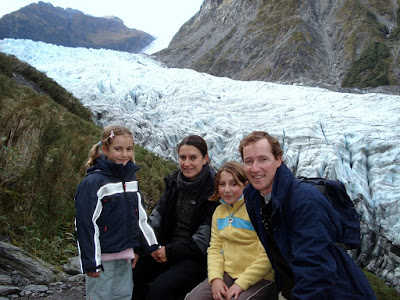
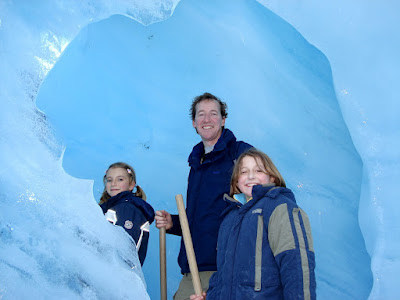
We survived, and not having been killed are of course stronger (big chunks of ice bring out the Nietzsche in me). Nina and Sara dealt with the heights like two little girls who know what it feels to zip along on a flying fox at 7 meters, and we all went on to have a surreal and rewarding experience walking on top of a glacier for 90 minutes or so.

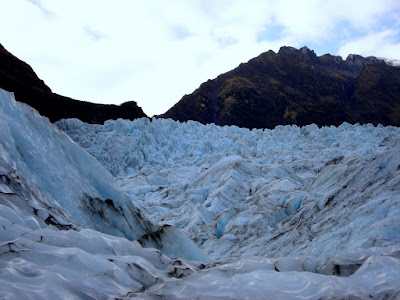
When we got to the edge of the glacier, we were handed poles, and told to put on our instep crampons. And then we walked on water. We stepped onto 12km of frozen but moving water. The surface was broken in a thousand different ways. Where it met the mountainside, it thrust upwards, trying to burst its banks. The centre of the flow moves faster than the edges, creating crevasses whose depths are disguised by the pools of water that fill them. We were walking in the melt zone of the glacier, where the liquid flow created other perfect imperfections on the icescape - archways, circular pools and waterfalls. From the mountain, the uppermost surface of the glacier is undulating but looks smooth. Up close, it is anything but. The ice looks like a snapshot of the choppy surface of a lake on a windy day.

On any trip, there are inevitably things that you wish you had kept your wallet closed for. You're probably glad you did them but you wished you didn't have to pay so much for it. We spent less than 100 euro in the backpackers in Franz Josef, and a little over 100 euros for the half-day trip on the Fox glacier. It was one of the best value highs we've had on the trip so far. If you come here with kids, be aware that there is practically nothing else to do in either Franz Josef or Fox Glacier. The evening activity is limited to going to the pub, and apparently they get quite boisterous. Our irresponsibility as parents doesn't extend to finding out in person.

Honest!!


Friday, May 23, 2008

West over Arthur's Pass

For the first time in quite some time, this blog is coming to you live. I've paid my blog debt and now I'm reporting directly from Franz Josef on the West Coast of New Zealand's South Island.

We stayed put in Christchurch for almost 2 weeks, but we couldn't resist any longer. We got into the car this morning and headed over the Arthur Pass. We've been looking west to the distant Alps since we first arrived in Christchurch, but it was only today that we pointed the car that way. After about 5 minutes in the car I mentioned to Letizia that finally being on the move again felt good and in fact moving has become our natural state of being. Staying put, even just for a week or two, was starting to weigh us down.

From coast to coast it's only a little over 200km. The first 70 kms were on the Canterbury Plains, flat and straight, with the foothills of the Alps appearing out of the mist. The second 70km was spend riding out of one valley and into another, each one different to the last. Some were tiny patches of fertile land, perhaps with a lake, others were stony flat badlands, others again with forests, until we reached Arthur's Pass. The rest of the trip to the coast was a steep and scenic descent to the sea. We turned south, lush treefern forests to our left, and the waves of the Tasman to our right. We were heading down to see the glaciers - and walk on them too. From start to finish we didn't pass anything approaching a large town. There were a dozen or more small towns, or collections of houses offering fruit, art or B&B. One sign advertised psychic readings and vegetable soup - an unusual combination that somehow seemed to work (something fulfilling, that also leaves you feeling full).

Our base for the next two nights is a small, cozy and cheap place called Glowworm Cottages in the centre of Franz Josef. For a room with four bunks, a kitchenette and an ensuite the total price for the 2 days comes in just under 100 euros. After that we'll head back up North to check out the Pancake Rocks, do a little panning for gold, and hopefully have the time and weather to check out the Devil's Punchbowl (thanks for that tip, Paul C).

Franz Josef was our first choice for a glacier walk, but unfortunately there's an age/height limit that Sara couldn't quite pass, not even on her tippy-toes wearing a pointy hat. A little further down the road, Fox Glacier doesn't have such requirements. But apparently the hike that leads up to the ice itself presents its own challenges - narrow trails with steep drops for example. We'll see if the Adrenalin Forest experience has prepared Nina and Sara (and Letizia and me, for that matter).

The town of Franz Josef is probably a great place if you don't have kids, but the only thing to do around here other than climbing a glacier is going to the pub. I think (hope) the glacier experience will be a positive one, but if you come here with kids, don't stay more than one night.

More tomorrow, if we survive the hike on the ice.

Thursday, May 22, 2008

Trying something out

I've been using Zemanta for the last few blog entries, by way of making it easier to link to related wikipedia articles, and finding related news. But now I've come across something called Apture which allows me to do something similar, but connecting to a larger selection of links, using multi-media formats which pop up directly on the screen.

For example if I mention a song called No Alarms and No Surprises by Radiohead, I can easily set up a few references to YouTube and similar. A reference to Hu Jintao might yield different results on different media formats.

Let me know if it gets too irritating.