Now, many many years later, Father Brendan is once more a priest (you can take the boy out of the God, but...) and finally the fortune of the parish priest is starting to faintly show its lustre. Last weekend, again through Livia's good offices, Padre Nicanor gave us the use of one of the Medical Centre's 4-wheel-drive pickups and we took to the countryside around Cusco.
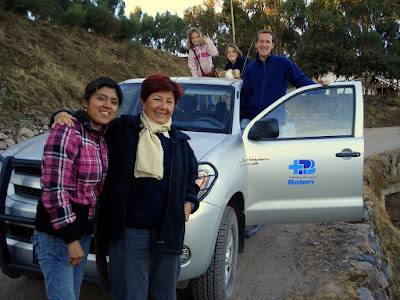
The new face in the picture above is Natalie, tour guide and niece of Señora Paulina from the Medical Centre (nothing here is done without contacts - I feel like I'm back in Italy). It's all very well having your own wheels, but they're not much good if you don't know where to point them. Natalie guided us around the area that can roughly be described as the Sacred Valley for the entire weekend, helping us work out a good itinerary and giving us her insights into the history of the Inca. In some sense it was a magical mystery tour. Our ambitions in Cusco centred entirely around the city itself and Machu Picchu, and we had little or no research done on what else there was to see. Idiots. The land around Cusco is rich in magnificant historic remnants of the Inca Empire, and with Natalie's guidance we took in some of the more important ones.
First stop was a place called Moray which won't show up on many maps, and in effect doesn't have much of a road. We crawled our way up the gravel track, having already spent over an hour on sealed roads, stopping off to pick up locals who flagged us down for a lift. We parked (some of our passengers offered to pay for the lift - a humbling experience given their clearly meagre resourses) and walked to the edge, to where the ground seemed to fall away, still not sure exactly what awaited us...
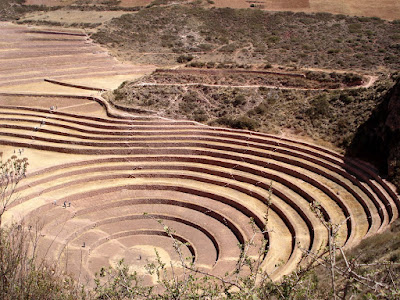
These beautifully executed and wonderfully restored concentric circles, leading down to a depth of 30 meters or so, formed the world's first greenhouse according to Natalie. What you are looking at is an experiment in agriculture. A system that created different micro-climates, allowing Inca society to grow various crops all year round, and even to develop different varieties. Most importantly, this was the larder that filled the stomach on which the Inca army marched. During the phase of imperial expansion, this experiment was undertaken to help build up the surplus of food that must precede every military advance.
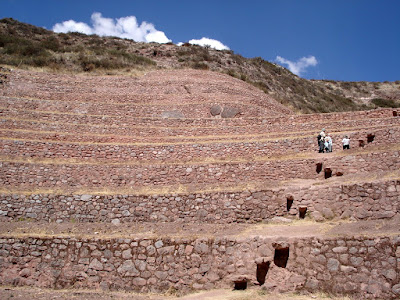
Nowadays it has another function. This site is considered by some as an important point of energy on the Earth's surface. When I hear the word 'energy' being used in this loose context, often by practicioners of alternative healing, I become immediately suspicious. But after climbing down to the very centre, still dealing with the altitude and heat, I was too breathless to put up a fight when Natalie suggested that we make a family offering to Pachamama. We didn't have coca leaves, we weren't inclined to sacrifice either of our daughters (given that they were well behaved that day) so we settled for one of the sweets that I constantly carry around in my pocket (we get them with the bill in Karl-Heinz's wonderful restaurant La Granja de Heidi across the road from our hotel - more on that in a later post). The Inca preferred even numbers apparently, so Natalie excluded herself from our offering. We buried the sweet, made a collective wish (which will remain as buried as the sweet itself until such time as it comes true), and struggled back to the edge of this enormous and breath-taking structure. Using steps like this...
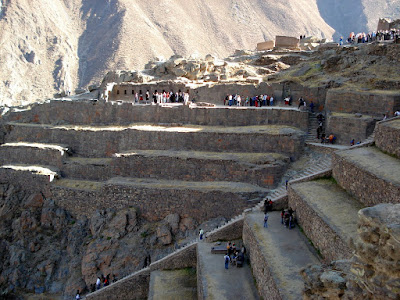
Next on the itinerary was Ollantaytambo, another hours drive away. Guide books will often describe this as a fortress on the edge of a town, but Natalie began to show herself to be something of a maverick when it comes to interpreting Inca history. This time, the road was more civilised. We drove over the cobbles of the town and parked in the main plaza. So far it looked like a pretty, lively place. It's where the train to Machu Picchu leaves from, so there was quite a bit of tourist activity about. It wasn't until we left the plaza and walked north to the edge of the town that the vast ladder of terraces that characterized these ruins suddenly came into view. It took our already faint breath completely away. Twice in one day we had been ambushed by the Inca, despite the fact that they were swept away 500 years ago. Imagine the impression that this civilization must have made on those who lived in it, and those who came to conquer it.
We had lunch first, to prepare for the climb upwards, during which Natalie continued to give us her particular views on the nature of the Inca. She was slow to even use the word 'empire', and portrayed the way of life as a golden age for Peruvians. Nobody went hungry, the empire itself was build up by good example rather than at the end of the sword, everything was just dandy until the bloodthirsty Spaniards turned up. In our trip so far, we have seen the stamp of imperialism in every country we visited, and I feel I can say that the imprint is the same regardless of culture. The rationale behind empire, and many of its methodologies, are distinctly human and shared by British, Spanish, Papal, Mandarin, Mongol and Maori. I have learned to mistrust historical explanations that insist on exceptions to normal human behaviour. (In case this sounds fatalistic, and too pessimistic of human nature itself, I will try to give a fuller picture of what I mean in a later blog. I like to spread the pain - your pain that is - over time.)
Nina and Sara, faced with another climb, spat the dummy. So Livia volunteered to stay with them (quite happily, as she has seen all this before) while Letizia, Natalie and I hiked upwards.
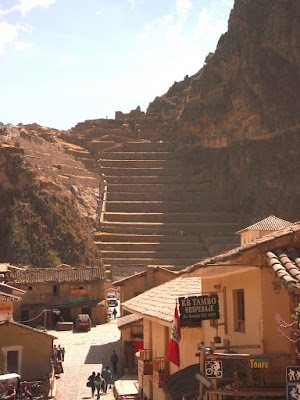
In fairness to Natalie, it is hard to see the Ollantaytambo ruins as a fortress, given the lovely unguarded set of steps that run right up the middle of the terraces. The terraces themselves hold historical record of agriculture, just like back at Moray. Natalie's depiction of the site as a mixture of temple, agriculture and normal habitation made sense as she guided us up and across the structure. Always in the back of my mind, however, is the thought that only a centralized and powerful state, with endless cheap labour at its disposal, and methods of enforcing its will, can hope to construct edifices like this and Moray.
But I remain an ignoramus on all South American history and cultures, so I will have to wait until I read much, much more and compare what I have read to what I have seen, before offering anything other than these generalized and broad-sweep opinions.
Padre Nicanor has something of a reputation as a fast driver. Livia calls him Il Pirata (the pirate). Given that this was my first Peruvian driving experience, I was taking it nice and handy. I made sure, on returning the car at the end of the day, to apologise to the Padre, thorugh Livia, for destroying his reputation by tootling around the Cusco countryside like a pensioner, in a car marked with the Centro Medico de Belen. He laughed out loud and beamed at me. But there was something unpredictable and flammable about his glee, like an American caricature of a mafia godfather. I handed back the keys nervously and promised to do better the following day.

