Showing posts with label china. Show all posts
Showing posts with label china. Show all posts
Friday, August 8, 2008
Back in the PRC
It has finally begun. One of the reasons we went to China first, rather than last, was to avoid the Olympic Crush. Now that the games have commenced, I feel a little nostalgic for Beijing. If you want a blow-by-blow account of goings on in Beijing you can check out Brendan O'Kane's blog coming to you live from that city.


Saturday, June 7, 2008
Some News from Sichuan
I mentioned a few weeks back that I had contacted what few people I knew or had met who live in and around Chengdu in the Sichuan province, to see how they were faring since the earthquake. This evening I got an email from Sim's Cozy Guesthouse in Chengdu. Since the crackdown in Tibet and the earthquake centred in Wenchuan county, Chengdu tourism is seeing a dramatic fall off (Chengdu is a launching pad for travelers to Tibet). Here's what Sim has to say:
I'm just passing on the message to anyone interested in visiting Sichuan. Inform yourself as to the real situation before discounting it out of hand. And if you do decide to visit Chengdu, you can do no better for cheap, confortable friendly accommodation than Sim's Cozy Guesthouse.
Recently, some of our guests called us to ask if Chengdu is safe to come, and others just skipped or cancelled to come to Chengdu (or Sichuan ). Here one thing we would like to announce to everyone is that you are safe at Chengdu , so please come to visit us! We luckily did not affected by this earthquake, and except some people who are afraid to sleep in their apartment buildings are sleeping in tents in parks, but the city is operating properly. You are able to visit Panda Center , Mt. Emei , Leshan Grand Buddha, Yibin Bamboo Forest and so on.
...
If your friends want to come but going to skip Sichuan because of the disaster, we really hope that you can tell them to get the accurate information from us and judge if it’s worth to visit. Please do not just be away from Sichuan . Disaster area is recovering everyday, and situation is changing all the time. Also, if there is anyone interested in volunteer work, we know some groups who are in actions and we try our best to make it work out.
Best WishesSim and MakiP.S. According to the latest notice, Tibet is going to be open for foreigners in the end of June after the torch relay finished in Lhasa .
Wednesday, May 14, 2008
Chengdu Revisited
The recent earthquake in Sichuan hit 50 miles northwest of Chengdu, where we stayed just 4 months ago. I've contacted Sim's Cozy Guesthouse, and luckily they haven't suffered any damage or injury. I've contacted Erik Wiersma to make sure he's good too, and hopefully I'll hear back from him.
Reports on damage in Chengdu itself seems to conflict, some talking of almost 1000 deaths, others report minimal damage. The Chinese people that we met a few weeks ago in Slope Point were from Chengdu. I've been in contact with them, and some of them have been home. One of them has suffered heavy damage to his apartment and possessions.
The Olympics are just around the corner and Bejing must surely have imagined different international headlines than those that have come to pass. So much has happened to China since our time there, first the Tibetan unrest, subsequent suppression and public opprobrium that followed, and now this devastating and tragic earthquake. In the first case, the Chinese showed their similarity with the Burmese regime, and in the second, they demonstrated the difference, by accepting foreign humanitarian aid immediately and mobilising the army in Sichuan as urgently as they did in Tibet. (Burma by stark and disgusting contrast are centralizing their resources into the administration of a referendum of dubious worth, and keeping US and other aid at arms length and away from those who need it.)
My undiluted sympathy goes out to those Chinese people caught up in this natural disaster. It has perhaps given an opportunity for ordinary people worldwide to connect to ordinary people in China through fund-raising and humanitarian organizations, over the heads of politicians and outside the straitjacket of politics.
Reports on damage in Chengdu itself seems to conflict, some talking of almost 1000 deaths, others report minimal damage. The Chinese people that we met a few weeks ago in Slope Point were from Chengdu. I've been in contact with them, and some of them have been home. One of them has suffered heavy damage to his apartment and possessions.
The Olympics are just around the corner and Bejing must surely have imagined different international headlines than those that have come to pass. So much has happened to China since our time there, first the Tibetan unrest, subsequent suppression and public opprobrium that followed, and now this devastating and tragic earthquake. In the first case, the Chinese showed their similarity with the Burmese regime, and in the second, they demonstrated the difference, by accepting foreign humanitarian aid immediately and mobilising the army in Sichuan as urgently as they did in Tibet. (Burma by stark and disgusting contrast are centralizing their resources into the administration of a referendum of dubious worth, and keeping US and other aid at arms length and away from those who need it.)
My undiluted sympathy goes out to those Chinese people caught up in this natural disaster. It has perhaps given an opportunity for ordinary people worldwide to connect to ordinary people in China through fund-raising and humanitarian organizations, over the heads of politicians and outside the straitjacket of politics.
Monday, April 14, 2008
Uncool
It's a sin against nature for a child above a certain age to believe that their parents are cool, even worse to openly declare this belief. So imagine my concern when Nina (8-about-to-be-9, and therefore well past aforementioned certain age) suggested a few weeks ago that she had cool parents. When I challenged her on this she insisted somewhat impatiently: "Sure you're cool. You're taking us around the world, aren't you?".
This is a worry.
I had it all planned out - or at least confidently predicted - shortly after she was born. Nina has a software engineer for a dad, a doctor of law and stay-at-home mamma, but her Italian aunt Giovanna lives in Paris and moves between fashion/art photography to dealing in antiques without visible effort. It's her job to be cool. It's her job to be right where Letizia and I are wrong, and provide for the you just don't understand me like Giovanna does (slam!!!) moments. And of course when Nina is old enough, it'll be to Gio that Nina will go on holidays, and certainly not anywhere with her parents.
So this new-found coolness of ours is upsetting everything. And it is new-found, by the way. Before we left Ireland last December, if you had asked Nina about whether she was excited about the trip, she would have said "not really". She wanted to stay with her friends, and her cousins, and of course her classmates. Was there anything she was looking forward too? The Great Wall of China? The Great Barrier Reef? The Big (if not indeed also Great) Pineapple of Woombye? Nope. But if you caught her in one of her more adventurous moods, she would confess a certain curiosity for a pair of cats in Christchurch, New Zealand. You see the first leg of our New Zealand trip was to be a house-swap (arranged through HomeForExchange) with a English/Kiwi couple called Ray and Louise. An optional part of this swap included the company of Satie and Willard, the resident cats. So in a nutshell, Nina was begrudgingly allowing us to take her and her sister to 8 new countries, across 3 continents and 2 hemispheres, on a trail littered with World Heritage listings, diverse cultures and climates, stocked with a zoological cornucopia of exotica, on condition she could make friends with a pair of antipodean moggies.
Now this is the kind of infuriating, illogical, and downright ungrateful behaviour that I am most comfortable with. This was child-parent communication in a language I could understand. Then it all went horribly, horribly wrong: As the trip began, so both Nina and Sara began to enjoy it.
As the fog of jet lag cleared in Beijing, they got into their stride. It was hard for them not to love the pandas in Chengdu, or the sweet treats in Xi'an. But they also developed a taste for the Shanghai marketplace haggling and the strangeness of Chinese buildings. And they were seeing things with minds much less tainted by the false familiarity of TV documentaries than we were. When we reached Australia, where they could actively engage with their surroundings thanks to the language, where we weren't moving at such a frenetic pace, and where we were meeting many new (to them) friends, things kicked up a notch. They couldn't bear to leave Sydney, or then Melbourne, then they didn't want to move on from Cairns, and finally they didn't want to say goodbye to Simon, Leah and Caitlin in Brisbane (they didn't as it happened - more on that in a later blog entry). And somewhere in those 12 Aussie weeks, Nina used the c-word against me: Cool, she said. And she meant it.
Cool doesn't sit well with me. Cool leads to teenage conversations that start with what a great dad I am and end with car keys getting handed over. I've never been cool, and so I'm entirely unsure how to manage it, and if I get used to being cool then I'm sure I'll start worrying about losing the status (by not handing over car keys or similar acts of willful parental spite).
But I'm playing the long game. I'm quietly optimistic that it won't last, that it's a temporary aberration that time and continued exposure to 'daddy humour' will heal. There are indications of a return to normality. As I write this, Nina and Sara are fast asleep here in Christchurch, with Willard purring gently at the bottom of their bed, and Willard and Satie have proved themselves to be as big a highlight of the trip as anticipated. Tomorrow Nina turns 9 and Sara has just turned 7 (every year brings us closer to the very uncool parents years). And in two short days, Zia Giovanna flies in from Paris.
Cool doesn't stand a chance.
This is a worry.
I had it all planned out - or at least confidently predicted - shortly after she was born. Nina has a software engineer for a dad, a doctor of law and stay-at-home mamma, but her Italian aunt Giovanna lives in Paris and moves between fashion/art photography to dealing in antiques without visible effort. It's her job to be cool. It's her job to be right where Letizia and I are wrong, and provide for the you just don't understand me like Giovanna does (slam!!!) moments. And of course when Nina is old enough, it'll be to Gio that Nina will go on holidays, and certainly not anywhere with her parents.
So this new-found coolness of ours is upsetting everything. And it is new-found, by the way. Before we left Ireland last December, if you had asked Nina about whether she was excited about the trip, she would have said "not really". She wanted to stay with her friends, and her cousins, and of course her classmates. Was there anything she was looking forward too? The Great Wall of China? The Great Barrier Reef? The Big (if not indeed also Great) Pineapple of Woombye? Nope. But if you caught her in one of her more adventurous moods, she would confess a certain curiosity for a pair of cats in Christchurch, New Zealand. You see the first leg of our New Zealand trip was to be a house-swap (arranged through HomeForExchange) with a English/Kiwi couple called Ray and Louise. An optional part of this swap included the company of Satie and Willard, the resident cats. So in a nutshell, Nina was begrudgingly allowing us to take her and her sister to 8 new countries, across 3 continents and 2 hemispheres, on a trail littered with World Heritage listings, diverse cultures and climates, stocked with a zoological cornucopia of exotica, on condition she could make friends with a pair of antipodean moggies.
Now this is the kind of infuriating, illogical, and downright ungrateful behaviour that I am most comfortable with. This was child-parent communication in a language I could understand. Then it all went horribly, horribly wrong: As the trip began, so both Nina and Sara began to enjoy it.
As the fog of jet lag cleared in Beijing, they got into their stride. It was hard for them not to love the pandas in Chengdu, or the sweet treats in Xi'an. But they also developed a taste for the Shanghai marketplace haggling and the strangeness of Chinese buildings. And they were seeing things with minds much less tainted by the false familiarity of TV documentaries than we were. When we reached Australia, where they could actively engage with their surroundings thanks to the language, where we weren't moving at such a frenetic pace, and where we were meeting many new (to them) friends, things kicked up a notch. They couldn't bear to leave Sydney, or then Melbourne, then they didn't want to move on from Cairns, and finally they didn't want to say goodbye to Simon, Leah and Caitlin in Brisbane (they didn't as it happened - more on that in a later blog entry). And somewhere in those 12 Aussie weeks, Nina used the c-word against me: Cool, she said. And she meant it.
Cool doesn't sit well with me. Cool leads to teenage conversations that start with what a great dad I am and end with car keys getting handed over. I've never been cool, and so I'm entirely unsure how to manage it, and if I get used to being cool then I'm sure I'll start worrying about losing the status (by not handing over car keys or similar acts of willful parental spite).
But I'm playing the long game. I'm quietly optimistic that it won't last, that it's a temporary aberration that time and continued exposure to 'daddy humour' will heal. There are indications of a return to normality. As I write this, Nina and Sara are fast asleep here in Christchurch, with Willard purring gently at the bottom of their bed, and Willard and Satie have proved themselves to be as big a highlight of the trip as anticipated. Tomorrow Nina turns 9 and Sara has just turned 7 (every year brings us closer to the very uncool parents years). And in two short days, Zia Giovanna flies in from Paris.
Cool doesn't stand a chance.
Monday, March 31, 2008
By Request: China and Tibet
A couple of readers of this blog expressed surprise that I hadn't mentioned anything about the current situation in Tibet, given that China was our first port of call. My opinions on the matter are probably not much more informed for having been to China, and so I didn't feel the need to write here on the matter. But for what they are worth, I offer my feelings and thoughts on the matter here for anyone who may be interested.
Chengdu is well known on the tourist trail as a convenient access point to Lhasa, the Tibetan capital. It is where many flights leave from, and now there is a When deciding on an itinerary, we had to chose from a wide range of destinations, and Tibet didn't make the cut. I bitterly regret the missed opportunity to go and see for myself what life in Tibet's capital is like, and now I assume it will be quite some time before tourists are given any access to the place.
At the time we visited China, our visa was not sufficient to go to Tibet, but it was a relatively straightforward matter to get the permit to visit Lhasa. But even that permit would not have granted us open access to all of Tibet. Further more specialized permits would have been needed. See this helpful site to get an idea. This kind of restriction, and others like the Great Firewall of China, indicate by themselves that all is not well.
During our stay in Sim's Cozy Guesthouse in Chengdu, I met a very pleasant Frenchman who had just returned from Lhasa. He was very much taken by the spiritual nature of the place, but to my surprise he expressed the notion that 'democracy isn't for everyone', by way of justifying, or at least explaining, the current political system in China, and Tibet. I have encountered this kind of philosophy before, from Chinese and Westerners alike, that the Chinese mind is not suited to democracy (similar arguments are made for Arab countries).
I do accept that every nation must find its own way to wellbeing, and that a Western form of representative democracy cannot be superimposed on any country without due consideration to the history and culture of that country. But I also believe that this reasoning can be taken too far, that it smacks of Orientalism, and that it provides a fig-leaf for authoritarian governments which simply do not want to share decision-making power. The turmoil that has swept Tibet and parts of Sichuan since our time in China demonstrates that in China as everywhere else, there is a natural human impetus to determine one's own future, rather than have it dictated by distant and unrepresentative interests. Irish people can quite naturally relate to this.
The Chinese prime minister betrayed a crass clumsiness when he tried to make the world believe that the Dalai Lama was secretly agitating for complete Tibetan independence and was in fact orchestrating the violence in Tibet. I can only assume that it was a message for internal consumption, because few people who live on the free side of the Great Firewall, and who can read whatever books they like, will see it as anything but blatant propaganda. I hope that reports that Hu Jintao will sit down once more with the Dalai Lama prove to be true. It doesn't matter which side you take, both sides need to talk.
I repeat my opinion that Chinese people are as curious, open and friendly as any you will meet. The people should not be tarred with the same brush as such an unrepresentative government. That said, I am sure that my opinions here will not be shared by many Chinese readers, who are understandably proud of their heritage, and unhappy to hear criticism from outsiders that they will consider ill-informed. But this is the whole point: the ability to inform oneself. Arriving at something approximating truth rests on the ability to freely exchange information and ideas. This blog cannot be accessed from behind the Great Firewall. Books like Wild Swans by Jung Chang or Freedom in Exile by the Dalai Lama cannot be bought there. It is absurd but true to say that those of us who live or move outside of China and who really want to understand China (rather than swallow whole their own local propaganda) stand a better chance of acquiring the full picture than those who who live exclusively within her borders. The constant nagging presence of the Great Firewall while we were in China was a reminder to me that this was not like any other country I have ever visited before. I loved my time in China, and look forward to returning some time soon, but part of me felt lighter when I first surfed the net again from Sydney.
If official China wants to be believed or even understood, then it will have to come to terms with the fact that along with free market values come inextricably linked values of transparency, accountability and freedom of information, movement and expression. Not because it's nicer that way, but because that's the only way the system protects itself from excess, abuse or corruption in the long run. For as long as China tries to pull the blanket over what it is doing in Tibet, it succeeds only in equating itself with neighbouring Burma, in the eyes of anyone with free access to information.
Chengdu is well known on the tourist trail as a convenient access point to Lhasa, the Tibetan capital. It is where many flights leave from, and now there is a When deciding on an itinerary, we had to chose from a wide range of destinations, and Tibet didn't make the cut. I bitterly regret the missed opportunity to go and see for myself what life in Tibet's capital is like, and now I assume it will be quite some time before tourists are given any access to the place.
At the time we visited China, our visa was not sufficient to go to Tibet, but it was a relatively straightforward matter to get the permit to visit Lhasa. But even that permit would not have granted us open access to all of Tibet. Further more specialized permits would have been needed. See this helpful site to get an idea. This kind of restriction, and others like the Great Firewall of China, indicate by themselves that all is not well.
During our stay in Sim's Cozy Guesthouse in Chengdu, I met a very pleasant Frenchman who had just returned from Lhasa. He was very much taken by the spiritual nature of the place, but to my surprise he expressed the notion that 'democracy isn't for everyone', by way of justifying, or at least explaining, the current political system in China, and Tibet. I have encountered this kind of philosophy before, from Chinese and Westerners alike, that the Chinese mind is not suited to democracy (similar arguments are made for Arab countries).
I do accept that every nation must find its own way to wellbeing, and that a Western form of representative democracy cannot be superimposed on any country without due consideration to the history and culture of that country. But I also believe that this reasoning can be taken too far, that it smacks of Orientalism, and that it provides a fig-leaf for authoritarian governments which simply do not want to share decision-making power. The turmoil that has swept Tibet and parts of Sichuan since our time in China demonstrates that in China as everywhere else, there is a natural human impetus to determine one's own future, rather than have it dictated by distant and unrepresentative interests. Irish people can quite naturally relate to this.
The Chinese prime minister betrayed a crass clumsiness when he tried to make the world believe that the Dalai Lama was secretly agitating for complete Tibetan independence and was in fact orchestrating the violence in Tibet. I can only assume that it was a message for internal consumption, because few people who live on the free side of the Great Firewall, and who can read whatever books they like, will see it as anything but blatant propaganda. I hope that reports that Hu Jintao will sit down once more with the Dalai Lama prove to be true. It doesn't matter which side you take, both sides need to talk.
I repeat my opinion that Chinese people are as curious, open and friendly as any you will meet. The people should not be tarred with the same brush as such an unrepresentative government. That said, I am sure that my opinions here will not be shared by many Chinese readers, who are understandably proud of their heritage, and unhappy to hear criticism from outsiders that they will consider ill-informed. But this is the whole point: the ability to inform oneself. Arriving at something approximating truth rests on the ability to freely exchange information and ideas. This blog cannot be accessed from behind the Great Firewall. Books like Wild Swans by Jung Chang or Freedom in Exile by the Dalai Lama cannot be bought there. It is absurd but true to say that those of us who live or move outside of China and who really want to understand China (rather than swallow whole their own local propaganda) stand a better chance of acquiring the full picture than those who who live exclusively within her borders. The constant nagging presence of the Great Firewall while we were in China was a reminder to me that this was not like any other country I have ever visited before. I loved my time in China, and look forward to returning some time soon, but part of me felt lighter when I first surfed the net again from Sydney.
If official China wants to be believed or even understood, then it will have to come to terms with the fact that along with free market values come inextricably linked values of transparency, accountability and freedom of information, movement and expression. Not because it's nicer that way, but because that's the only way the system protects itself from excess, abuse or corruption in the long run. For as long as China tries to pull the blanket over what it is doing in Tibet, it succeeds only in equating itself with neighbouring Burma, in the eyes of anyone with free access to information.
Wednesday, February 27, 2008
Melbourne, via the Snowy Mountains
It's been a fast and almost completely offline 4 days from Sydney to Melbourne, via Canberra, Threadbo and Rutherglen. But we're in Melbourne now for a few days - enough to collect our thoughts about the stay in Sydney and the trip from there to here.
Canberrra was surreal. It's name means Meeting Place in some unspecified Aboriginal language, and it was build out of nowhere when the newly federated states of Australia, in search of a capital, couldn't chose between Sydney and Melbourne. Our first impression of the place was 'where is it!?'. We were approaching the city, about 7km out according to our map, and all we could see was bush. Then, when we rounded a corner, we say the Telstra tower on Black Mountain poking from over a hilltop. Five minutes late we were in downtown Canberra. It's not a particularly small place (300,000 residents) - it's just, well, sudden. The city is a motorist's dream and a pedestrian's nightmare. I'm not surprised it wore out Bill Bryson. There are arterial avenues spreading into every district (in fact the borders of the districts are very clearly delineated by those avenues) from which then spread neat and, where possible orthogonal streets, all lined with houses or occasionally businesses. We booked two nights in a quarter of the city called Kingston - apparently one of the livelier ones with a good cafe scene. We found the block of cafes and restaurants not far from our B&B, but it really was nothing special. Windswept, predictable and without any atmosphere.
After checking in, we went to see the truly wonderful National Museum of Australia, where my favourite section was the one entitled Nation. One corner was dedicated to the way Aussies speak English. Letizia has already blogged on some of her favourite items of Australian vocabulary, and here was a museum exhibit that showed, in interactive and multimedia formats, many of these items, and even their etymology (I learned that the famous 'Sheila', meaning 'woman' came from the Irish name Sile). The building itself, its layout, design and interior made it a pleasure just to be there.
On day two in Canberra - a Sunday - we started with a visit to another excellent museum, this time the Questacon. It's a science museum, the kind that Nina and Sara claim to like the most. It was very good indeed, and we passed 3 hours in there with ease, but in the end, the best museum of it's kind that I've ever brought the kids to is Edinburgh's Our Dynamic Earth (though I haven't been to London's much acclaimed science museum.
While I'm on this subject, I'm reminded of our trip to Shanghai's equivalent, which was a terrible disappointment. Much of the content was given over to manned space flight, now that China has entered this exclusive club, but all the interesting related exhibits were closed. What remained felt like propaganda. There was an exhibit on pollution, which caught our attention. I was interested to see what official China had to say about the matter. I was shocked - the section on air pollution talked about the poor quality of air in London and Los Angeles. We had just spluttered in from Chengdu where visibility was down to 5 blocks for the duration of our 4-day stay. The only mention of Chinese pollution was the issue of the Suzhou Creek, and even that exhibit was all about the great strides that had been made to reclaim it.
Anyway, for the rest of Sunday we wandered around the Australian Commonwealth's capital looking for all the people (cue Madacascar: 'We bozos got the people, but they're not a very lively bunch'). We found them eventually, split over two groups. About 40 of the them spread around 4 cafe's in the corner of the central pedestrian zone. Mostly students, probably half of them visitors. At this point, Canberra reminded us of Stuttgart after 5pm before they liberalized the shopping laws. Concrete, empty, clean, and with a few well-hidden corners with some life stubbornly clinging on. The rest of Canberra was visiting the Sunday market in the Old Bus Depot right on the edge of Kingston. It was clear from the faces of those perusing the stalls (containing the largest variety of materials and styles for toilet roll holders that I have ever seen) that they were there not to be amused, but to be consoled. Consoled that neither Sydney nor Melbourne had been chosen to be the capital of Australia.
NEXT!
Threadbo. This isn't so much a town as a resort. Nestled at 1300m in the Snowy Mountains, it's a ski resort during Winter and a bush-walking centre in the Summer. We took a skilift, and then walked for 2km to reach a height of 2000m from where we could see the highest point in Australia - Mount Kosciuszko (2200m approx). Another 4km walking would have taken us to the summit, but most likely to the hospital as well, so we admired it from a distance. My Polish neighbours (hi Pavel and Gosia!) will recognize the name - it's a Polish hero general. The mountain was given its name by a Polish explorer as he felt the peak resembled the tomb of the general. As peaks go, it's not terribly high, but this is an indication of how ancient this continent is - how geologically stable it's been. The peaks would have soared much higher after their birth, but eons of wind and rain have worn them away. A similar erosion of your budget and patience will take place if you hang round in Threadbo too long. We had one meal there, put paid as if we had three. My pizza both tasted and cost as if I had scraped the contents of my wallet onto a pizza base. Other choices were similarly unhappy. Try as we might to rearrange our plates between the four of us, we could find no configuration that would satisfy more than one person around the table (i.e. whoever ended up with the Chicken Schnitzel).
The scenery around Threadbo and on the road from Threadbo to our next stop, Rutherglen, was out of this world. Almost literally. We moved from deep eucalyptus forest, with the occasional roo or wallaby peering through the treeline, to red earth and bare trunks (and the strange view of Lake Hume, very low, dotted with tree trunks, similar to a lake on the road between Cork and Guganbarra) and then eventually vineyards and pasture land. We pulled into Rutherglen 3 hours after departing Threadbo, looking forward to slowly sampling some of the local wines. And that's exactly what we did. We picked a motel (which turned out to be the cleanest, most comfortable and best value accommodation of the 4 days, Motel Woongarra) and went to two local wineries (there are about 20 to choose from). After a quick splash in the pool, we headed into town for a simple but filling meal in the Poacher's Paradise, and had even more wine.
So we're in Melbourne, looking forward to converting another abstract name into a real place, and building up a mental model of life here. After this, we'll return to Sydney by the coastal route, for one night, before taking a flight to Cairns. I hope to blog once more on the Sydney experience soon.
PS: In order to spread the pain of this blog even further, I've started writing a once-fortnightly article for the Carrigdhoun - a local newspaper that covers a lot of south county Cork. The first one, on Beijing, came out on Tuesday.
Saturday, February 2, 2008
China and Australia: Budgeting Accomodation and Transport with Kids
if you plan to travel to either China or Australia with children, you'll find both places very accomodating, but in different ways. It's worth understanding these differences up front, to help with your budget.
In China, the only places where we each of us got a bed to ourselves was the train to Xi'an and the boat on the Yangtze. In very other case, if you have more than one child, and don't want two rooms, you'll end up putting one of them in the extra bed (for which you'll pay something like 20% on top of the room rate) and the other (or others!) into the double bed with you. Very romantic. The alternative of two rooms means moving up the price bracket. For us it wasn't an option.
Very many attractions in China have a reduced rate, or no fee at all, for children under 1.2 meters. It's odd, and seems arbitrary, but it's almost universally applied. Universally, but not rigourously. Although Sara is a shade over 1.2 meters, she always got whatever discount was on offer. On one occasions she was going to be charged full price but when I pushed, even a little, the cashier conceded. All these rebates add up, expecially when you consider that over 1.2 meters pays the full adult price.
One place this height policy did not apply was in the underground/subway trains. In Beijing we all paid the 2 RMB and in Shanghai we had to pay 4 each. So for many trips, with four of us, it made more economic sense to take a taxi, where the minimum fare was 11 RMB but for most central destinations didn't rise much beyond that. But be aware that if you have more than 2 kids, you and your luggage will not fit into most taxis. There were a lot of scalpers trying to sell us van trips to our hotel at Shanghai's Hongqiao airport, and they tried to convince us that we would not fit into a taxi. By ignoring them, we saved ourselves a bill that would have been 4 times the taxi fare. if you don't want to separate into two taxis, and you don't want to line the pockets of those van operators working the airports, organize a pickup with your hotel. The price will be more reasonable than anything you can get in situ.
In Sydney so far, the experience has been in line with European expectations. Based on age, you will get a discount on admission to many attractions and museums. Family tickets typically cover parents and 2 kids, so if you have more, you're going to have to dig a little deeper.
Again, public transport is the exception to the rule, but in this case, a positive one. If you are travelling with your children by Sydney bus, train or ferry, you pay half for your first child, and nothing at all for any others (you hear that Tim!?) We pay for weekly travel tickets that cover everything we need - and the bus coverage in particular is excellent - at a cost of AU$87.50 (about 50 euro).
Saturday, January 19, 2008
Being There
You can read all the books and watch all the TV you want, but there are some views that can only be appreciated in the round, and some experiences can only be had in person. You just have to be there.
I didn't manage to hear the erhu played well (I heard it played, alright). I didn't get around to tasting snake either. But as far as my three themes for this trip are concerned, I can tick two of the boxes. I did learn a lot about my wife and daughters in these three weeks. They are quite an amazing band of fellow travellers. They are flexible, positive, patient and funny. We drive each other daft regularly, and there is a lot being asked of the kids in terms of endless walking, eating and uprooting. But they seem genuinely happy and at ease within the newly mobile family unit, and extremely adaptable to the new conditions. Letizia, who went along only reluctantly with my desire to see China, embraced the experience fully. I couldn't have asked for better company.
On the topic of 'Collapse' I've seen some things with my own eyes that previously I had only read about: on the Yangtze, in the countryside and in the cities. Diamond's 'Lurching Giant' is indeed a colossus. The scale of the country and the speed of its journey from poverty to prosperity is hard to take in. The Irish government, in their own little way, have been doing a fairly patchy job of managing growth for the benefit of the many, over the last two decades. And that has been with all the advantages (yes, they are advantages) of a free press, and independant judiciary and centuries of growing up as a part (albeit neglected or abused) of Britain's modern economy and society.
China is trying the same thing on a scale that is three orders of magnitude greater than Ireland's, with a political history of unbending autocracy for 3 millennia. I would put money on the wheels coming off within a decade or so, though I hope it will be a temporary setback.
This trip has changed the face of China for me. It was an iconic abstraction before, defined in terms of numbers, names and dates. Now it has a human face. It's not always pretty, but I can relate to it. I can see the young ambitious faces of people working in tourism, the kind smiling faces of grandparents looking at Nina and Sara, cheeky teenage grins and shouts of 'Laowei' from behind steaming pots on Xi'an streets, earnestly attentive taxi drivers trying to figure out where the hell this foreigner wants to go, unctuous salesmen and saleswomen of overpriced tat, the haughty countenances of young Shanghainese women on the Huaihai Lu, and the openly curious expressions of Chinese children.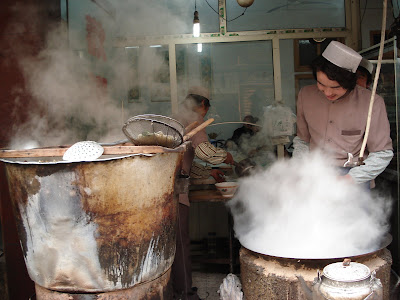
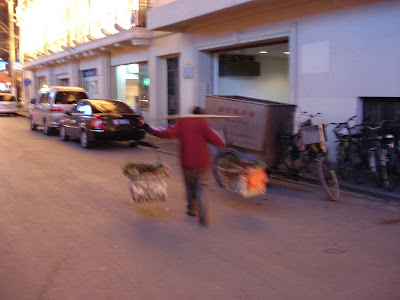
Sting only wrote one decent lyric after the Police broke up (monkeys, typewriters etc.): "I hope the Russians love their children too". However closed the Chinese government remains to international scrutiny and censure, much less to democratic reforms, the Chinese people as a group are open and welcoming, curious and interested. Yes, they love their children too, and you, if you are reading this from outside this fascinating country, have to come and meet them.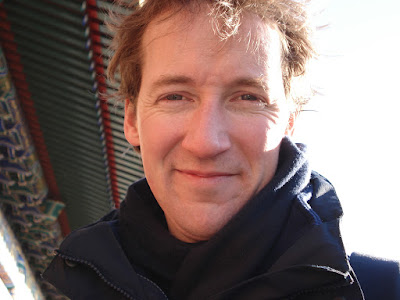
You smell that?
We stink.
Or so Letizia and the girls tell me. Despite my generous (not to say handsome) proboscis, and accompanying nickname of 'Buckbeak', I have all the sense of smell of a shoe. A shoe with a cold. My three fellow-travellers, princesses-on-the-pea every one of them, are blessed with the ability to isolate odours at the twitch of their little button-noses. In fact they can classify and order by date our acquired fragrances over the past three weeks. A 'taste', if you will:
- Sara's jumper still reeks of an unhappy encounter with with cheese and chive Pringles in Beijing.
- Letizia's jacket carries with it the olfactory imprint of Sichuanese cooking since Chengdu.
- Nina, incredibly, has emerged unscathed and untainted, and still smelling of, well, Nina.
I just stink. So no change there, right? Boys, eh?
What really amazes me is that we don't smell more. One of the reasons for this is the very wise investment we made in thermal underwear. Wait - wait - don't hang up! I'm not going to post any pictures, and just forget about the longjohns with flaps in strategic places that you remember from Grizzly Adams. It's all gone upmarket since then.
When Conor Goulding was leaving Ireland for Australia via South America a few months back, he made the mistake of asking me what I thought he should pack. Actually, come to think of it, he may not have asked me, but that has never stopped me giving generously of my wisdom before. 'Thermals' I said. Probably shouted it across the room in a packed lunchtime pub, in fact. 'Essential and easily compressed. Like oxygen.' (Warning: I may be making some of this up as I go along.)
And so it has proven to be. These thermals may not have flaps, but they are anti-bacterial and you would have to eat a lot of fish-flavoured pork to stink them up. And God knows I've tried.
We will have our very own washing machine in Sydney, and the anticipation of this momentous change in living conditions is strongly felt in some quarters of the Lawlor family right now. Three quarters, to be precise. If I'm not very careful I might just find myself gasping for breath in the middle of the 'heavily soiled' program, wishing their were flaps after all.
When we get to Oz, we'll finally be able to reply to comments on our blogs (reminder, Letizia is blogging here and even if you can't read Italian, she's posting a lot more photos than me). So if you've been reading for a while, but not sure about commenting, please do! We really look forward to hearing from you, whether we know you already or not yet.
Planet Shanghai
Shanghai is a strange planet. At first it felt - no, looked - more Western than the West, as our taxi made its way past the countless neon-lit skyscrapers between Hongqiao airport and our hotel on Nanjing Dong Lu.
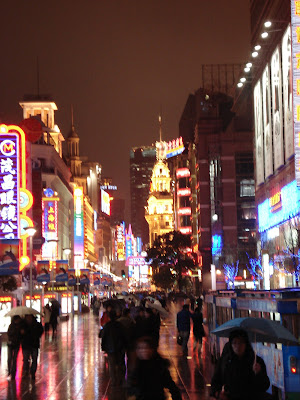
Now after a few days of getting ever so slightly under the skin of this city, I'm convinced that it's just as Chinese as any other city we've seen.
Now after a few days of getting ever so slightly under the skin of this city, I'm convinced that it's just as Chinese as any other city we've seen.
Beyond Nanjing Dong Lu, the streets disintegrate into the broken pavements we've become used to. The pedestrian zone, already under constant guerilla attack from mopeds and motorbikes, give way to aggressive Chinese driving (admittedly not to the same degree of lawlessness as Chengdu). Despite the glass and metal storefronts, the occasional shop still sports a tinny loud-hailer assaulting the public ear with what are presumeably sales pitches. The hawkers and vendors, beggers and grifters are still there, and still picking us out of the crowd.
Don't get me wrong - this is all good. I'm relieved we're still in China.
On our first full day we took the girls on their long-promised shopping trip for Nintendo games. We took the metro to Xujiahui station which had a direct entrance to the Digital Pacific Plaza: Six floors of technological bazaar. The process was complicated in that games were on offer on CDs rather than on cartridges, which meant that we also had to buy memory cards, and USB readers for the cards, in order to download onto the girls devices. We had to find what was on the CDs, make sure it was stuff that the girls wanted, was in English, and actually worked. In doing all this we discovered that in Shanghai it is no easier to get yourself understood in English than anywhere else in this country. So my poor battered brain, and poor tattered dictionary were given another workout. Almost 2 hours later we had 1000 games, and two 1G memory cards plus USB readers for 65 euros. I have no idea if that is a good deal for here, but based on Irish prices I can feel reasonably happy with it. I also put into practice the very important haggling technique of 'letting your arse do the talking' (anyone who knows me will no doubt reflect on how easily that will have come to me). What I mean is that we were seated behind the counter, with the salespeople, going though the disks. When they wouldn't come down far enough in price, it was enough to lift my arse off the chair, and begin to gather my belonging, for the price to come down. Energy well spent.
I took a good look at laptop prices as well. i'm starting to feel the limitations of the Nokia N800 a little. In fairness to the poor device, it's standing up well to the demands we're making on it. But the browser is having a hard time with some of the AJAX-based sites we use so much, and regularly falls over. And it just can't handle Google spreadsheets updating, so the budget is getting done by hand. There were some nice little machines like a Sony Viao or Fujitsu Lifebook for around 1100 to 1400 euro. But I think I'll keep my powder dry.
On day 2 in Shanghai we went shopping for 'antiques' (if that thing is old, then I'm flippin' ancient!) on Dongtai Lu. Nina is BIG into the whole browsing and haggling experience (I think she gets it from her Italian nonna's side of the family) which makes a welcome change from her previously held attitude of money burning holes in her pockets. I'm definitely getting the hang of this haggling, managing to get prices down to an eigth or even a tenth of the asking price. Must try that on the property market back home.
On Wednesday we visited Chinesepod on the Huangpi Nan Lu. CPod is a very successful company co-founded in Shanghai by an Irishman called Ken Carroll. They teach Mandarin Chinese online to thousands worldwide, and have become one of the world's most listened-to podcasts. I've used it regularly over the last 2 years to supplement my lessons from my very talented local teacher Liping, and it was great to see the premises, meet Jenny Zhu, Aggie and John Pasden (much to my disappointment, Ken wasn't in that day) and talk to some of the folks behind the scenes like John Biesnecker and Ross - another Irishman - who has just joined ChinesePod but has been living in Shanghai for the last three years. 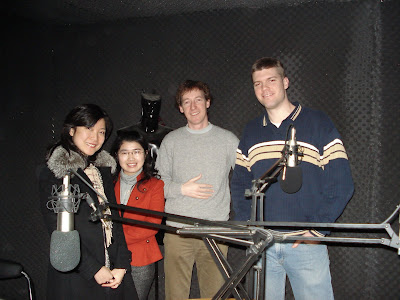
(Jenny, Aggie, some mug wearing thermal underwear, and John)
Keep an eye on the company behind CPod - Praxis Language. They've been teaching Spanish on SpanishSense using the same business and pedagogical model as Chinese for quite some time now (we met the SpanishSense guys too - what a great bunch - I'm looking forward to tuning in to those lessons, along with Letizia, in preparation for South America). Early this year they'll be rolling out three more languages, including French (Nicolas - this might be your chance to finally be understood in Paris) and Italian. Russian and Arabic will eventually follow.
In the meantime, we've been looking at a few museums, checking out some of the other quarters of the city, and generally hanging out. Shanghai is something of a wind-down for us. It's a place to catch our breath, and catch up with our blogging. In truth, we can already feel the pull of Australia, and we've very excited about our next stop: Five whole weeks in Sydney!
Thursday, January 17, 2008
Ghosts of the Yangtze
Our first stop on the cruise was the town of Fengdu. It's known as the City of Ghosts because it is to here that all Chinese must return when they die, even those living abroad (did you hear that, xiao Wang?), to be judged by the King of the Underworld. The good go to red heaven, and the bad go to blue hell.
There are ghosts aplenty here - some very recent ones. Almost all the temples in the Fengdu complex were destroyed by the Red Guard during the Cultural Revolution. The fact that these officially sanctioned hooligans were scared of destroying the temple of the King of the Underworld himself, gives an idea of the amount of power that was handed - locally at least - to the ignorant and superstitious, all just for the sake of a powerplay back in the capital. The Red Guard was motivated by violence and petty power. Maoist principles were just a lick of red paint on the shithouse wall.
This wasn't a Chinese problem. The parallels are easily seen with the early SA in inter-war Germany, the blackshirts under Mussolini, and the pickup-driving, Kalashnikov-wielding Taliban. Ignorance and violence are a natural match. The repeating pattern of unholy alliances between destructive and arrogant youth and cynical manipulative experience makes me very angry - and very frightened too when I think of what kind of circumstances could bring about the same pattern for me or my daughters. Because despite what some bestsellers say, I don't think anyone can really believe that history is over.
The other ghost that haunts this part of the Yangtze lies a few hundred kilometers downstream - the Three Gorges Dam. 
There is a background eeriness in the many references to what has already been submerged under the rising waters of the dam, and what awaits the final phase of the project in a few months time. Life around the Yangtze is coloured by numbers: 156 metres above sea level - the current height of the water here. 175 metres - the final dry season level. 13 cities, 140 towns, the homes of 1.4 million people - all under water when the project is complete. Everything that we look at has a question mark over it: Will it still be here in a year's time? Everything we see can be compared dramatically with pictures of 10 years ago or so. The river banks today are unnatural - their ecology needs time to adapt to the new reality.
The spell of numbers and levels is only broken when we finally move through the locks of the great dam itself. The landscape is once more fixed and reliable. No more disappearing towns. But just before that happened, there was time for one more moment of surreality. The the boat made its way through the 5 chambers of the shiplock, snow began to fall. Nina, Sara and I went uptop, along with the Australian/Indonesian family we shared the dinner table with, and had a snowball fight under the cold glow of the locks neon lights, while moving slowly through the belly of the largest dam in the world. If you ask the girls what they remember most about the cruise, they will probably say the snowball fight. Me too, actually.

Should the dam have been built or not? This is the question that was posed by Luther, our Yangtze Guide on the Victoria Star, after a powerpoint presentation on the pros and cons of the project. He left the question open, and left plenty of room for both sides of the argument in his talk. He raised negative consequences of the dam that I hadn't thought of or heard about before. Most importantly, he avoided the temptation to be didactic or propagandist on the matter.
My own impression is that although national pride is noted as one of the minor reasons for the project, it has at least as much to do with the decision to build as the three major ones: Flood control, Power generation and Improved navigability. I don't know what decision I would have made, but I'm uneasy with the knowledge that only a political system of almost absolute centralized power could decide to relocate 1.4 million souls, and that this very same monopoly on power has led to the kind of corruption that can jeopardise the safety and viability of a megaproject such as the Three Gorges Dam
See www.ctgpc.cn and www.threegorgesprode.org (banned in China).
Make up your own mind.
Wednesday, January 16, 2008
Counting in Chinese
I've been teaching Nina and Sara to count to 10 in Chinese, complete with the correct tones. They seem to enjoy this a lot - it's a bit like singing a song. So here, for the benefit of blog readers, is the same lesson, with some annotations to help the memory.
(The tones are 1 - high and flat, 2 - rising steadily, 3 - down and back up, 4 - down abruptly)
- yi1 (The number of polical parties allowed to hold power in the People's Republic of China)
- er4/liang3 (The number of official heroes of the PRC - Mao Zedong and Deng Xiaoping)
- san1 (The number of weeks we're spending in China, or alternatively the three T's that you have to be careful about mentioning: Tibet, Taiwan and Tiananmen)
- si4 (The size of our travel party, otherwise known as the family)
- wu3 (The number of claws one a Chinese dragon - Japanese have six)
- liu4 (The number of places we have slept in China, including the train from Beijing to Xi'an)
- qi1 (The number of levels to a Chinese pagoda - thanks to Sandra for that bit of info)
- ba1 (The number of times, admittedly approximate, I have been tempted to chuck the Rough Guide to China into the nearest bin, river or ditch)
- jiu3 (The number of men who run China - the standing committee of the Politburo of the Chinese Communist Party, the largest political party on Earth with 66 million members. Fianna Fail eat your heart out)
- shi2 (The number of RMB you can squeeze into a single euro, or alternatively, what you should mentally divide by when converting what a vendor asks for when deciding what to offer back)
Monday, January 14, 2008
Yangtze Stories

When we got on board the Victories Star with the indispensible help of Jolin Cheng (with whom we booked the cruise), and after the initial relief and relaxation had worn off, I started to have some regrets about including three days cruise in the itinerary. We were moving from being independant travellers to packaged tourists. We were amongst the youngest passengers aboard, and I was starting to hear English accents around me - atheir familiar ring reminding that we were not so adventurous after all. Letizia told me that I was actually being rude to some of the people we met - I thought at the time that I was merely being distant.
I don't like being rude to people who aren't being rude to me, so I copped myself on and started to engage a little. Two English ladies in or around retirement age shared their stories with me and I'm glad I got out of travel-snob mode, because teh stories were facinating:
Wendy's next step after the cruise, like our own, was Shanghai. She was going to track down the church where her parents had wed, one month after they met on a ship to that city. Wendy's mother was American, and only 21 years of age. By the time Japanese bombs started falling on Shanghai, she had given birth to Wendy's oldest sister, and both mother and baby were evacuated back to London, followed eventually by Wendy's father. Of course this wasn't much of an escape as within a short space of time, German bombs wre raining down on London. I tried to imagine life for the 21-year-old American girl, caught up first in a coup-de-foudre, then bombed out of Shanghai with baby in arms, to the cold comfort of wartime Britain, without her husband, who was presumably her only connection to that place. Wendy's mother died last June, though apparently her memories of such an extraordinary episode in history died many years before.
Marian used to cycle around England as a teenager, going from hostel to hostel. When she maried a Turkish man who had no interest in travel and adventure, she left behind all ambitions to see the world. She eventually split from her husband, and had to bring up her children on her own and in financial hardship. Now her children are grown up - one is living in Shanghai, the other in Spain. Marian now owns her own property in England, which she rents out occasionally to students to fund her worldwide travels. She spends at least four months a year on the road, usually staying in hostels (like us, the cruise was something of an exception for her) and basing her travel plans on such excellent logic as sticking to one 'language zone' at a time, travelling slowly, and leaving places nearer to Britain to later year - when she might not be so mobile (she already had both hips replaced). And yet she feels she is always working against the Big Clock. "If I put it off till next year, will I still be alive to do it?"
Marian - the same logic applies to the rest of us.
Chinese Rules of the Road
I don't think you'll find these rules written down anywhere, but I have observed Chinese driving for 2 weeks now, and extracted the following basic rules:
I may have missed some, in which case I'll add them afterwards. Assuming I survive another week of these rules.
- The car is king, pedestrians are expendable scum. Every other form of road user fits somewhere between these two. Know your place.
- The direction of flow of traffic for a given lane is subject to change without notice, and based on simple majority rule.
- The meaning of the car horn, like the chinese language itself, depends a great deal on context. One sound can mean :
a. I am going for that improbably small space - don't get in my way.
b. I am about to overtake you (in a lane of my chosing) - don't try to stop me.
c. I'm in a car. I'm travelling at speed. I'll honk if I bloody well want to honk. - Precendece is always given to those with the least to lose.
- Traffic lights are not only decorative, they also serve as an indication of traffic conditions immediately ahead.
I may have missed some, in which case I'll add them afterwards. Assuming I survive another week of these rules.
Sunday, January 13, 2008
Inside China, Outside Beijing
Blog's been a bit quiet for the last few days. Connectivity in Chengdu wasn't great, and then we had 3 nights on board the Victoria Star on the Yangtze where we decided to stay away from the 'net. More on both Chengdu and teh Yangtze later. For now, here's my musings on some of the grimmer and grimier sides to China. (Don't worry Mr. Clancy - it's still a great place to visit and you do well to extend your stay.)
...
...
In the soft-seat waiting room of the Chengdu North railway station, and damn glad there were no hard seats available on our T888 to Chongqing. Chengdu was a good place to relax, to save money, and to eat good food. We saw the two main things we planned to see, and had the good sense not to run around too much. Sim's Cozy Guesthouse was our oasis - it's bar especially - and given that the city itself had nothing much to recommend it, and the cloud of pollution (or was it really fog?) made it even less attractive, we felt no pressure to leave Sim's without good reason.
In the last few days we have seen a very different side of China. We've taken more public transport, got much further outside the city limits, and seen the countryside, through a dense cloud of ever-present smog. The tidiness we noticed in Beijing remains - there is no shortage of people who can be employed to sweep the streets clean. But Beijing now appears relatively organized compared with here in Chengdu. When you hear about the increasing inefficiency of the Chinese economy, and the fact that it needs more and more investment to extract the same level of growth, you feel you can almost see the physical manifestation of this on the streets. The country is creaking under the weight of its own success. It clearly needs some period of consolidation to concentrate on doing things smarter, laying the way for future, more sustainable growth.
(In software terminology, the country needs some time to refactor itself. It has rushed headlong to meet its deadlines, but the economy has probably lost so much of its shape as a consequence that it cannot be further built upon for much longer without losing its ability to return on any investment.)
Some ideas and practices will have to be thrown away (how can entrepreneurs feel secure about their efforts if basic issues like private property are so nebulous?) and others will have to be modified (can the one-child policy be sustained in the face of an aging population and a widening gender imbalance?). It's hard to change the behaviours and mindsets of even a modest-sezed group of people - I have no idea how you go about doing it with 1.2 billion people.
Here's some concrete signs of an unstable economic platform that, for want of a better term, I'll call sino-sprawl:
1) The traffic:
It's not that there aren't any rules - it's just that they're not the same as the ones that are presumeably written down somewhere. You get the feeling that the roads have outgrown the old rules and have evolved new ones. The result is a kind of intelligent system, but one which is firstly not amenable to any kind of further planning or rationalization, and secondly is teaching a new generation of road users all the wrong things. I will never EVER complain about Italian drivers again. Their somewhat ambivilant attitude to lane discipline is just a change in accent compared to the indecipherable language of Chinese driving.
2) Pollution:
I haven't seen a blue sky since our first day in Xi'an. "So what" say the Irish readers, "we haven't seen one since September". Well, let me put it differently: I haven't seen more that 5 city blocks into the distance in these past few days. Some locals here have defended the situation by saying to me "What about the famous London fog?" Well I think it might still have been around in Sherlock Holmes' time, and I suspect that this is why it's so famous. But I seem to remember that even this 'fog' was a product of England's industry rather than its climate. Suffice to say that certain part of China seem to be choking themselves, and there are surely kids around here who have never known anything else.
3)
Construction:
In Beijing we marvelled at the newness and the growth. In Cork, the tallest building in the Republic of Ireland is nearing completion,but it would be lost in scale, and long forgotten in construction time, if it had been build in Beijing. All very impressive, until you look at the skyline of Chengdu. There are a great many successful large building projects underway here, but there are also some skeletal remains of buildings that have run out of financing - and some eyesores that you kind of wish had suffered the same fate. China is building fast, yes, but also loose.
4)
Labour:
This is only a superficial observation (well of course all these observations are), but if I were a foreman on Shopfloor China, I'd like to ask half my workers what the hell they were doing. A lot of jobs seem to involve hanging round a lot, or playing cards waiting for something to happen. I wouldn't like to get up on the scaffolding I saw being erected in downtown Xi'an by 4 lads, 2 of whom were blindly banging their spanners against joints, looking at the passing city crowds instead of concentrating on the job in hand. I've never worked on a building site, so perhaps I've got it all wrong. Maybe it wasn't dangerous - just inefficient. But I think this is the whole point. When you have enough people available to work at low wages, you can afford to be inefficient. China has appears to have allowed herself to go this way.
Wednesday, January 9, 2008
Pannacotta Warriors
We're a little over a week on the road now, so it's worth making a few observations about how the kids are coping with the experience.
What I find the most remarkable, when I look at their expressions, watch them interact with each other, and when I talk to (or at) them, is how little anything has changed. They are neither thrown by the situation, nor bowled over by it. The usual emotional triggers still apply: tiredness, hunger, desserts and gift shops. Just like at home.
In one way, this is great. I was following a Freakonomics blog thread a few weeks back about whether it is a good thing to aim to make our kids happy. Of course we want them to be happy, but should that be the primary objective or should we concentrate on other things and let happiness take care of itself, in whatever form that might take?
What I would wish for my daughters (and I am not suggesting for a minute that this is within my gift) is that they be robust, that they take no shit that they don't think they deserve, and always want to keep going even if it's easier to stop. That they be able to distinguish a friend from an enemy, and a setback from a disaster. The fact that the last week has changed nothing in the dynamics of our family might just be evidence of this kind of robustness. They still bicker, and then eventually hug and then go back to bickersville. I still have to tell them to do the same thing three times before they even begin to listen. They are still more interested in dessert than main course (in fact they are more interested in dessert than in most other things they've seen with the possible exception of the pandas in Chengdu.)
So what on Earth was the point in bringing them around the world in the first place? Travel isn't a collection of sights with their explanatory plaques alongside. Travel is supposed to be about who you are and how you relate to what you find on the way. We are moving around as a unit and much of this trip is about who we are as a family. Because we are living in such close quarters ("Daddy, what did I tell you about snoring? - Sara 3am) and doing everything together, then the good and the bad get magnified. There's nowhere to hide. No school, no office, no green out the front, not even another room at the moment. If there's something we're doing wrong then we'll simply have to fix it. And when something good happens, like an unsolicited confidence from Nina - a very private young lady - then it's harder to take for granted.
So how are the kid's? They're doing great. They're having fun, learning lots about China and about their own family. They're wide awake, taking it all in and wondering what's for dessert.
Friday, January 4, 2008
Buckbeak in Xi'an
Beijing is already a 24-hour old memory. It is a monumental city. Quite literally. I think that almost every day we were there we visited a UNESCO World Heritage site. And it's changing almost daily. Our Rough Guide was bought only a year ago, but already it needs updating - including some of the maps! One of the last images of the city was of the face of a new tall office block builiding, with its glass front being hoisted into place one window at a time, while a steady raiin of welding sparks fell from the top floor above. And I have never seen a train station as large as Beijing Xi. It's larger than any airport in Ireland, and is relatively centrally located in the city. But again, it was well orgainized and I found it easy to make my way to the correct section to wait for our overnight departure to Xi'an (I found it a great deal harder to convince Letizia that I had found the right place, but I'm kinda used to that).
Xi'an is an altogether different proposition. From the outset, let me tell you that I think it's a fantastic spot, and even though we haven't gone to see the Terracotta Warriors yet, I'm very glad it was on the itineray. It's an older city than Beijing, with a longer imperial history. The warriors that we'll go to see tomorrow were created as part of the funeral ceremonies of one of the most important and most terrible of Chinese emperors: Shi Huangdi of the Qin dynasty, which although it goes back more than 2 millenia is probably where this country got it European name. Xi'an was Shi Huangdi's capital after he united, for the first time, what is now China.
Now it's a well-to-do provincial capital which thanks to its surviving city wall, has a walkable inner city. The highlight of this place has to be the Muslim quarter. This is a foodstall and market area spread across a large number of streets and alleyways. But there is nothing like the in-your-face street vendor attitude of Beijing. We still stood out like sore thumbs, and drew the occasional prolonged stare, but for reasons that I can't explain, this provincial capital seems more urbane and at ease with foreigners than the national capital.
Needless to say we got thoroughly and royally screwed at the market today - at least at the start. Letizia bought a set of chopsticks which I (very proudly) haggled down from 16 euro to 14, only to find the exact same ones around the corner for less than 4. We hadn't much intention of buying much or indeed anything today, but once we realised how lame we had been, we embarked on a series of terrifying reprisal purchases, buying things we neither wanted nor needed (which we will now have to post home from Shanghai) for prices that enduced scowls from the vendors. We're not proud of what we did, and we know that in the end, there were no winners here today(except for the bugger with the 16 euro chops).
On an unrelataed note, a Beijing Harry Potter poster provoked a dinnertime conversation about who in the family corresponded to which charactor in the Potter books. Sara needed almost no time to figure me out: Buckbeak. I ask you!? A combined 5000 pages or so of heros both major and minor, and I get Buckbeak. I think I might be posting more than just chopsticks from Shanghai.
Wednesday, January 2, 2008
Tea, and a show...

On the Qianmenxidajie there is a teahouse, well indicated in the guidebooks, called Laoshe Teahouse (Laoshe chaguan) where for a reasonable price you can get watered and entertained together. We went there yesterday after a morning in the spectacular Temple of Heaven and a browse through the little alleys of Qianmen. For 210RMB (a little more than 20 euro) the whole family could be treated to a show of acrobatics, music, comedy, shadow play and the like. And the price included "tea and a snake".
What now? Snake is definitly on my to-eat list but I wasn't expecting to encounter any here, and certainly not with tea. Dammit - turns out it was "tea and a snack". The snake will have to wait (presumably in long grass somewhere). But despite this initial disappointment, the show itself was great. From the very start, the tea was flowing. I got a cup with some jasmine tea leaves, and the waiters come very regularly to add some more hot water. The girls didn't think much of it, but I sipped away and needed a refill each time.
First act: Shadow play. From behind the screen, a group of puppeteers recreated scenes involving the Monkey King and various other charaters I'm too ignorant to identify.
Slurp of tea. Then came some vocal imitators - birds, jets, trains. Nina and Sara lapped it up. More tea slurping. Peking Opera. Slurp.
Vase juggling. Slurpedy slurp. Another hour of all kind of wonderous entertainment involving magic, song and (apparently) satire, all accompanied by refills of tea.
The highlight for me was something called Kung Fu Tea. My colleague Simon Wang had told me about this already. 'Kung Fu' (actually Gong Fu) is an adjective that can be applied to any activity taken to its ultimate height in expert execution. In this case, two tea waiters performed synchronized acrobatics with very long-handled teapots, pouring tea in improbably difficult ways and directions. Sluuuuuuuuurp.
I don't know how many litres of jasmine tea I consumed, but when the curtain came down I made straight for the gents where I put on an inpromptu demonstration of the little-known, but exceedingly satisfying occidental art of kung fu pissing. I haven't included photos.
Liping and Ian: Today we went to the Summer Palace - photos will be uploaded presently - and on the way I chatted - yes chatted - with the taxi driver all the way there. I'm not saying it was the most scintillating conversation the man ever had, but personally I've been treated to worse by Dublin cabbies. So anyone in Cork who wants to learn Chinese, note that you have an excellent local teacher available in Xiong Liping.
Tomorrow we'll check out the Forbidden City before jumping on an overnight train to Xi'an to see the terracotta warriors, and of course, have more tea.
Giangi: I've reduced the exposure. Thanks!
Simon Moore: Now that you know the trip isn't an elaborate hoax, I'd like to see photographic evidence that your new offspring isn't one either...
Monday, December 31, 2007
Our original Great Wall plan was to go to the 3 hour distant Simatai section. In the end we opted for the closest and more touristy Badaling section, given that it's not high season. I wanted to find the #1 or #5 tourist bus which leaves from the very street our hotel is on, but I couldn't find it and we ended up on a tour bus. The price was more or less the same, and the kids went free. So no damage done.
The organisation and cleanliness of the first day gave way finally to the kind of chaotic mess that I was expecting. We were bumped from bus to bus, each one messier than the last before we finally got underway. The windows of the bus, like those of the hotel, werre cakes in dried, fine dust, and indication I suppose of how things can be here when the sky isn't as blue as it continues to be for us right now.
Most of the other tour passengers were Chinese, and our relative rareness as Westerners continues to surprise me. It took 1.5 hours or travel time to get to the Badaling section, and then out we got and started marching. We ignored the cable car option and walked to the main entrance. It was busy enough but not crazy, there were vendors aplenty but not as many as Tiananmen square, and everywhere were signs of present-day China. But the wall was magnificent.
The steepness of certain sections bordered on sheer drop but that didn't stop Sara. She hit the trail like a bargain hunter in a sale and we struggled to keep up with her. If she had her way we were going all the way to the Yellow Sea. She slept all the way there, and all the way back, but she gave the wall, and the overpriced hot chocolcate afterwards, her undivided attention.
(you can check out all our photos uploaded so far here)
It's already 2008 here in Beijing, and the jetlag has another day to run, I think, so I'm wishing you a Xinnian kuaile (Happy New Year) from a pre-dawn hotel room in Beijing.
Thanks for the comments on the previous entry. The Great Firewall of China lets me post to my blog, but not to read it (and so, not to reply directly to comments). Tomorrow we'll be staying nearby, going to the Temple of Heaven (that's right Mam - I'm going to to a church, and it's not even Sunday) and wandering slowly North to Qienmen to browse the older alleyways (hutong) of the city. We got a small taste of them yesterday when we needed a pharmacy, and I think it's going to be an interesting experience. We might even take in a show - more tomorrow.
Sunday, December 30, 2007
Blue skies and jetlag


What can I say? The only reason we ventured out in -2 C instead of staying in our nice warm hotel room is that we have to try to kick the jetlag rather than just succumb. Beijing looks fantastic, even clean. I was expecting dust and smog but we have been lucky so far. The airport was a model of efficiency, and folks on the street are fun. The hawkers of various tat on the street are prepared to laugh it off when you tell them they're too expensive. And the requests for photos with the laowei kids is actually quite charming (though that might wear off).
We're going to ground for the next 18 hours or so, with a view to going to the great wall tomorrow at a reasonably early hour. Till then.
Subscribe to:
Posts (Atom)