Showing posts with label uluru. Show all posts

Wednesday, April 9, 2008

The Rock

Near the start of our 6-hour bus trip from Alice Springs to Uluru (Ayres Rock), our driver Gordon pointed out that if we were to get off the bus, leave the road and walk westwards, we would be more likely to encounter the Indian Ocean than to encounter another human being. And that'd be something like 2000km later, so much more likely again would be a lingering death in the desert. At first I didn't think too much about this - I've read a dozen similar parables from just about every book I've read on Australia. But now that I found myself in the desert for the first time, I looked at things a little closer. I imagined doing exactly what Gordon described. The thought occurred to me that even if I just wandered for 30-40 minutes westwards, I wouldn't be too sure that I could even make my way back to the road, as I could distinguish no landmarks. And if I couldn't find the road, then I might as well be half way to the Indian Ocean as far as my chances of survival are concerned. Northern Territory, where both Alice and Uluru lie, makes up a little shy of one fifth of Australia's area, but has a population of only 210,000 people. Or put another way, NT is 20 times bigger than Ireland, with 20 times fewer inhabitants. The very idea of providing universal mobile phone coverage here is preposterous, so anywhere outside of major population centres, you can forget about phoning for help.

And yet this road through the dead heart of Oz serves as the boundary between some of the various cattle stations (cow farms to you and me) that operate out here. These can encompass enormous areas - approaching the size of Belgium, or Connaught (and making the latter look like bounteous meadowlands). Occasionally we saw cattle, alone or bunched in twos or threes, meandering around the bush, grazing on who knows what. Maybe the word desert is misleading here. It's not the Sahara, with nothing but sand dunes as far as the eye can see. If you look from the road, you'll see lanky trees to a height of 4 or 5 metres in some places, bushes and scrub occupying the middle area, and course grasses in the foreground. Only occasional glimpses of red sand can be made out. But when you step into the landscape, you realise that all that vegetation is thinly spread out, and 80% of the space is bright oxidized red sand. This is why the cattle stations are so damn big - around here, a single head of cattle needs 2 square kilometers (200 hectares) to feed itself. This is almost the definition of marginal land. As we move closer and closer to Uluru, the cattle stations fall away. There's clearly just no point in trying.

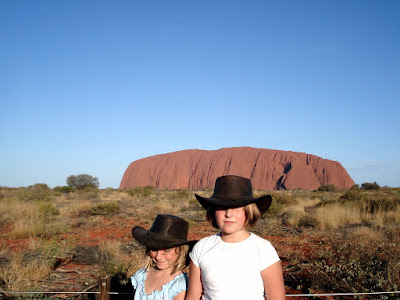
I'm glad we spent a night in that shithole of Alice Springs (there you go Dunc, self-censorship lifted ;-) if only because the journey by bus sets Uluru into context in a way that flying directly to its airport could never do. It's far away from everything and everywhere. We spent the next 2 days visiting two major sites: The Olgas (Kata Tjuta) and Ayres Rock (Uluru), and Letizia has outdone herself with the photographs this time. The walks we did were not terribly strenuous though in the heat, and constantly beset by flies, even small efforts took their toll. Poor Nina and Sara: they've been marched up and down over the last 3 months, but they are still going strong. What really helped their resilience this time was the purchase of two really cute hats that look like they're straight out of Crocodile Dundee. They couldn't believe their eyes when their normally cautious parents loosened the purse strings a little and treated them to these hats. They wore them proudly up the gorge between the Olgas, and around the base of Uluru at ungodly hours of the morning. A great investment. I suspect you won't see a single picture of them from here on in without the hats.

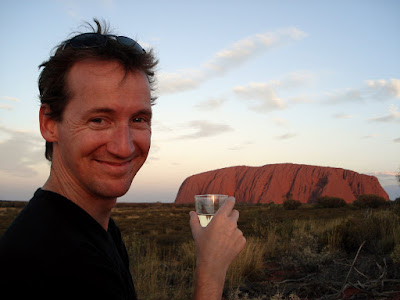
Sunset on the rock is truly beautiful, and it does change colour continuously as the sun reaches the horizon. The place where most people watch it from isn't too busy - you can certainly get away from the noise if you want to. But it's not a spiritual experience - and I'm not just saying that because I'm the crusty old Cartesian my wife describes me as. It's a beautiful sight, it's a relaxing experience, a great backdrop for a glass of wine and a stupid grin, but sunset from Fraser Island will remain with me forever.


Before coming to Uluru I had read of the handover of 1985, when the government of Bob Hawke decided to recognize the title of the indigenous people of Uluru (the Anangu) to this land. I was looking forward to seeing a part of Australia that was in the hands and under the management of the first owners. This was pretty naive of me. When the handover took place, Uluru was already a National Park at the time, not to mention a popular tourist destination. The deal reached between Hawke and the Anangu hinged on the condition that the Anangu lease the land back to the federal government for the next 99 years. There was no visible sign of black ownership anywhere. There were plenty of references to local culture and lore from the (white) guides and in the resorts literature. But then again, in modern Australia, such references are everywhere. You'll find Dreamtime stories related to the creation of the moon and the stars in Sydney Observatory but it hasn't been handed over to the long-eradicated Eora people. It seems that it will take many more generations - maybe longer than a 99-year lease will provide for - for the aboriginals to assume the real day-to-day management of this, or any other, large project.


The Anangu never lived around Uluru - it wouldn't support a permanent human presence. They visited for special occasions, like rites-of-passage ceremonies. They would also come after rainfall and make the best of the increase in edible flora and fauna (digging up honey ants seems to have been a favourite treat in this area), but like most aboriginals, they moved around to allow the earth to recover and regenerate, sometimes giving it a helping hand by setting fire to it before leaving. (In case this sounds a little crazy, firestick farming has only recently begun to be understood scientifically as an effective way to convert scrub into grazing - supporting the kind of wildlife that the aboriginals liked to hunt.) In a harsh environment like this, where man made no pretension to conquer nature by farming, but instead had to make do with living within its limitation, the aboriginal population itself rose and fell, matching the numbers of animals and plants that it fed on. It sounds primitive, but population control is a complicated matter, and one that modern societies would do well to learn (says the man with two kids).


To those who voted for us to go to Uluru, thank you. I'm very glad we went, and would have regretted missing it. In fact my only regret about going is that we didn't spend another night and go to see King's Canyon. But I think a 17% budget overrun is quite enough, don't you?

I've got one more blog in me before we leave for New Zealand on Saturday - something to summarize the Australian experience if that's possible. Thanks for continuing to follow the blog (or indeed thanks for visiting if you've just arrived).

Without any attempt to relate this to anything I've just written, spare a thought for this gentleman:


We encountered him on the road to Uluru from Alice. Those are camels that you can see there, and they are harnessed to the motor-less carcass of some old car. What you probably can't see are the solar panels on top, and the laptop inside. Apparently this guy has been wandering the backroads of Australia for over a decade now, sustaining himself with casual work wherever he stops. He's German apparently, and before the car, he had an old cart whose wheels were big enough to allow him to travel along the dried river beds. Now he has to content himself with sharing the road with the likes of us. For all I know, the chap has his own blog out there, but I'm stuffed if I can find it. Next time you think it's a crazy dream to up stakes with your family and travel around the world for no good reason, remember - there is always somebody out there crazier than you.

Tuesday, April 8, 2008

Mrs Todd's Billabong

Alice Springs started life as a telegraph station. It's half way between Adelaide in South Australia and Darwin in the Northern Territory. That is to say it's about 1500 km from both of them, and further again from the East and West coasts. Much further. In 1865, the British parliament approved the construction of a telegraph line to stretch from Port Augusta in Southern Australia, across the emptiness of Central Australia, to Darwin with the ambition of connecting eventually to the telegraph line in Java, and so on to Mother England. (Just 57 years earlier, it had taken a full year for the news of the Sydney mutiny against Governor Bligh to reach London - this was real progress.) Alice Springs was the halfway point and a repeater station for that telegraph line.

By the time we landed in Alice Springs airport, we had flown two and a half hours over, well, mostly nothing. Below us, the pale colours of uncharitable Australian farmland gave way to the completely unworkable sands that make up the Red Centre. Once we got off the aircraft and walked to the terminal building (it was well hidden belong scrub on the edge of the runway, giving us the impression of having landed on an abandoned airstrip), that red sand started to accumulate on our shoes. A brief but costly taxi ride through the unimaginatively named Gap to the centre of Alice Springs left us outside the Aurora hotel, ready to check in, unpack and explore.

Within one hour of getting there, I sent the following text to Simon back in Brisbane: "Alice is a hole". Nothing happened in the intervening hours of our stay to make me revise this opinion.

The town was originally called Stuart (as in Stuart highway - the road that follows the route opened up by explorer John Stuart) but was changed to Alice Springs in the 1930s. So who the flip is Alice? She was the wife of Sir Charles Todd, the top man in South Australia's postal service. The 'Springs' in question were in fact a Billabong - a seasonal and sometimes stagnant waterhole rather than a clean source of fresh water. The river through Alice was named the Todd river after Charles himself, but in these parts rivers are not the permanent fixtures that most of us are used to. The Todd river hasn't passed though Alice for more than two years. It's just a dried up riverbed, marked out by gum trees that can tap the remaining underground water. So both Alice and Charles were unfortunate enough to have given their names to geographic entities that, for most practical purposes, don't exist.

The Alice Springs that we were expecting doesn't exist either. The town that started life as a telegraph station is now home to a node on the US military communications network, and manned by as much as 2000 Americans (I saw none - perhaps they don't exist either). The technology has changed, but the function remains the same: take a signal from point A and forward it to point B. The Book of Lies (aka The Rough Guide to Australia) told us we would find a metropolitan atmosphere, in part thanks to the large US population. What we found was a flyblown, unwelcoming shambles, that didn't extend to any great extent beyond the central pedestrian section of Todd Street. Most of the aboriginals in sight were either propped like sacks of potatoes at the edge of the road, or wandering the public spaces aimlessly. Every now and then a group of young kids on BMX bikes flits across the road or path, like a small flock of birds, causing cars to brake suddenly. There's a piece of graffiti that reads "Fuck Racist Cops" where somebody has crossed out the first word and replaced it with "Support". Both of these sentiments seem to me in keeping with the atmosphere of this town.

All the aboriginal art dealerships we saw were in white hands. I heard English, Scottish, Australian and Dutch accents coming back across the desk at us, as we wandered from shop to shop looking for something that we'd like to buy. We eventually found some pieces that we liked - one for ourselves and another for Simon and Leah - in the Mbantua Gallery.

We left at 6am the following morning on a six hour bus trip to Uluru (more on that later). It's the first place we've been to in Australia that I have no desire to revisit.

Tuesday, April 1, 2008

Update on Uluru

We're going. And as my father would say, to hell with poverty.


The whole trip will cost about 2 weeks' worth of Australia but will last just three nights. But in the end it was a no-brainer - and all the nicer that the poll results back us up (I should point out that things were neck-and-neck on Letizia's blog's poll, with the 'si' camp shading it). We both feel that if Uluru provides anything like the level of lasting impact that Fraser Island gave, then it will have been worth blowing the budget for (sorry, re-allocating funds - thanks Andrew).


Duncan, better start working on those blow-up matrasses.

Tuesday, March 18, 2008

A little audience participation, please...

We have a hard decision to make. We've left visiting Uluru (Ayer's Rock) until the last moment, and it wasn't such a smart move. It costs a lot to get there from Brisbane. So we are on the horns of a dilemma: Do we go there, and blow the Australian budget by about 2000 euros, or do we let it go and leave Australia without having seen one of its most iconic sights?


There's a survey gadget on the right of this blog, so feel free to vote. In the end, we'll make up our own minds, but we'll take on board your advice. If you have detailed comments to make, rather than just a vote, feel free to attach them to this post.


Please be aware that if you vote 'yes', and we become destitute as a result, you may have to give us food and shelter on our return.