As an indication of how long we've been in Australia now (11 weeks), we think nothing of rolling off names like Tangalooma, Uluru, Wollongong, and so on. Wagga Wagga still solicits a gentle giggle, but even that's settling down now.
The aforementioned Tangalooma is a resort on the West coast of Moreton Island - another Sandy Island off the Queensland coast, but this time just a hour's boat trip from the Centre of Brisbane. Like Fraser, there's lots to do there, but where Fraser has dingos, Tangalooma has dolphins. Wild ones that swim to the beach most nights, and which you can get to feed under very controlled circumstances. We left Brizzy at 10:am and got back at 9:00 pm, and I'm hard pushed to account for much of what we did there. We didn't do the helicopter rides, we didn't do the quad biking, we didn't even walk as far as the wrecks that lie on the beach, preferring to just snorkel close to the resort itself. The most strenuous activity of the day was a half-hour kayaking which Nina really enjoyed, but Sara considered to be "a little bit boring actually". Partly we were saving money (it wouldn't do to turn up at Duncan's house expecting bed and board after skiting around in a helicopter a few days previously), but partly we were just kicking back and chilling out. As well as the four of us, there was Leah and little Caitlin who came along for the trip, so we six make camp on the edge of the beach within easy reach of sea and pool, and let the day stretch lazily (Leah was kept a little busy taking care of Caity but she a professional and found the time to send Simon - who is doing absurd hours in the office - a little picture of our surroundings. He replied with a picture from his desk. Two screens, he has! I was very jealous. Honestly.)
Another reason perhaps that we didn't run around trying to do everything available on the island is that we were there principally to experience the arrival of the 9 or so regular dolphin visitors to Tangalooma, and if possible, get to feed them. The dolphins come in at sunset, which in Queensland is around 6:00 pm (Queensland does not observe Daylight Saving/Summer time - something related to a morbid fear of sun-faded curtains). By this time we were all nicely sun-tired, and beach-faded, and I personally was experiencing a dramatically reduced attention span, hanging round the jetty, almost forgetting why I was there. Funny how a dorsal fin can change all that.
The dolphins could be seen making their unhurried way from the South, in the shallow water along the beach. There was a hydrophone in the water at this point, picking up the clicks and squeaks they were producing, and playing it to the crowd of 100 or so people waiting around the darkening jetty. There wasn't a single announcement, not a single explanation, from the marine biologists who were managing this event. They just let the dolphins do the talking, and it was sublime. The atmosphere was such that when the animals finally approached the jetty, and we could see them clearly though the shallow transparent water, I felt like I was in an alien encounter. A good 30 minutes passed where the 8 individuals who turned up that night did the talking and put on a beautiful display of swimming, hunting and good old-fashioned jack-assing in front of the delighted crowd. It was clear that some were younger than others, and at least one juvenile was inseparable from its mother. A group of 3 or 4 writhed about together for a while, right in front of where I stood with Nina, until they stopped, and one by one stuck an eye above the surface to look right at us. One family, gazing at another. Each as curious, it would appear, as the other.
At 6:30 it was time for the public to feed the dolphins, so we queued up on the beach, and followed the precise instructions of the biologists: rinse off any sun cream - it irritates the dolphins' eyes; wash hands thoroughly in disinfectant, and no touching the animals. When it was time for Nina and I to enter the water, we held the fish in the way we were told, put our hands under water, and watched spellbound as Storm and Silhouette rolled over, approached us, and very very gently relieved us of the fish that had been stinking up our hands in the queue.
I've never been one to get too excited about dolphins - I certainly would never ascribe to them the human level of intelligence that some New Age commentators seem to do. But this was unmistakably an encounter with intelligent, beautiful, graceful beasts, that will have a lasting effect on how I see them. Once more, in the age of TV, we feel like we've already seen everything. And it a way, we have. There was no surprise to me in their physical appearance, or in the grace and strength they displayed in the water. I've seen Jacques Cousteau documentaries since I was younger than Nina and Sara. But for some strange reason I was as excited and moved by the actual physical proximity to these 8 dolphins as were Nina and Sara. I can't quite say why, but I'm glad it felt that way.
Letizia has posted on Tangalooma, and as ever has included some great photos. All of the dolphin shots were taken by Leah, except for the ones with the resort logo in the corner.
If you find yourself in Brisbane, and don't have the time to go to Fraser, then make it as far as Tangalooma. You won't be sorry.
Showing posts with label queensland. Show all posts
Showing posts with label queensland. Show all posts
Thursday, April 3, 2008


Saturday, March 29, 2008
D - I - N - G - O (and dingo was his name-o)
To be sung to the tune of Bingo:
A wolf from Asia came to Oz, and dingo was its name-o.
D - I - N - G - O, D - I - N - G - O, D - I - N - G - O
And dingo was its name-o.
It came 5 thousand years ago, and traders were to blame-o,
D - I - N - G - O, D - I - N - G - O, D - I - N - G - O
And traders were to blame-o.
On Fraser Island we saw none, but did see a few cane-toads,
C - A - N - E (croak), C - A - N - E (croak), C - A - N - E (croak)
We did see a few cane-toads.
I could go on (believe me) but frankly, I'm boring myself here (as opposed to just boring you, which I can live with).
What I am getting at here is that after Australia Zoo, we continued North to Hervey Bay and stayed overnight, ready to catch a ferry the next morning to Kingfisher Bay Resort on Fraser Island. Fraser Island is known for many things, and one of them is the dingo - a wild dog, more like a wolf really. Anyone who knows Letizia and me will understand that we divide work between us based on interest and competence. Hence I am generally in charge of navigation, budget and boring the children with historical information, while Letizia is in charge of, well, everything else. And when it comes to being worried about Australian bities and beasties, Letizia takes the job very seriously indeed. Having recently survived a trip to the Great Barrier Reef without anyone succumbing to sharks, rays, stingers or marooning, and having passed through Australia Zoo without passing through Murray the Saltwater Crocodile's digestive tract, Letizia had plenty of time and energy to devote to anxiety over the Fraser Island dingos. I fulfilled my role of being insensitive and feckless (we really make a fine team).
On arrival to the resort, we made straight for the briefing room. We were given a talk on the island and some of its features, including the dingos. There we learned that dingos are a relatively recently introduced species. They came to the Australian continent in traders boats about 5000 years ago, and are more closely related to Asian wolves than to dogs. We were given advice on how to behave on seeing a dingo: stand your ground, stare it down, NEVER run. I knew straight away that Sara was not getting off the island alive. Three days previously I had watched her scream in hysterical circles on the black strand of Sandgate, an over-excited lapdog yelping along behind her.
Afterwards, we made our way to reception to check in. When all the usual business was out of the way, the young woman behind the desk made the mistake of asking "Anything else I can help you with?". Letizia grabbed the poor woman by the label, dragged her over the reception desk to within whispering distance and growled "What's the story with the dogs?" I thought I heard the poor woman squeak back something about them being wolves not dogs (they really are professional!) but she quickly moved on to tell us about the dingo-proof fence that surrounded the resort. This seemed to placate Letizia and we made our way to our accommodation.
We saw and learned so much over the two days of our stay (which included an 8 hour tour to some of the scenic spots) that I can't begin to do it justice. But let me point out some main points.
We stayed almost exactly 48 hours on the island without a single (independently substantiated) dingo sighting. And guess what - Letizia was disappointed!! :-)
We absolutely loved this place, and I could just as easily (for YOU, at least) have replaced the entire spiel above with one small word: Go!!!
A wolf from Asia came to Oz, and dingo was its name-o.
D - I - N - G - O, D - I - N - G - O, D - I - N - G - O
And dingo was its name-o.
It came 5 thousand years ago, and traders were to blame-o,
D - I - N - G - O, D - I - N - G - O, D - I - N - G - O
And traders were to blame-o.
On Fraser Island we saw none, but did see a few cane-toads,
C - A - N - E (croak), C - A - N - E (croak), C - A - N - E (croak)
We did see a few cane-toads.
I could go on (believe me) but frankly, I'm boring myself here (as opposed to just boring you, which I can live with).
What I am getting at here is that after Australia Zoo, we continued North to Hervey Bay and stayed overnight, ready to catch a ferry the next morning to Kingfisher Bay Resort on Fraser Island. Fraser Island is known for many things, and one of them is the dingo - a wild dog, more like a wolf really. Anyone who knows Letizia and me will understand that we divide work between us based on interest and competence. Hence I am generally in charge of navigation, budget and boring the children with historical information, while Letizia is in charge of, well, everything else. And when it comes to being worried about Australian bities and beasties, Letizia takes the job very seriously indeed. Having recently survived a trip to the Great Barrier Reef without anyone succumbing to sharks, rays, stingers or marooning, and having passed through Australia Zoo without passing through Murray the Saltwater Crocodile's digestive tract, Letizia had plenty of time and energy to devote to anxiety over the Fraser Island dingos. I fulfilled my role of being insensitive and feckless (we really make a fine team).
On arrival to the resort, we made straight for the briefing room. We were given a talk on the island and some of its features, including the dingos. There we learned that dingos are a relatively recently introduced species. They came to the Australian continent in traders boats about 5000 years ago, and are more closely related to Asian wolves than to dogs. We were given advice on how to behave on seeing a dingo: stand your ground, stare it down, NEVER run. I knew straight away that Sara was not getting off the island alive. Three days previously I had watched her scream in hysterical circles on the black strand of Sandgate, an over-excited lapdog yelping along behind her.
Afterwards, we made our way to reception to check in. When all the usual business was out of the way, the young woman behind the desk made the mistake of asking "Anything else I can help you with?". Letizia grabbed the poor woman by the label, dragged her over the reception desk to within whispering distance and growled "What's the story with the dogs?" I thought I heard the poor woman squeak back something about them being wolves not dogs (they really are professional!) but she quickly moved on to tell us about the dingo-proof fence that surrounded the resort. This seemed to placate Letizia and we made our way to our accommodation.
We saw and learned so much over the two days of our stay (which included an 8 hour tour to some of the scenic spots) that I can't begin to do it justice. But let me point out some main points.
- The island is listed as a World Heritage Site under 2 categories, one of which is geomorphology: the place contains a huge variety of different landscapes and is constantly changing in a number of interesting ways, due to the fact that it's entirely composed of sand (the largest such island in the world.)
- There is an aquifer under the island that produces freshwater lakes and streams. It holds 30 times more water than Sydney Harbour, and can be safely consumed straight from the streams. The water you drink has been slowly filtered through the islands sand from rain that fell over a hundred years ago.
- The streams run over sand (of course) which means that although they run quickly, they also run completely silently. You can walk from rainforest to new growth forest, alongside a creek, and not even know it's there.
- We went to swim in Lake Mckenzie, a perfect, clear freshwater paradise. You might be asking yourself, how do you get a lake on a sandy island, sand being not much good for holding water. There are differently kinds of lakes on Fraser and McKenzie is called a perched lake. It sits on top of a layer of coffee rock, which isn't rock at all, but compressed organic material that becomes impervious to water. You can see this all over the beaches as well, and it really does look like rock. Till you pick it up and grind it with your hands. You end up with powder and coffee-coloured stains on your hands.
- The dingos on the island are almost 100% genetically pure. Most dingos on mainland Australia are less than 50% pure having mixed with domestic dogs brought by Europeans. It's interesting to note that if the dingo had been introduced by the white man 200 years ago, ecologists would probably be trying to destroy it (as we saw them do to the Cane Toad) rather than protect it.
- The sunsets from the pier at the resort were breathtaking, and Letizia has done a great job of capturing them on her Fraser Island blog post - with lots of other photos from different parts of the island.
- The East (Pacific) Coast of the island is mostly taken up with one big beach called the Seventy Five Mile Beach. It's Sixty Five Miles (100km) long. Go figure. It's also the main highway of the island, where most rules of the road apply, though you can drive on either side of it as long as you indicate to oncoming traffic which side you intend to pass them on. Oh - and you have to yield to planes that take off and land.
- The rest of the island road system consists of trails that are passed only with difficulty using 4wd vehicles.
- The island was heavily logged for more than 100 years. Of particular interest were the Satinay trees that became highly valued when it was discovered that they were immune to the rot caused by salt water bugs. Fraser Island Satinay was used to rebuild London docks after WWII and to line the sides of the Suez. The reason logging was eventually stopped was that the Queensland government were persuaded that the island was worth more as an eco-tourism destination than as a source of timber. This is an interesting, though probably rare, example of how the tourism industry can actually work to increase conservationism rather than to reduce it. No tourists = loggers.
We stayed almost exactly 48 hours on the island without a single (independently substantiated) dingo sighting. And guess what - Letizia was disappointed!! :-)
We absolutely loved this place, and I could just as easily (for YOU, at least) have replaced the entire spiel above with one small word: Go!!!
Crikey! Australia Zoo!
Steve Irwin died on September 6 2006 when he and a camera man apparently boxed in a stingray which then sank its barb into Irwin's heart. The reaction was global, most of it in praise of the man, some saying that he had pretty much been asking for it.
The news reached our home in Cork of course, and Nina and Sara were put out, and not a little puzzled, by the fact that the Crocodile Hunter they enjoyed watching on TV was dead. 18 months later (on Sunday last) we headed North from Brisbane on the the Bruce Highway, turning off onto the recently renamed Steve Irwin Way to visit Australia Zoo, the home of the Irwin family, and the place where many scenes from the Croc Files were shot. You could hardly tell the poor guy was dead.
Posters and billboards of Steve were everywhere - outside, inside, on the huge 2-level Australia Zoo coaches in the car park. Big cardboard Crikeys all over the shop. The zoo literature made no mention of his death, and of course inside everything was business as usual. I didn't expect black armbands, but the experience was a little eerie none the less.
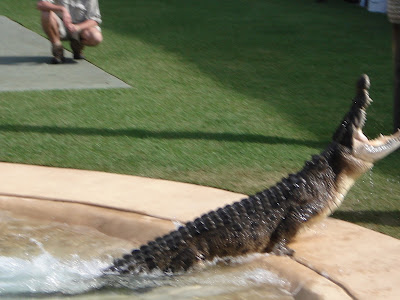
We spent about 5 hours in the zoo itself, 2 hours of which was taken up by a spectacle in the Crocoseum - a 3000 seater stadium-like structure in the heart of the zoo - where we saw a bird show, snakes, elephants and of course crocodiles. Well, a crocodile. A bloody great saltwater beast that would make you shiver:
The show had a very strong conservationist message in it, as well as pointing out just
how easily the threat of crocodiles is dealt with compared to many other predators. I think this is what Irwin was interested in getting across: they might look like monsters, but they've been around for a very long time, they've earned their place in the ecosystem, and we should give them the respect and protection they're due. And finally we heard phrases like "Steve's memory" and saw a wall of khaki shirts with messages of condolence and support. And in fairness to the Australia Zoo, it was all done in a positive, upbeat way - like applause at an actors funeral.
Other notable sights in the zoo were wombats that actually moved around. We've been to three other places where wombats were potentially available to be seen. In each and every place the said wombat was comatose and arse to the window. In Australia Zoo, the wombats were frolicking with the staff, practically playing catch. I asked a keeper how this was so, and she explained that their wombats were effectively trained to stay awake during the day, and would sleep all night, which struck me as a strange thing for a zoo to do to a nocturnal animal.
Another creature that was more lively here than elsewhere was the koala. These fellas get so little energy from they gum leaves they eat that they can barely stay awake for more than 6 hours a day. They make Giant Pandas look like gym nazis by comparison. But here, our jaws dropped to see koalas moving around trees (despite the fact that there were plenty of perfectly fine leaves to be had where they were) and on one occasion, get down onto the ground and move to a different tree. I suspect genetically modified eucalyptus trees, with caffeine added.
We also had another close look at a kookaburra, and I got a picture to show readers of this blog why having three of them perched at your shoulder and eyeing up your beef lasagne can be a disconcerting experience. Take a look at the bill on this guy:

The girls had a good day out, and learned lots. They dwelt a while on the unfairness of Irwin's sudden death, feeling very sorry for Bindi, his daughter who would be about Nina's age. Life can be desperately unfair, and it's good to learn that early on. It either prepares you for what can be thrown at you, or makes you damn glad of what you have.
The news reached our home in Cork of course, and Nina and Sara were put out, and not a little puzzled, by the fact that the Crocodile Hunter they enjoyed watching on TV was dead. 18 months later (on Sunday last) we headed North from Brisbane on the the Bruce Highway, turning off onto the recently renamed Steve Irwin Way to visit Australia Zoo, the home of the Irwin family, and the place where many scenes from the Croc Files were shot. You could hardly tell the poor guy was dead.
Posters and billboards of Steve were everywhere - outside, inside, on the huge 2-level Australia Zoo coaches in the car park. Big cardboard Crikeys all over the shop. The zoo literature made no mention of his death, and of course inside everything was business as usual. I didn't expect black armbands, but the experience was a little eerie none the less.
We spent about 5 hours in the zoo itself, 2 hours of which was taken up by a spectacle in the Crocoseum - a 3000 seater stadium-like structure in the heart of the zoo - where we saw a bird show, snakes, elephants and of course crocodiles. Well, a crocodile. A bloody great saltwater beast that would make you shiver:
The show had a very strong conservationist message in it, as well as pointing out just
how easily the threat of crocodiles is dealt with compared to many other predators. I think this is what Irwin was interested in getting across: they might look like monsters, but they've been around for a very long time, they've earned their place in the ecosystem, and we should give them the respect and protection they're due. And finally we heard phrases like "Steve's memory" and saw a wall of khaki shirts with messages of condolence and support. And in fairness to the Australia Zoo, it was all done in a positive, upbeat way - like applause at an actors funeral.
Other notable sights in the zoo were wombats that actually moved around. We've been to three other places where wombats were potentially available to be seen. In each and every place the said wombat was comatose and arse to the window. In Australia Zoo, the wombats were frolicking with the staff, practically playing catch. I asked a keeper how this was so, and she explained that their wombats were effectively trained to stay awake during the day, and would sleep all night, which struck me as a strange thing for a zoo to do to a nocturnal animal.
Another creature that was more lively here than elsewhere was the koala. These fellas get so little energy from they gum leaves they eat that they can barely stay awake for more than 6 hours a day. They make Giant Pandas look like gym nazis by comparison. But here, our jaws dropped to see koalas moving around trees (despite the fact that there were plenty of perfectly fine leaves to be had where they were) and on one occasion, get down onto the ground and move to a different tree. I suspect genetically modified eucalyptus trees, with caffeine added.
We also had another close look at a kookaburra, and I got a picture to show readers of this blog why having three of them perched at your shoulder and eyeing up your beef lasagne can be a disconcerting experience. Take a look at the bill on this guy:
The girls had a good day out, and learned lots. They dwelt a while on the unfairness of Irwin's sudden death, feeling very sorry for Bindi, his daughter who would be about Nina's age. Life can be desperately unfair, and it's good to learn that early on. It either prepares you for what can be thrown at you, or makes you damn glad of what you have.
Subscribe to:
Posts (Atom)