June 2009: Our family trip around the world was beautiful while it lasted but now it's over. So
what's next for a change-addict? Life Part II is underway, and it's time to decide how to spend it.
While Stocks Last.
Showing posts with label chile. Show all posts
Saturday, July 26, 2008
Friday, July 25, 2008
I Lique Iquique
"I like Iquique". I don't know how many times I made this pronouncement over the last 2 days. Mostly because I'm surprised. This was supposed to be a place to sleep and eat for the last few days in Chile before flying on to Peru. I was expecting a place that smelled of fishmeal, and looked aged and delapidated (smelly and crumbling - just like me!).
Iquique (Ee-key-kay) used to be one of the wealthiest places on the planet. They dug their wealth out of the ground around here. More salt. Saltpetre to be precise. The nitrates that were exported to Europe from here at the turn of the 19th century were used for the complementary purposes of blowing people up, and disinfecting their wounds. The nitrate boom (npi) lasted until the end of World War I, and then the town went into decline. Valparaiso started its decline when the Suez canal was completed, and still looks ragged today. But Iquique found a replacement industry. That's why I was expecting the place to smell of fish.
What we found on arrival (which by the way was at five in the morning after sleeping on the bus for 7 hours from San Pedro) was a beautifully preserved town centre and a moderately built-up beach area about 2km out of town. Our hotel is on the waterfront and looks out over a little flotilla of red fishing boats - so red that you can even make out their colour by night - as well as an even smaller flotilla of pelicans and a lone visiting seal. From our balcony we can see the beach stretching away, the city behind it, and towering above everything, an 800m mountain range that surges up behind the city.
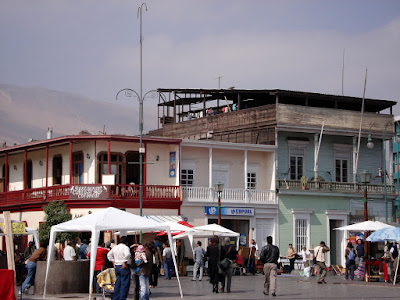
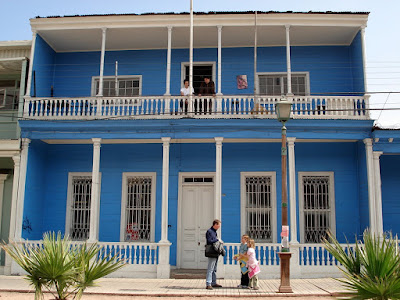
The most interesting road in the city is Baquedano, which is made up of the mostly restored mansions of the nitrate era. Given that the Internet in our hotel isn't working properly, we spent both of our afternoons here sitting in the sun outside Ronny Tequila's, enjoying a good lunch and using their free WIFI to upload photos and bore the hell out of you.
Because Chile is long and thin, and because there don't seem to be that many gringos on the tourist trail here, it's natural to bump into the same people time and again as you travel through the country. On the trip to the observatory I met a girl from Reunion called Nicoletta, and next encountered her on top of sand dune in the Valley of the Moon outside San Pedro. At that time she was talking to an English girl, who we briefly chatted to. Today, outside our favourite WIFI spot we bumped into the English girl again, this time with her boyfriend. From...Dublin! They are in their final three weeks of a one year journey. I asked him if he was the chap I had seen with the Dublin colours in San Pedro - apparently not. No shortage of Paddies in these here parts, it appears. (Hi Peter and Roxanne, if you get around to tuning in.)
Were looking forward to, or dreading, their return to normal life? I inquired. I had a particular reason for asking. Because our trip has always had a shape - a beginning a middle and an end - as the clock has ticked on I've found my attitude towards it changing. I remember telling my dad a few months back that if I had the money I'd happily stay out for another year, work- and school-life notwithstanding. Back in Oz, the only consolation on leaving one beautiful place was the knowledge that I was moving on to somewhere new. Well things have changed. South America was always going to be the last lap, and because that has always been its assigned role, I find that my attitude towards returning home is changing, dutifully following the curve of take off and landing that has been programmed years in advance. I hereby publically admit that I'm beginning to look forward to coming home. Funnily enough, that's what Roxanne and Peter reported as well.
Don't get me wrong. Once we recovered from our jet lag and moved on from Santiago, we've had a terrific time here in Chile. It has the flavour of real adventure that New Zealand, unmissible and rewarding though it is, didn't have simply because of its cultural familiarity. I expect even more of the same from Peru. But this time next month we´ll have spent one night in our own bed in Cork. And strangely, I'm very OK with that.
Perhaps I'm just getting old.

Same mierda, different day?

Iquique (Ee-key-kay) used to be one of the wealthiest places on the planet. They dug their wealth out of the ground around here. More salt. Saltpetre to be precise. The nitrates that were exported to Europe from here at the turn of the 19th century were used for the complementary purposes of blowing people up, and disinfecting their wounds. The nitrate boom (npi) lasted until the end of World War I, and then the town went into decline. Valparaiso started its decline when the Suez canal was completed, and still looks ragged today. But Iquique found a replacement industry. That's why I was expecting the place to smell of fish.
What we found on arrival (which by the way was at five in the morning after sleeping on the bus for 7 hours from San Pedro) was a beautifully preserved town centre and a moderately built-up beach area about 2km out of town. Our hotel is on the waterfront and looks out over a little flotilla of red fishing boats - so red that you can even make out their colour by night - as well as an even smaller flotilla of pelicans and a lone visiting seal. From our balcony we can see the beach stretching away, the city behind it, and towering above everything, an 800m mountain range that surges up behind the city.
The most interesting road in the city is Baquedano, which is made up of the mostly restored mansions of the nitrate era. Given that the Internet in our hotel isn't working properly, we spent both of our afternoons here sitting in the sun outside Ronny Tequila's, enjoying a good lunch and using their free WIFI to upload photos and bore the hell out of you.
Because Chile is long and thin, and because there don't seem to be that many gringos on the tourist trail here, it's natural to bump into the same people time and again as you travel through the country. On the trip to the observatory I met a girl from Reunion called Nicoletta, and next encountered her on top of sand dune in the Valley of the Moon outside San Pedro. At that time she was talking to an English girl, who we briefly chatted to. Today, outside our favourite WIFI spot we bumped into the English girl again, this time with her boyfriend. From...Dublin! They are in their final three weeks of a one year journey. I asked him if he was the chap I had seen with the Dublin colours in San Pedro - apparently not. No shortage of Paddies in these here parts, it appears. (Hi Peter and Roxanne, if you get around to tuning in.)
Were looking forward to, or dreading, their return to normal life? I inquired. I had a particular reason for asking. Because our trip has always had a shape - a beginning a middle and an end - as the clock has ticked on I've found my attitude towards it changing. I remember telling my dad a few months back that if I had the money I'd happily stay out for another year, work- and school-life notwithstanding. Back in Oz, the only consolation on leaving one beautiful place was the knowledge that I was moving on to somewhere new. Well things have changed. South America was always going to be the last lap, and because that has always been its assigned role, I find that my attitude towards returning home is changing, dutifully following the curve of take off and landing that has been programmed years in advance. I hereby publically admit that I'm beginning to look forward to coming home. Funnily enough, that's what Roxanne and Peter reported as well.
Don't get me wrong. Once we recovered from our jet lag and moved on from Santiago, we've had a terrific time here in Chile. It has the flavour of real adventure that New Zealand, unmissible and rewarding though it is, didn't have simply because of its cultural familiarity. I expect even more of the same from Peru. But this time next month we´ll have spent one night in our own bed in Cork. And strangely, I'm very OK with that.
Perhaps I'm just getting old.
Same mierda, different day?
Thursday, July 24, 2008
Unsavoury Tales of Salt
In an interesting coincidence, during our visit to San Pedro de Atacama and its Salt Flats, I was reading a book about the history of salt. I picked up Salt, A World History by Mark Karlansky in Auckland airport during one of our long sojourns there. A cover as umpromising as that, I reasoned, was sure to hide an excellent book. Only a publisher who was very confidant of their author's ability to truely facinate the reader would risk their money on 450 pages of a book like that. (The same auther has a track record - a biography of the cod. As in fish. Seriously.)
But usually the simplest explanation is the correct one. A book about salt is, well, hard to swallow. I'm on page 256 now, and I feel like my brain has been pickled in brine. I have been almost entirely leached of my will to read. On the bright side, the book did help somewhat with my Santiago insomnia. And I have learned a few things, though painfully (like, not to buy the book about cod).
Why is the sea salty?
I'm very comfortable with the answer "I don't know" to most questions that anyone, especially my daughters, might put to me. I like the ring of it. I like its simplicity. And it suits me. But the nature of my children is to abhor this vacuum. When given the choice between idle and ill-founded conjecture on one hand, and the honest admission of ignorance on the other, Nina and Sara generally opt for the former. In face, in the absence of an answer to a question like "Why is the sea salty?" they are capable of constructing a complete mytholigical edifice involving princesses and tyrannical kings (who knows why, but hard-done-by princesses and tyrant kings feature regularly in their stories...)
But the answer to the above question was answered for us in, of all places, the desert. When you visit the Salar de Atacama despite being in one of the driest places on Earth you'll find salty lagoons with shrimps swimming in them, and three different species of flamingo that feed on the shrimp. Around the lagoons there is nothing but jagged salt-encrusted plains. Around the salt there is only the rocks and dust of the desert. And all of this is enclosed by the Andes on one side and the Cordillera de la Sal (yes, salt) on the other. Where does the water, and the salt come from?
I don't know.
Just kidding. Force of habit. It's meltwater from the Andean snow peaks. It flows downward like a river, but under the surface of the ground. Like any river, it carries along with it the minerals of the soil through which it runs. But this river never gets even close to the sea. It hits the high plains between the two mountain ranges, where the impermeable rock pushes it to the surface. 96% of the water evaporates, depositing the salt crystals in ever-growing clumps. The remaining 4% creates the lagoons.
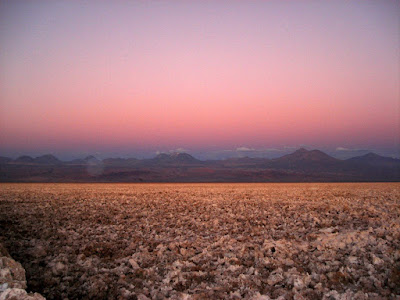
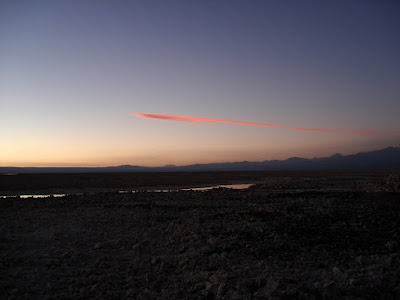
The effect that this produces is best told with pictures - Letizia's of course. Looked at closely, the Salt Flats aren't really flat at all. The surface looks like badly-ploughed earth, sprinkled with snow. And when the sun goes down, the colour of the salt, and the reflection of the reddening mountains and volcano in the lagoon outdoes even Uluru. Even without the champagne.


What's that? Oh - what does make the sea salty? Well, just allow a river to reach the sea (many do, apparently) and the same process of surface evaporation, carried on over eons, makes for a salty sea. Well that's one explanation. Another one is that the evil king, punishing his two poor innocent daughters for not eating their dinner, makes them fill the sea with the kingdom's salt, teaspoon by teaspoon.
You choose.
But usually the simplest explanation is the correct one. A book about salt is, well, hard to swallow. I'm on page 256 now, and I feel like my brain has been pickled in brine. I have been almost entirely leached of my will to read. On the bright side, the book did help somewhat with my Santiago insomnia. And I have learned a few things, though painfully (like, not to buy the book about cod).
Why is the sea salty?
I'm very comfortable with the answer "I don't know" to most questions that anyone, especially my daughters, might put to me. I like the ring of it. I like its simplicity. And it suits me. But the nature of my children is to abhor this vacuum. When given the choice between idle and ill-founded conjecture on one hand, and the honest admission of ignorance on the other, Nina and Sara generally opt for the former. In face, in the absence of an answer to a question like "Why is the sea salty?" they are capable of constructing a complete mytholigical edifice involving princesses and tyrannical kings (who knows why, but hard-done-by princesses and tyrant kings feature regularly in their stories...)
But the answer to the above question was answered for us in, of all places, the desert. When you visit the Salar de Atacama despite being in one of the driest places on Earth you'll find salty lagoons with shrimps swimming in them, and three different species of flamingo that feed on the shrimp. Around the lagoons there is nothing but jagged salt-encrusted plains. Around the salt there is only the rocks and dust of the desert. And all of this is enclosed by the Andes on one side and the Cordillera de la Sal (yes, salt) on the other. Where does the water, and the salt come from?
I don't know.
Just kidding. Force of habit. It's meltwater from the Andean snow peaks. It flows downward like a river, but under the surface of the ground. Like any river, it carries along with it the minerals of the soil through which it runs. But this river never gets even close to the sea. It hits the high plains between the two mountain ranges, where the impermeable rock pushes it to the surface. 96% of the water evaporates, depositing the salt crystals in ever-growing clumps. The remaining 4% creates the lagoons.
The effect that this produces is best told with pictures - Letizia's of course. Looked at closely, the Salt Flats aren't really flat at all. The surface looks like badly-ploughed earth, sprinkled with snow. And when the sun goes down, the colour of the salt, and the reflection of the reddening mountains and volcano in the lagoon outdoes even Uluru. Even without the champagne.
What's that? Oh - what does make the sea salty? Well, just allow a river to reach the sea (many do, apparently) and the same process of surface evaporation, carried on over eons, makes for a salty sea. Well that's one explanation. Another one is that the evil king, punishing his two poor innocent daughters for not eating their dinner, makes them fill the sea with the kingdom's salt, teaspoon by teaspoon.
You choose.
Labels:
chile,
salar de atacama,
san pedro de atacama,
travel
Wednesday, July 23, 2008
I Spy
I though I had seen desert. Our trip to Australia´s Red Centre was my first time in such an arid part of the world. Nine months without rain, we were told, and it looked it too. On the bus between Alice and Uluru, some parts were particularly sparsely vegetated and completely unsuitable for cattle stations. Then I saw the Atacama.
We´ve been brushing the edges of desert or semi desert for a few days already, as we´ve been making our way North aboard countless buses (well, 4 buses actually). After 2 days in La Serena we took a night bus to Calama and onwards to San Pedro de Atacama, forsaking the coast in order to follow the strongly worded advice of Iain Ballesty (I got the feeling he´d track us down and hurt us if we bypassed S. Pedro) and the gentle prodding of `Nonna Carla`.
I´ve never seen a place like the Atacama, or a town like San Pedro. San Pedro is an oasis. Literally. Everything else is dry as toast. This is not a place of little rain. It simply doesn´t happen here. You´ll appreciate that for an Irishman, this is a hard concept to register. It offends my Celtic sensibilities. Believe me, I´m not fond of rain, but I feel it may have a role to play in earthly matters. If the lunar features of the Atacama are anything to go by, I might just be on to something. Australia was just barren. The Atacama is dead. Some isolated parts are sandy in the way one would expect (or in your case David French, in the way one has experienced) but mostly I saw hard rock with a dusting of, em, dust. It´s a brave individual indeed who would try to hammer a tent peg into the Atacama ground.
Back in Santiago, Iain had told the girls how they might play I Spy in this part of the world:"I spy with my little eye somthing beginning with S." "Sand." "Yes. Your turn."
"I spy with my little eye somthing beginning with S." "Sky." "Yep. Now what do we play?"
If you look through any edition of the Rough Guide (and we're on our 4th so far), you'll become familiar with the light brown tone of their city maps. Flicking from map to map, you could be forgiven for thinking that every city looks much like the other. Especially in Chile, where a grid layout centred around a Plaza de Armas is standard. According to the map of San Pedro, we had to walk three blocks East and three blocks South to get from the Tur-Bus terminal to our hosteria. One small but important feature of the map, that might have hinted at how different San Pedro was from all those other maps, was the scale. A San Pedro block will take you all of thirty seconds to walk. Stroll. But if you are wearing a rucksack and dragging two wheeled samsonites (admitedly much lighter than when I was dragging them through China) across dirt-track streets, spending as much energy in balancing them as dragging them, the blocks start to look big again. Even the Tur-Bus terminal itself isn't much more than a dusty corral lined with rough wood fencing. We were spared the journey by the arrival of Señor Samuel in his taxi - indistinguishable from a big city taxi in colour and model except for the fact that it took up the entire road, adobe wall to adobe wall. Our three block by three block journey, made longer by the necessary one-way system, effectively spanned the limits of this town. We weren't in the city any more.
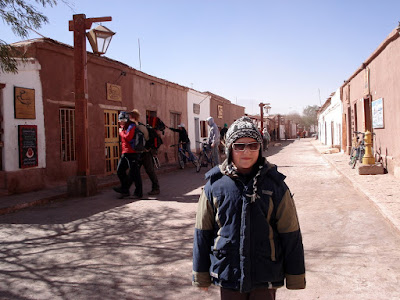
Our time in San Pedro organised itself as follows: On both evenings we left the village on a tour bus, first to the Salar (salt flats) and then to the Valle de la Luna (Valley of the Moon). But our mornings and afternoons were spent browsing the streets, this time without the samsonites. As you might have understood, this doesn't take a lot of time. But that was fine - we weren't in any hurry. Nothing is taller than one or one-and-a-half floors high, except for the steeple of the church of San Pedro. Almost every single door is open, and shows a cafe, a shop of artisan goods, or a tour operator behind it. If this doesn't sound very enticing, you have to allow for the atmosphere. Yes, it's full of tourists, but anyone who makes the trip to a place so isolated really wants to be there, and everyone seems to fall under the same spell. There is no sign of boxer shorts emblazoned with national flags here, although I'd swear I saw a Dublin GAA jersey.
We tried out a lot of eateries, either early before our tours, or later when we returned in the dark. Not every experience was positive but my favourite was the first one we stumbled across was Bistro Les Copains on the corner of Tocopilla and Caracoles streets. A shallow room opening directly onto the street, it can fit about 10 people. The owner speaks good english makes you feel genuinely welcome. The fare is simple but good. And to top it all off, they offer a very cheap laundry service as well. Beef sandwich and clean knickers. What more could a traveller ask for.
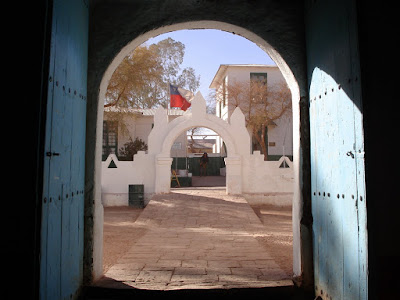
As I said, I'll blog separately about the two tours we took. But hopefully the following pictures, courtesy of Letizia, will give you a feeling for the sand-stroked genteel nature of San Pedro de Atacama.
Tuesday, July 22, 2008
The Rabbit in the Moon
On the evening of our second day in La Serena we were collected from the hotel and brought by minibus to a town about 40 minutes inland by the name of Vicuña. From there, a road of sorts led up. Up through the town. Up the side of a hill. Up through the fog that was beginning to envelope Vicuña. The road was just a dirt track, sometimes with high banks of recently cleared earth. No street lighting. This should have been well off-piste, but bit by bit our minivan was joined by others. Cars, vans and buses joined their headlights together into a slow procession upwards, until finally we all came to a stop in the carpark of the Mamalluca Observatory.
There are dozens of large telescopes pointing skywards in Central and Northern Chile. The skies here are famous for being clear. Many are European, or American or international collaborations. As our guide would later say, Chile doesn't have as much money as Europe or America, but it has lots of sky. The Mamalluca Observatory was established with the hand-me-downs of larger installations with the express purpose of acting as a public access site. Whereas bigger sites with enormous lenses will let you look in, they won't let you look up. Mamalluca's modest 30 cm reflecting telescope was more than enough for us. We were able to look at Jupiter and make out its layered surface and four of its moons. I have a starter refracting telescope at home which I've pointed on occasion at the planets (not that they've noticed). Cold hands, rickety tripods and no tracking device to keep you on target means that most of the time is spent twiddling knobs and stamping feet, and only a very few seconds actually observing. Jupiter through the lens, until my trip to Mamalluca, looked like a distant stale biscuit. Rich Tea, at a guess.
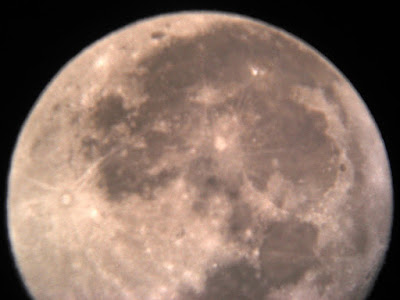
There was a full moon that night. Not ideal for looking into deep space, but nice for looking at, well, the moon. So we did. The best place to look, according to Alfredo our guide (who for some reason spoke with an accent precisely the same as my Norwegian friend Kaare - either Alfredo is Norwegian or Kaare has been having a great laugh at my expense for many's the year now) is at the edge of the moon, where you can see the details stand out in three dimensions. We studied an intriguing pimple on the lunar surface only to be told later than it was 3km deep and tens or even hundreds of km wide.
After a powerpoint presentation on the lifecycle of stars and an introduction to the "humourous" naming convention of telescopes (let's just say that astronomy nerds make us computer nerds seem like real wags), we went outside to some other less powerful scopes with wider fields of view - perfect for more moongazing. Letizia took some great pictures through the lens. Then something happened to make me lose track of the astronomical goings on: we met an Irish family of four who were on a ten week tour of South America. Their children were close in age to Nina and Sara and so before long, the four of them were running around like feral llamas, while Letizia and I compared notes with the parents. It felt really good to find someone doing something as daft as we were. I never did get around to asking names, but I did write down this blog address and I hope they get the chance to tune in (hi there family from Meath, if you're reading!).
Since arriving in the Southern Hemisphere, as well as performing important experiments in fluid dynamics, we noticed how different the night sky is down here. The Southern Cross, as its name suggests, is not visible from Ireland (unless you are looking at an Australian or New Zealand flag in Ireland). And Orion - an easy constellation to spot back home - is harder to find due to the fact that he's generally standing on his head down here. ("Silly Orion, always drunk" - Nina and Sara's interpretation). Now Alfredo (or Kaare as I had by now come to think of him) pointed out something which, in all my beer-fueled discussions on matters austral with Simon Pett, I had never noticed. The moon is upside down here too. The Man in the Moon that you can make out from the Northern Hemisphere is nowhere to be seen. In his place is the Rabbit in the Moon. And I have to say that the Rabbit is much more convincing than the Man. Find a picture of the moon (chances are it'll be a Northern Hemisphere one), twiddle it around and hold it at arms length.
What's up doc?!
Monday, July 21, 2008
Darwinism and Table Soccer
The seven hour bus trip from Santiago to La Serena was a piece of cake. We took a taxi to the terminal of Tur-Bus, and found there a level of organisation as good as any airport. Our tickets already specified the bay number that the bus would use. We bought some food for the trip and got settled in on board. No checkin, no security - and no delays.
The place that 'Nonna Carla' had chosen for us was outside the centre of the town, just by the beach. It's clearly not swimming weather right now, but the seafront made a good place to walk. I noticed a blue sign right by the water with a picture of a huge wave on it. On closer examination it turned out to be an indication for the escape route in case of a tsunami. Nothing is left to chance in La Serena - the sign pointed away from the ocean. Darwin, like God, is being relegated to ever smaller spheres of influence by modern man.
Our hotel was actually a park of cabañas - tiny self-catering cabins that are perfect for Summer, but definitely not made to retain heat. But we were fine with it. We were glad to be out of a smoggy city, and Nina and Sara soon found little friends around the park. For families based in Santiago, La Serena is the holiday destination of choice. The Winter school holidays are on right now, so the girls (and Letizia and I) were able to resume the sport that practically defined our week in Fiji: table soccer. In Fiji, I did my impression of Little Britain's Competitive Dad, doing a lap of the table on every goal, punching the air, and generally bewildering my young (and now that I think of it, slightly cross-eyed) opponent. And yet he kept coming back for more. Sucker!!! In La Serena I tried to suppress this instinct when playing Filipe, an 11-year-old Santiago boy. And I almost succeeded. In any case, we have decided that table-soccer (or tacataca as it is known in Chile) is the sport for the Lawlor family, combining as it does a minimal fitness requirement, no dedication whatsoever and a take-no-prisoners approach to gratuitous displays of victory. We'll be acquiring a table when we get home (though we have nowhere to put it, as the funds that might have gone into converting the attic went into this trip instead).
Across the road from our cabañas we found a great steak restaurant. For less than 7 euros I got one of the best filets I've ever enjoyed. 400g of rosey-on-the-inside, al-dente-on-the-outside happiness. Our waiter turned out to have a very unusual first name. He was called Darwin. I know that Charles Darwin passed this way before on The Beagle. But I didn't think he had left his own genetic imprint on the place. Could this man in front of me be the fruit of Charles Darwin's own long forgotten experiment in heredity, I wondered? Apparently not - it seems that his father was a scientist and named his son out of reverence for a great scientific thinker. (It might have been kinder to simply call him Charles). I was tempted to ask him what names his siblings were carrying around (Copernicus is working desserts tonight and it's Einstein's night off). But he still had all the steak-knives in his hand so I though better of it. I also didn't find out if he shared my concerns about the negative effect that the tsunami sign might have on the future of the local gene pool. Some times it's safer to be on the other side of a nice big language barrier.
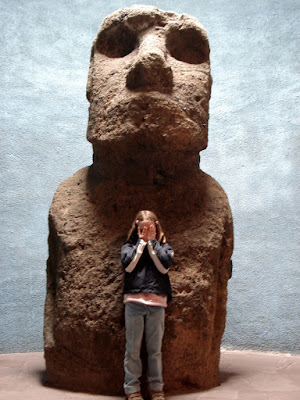
La Serena has a great deal more to offer than steak and table soccer of course. We took some time to stroll around the city centre, browse in a pretty covered market, and have a reasonably priced meal or two. But oddly enough, table soccer and walks along the beach (including a few goes on a bungy trampoline for Nina and Sara) was all we really wanted. The girls had had to deal with 4 days in Santiago with very little to do except watch their parents disintegrate due to lack of sleep (probably not such a bad passtime for most kids, but not nearly as good if you can't have a laugh with your friends about it). La Serena offered them a chance to just do what they wanted to do. Apart from a quick tour of a surprisingly good archeological museum - which included an orginal maoi statue from Easter Island - we contented ourselves with strolling, eating, ping-pong and table soccer. As far as this family is concerned, La Serena was a GOOOOOOOOAAAAAAAAAAALLLLLLLLLLLLLL!!!!!!!!!
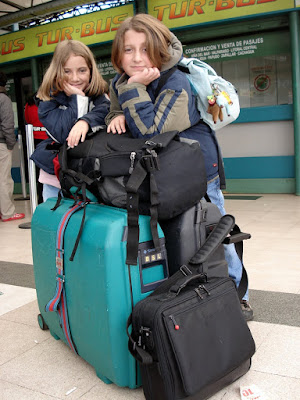
Nina and Sara, ready for the bus to get out of Santiago.
Sunday, July 20, 2008
North
Men and women have different ways of orienting themselves in the unknown. Women prefer to use landmarks when giving directions. Men, on the whole, speak in terms of compass points, road numbers and distances. I love the REM song called Stand: "Stand in the place where you live/Now face North/ Think about direction, wonder why you haven't before". I keep a little compass in my pocket. I use it to check the direction of taxi routes compared to my expectations. I use it when we are hiking to ensure we are going in more or less the right direction. But mostly I just use it because I like to know where North is. I like to picture us, in my mind's eye, superimposed on the little globe that sits in our living room back home.
Letizia likes to tease me for my y-chromosome ways. "Which way is the river?" she says, echoing a question I often ask myself aloud when reading city maps. Compass points leave her cold. But for once now, and for the next several days, we will both instantly know in which direction North lies. Even without a compass. North is the front of the bus.
Friday, July 18, 2008
Insomnia
I have to tell the truth. Over the last four days in Santiago, I've felt like the wheels were finally coming off our little wagon. Sleep deprivation can play merry hell with your sense of wellbeing. The loneliness of insomnia dulls your daytime senses, and barbs your mood. It's hard to like a city such as Santiago in this state of mind, and so I fully accept that my memories of it are coloured darkly, unfairly.
When I think of our four days there, I think of crowded fast-moving streets that tolerate strolling visitors only with impatience. I think of feeling hunger but being surrounded only by junkfood, both local and imported. I think of high historical buildings whose elegance is studded with haphazard ground-floor commerce. I think of air that I can taste as I breathe.
But there are brighter memories too. An hour spent in the company of Iain Ballesty, Darragh's brother, over lunch. He gave us good advice for our northward trip through Chile, and made Nina and Sara laugh by telling them "I hate your guts" when they described their trips to Fox Glacier and whale-watching in Kaikoura. Our visit to the Museum of Pre-Columbian Art was well worth the time - the girls were quite engaged by it and I particularly liked the many complex tapestries and weaving styles displayed. The staff of our hotel were very kind to us, and that can make a big difference to any stay. "Nonna Carla" from the travel agency was a terrific find.
The biggest problem though was the gray pessimism that settled over us, and that I personally struggled to see past. The long road North to Cusco didn't invite us quite so much anymore. The task of organizing and then executing a plan that involved many thousands of kilometres, and bus trips of 15 hours or more, with the sure reward of being laid low for days with altitude sickness...well it led me for the very first time to look forward to going back home. I am not a person easily disposed to worry. I am irritatingly positive and boringly even keeled (Mam, Dad - you must have done something right when I was growing up). But on those occasions when my spirits dampen, the effect tends to seep to the bone. The fact that both Letizia and I have been feeling down, and that Santiago doesn't hold much interest for children, has meant that the last few days have been hard for Nina and Sara. They are patient, but I've realised that some places bring them out of themselves, while others make them sink back into their warm jackets like a tortoise into its shell. This has been Tortoise-Town.
They are simple creatures however, like their father. It doesn't take too much to find our feet again. As I write this, I am on a very comfortable Tur-Bus heading North to La Serena. The Pacific is on my left, rolling hills of low scrub to my right. The sun is shining. The girls are playing in the seats behind me, and Letizia is napping next to me. I actually slept OK last night, and I can feel the difference already. Tomorrow night we will visit one of the many observatories for which these famously cloud-free parts are known for.
She'll be right.
Tuesday, July 15, 2008
Sleepwalking in Santiago
We've been in Chile for 2 days now, but so far we're experiencing it through the haze of jetlag. It was always our plan to take the time here to recover from the inevitable effects, and to plan our trip in detail. We're succeeding in doing the latter, but the jetlag is taking longer than we expected. Dave French, whose travelometer goes Spinal Tap style all the way up to eleven, tells us that we need to allow one day for every time zone change. At that rate, we'll be almost finished with Chile by the time we fully recover.
We've taken a close look at our plans for the next two weeks. Our fixed point is Cuzco on the 30th of July. Our plan was to cover the distance from Santiago to Arica (30 hour bus trip) and cross from there to La Paz (another 7 hours), spending 2 days there before moving on to Lake Titicaca. There are too many problems with this. Firstly, in our rush North, we would miss out on many sights and experiences that Chile has to offer, chief amongst which is San Pedro de Atacama. Secondly, we could expect to be laid low with altitude sickness in La Paz for the 2 days we planned to stay there, recovering just in time to leave.
Our new itinerary leaves us more time in Chile, stopping off in La Serena (and getting a tour of the Mamalluca observatory), then making our way to San Pedro de Atacama for two nights of desert contemplation and a visit to the Salt Plains. Finally we will spend two nights in Iquique from where we will fly directly to Araquipa in Peru. We'll have time to reach Cuzco via Lake Titicaca - we wouldn't think of missing out on that.
Even without the language gap - which Letizia is spanning brilliantly - managing your own trip in Chile is not as straight forward as in Australia or New Zealand. There's a huge variety of bus companies, each with their own specialised areas of interest. High car hire cost rules this more independant option out. And even if LAN and other airlines have an online booking system, not all flights are available this way. We decided to seek out the help of a travel agency and basically picked the closest one to our hotel that we could find in the Yellow Pages. With the address in hand we went out to find the office, expecting something like Flight Centre - a highstreet shop with lots of brochures in the window (and maybe even an inflatable pilot outside the door). What we found was a doorbell to a closed office on the 11th floor of a 12 floor building. So we rang.
The door creaked open, and a suspicious pair of eyes peered out at us. Clearly not used to personal calls. Once the initial suspicion passed, we were invited in,. An english speaker was found but it was becoming clear that this agency did not deal with the public. But once it was established that Letizia was Italian, conversation switched immediately to Italian. The company was Italian-owned, and we were speaking with the daughter of the owner. All doors opened. Take off your coats! Sit down! A few moments later the owner herself swept into the room, introducing herself to Nina and Sara first as 'Nonna (Granny) Carla', before directing a tornado of welcome at Letizia and me. There was no talk of business at first - that would have been crude. This was business Latin style. Carla brought us out onto the balcony to admire the sunset over Santiago. She showed us pictures of her grandchildren back in Europe, and we approved. We described our travels to her and she expressed her approval. When, and only when these nicities were observed did we move on to what might have brought us to her office. Up until that point we might just as easily have been making a courtesy call to a distant relative.
A little over 24 hours later, we now have travel and accommodation and some activity vouchers for the rest of our Chilean stay, as well as our flight to Peru - all in the quaint kind of customized plastic folders that were used at home when flying was still something of a big deal. Now we just have to kick this jetlag and get stuck in.
Tomorrow we make a day trip to Valparaiso. More when we get back from that.
We've taken a close look at our plans for the next two weeks. Our fixed point is Cuzco on the 30th of July. Our plan was to cover the distance from Santiago to Arica (30 hour bus trip) and cross from there to La Paz (another 7 hours), spending 2 days there before moving on to Lake Titicaca. There are too many problems with this. Firstly, in our rush North, we would miss out on many sights and experiences that Chile has to offer, chief amongst which is San Pedro de Atacama. Secondly, we could expect to be laid low with altitude sickness in La Paz for the 2 days we planned to stay there, recovering just in time to leave.
Our new itinerary leaves us more time in Chile, stopping off in La Serena (and getting a tour of the Mamalluca observatory), then making our way to San Pedro de Atacama for two nights of desert contemplation and a visit to the Salt Plains. Finally we will spend two nights in Iquique from where we will fly directly to Araquipa in Peru. We'll have time to reach Cuzco via Lake Titicaca - we wouldn't think of missing out on that.
Even without the language gap - which Letizia is spanning brilliantly - managing your own trip in Chile is not as straight forward as in Australia or New Zealand. There's a huge variety of bus companies, each with their own specialised areas of interest. High car hire cost rules this more independant option out. And even if LAN and other airlines have an online booking system, not all flights are available this way. We decided to seek out the help of a travel agency and basically picked the closest one to our hotel that we could find in the Yellow Pages. With the address in hand we went out to find the office, expecting something like Flight Centre - a highstreet shop with lots of brochures in the window (and maybe even an inflatable pilot outside the door). What we found was a doorbell to a closed office on the 11th floor of a 12 floor building. So we rang.
The door creaked open, and a suspicious pair of eyes peered out at us. Clearly not used to personal calls. Once the initial suspicion passed, we were invited in,. An english speaker was found but it was becoming clear that this agency did not deal with the public. But once it was established that Letizia was Italian, conversation switched immediately to Italian. The company was Italian-owned, and we were speaking with the daughter of the owner. All doors opened. Take off your coats! Sit down! A few moments later the owner herself swept into the room, introducing herself to Nina and Sara first as 'Nonna (Granny) Carla', before directing a tornado of welcome at Letizia and me. There was no talk of business at first - that would have been crude. This was business Latin style. Carla brought us out onto the balcony to admire the sunset over Santiago. She showed us pictures of her grandchildren back in Europe, and we approved. We described our travels to her and she expressed her approval. When, and only when these nicities were observed did we move on to what might have brought us to her office. Up until that point we might just as easily have been making a courtesy call to a distant relative.
A little over 24 hours later, we now have travel and accommodation and some activity vouchers for the rest of our Chilean stay, as well as our flight to Peru - all in the quaint kind of customized plastic folders that were used at home when flying was still something of a big deal. Now we just have to kick this jetlag and get stuck in.
Tomorrow we make a day trip to Valparaiso. More when we get back from that.
Subscribe to:
Posts (Atom)