Showing posts with label new zealand. Show all posts

Wednesday, September 10, 2008

Half a World Away

Today I was trading notes with a friend who spent some time in New Zealand. Before ever we left, he and I had talked a little about his time there, spent exclusively on the South Island. Interested though I was back then, it was an entirely different conversation this second time. Once again, being there makes all the difference. The abstract concept that I had mentally filed and labelled 'New Zealand' a year ago has been erased, and in its place are memories of a real country.

I never did find the time in South America to come back to the topic of New Zealand on this blog, so I hope you'll indulge me in a little reverie and soapboxing now.

Two images come immediately to mind when I think back on our time in NZ - especially on the South Island - that were constants in an otherwise ever-changing landscape. Firstly, the braided river systems. Wide stretches of rockstrewn flatlands through which trickled a few inches of water. Every time we drove over a bridge, we saw another one. The second, was the permanent company of birds of prey which hovered over every road we travelled like an Unholy Spirit. Both of these images bring me back immediately to the sensation of motoring though thousands of kilometers of breath-taking New Zealand beauty, and I once again experience the sense of mission and common purpose that seemed to travel with us during those weeks and months.

I'm happy to say, once more, that nostalgia plays no part in these memories, because nostalgia suggests some element of regret. And we regret nothing about NZ - not even saying goodbye when the time came. We had an unforgettable time there, made some new friends (I will email Dee - I really will!), and in 12 weeks we got to almost every angle of those amazing islands. We got, if I can be so mercenary, what we came for.

That said, I can't pretend to really understand New Zealand in any profound way, because I didn't get to understand any New Zealanders very well. They are a welcoming, hospitable people who nevertheless retain a degree of reserve that differentiates them from Australians. This is emphatically not a criticism, just an observation from somebody who has acquired the Irish habit of assuming everybody wants to be his best friend. 'Reserve', to an Irishman, is something one does to a hotel room.

It could be that the difference between Australians and New Zealanders (and in a very tenuous way the difference between the treatment meted out to the Aboriginals and the Maori) can be partly explained by the kind of people who travelled from these islands to those ones, around 150 years ago, to populate the new colony. If Australia was the dumping ground for the criminal class, New Zealand was the Ark that would carry those who wished to leave the iniquities of Britain and found a new Better Britain in the south seas. Christchurch, for example, was founded by an association presided over by the Archbishop of Canterbury and whose advertising...

(taken from here)

...sought diligent labourers who could be vouched for by their local clergy. It was altogether a different way of making up the numbers than the policies that were been pursued in Australia. And this goes some way towards explaining why the percentage of Irish in New Zealand has always been much lower in New Zealand than in Australia, English and Scottish being the two dominant colonising cultures. Many generations have come and gone of course, and gold rushes in particular must have changed the composition of the population, but I feel that something of that original conservative and religious character remains around the South Island in general and Christchurch in particular (remember those absurdly long school uniform skirts!?).

But here's the kicker: I suspect that it was because of that streak of religious conservatism that New Zealand established practices that today would be considered the work of liberals. New Zealand was famously the first country in the world (yes, the whole world) to give women the vote. It was also the first, as far as I know, to set up something like social security. It was, in short, a great big open-air social experiment, and Kiwis knew it and were proud of it. They were driven not by a modern radical spirit, but out of a modern application of widely-shared christian values. That coin's other face showed itself too, for example in a relatively late acceptance of legalized homosexuality (1986) - seven years before Ireland, it should be noted, but still tardily at odds with NZ trail-blazing in other matters.

And of course I can't help but wonder whether this deliberately worthy approach to social mores, informed as it was by christian charity, might not have shielded the Maori from some of the worst excesses seen in Tasmania and mainland Australia. Don't get me wrong - the Maori had it bad and for a while it looked like they and their culture wouldn't last. But since 1867 New Zealand provided for Maori representation in parliament. It was only four seats to be sure, a sop with little political power, but it was four more than in any Australian colony, and these crumbs were enough to feed the political ambitions of certain sections of the Maori community, Apirana Ngata perhaps the most famous of these, his bust on prominent display in the foyer of the House of Parliament in Wellington. Mere gestures like those four seats, even if made cynically and in a paternalistic spirit, are made in any case because there is public support for the ideals that they feign. And once institutionalized, they can grow in significance over generations until they finally become what they first only pretended to be.

Today in New Zealand Maori culture is strong. There are problems for sure, but the situation is incomparable to that of the Australian Aboriginal. Anne, whom we met at a Wellington Bookcrosser meeting, told me that Maori in Australia (and there are many) find communicating with Aboriginals there to be as hard as talking with Martians. Some Maori idealists of Anne's acquaintance returned from missions in the Oz outback bitter and even racist.

As I suggested in an earlier blog entry, the Maori themselves were certainly better prepared for Europe's arrival, thanks to their agriculture and all that it led to in terms of social structures and complexity. This social and cultural similarity with Europeans meant that in times of war the Maori were able to fight back and in times of peace there was a great deal of intermarriage. But it was the nature of those who came to settle their lands too, which had an influence on the fate of the Maori, cushioning what might have been a mortal blow.

---

Back in Europe now, and trying to cushion the blow of returning to normal life (a term I can't take seriously), we can't help but look for signs of change and growth in ourselves but especially our kids. Yesterday, Sara demonstrated her new ability to pick things out on our globe here at home. She found all the countries we had been to with relative ease, immediated heading south of the equator, and generally showing a certain ease with the planet that she simply didn't have before we left. Letizia told her to put one index finger on New Zealand and the other on Ireland. Wow! She couldn't get over how far away these two points were from each other - they couldn't possibly be further. It's half a world away. And yet for as long as those braided rivers continue to trickle through my thoughts, and the birds of prey haunt my memory, it will always feel very, very near.

Now, before I disappear up my own artistry, here's a demonstration of how NOT to perform the haka, which I made to the collective embarassment of my family and the combined ridicule of three tables of Japanese tourists in a Rotorua hotel:


Em - that's me on the right, in case you weren't sure.

Tuesday, August 26, 2008

8 Months in 4 Minutes

A 4-minute tour of the world, to the music of New Zealand band Shihad (the song is called Vampires and it was playing a lot when we were there). It might take a while to load - best to let it load and watch it all at once.


Saturday, July 12, 2008

Previously, on Lost

The story so far: Our time in New Zealand is almost up. We spent 4 days in Auckland, headed to Fiji for a week, and we're now back in Auckland for one night before heading East again, across the Pacific Ocean to Chile. I'll try to compress the days since the glowworm caves into this one blog entry...

Auckland gets a bad rap in tourist lore. Just another city. Concrete Jungle. Fly in and move on. Based on this reputation, we decided to book a motel near the airport and shuttle in and out to the city centre as we wanted/needed. Our first impression of Auckland was confirming our prejudices. We pulled up outside our motel - the Travel Air Motel - and got a sinking feeling. We're not so picky. We have only run away from one other hotel in 6 months. But when we saw our rooms, we realised that we had been completely misled. If I had thought of it in time, I would have taken pictures for you to compare to their website. We got into the car again, leaving some of our our luggage, with a plan to see the city and look for alternative accommodation for the following nights, and were very pleasantly surprised by what we say. It's a bigger city than anything else we've seen in NZ. Bigger and more built up than the capital, Wellington. But it was pretty. There was a nice rolling feel to the streets (a bit like parts of Wellie), nice views out over the water, and parkland easily visible from parts of the built-up centre. With the help of i-Site, at the base of Auckland's famous Sky Tower, we found a great deal for a luxurious hotel right in the centre. We figured that the relaxing part of our trip (Fiji) could start a few days early.

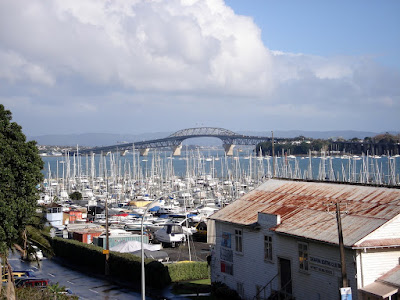
And that's how it came to pass. We went back to the fleapit near the airport, paid $20 penalty for late cancellation, picked up our luggage and left in a cloud of dust and relief. That was the easy part. Then came the walk of shame. When you're staying in a posh hotel, it seems bad form to trail across it's wide lobby, dressed for the road and with laden down with bags of groceries and knicknacks. But when you have to do it, do it with your chin up. We must have made a fine sight, Cheerios poking out of the plastic bags, a dusty single file of noses in the air. We shopped a little, took a spin across harbour bridge to Devonport for a walk and a few photos, ate on Ponsonby Road, and checked out Auckland Museum (again, an excellent example of how museums should be put run).


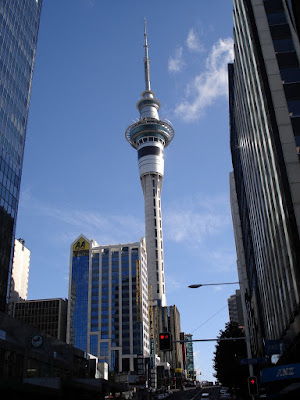
If I hadn't bungied in Taupo, I would have considered jumping off the Sky Tower, but luckily all that was out of my system. Instead we hand a poolside view of the jumpers from the fifth floor of our hotel. The tower itself is a beautiful feature of the city, and I was surprised to learn that it was so new - built in 1995. It dominates the cityscape, and gives the place a focus and an identity. It's hard to imagine Auckland without the Sky Tower. That's the best test for any new structure (I wonder if Dubliners have yet come to the same conclusion about the Spire).


During our 12 weeks in New Zealand, I've learned that this is not just a smaller, colder version of Australia, nor are Kiwis indistinguishable from Aussies. There is something very different going on here, and these two new countries have very different histories despite their superficial similarities. I have at least one other blog in me about those differences, and the part they play in explaining the gap between Maori and Australian Aboriginal. It's unfortunate, but probably unavoidable, to describe New Zealand by contrasting it with its bigger neighbour. But the fact remains that the differences really are surprising. If history had taken a very slightly different turn (for example if NZ didn't take part in the Boer War, and thereby find itself afterwards in a period of intense nationalist sentiment), New Zealand just might have been federated alongside New South Wales, Queensland, Victoria and the others into what became Australia. The fact that it didn't, and has continued in many different political, social and cultural ways to plough its own furrow, has added to the diversity of this region, and provided the world with some truly worthwhile examples.

I'm going to miss the place, but I'm more than ready to move on. We've been too long in English-speaking countries which, for all their differences, are clearly not going to be as different as China was, or as Chile, Bolivia, Peru and Argentina are likely to be. The next six weeks might be viewed as our homeward leg. We're going to cross the International Date Line within an hour of taking off tomorrow. For those of you in Europe it means that, like a coin moving invisibly between a magician's hands, we'll appear on the other side of your screen. From 12 hours ahead of you, we'll suddenly be just 5 hours behind you. Having lost hours with each move to the east, we'll be paid back in bulk (and in advance for future time zones crossed) by being given the chance to live parts of the 11th and 12th of July twice. We're getting closer to home, and we can now say that next month, we'll be back in Ireland.

It might be viewed as our homeward leg. But I'll play every mental trick that I can to remind myself that six weeks is a looooong vacation, even if it comes as the last six weeks of an eight month trip. I'm gasping for the kind of discomfort that comes with moving through non-English speaking territory, and the chance for Nina and Sara to see a whole other way of life.

Friday, July 4, 2008

Afterglow

We changed our plans to go straight from Roturua to Auckland in favour of a one-night stopover in Waitomo Cave. This tiny little place, almost on the West coast of the North Island, is popular for caving and black-water rafting. But we were not going for any more extreme sports. After Zorbing, Bungy Jumping, and playing mini-golf in the rain (mini-golf has always been extreme for us - the last time Letizia and I played, it was midnight and we were under the influence of large gins-and-tonic - I blame you guys Phil and Sheila) we had a more gentle activity in mind: watching glow-worms. While in the South Island, we missed a few opportunities to see glow-worms, and Waitomo Cave has a great reputation in this regard.

We opted for a combination tour of Aranui Cave (no glow-worms but beautiful rock formations) and the glow-worm tour of Waitomo Cave itself. Aranui has the singular feature of having been discovered by a wild pig, though the cave was named, most unfairly in my opinion, after the Maori hunter who was chasing the pig at the time. We were given a great tour that took us deep into the earth and shown stalactites that had been forming over hundred of thousands of years (it takes a century to add one cubic centimetre to these natural sculptures).

Respecting the convention honoured by caves the world over, certain structures were given names to reflect passing resemblances. At one particularly populated section of the cave, our guide stopped and her torch beam settled on one formation after the other and she reeled off their poetic names: Snow White, Elephant's Head, Fairy Glade etc. Then she snapped her torch off, and walked wordlessly past Penis Forest and the adjoining I've Never Seen One So Big.

Waitomo Cave was a great deal more spacious, and the management had worked much harder on making the interior as pleasant as possible. Well-crafted spiral staircases led down to the cathedral, and the lighting was beautifully executed. The geological features were less dramatic than Aranui, but the cave's history is no less compelling. The guide pointed towards the "most recent" rockfall to have taken place - a large chunk of limestone that fell from the roof of the cathedral around 2000 years ago. "That rock fell when Jesus was alive", I said to Nina, an idea which elicited the sought-after oohs and aahs. The cave itself was formed about 6 million years ago, which is around about the time that the evolutionary tree branched - one branch leading to the Orangutan, the other to you and me. But we were there to see something ephemeral. A creature whose lifespan is less than a single year. An insect that when it reaches maturity lives for 2 or 3 days, living only long enough to breed.

We were led down some more steps to the sound of water. I say 'sound' because it was harder and harder to see anything. Our group of about 15 people felt our way onto a boat, and then pushed off into total darkness, silent except for the lapping of water and the occasional intake of breath. Above us, the ceiling was a net of green-blue points of light. Not like a starry sky as the brochure would have us believe. The points moved in relation to each other as we floated by underneath, a parallax effect created by the fact that the net of glow-worms took on the concave shapes in the stone above. It's hard to find a complete silence. Nature is loud, not just cities. The last time I remember a perfect silence was in a woods just outside Jasper in British Columbia, Canada. To achieve that sort of quiet you either need the kind of expanse that Canada provides, or the kind of deathly enclosure you'll find in a cave. As much as I enjoyed the light-show, I enjoyed the peace it brought even more. I sat back, one arm around Nina, and just kept on looking up.

Thursday, July 3, 2008

We Stink. Again.

Look out for the smell of rotten eggs! This is the advice given to everyone going to Rotorua, as if we were all brought up with malfunctioning fridges stuffed with unused eggs. I for one had no idea what rotten eggs smelled like, though after a week in Rotorua I know now. The warning are so stark and alarming that when you actually get there you end up wondering what the big deal was all about. Sure there's a bit of a whiff in the air, but nothing too overpowering. Of course after 6 months on the road our sense of smell has probably diminished somewhat a little. (And the commonplace about deficient senses being compensated by others has proved to be nonsense. My sense of humour, for example, is as poor as ever.)

A week is a long time in politics they say, but it's a fleeting moment in Rotorua (see??!!). Even in bad weather, the list of things to do is longer than the time you have to do it. The essence of the place might lie in the springs, mud and volcanic walks that together provide the famous aroma. But Rotorua is also home to a vibrant Maori culture that is very happy to share itself with visitors (well, rent itself out really), and there are a number of extreme activities that can be enjoyed or endured there. Zorbing (covered in a previous post) was invented in Rotorua, and is the only place in NZ that I know of where you can do this.

After 8 weeks in the South Island, with hardly a Maori face in sight, we were expecting to get a closeup view of New Zealand's indigenous culture right here. One of our first actions on arriving in Rotorua was to book ourselves in for an evening of Maori song, dance and food - the famous hangi (a method of cooking using heated volcanic stone and mounds of earth). There were many such events competing with each other, and we went with the recommendation of our motel host. It was run in a nearby hotel, and included transport to and from. From the outset of the evening, it was clear that this was going to be the kind of get-together that I would warn tourists visiting Ireland against. The vast majority of the audience appeared to be bussed in directly from Japan. And I learned more about the European travel woes of the Queenslanders with whom we shared a table than I did about Maori life and attitudes. It was the equivalent of a sightseeing bus tour through Maori culture, but you know, once in a while a open-top bus tour is a good start when getting to know a new place.

It didn't bother this particular musical snob that the singing was backed up with a gently strummed guitar - who would walk out on a trad musical session when somebody pulls out a 'foreign' instrument like a bouzouki or a banjo (I'll admit to getting antsy when a piano accordion is produced, but I'm of one mind with Gary Larson when he depicts that particular instrument as Hell's equivalent of the heavenly lyre). And I quite liked it when the poi dancers picked on Letizia and dragged her up on stage to learn a little about this most graceful of Maori activities. Letizia, being of a shy disposition, was not particularly happy about it at all, but she acquitted herself very well in front of her family, the Queenslanders and the small Japanese city. And if I may say so, she showed that an Italian woman can sway her hips was every bit as much allure as any Polynesian.

I wish the same could be said for my ability to perform the haka. As soon as Letizia was allowed to return to her place, the male performers came down into the audience in search of 'volunteers' to learn this warrior posture dance. If you follow rugby, or you read this blog regularly, then you know what I'm talking about. Ka mate! Ka mate! Ka ora! Ka ora! Tenei i tangata, puhuruhuru! A menacing chant accompanied by much foot-stomping, thigh-slapping, eye-popping and tongue-protrusion. A quasi-musical performance likely to put the fear of a painful death into anyone watching (a bit like the aforementioned piano-accordion, now that I think of it). Maori people, on the whole, are beautiful to behold. The woman possess an appeal that is hard to convey but easy to appreciate. The men are tall, muscular and hard to argue with. This is how I ended up on the stage, alongside my haka mentor, squinting against the spotlights. It's hard to imagine a greater mismatch than this woolly-jumpered stick man set along side a man who clearly started life as a an enormous pair of pectoral muscles around which a human was generously constructed. I watched and tried to keep up as the warrior showed me the basics, but the results, far from being fierce and frightening were perceived by my watching (and filming!) family as oscillating between high comedy and low farce. All I had to show for my efforts at the end of the evening was a little tiki that I was given before leaving the stage (which I think I still have), and two badly bruised thighs (which I definitely still have).

We did lots of other fun and unusual things in Rotorua, which I won't bore you with right now (though I reserve the right to return to), including a trip to a mud spa, and a half-day wandering around the original Rotorua bath houses, now an excellent museum. In this last place, we learned that Rotorua is New Zealand first major tourist attraction and has been welcoming geothermal pilgrims for more than 125 years now. My guess is that more people have been to Rotorua than have had occasion to smell actual, real-life rotten eggs. In fact if humans were even close to being truly rational beings, people would be warned to check their eggs, and throw out any that smelled like Rotorua.

Wednesday, July 2, 2008

Taupo Bungy

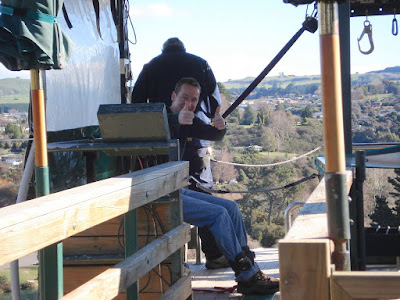
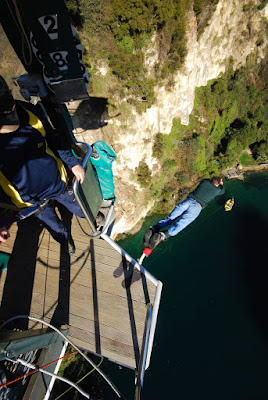
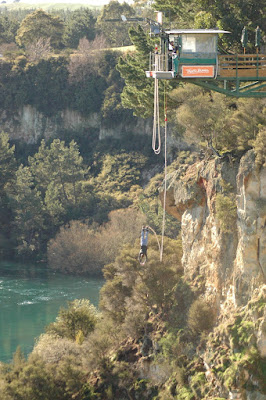
I had no intention of doing a bungy jump. If I was going to do anything it would have been a parachute jump. But then I saw the Taupo Bungy location. It's a huge cantilevered platform that stretches 30 metres out, high above the blue-green Waikapo river. It looks like an enormous diving board - and I suppose that's exactly what it is. Hell - I can parachute back home.

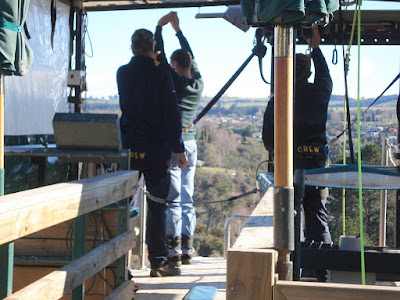
I went through a phase of reading about capital punishment a few years back, and one of the titles was The Executioner's Protocol that details the routine followed on US death rows. Every detail of inmate preparation is codified in elaborate detail. Everyone in the execution team knows what they must do at every stage of the procedure. Giving every step a sense of quasi-religious ritual takes everyone's mind off the less palatable goal to which they are all working. As I watched Charlie and his assistant haul back up the bungy, fasten my leather ankle-straps (Velcro? you've got to be kidding!), check and cross-check the various carabiners, cords and catches that made up the bungy kit, I felt I was watching the Film of the Book. Was it possible that the only way these guys could bring themselves to chuck a perfectly polite and otherwise healthy customer off their lovely cantilevered platform, was by playing mind games with themselves? I thought that was MY job?

"Do you want to touch the water?"

I looked down the 47 meters (that's not much change from 150 feet folks) to the river.

That water down there? Em, OK. I'll dip my hands, I said, thinking that they could use a little rinse given how sweaty my palms had become. My nerves still were serviceable though. I was no more anxious than I might be before a speaking engagement (perhaps where the topic is freedom of conscience and the audience is a pickup full of Kalashnikov-wielding Taliban). I was invited to walk to the edge and toe the white line that marked the boundary between platform and void. I shuffled over. Dead Man Walking!

Here's are the rules for jumping off a high platform:
1) Fool yourself with steps: Driving there; Getting out of the car; Paying your money; Walking to the preparation area; Let them strap you in; Fall. Take these steps in perfect sequence, forgetting each one as it passes, only thinking about the one in hand.
2) Abstract the height (easy for Abstracto!) in a cartoon fashion. Think canyons, coyotes and delayed applications of the law of gravity.
3) Obey. Do not think. (There'll be plenty of time for logical regret later). When the man says stand on the white line, do it. When the man says wave at the camera, give a nice rigid-with-fear arm quiver. When the man says fall forward, remember that he might seem nice and calm now, but if you piss him off he will beat you to a pulp with that clipboard. And then he'll push you off anyway. Especially if you are the weeping Japanese girl that was up just before me.

So I obeyed. I really, really didn't want to do it. The moment I had toed the white line, the coyote disappeared and all I was left with was the canyon. I didn't have the will to take the step for myself, and so I entrusted myself to Taupo Bungy's fear of litigation, secure in the knowledge that if anything went wrong it would be ALL THEIR FAULT. So there! I leaned out.

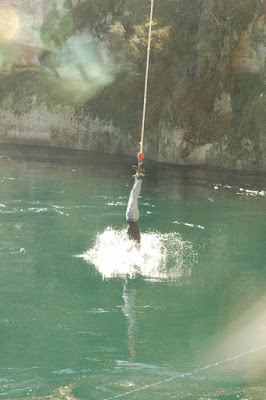
My recollection of what happened next is fogged by physical violence and adrenalin. I was mugged. Gravity mugged me. It scooped me off that ledge with the tenderness of a metal claw, and dragged me towards the water. I didn't feel like I was falling 47 meters (well - what experience would I base it on?), just that I was travelling very very fast. I think I had the presence of mind to scream on the way down, something I'm obviously very proud of. And I remember reaching out with my hands to see if I would really touch the water as promised, only to get my head and shoulders completely ducked. I wouldn't like to guess how long I was submerged - it wasn't long enough to inhale, luckily. But it was long enough for me to form the classical facial expression of the slightly irked customer. Head cocked, one eyebrow raised, what part of 'dip my hands' do you not you understand? But the thought was immediately erased by the realisation that I was still alive and I couldn't fall any further. (Wrong again - there's quite a fall left in that second bounce).

"That was the stupidest thing I've done all day" I said to the boat crew who untied me and ferried me to the shore. In truth, it wasn't. I'm glad I did it. It was a blast. But it left no lasting effect, except for an ugly insight into the last moments of suicide jumpers (a decidedly terrible way to go).

If you are going to New Zealand, and you are thinking of a bungy jump, I can recommend Taupo Bungy to you as a good starter, better in my opinion than the better-known but over-trafficked A.J. Hackett jump in Queenstown. It's slightly higher, it offers the option of a dunk in the water, the setting is much more beautiful, you won't have to wait as long, and the crew there are terrific. It's right in the town of Taupo as well, so you can go have a beer or a bite to eat afterwards. Just don't do it before.


And the evidence (Mam, Dad - you might not want to watch this)...

Thursday, June 26, 2008

Bubble Boy


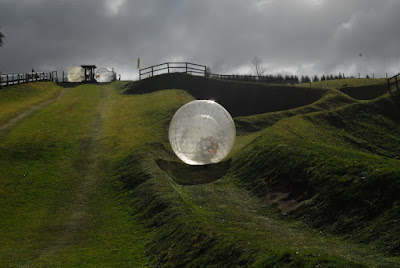
Don't know what the guy on the left is so excited about - I was the one who rolled down the hill in the big plastic bubble.


It's called Zorbing. Extreme? Not really. Extremely silly for sure. And well worth the 44 bucks.

Wednesday, June 25, 2008

Walking on Fire, but not on Air. Yet.

When Nina was celebrating one of her earlier birthdays - probably fourth - she and her friends were running round the front garden when it started to rain. Letizia called from the house - "It's raining out there!!". Nina responded by rounding up her friends "It's raining out the front garden. Quick. Everyone round to the back garden."

We laughed at the time of course, but we've been playing a larger scale trick for the last month or so on the South Island. "It's raining East of the Alps - quick - let's head West". And it has by and large worked. We've seen a bit of rain, but nothing sustained, and nothing that didn't clear up about 100km into any given trip. Our luck has finally run out.

The last 4 nights - 2 in Taupo and 2 here in Rotorua have been rainy. Though we've dodged the worst of the showers (more though luck than planning) and succeeded in getting out and about, there was no getting around the fact that this was not jumping weather. Certainly not with a parachute, and probably not even a bungy. But don't count us out quite yet. The bungy site in Taupo is gorgeous. It's so beautiful that I've been overtaken by the desire to do it myself. It's only an hour back down the road, and if the Sunday weather forecast is what it promises (and we don't chicken out) we'll celebrate our 11th wedding anniversary by chucking ourselves off a cliff. Can you think of a better way?

In the meantime, our South Island glacial walk is being tidily balanced with a series of North Island geothermal experience. New Zealand lies, tectonically speaking (ahem), right along the line between the Australian plate and the Pacific Plate. As the Pacific pushes under the Australian it formed the Southern Alps and so indirectly the glacier we walked along. The action that has generated so much ice in the South Island creates fire in the North. Taupo, and even more so Rotorua, are bubbling, steaming, sulphurous centers of seismic, geothermal and volcanic instability. Every town we've visited since leaving Wellington has experienced some cataclysmic event thanks to the fault lines that lie below. Napier was wiped out by a 1931 earthquake, an eruption deleted an entire Maori town just over a hundred years ago near Rotorua, and Lake Taupo itself fills in a dormant caldera that when it last exploded about 1800 years ago, left its stroke in the writing of the Chinese and Romans, by means of a global ashen mark in the sky.

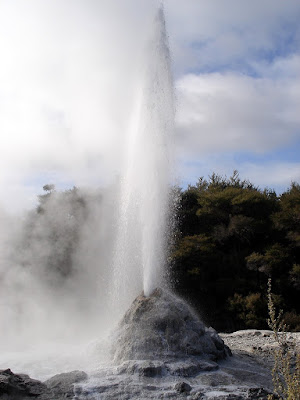
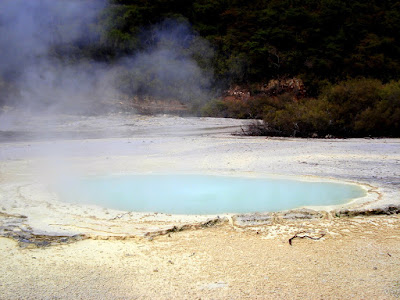
The signs of this volatility are everywhere. When you drive outside of Taupo, steam pours out of the greenery and across the road near the geothermal electricity generation station (7% of NZ's electricity is generated this way). Nearby, the Craters of the Moon Geothermal Walk offered us a way to get a closer look, and smell. But far more spectacular is the Wai-o-Tapu (Sacred Waters) site, 30km outside of Rotorua. We visited this today, luckily without getting rained on, and enjoyed scenery that until now I would not have said belongs on Earth. Letizia has taken some fantastic pictures, a few of which I've nicked. Don't tell her! Mind you, what's she gonna do? Chuck me off a cliff...? Oh.


Monday, June 23, 2008

The Best Day So Far (Apparently)

"That was the best day of the trip so far" said Nina, with the typical exaggeration and amnesia of a nine-year-old. With so many UNESCO World Heritage sites under our belt, with Beijing, Sydney, Fraser Island and Fox Glacier still bearing 'Wet Paint' signs in my own mind, why in god's name did she choose Napier, pretty though it is, as The Best? You tell me.
Out of the various options Napier had to offer, Nina nad Sara chose the playground and Marine World. Letizia and I chose a self-guided tour of the Art Deco buildings, and the Earthquake Museum (Napier was flatted in 1935 by an 8.6 quake and subsequently rebuilt in an almost uniform Art Deco style).

The playground turned out to be what Italians call a 'pacco' - a waste of time, something that doesn't deliver on its promise. A disappointment. It was relatively new, wit a quirky design that looked well against the Art Deco backdrop of the town. But it was ill-concieved and badly maintained. The girls squeezed what they could from it, but left knowing that, given the glowing reports we had received, it should have been better.

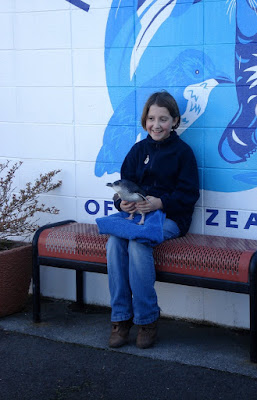
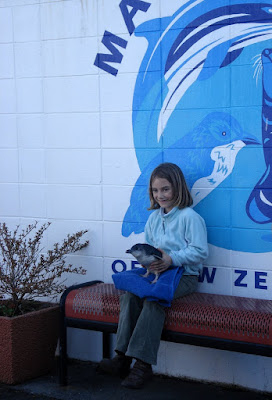
They endured the Art Deco tour before falling gratefully upon Marine World, fuelled with stories of being able to hold penguins. These girls have fed wild dolphins in Tangalooma, and seen dozens of them surf the bow waves of the catamaran on Milford Sound. They've seen truely spectacular synchronized dolphin shows in the Gold Coast. Napier's Marine World, on the face of it, should have been a let down. But that same childhood amnesia and fixation with the here and now prevailed. They loved the tricks of the single, ancient dolphin called Kerry. And although they've seen fur seals in the wild on at least 3 occasions here in New Zealand, they still adored the pup that was taken for walkies around the thin Winter crown that lay scattered about the small poolside terraces. The half-hearted applause sounded like piss dribbling out of a bucket onto concrete, but that didn't diminish their enthusiasm. And at the end of the show, they did get to hold a penguin; a Little Blue called Alfred who was missing one eye and blind in the other. An admission-paying parent might mistake this for a 'pacco', and a pathetic one at that. But Nina and Sara, as they posed with the shivering bundle (penguins, the girls reminded me, shiver from warmth rather than cold) just felt how good the moment was.

We duely visited the museum where the girls remained unmoved by an old lady's filmed testimony of the earthquake, whereas I was close to tears. But they were just words from an old lady with a lot of makeup. Words are rarely enough for kids.

After our relatively busy day, we relaxed in the hostel for a few hours. I tried to read but failed; I was dragged to the pool table where my daughters found themselves in unquestionable need of help (this was their first time playing pool) but unwilling to properly accept it. "We'll just use our own rules, Daddy". When I challenged Letizia to a game, and discovered that it was also her first time, Nina and Sara looked on, in open-mouthed thrall of their father's consummate skill. I'm a below-average player of pool. Well below average. I should have been a 'pacco'. I know that I'm a 'pacco'.

We ate dinner in a Mongolian BBQ, where most appealing characteristic for the girls was the unlimited supply of icecream and soft drinks that came with the meal. Letizia and I are unashamed hard-asses when it comes to eating healthily, but every now and then we ignore our own rules. Afterwards, we walked back to the hostel joking about all the funny made-up words the girls used by mistake just a few years ago (they love stories about when they were younger). And this was the contented atmosphere in which Nina proclaimed this to be The Best Day So Far.

More often than not, I don't respond in the positive to my daughters' requests to play. I'm stuck in a book, talking to Letizia, or worse - working on this stupid blog. Too often, I am missing one eye, and blind in the other. But not today. Today I played pool, joined in, laughed - I might even have skipped at one point. I did enough today for my amnesiac daughters to forget the fact that their father is often something of a 'pacco', and they just felt how good the moment was.
If it's this easy, this inanely, embarassingly easy to make them happy, why the hell can't I manage to do it every day?


Wednesday, June 18, 2008

Flying Kites

It was our third time going to Te Papa, Wellington's famous museum. We were late getting there and Nina was stressed in an understated way visible only to her parents. We were supposed to be attending a Maori kite-making session, but Letizia and I had dawdled over our morning lattes - at least that's how Nina would have it (If only her respect for time-keeping extended to things that her parents cared about - like bedtime, for example).

To their great credit, Nina and Sara can amuse themselves for many hours with nothing but scissors, stickytape and cardboard foolishly discarded from the Adult World. These are the basic elements and implements in the Junior Alchemy Set. From these, all Art springs forth. The transformation of base cardboard to precious artifact is unstoppable when catalysed with enough self-belief, perseverance and Pritt-Stick. This is the core dogma of the religion of Make and Do, to which my daughters fervently adhere. Deep indeed is their conviction in redemption through the transformative power of handicraft. The very thought of a creative opportunity lost to the whims of their parents (an unhurried breakfast, for example, or an irreverent haste in disposing of beer cartons) weighs heavily on their tender hearts.

In the name of this religion, we have left a trail of cut-out houses and paper hats across two continents and three countries. For this have our generous hosts found, after our departure, tell-tale traces of paper clippings on their carpets, leading to mutilated egg-cartons and water-bottles stuffed hastily into shallow-grave cupboards. And for this did we race to the fourth floor of Te Papa, and elbow ourselves a place at the altar of Arts and Crafts.

I never knew that the Maori made kites, but apparently it was an important part of celebrating Matariki, or Maori New Year. Not that I knew this at the time. The Te Papa staff probably explained this at the start (when we were still looking for space in the car park) but even if they had told us on our arrival I probably wouldn't have been very receptive. All I knew was that I was perspiring like a pig, breathing like an ill-hinged bellows and surrounded by a confusion of sticks, crepe-paper and strangers. And all because of Nina and Sara's fundamentalist and irrational beliefs vis-a-vis Making Things With Paper. This is not a state of mind that lends itself to making new friends.

And yet that's exactly what happened. That new friend was an Aussie woman with a broad smile, a disarming openness, and a positive attitude made of reinforced concrete. Di, and her beautiful daughter Trinity, had the misfortune to share not only the table but the only serviceable roll of stickytape with us, and it cost her dearly. Di has done her fair share of traveling, and living beyond her native borders and explained that as a result, she feels a certain solidarity with travellers. It's one thing to feel sorry for strangers (and god knows that our demeanour evoked pity), but it's another matter entirely to do what Di did next: to invite those strangers to dinner. To make such a leap of faith in your fellow man takes something special. When we got over the initial shock, we of course accepted the invitation.

Di, thanks for your kindness. If one day back in Cork I scare the bejeezus out of some unsuspecting backpackers by inviting them home for dinner, it will be entirely your fault.

Monday, June 16, 2008

Troublesome Treaties

Since we've left Ireland almost 6 months ago, the Irish people gave Bertie Aherne an early bath, albeit indirectly, and now have rejected the Lisbon Treaty as well. The best political commentator I know (that's you Jim if you're reading) predicted a year ago or more that Bertie would finally have to go if and when the economy started to splutter, and I'm in no doubt that he was right on this. I wonder if the fact that it continues to splutter, belch and occasionally fart is partly responsible for the treaty's rejection as well. In any case, the Irish had the opportunity to decide whether the Treaty was a good idea or not, and their voice was duly heard, even it it's hard to tell what it's saying.

The Lisbon treaty was negotiated and redrafted over years by expert civil servants and lawyers, translated into every official European language by dedicated teams of polyglots, and debated for months by various national parliaments and the Irish electorate. The Treaty of Waitangi (1840) by contrast was drafted in 4 days by three men (and not one of them a lawyer), translated badly by a missionary, and debated by a subset of Maori chiefs, none of whom really had the authority to sign it on behalf of their people, and for whom many of the concepts of modern statecraft meant nothing. But sign it they did, and in so doing transferred sovereignty of the islands of New Zealand, considered at that point to lie in the hands of the United Tribes of New Zealand, to Queen Victoria of England.

That the United Tribes of New Zealand was non-existent in any functional sense didn't seem to matter. There was no political union under Maori - the Maori name for New Zealand (Aotearoa) was unlikely to have been used by Maori, and was probably a romantic invention of European missionaries. The very word Maori was only coined by Maori as a way to distinguish themselves from the Pakeha (Europeans), and means simply 'ordinary' or 'normal'.

That key words from the treaty like, em, sovereignty for example, were translated badly (and inconsistently with previous English/Maori documents), was overlooked or ignored.

British motives behind the treaty are interesting to look at. It's easy to imagine the Treaty as the product of rapacious imperialism, but the kind of people behind its creation (James Stephen, Lord Glenelg) were those who pushed successfully for an end to slavery in the British Empire. Conditions for the Maori had become particularly difficult since whalers had started operating from New Zealand's shores, and it was felt that something had to be done to protect and conserve New Zealand for the Maori. But the unseemly haste, which made the treaty such a flawed document, was driven by baser motives: a race against time to prevent The New Zealand Company from seeing though its plans of 'Systematic [private] Colonisation' of the islands. And the way in which colonisation was seen through was far from the 'New Zealand for the Maori' sentiments nurtured by the Treaty's creators and sponsors. Settlers and Crown authorities often interpreted the treaty in ways that favoured Pakeha over Maori, or else disregarded the provisions of the Treaty entirely.

The very fact that there was a treaty at all is another indication of the difference between the fates of Australian aboriginal and Maori societies (no - I'm not through with this topic yet). A treaty was required because New Zealand, unlike Australia, was not deemed to be Terra Nullius by the British. It was occupied and defended in a way that Europeans could related to. Farming was well established, and a continuous state of war between tribes, with alliances chopping and changing regularly, meant that the technology and organisation available to Maori for their first contacts with Europeans was enough to keep them at arms length for quite a while.

Tasman arrived in 1642, lost four sailors to Maori spears, and buggered off. A full 127 years passed before the next European explorer, James Cook, passed by, and despite his famous ability to negotiate with locals, and the advantage of a Polynesian language speaker on board, still managed to get into several skirmishes. Although the Maori came off worst in these clashes, the belligerence of the natives was reported back to London and surely had some influence on the selection of New South Wales over New Zealand as a suitable place to set up a penal colony. And that relative proximity of a British outpost in Sydney just 10 years after Cook's voyage allowed the Maori to build up a relationship with London gradually. Sixty years passed between the settlement of Sydney and the Treaty of Waitangi, during which there was much trade and exchange of people, and the gradual establishment of private whaling stations on New Zealand coasts.

For the first New Zealanders, almost 200 years passed between first contact with Europe and final colonisation. Compare that with 10 years for the Eora people of Sydney, and consider also that Australian colonisation took place without a treaty, and with complete and total disregard for the First Owners of Australia. No provision was made for the protection of their rights or property, as happened in New Zealand. Although technically subjects of the Crown, those who attempted to repel the invasion of their lands were officially considered on a par with enemies of the state. This ambiguity in law left the Aboriginals to the tender mercy of settlers, by whom they were considered at best competition, and at worst, vermin. I've already mentioned the fact that Australian aboriginals were still hunter-gathers, given Jared Diamond's reasons for why this was so, and outlined how this left the Aboriginal less prepared, technologically and socially, for invasion and sustained warfare. This lack of preparedness, the speed of colonisation, and its ferocity, meant that Aboriginal societies in Australia (and in the case of Tasmania, even the population itself) were destroyed. And it's not at all clear to me if they will ever recover. It was an exact analogue of what happened to the Moriori of the Chatham islands, except in this case the both the aggressors and the vanquished were Polynesians. The Maori suffered terribly but were able to defend themselves better and their society was not dealt quite the same killer blow and in the case of Australian aboriginals.

Through a mixture of base and noble purposes, the Treaty of Waitangi was more or less thrust upon the Maori, but I wonder what would have happened if it had not? The fates of other Polynesian peoples, under the "broad sweep of history" that Jared Diamond describes in Guns, Germs and Steel which I blogged about recently, was varied and ranged from absolute annihilation to a retained and functioning independence. There's no safe assumption that things would have been any better for the Maori without Waitangi.

The unity of Europe was conceived with noble reasons - to end the wars that had raged between the constantly switching alliances of European tribes, to protect itself from external aggression, and to create and environment suitable for mutual prosperity (some of which seems remarkably similar to the situation that pertained amongst Maori before Waitangi). Europe has rejected unity attempted in the past by horse, sword and panzer, until it's more recent acquiescence to the pen. The Treaty of Lisbon, written in dense legalese and referring to many other previous treaties, may have been effectively just as open to misinterpretation (and misrepresentation) to Irish voters as Waitangi was to the Maori. It might have been put in force over the heads of all EU countries other then Ireland. I'm happy we had our opportunity to vote on it, but I think that the arguments for the treaty was made very badly indeed, and I'm not sure sure that we'll be any better off for having rejected it.

Thursday, June 12, 2008

I Got the Paua

We have a flair, it would appear, for reaching southernmost points. Today we drove to Cape Palliser for almost no other reason than it was in a corner we could easily reach - my travel strategy is the same as my tooth brushing technique. We were expecting to find a lighthouse, and a seal colony there. Or would that be a seal dominion now? Or a constitutional monarchy of seals, perhaps? In any case, we found ourselves traveling a one-way road, that finished in Cape Palliser itself and frayed quite a bit towards the end. The road seemed far too close, and at too similar a height, to the waves of Cook Strait which thrashed menacingly on one side with high mountains just a hundred meters inland of us. One big wave would have sorted us out. But we made it to the Cape, and we could see the lighthouse alright (it wouldn't be much of a lighthouse if we couldn't, now would it) but there wasn't a seal in sight.

This was supposed to be one of NZ's largest colonies. I thought we'd be deafened with the noise of barking (and the odd rendition of Crazy). But when we stepped from the car, and began to walk along the verge that separated the barren soil from the stony beach, there was nothing but the wind and the waves pushing back at us, asking us what the hell we wanted anyway.

Good question, actually. A seal, perhaps? We had driven for 2 hours to get here so a New Zealand fur seal would be nice. We've seen one or two before, but we we don't have any back home so we're not ready turn up our noses at them quite yet. We looked out upon the stones and the waves, and implored the Maori spirit of the sea to reward us for our trip but all he did was blow Letizia's beanie off (yes - that beanie) and along the beach. We gave chase and eventually caught the beanie just before it was lost to us forever. Incredibly (in the sense that it sounds made up, and probably is) the flyaway headwear led us to a treasure, a collection of paua shells just lying there on the grass, unclaimed. We had already paid 12 bucks a pop for a lot of these mother-of-pearl shells back in Christchurch, so we obviously took a few as, er, consolation for the missing seals.

As we started to make our way back to the car, Letizia managed to hear the call of nature over the noise of the wind and waves, and made her way towards the nearest bit of scrub at the edge of the shore. The girls and I prepared ourselves for a wait, but we needn't have bothered. Letizia had barely disappeared from view when suddenly, there she was again, running towards the car at a speed that was all the more impressive for the headwind she had to content with.

She had found the seals.

Wednesday, June 11, 2008

Wellington Fits Like a Glove

The Southern Cross bar on Abel Smith Street is large - it must hold as many as 200 drinkers when full, and many of them sit outside when the weather permits or (in the case of smokers) when the law insists. It's the outdoor voices that you can hear the most from our apartment. But from six floors up, the distance is sufficient to filter out all content, just leaving the carrier signal, a white noise that is distinctly human in its cadence but devoid of even a single recognisable word. Tomorrow morning, that's how these conversations will be remembered even by those who are engaged in them now. I'm hearing 8 hours into their future.

I love the noise. I love being back in the city. The only thing you could hear in our Christchurch house was Willard the cat occasionally mewing and the canary next door whistling the first two lines of Happy Birthday To You. That was very peaceful and welcome for a while, but by the end it was the constantly murmured rosary of city life that I was praying for.

I love Wellington. I love the fact that we exit our apartment practically onto Cuba Street which feels a bit like Newtown in Sydney. Undeniably smaller, but unmistakeably urban and confidant. Using my recently developed Index of School Uniform Skirt Length (which I recognize is borderline perv, but I am a Man of Science, dammit, and data are data) I can report that the atmosphere in Wellington is much less austere than Christchurch. I love the fact that there are too many museums and places of historical and political interest here, and that I will have to choose carefully the ones I plan to visit. I love that at the end of every day here so far I feel I've seen something worthwhile and only added to the list of things to be seen before we leave.

Let me give you an example of a day well spent. Letizia went to get her hair done today, something that ladies (and especially Italian ladies) will know is the kind of service that one can only safely look for in a town that you either know very well, or trust based on its appearance of sophistication. Together with Nina and Sara, I toured the parliament house and executive wing and then crossed the road to see the decomposed remains of an original Maori version of the Treaty of Waitangi (the 1840 'agreement' between Queen Victoria and the collected heads of the various Maori tribes that brought New Zealand into the British Empire as a colony - a document held in such disdain by Maori that the National Archive provides a wooden bowl of water outside the Constitution Room where it is displayed room, so visiting Maori may symbolically decontaminate themselves after viewing it).

This evening, after chilling out at home for an hour, we went to the Opera House to see a superb performance of Cats. Well I'm assuming it was superb. A man can only be expected to devote a minimum of attention to the appreciation of music, when he is watching a troupe of lithe actresses, dressed in figure-hugging body stockings, crawling around the stage on all fours. Oh look, people clapped a lot. I clapped a lot. It was all good.

And this was a typical day for us here in Wellington. Not every day involves leotard-clan feline impersonation of course, but at the end of the day, when we relax back 'home', there is generally a feeling of having seen something worthwhile. Accompanied as ever by the satisfying background music of people with more stamina and fewer responsibilities than us having a good time into the wee hours.

In point of fact, as I write this I've noticed that the noise has faded away. It must be damn late. And there's lots more to do tomorrow. Goodnight, and pleasant dreams (purrrrr).

Saturday, June 7, 2008

Wellington for the Rugby

We're in Wellington, on the North Island, where it's Ireland vs All-Blacks (that's rugby, for readers from the US) tonight at 7:30 local time. We don't have tickets of course (and even if we had, Nina and Sara would have spat the dummy at the prospect of being forced to watch the game from the windswept terraces), but we are living around the corner from the very lively Cuba Street, and will probably take this opportunity to go to the nearest Irish bar and watch the match on the big screen. That's assuming we don't get kicked out or deported for bringing minors to the pub.

In 100 years of playing the New Zealand team, Ireland has a perfect record. We've never beaten them. When Munster beat a visiting All-Black some time back in the 1950's, the euphoria was such that somebody wrote a play about it. But all is not well in the NZ camp. Eight months ago, they lost to Wales, and judging by the tone of sports commentators you'd think it happened yesterday. To Kiwis, rugby is more, much more, than a game. It is a symbol of national pride, and the very idea of losing is something that perhaps due to a lack of practise, they are not comfortable with.

If there is an upset tonight, then I suspect that any advantage my Oirish accent has given me up till now will vanish. I suspect I'm very safe though.

Friday, June 6, 2008

How much for the whale?

If you get into a boat in Kaikoura and head East for just a few minutes, you will go over the edge of a vertical cliff with a drop of about 800 meters. The drop leads down further to a canyon 1300m at its deepest point. Within easy sight of the shore, you are off the continental shelf and into deep ocean water. The combination of the deep canyon and the intersection of two opposing ocean currents in these waters, brings nutrient rich deep-water closer to the surface, creating an ecosystem all of its own. The krill and plankton attract the fish, the fish attract the squid, the squid attract the whales and the whales attract the tourists.

They used to attract the whaling industry of course, but in New Zealand that all came to an end at the end of the 1970s. Apart from the ecological considerations behind the decision to ban whaling in NZ waters, the economic results are interesting. Whales in Kaikoura are like the trees on Fraser Island in Queensland, in that they are worth more alive than dead. The tourist industry here in New Zealand isn't just about bungy jumping and tequila slamming. It's about hiking through nature reserves and observing wildlife in its natural context. Conservation-based tourism is big business. Just about every reserve or animal encounter we have seen on the South Island is in private hands, and in each case the result of tourism is increased stocks and greater understanding of the creatures in question. The inclusion of wildlife in the global money-go-round seems to be working to the mutual benefit of economy and ecology alike. Economic pressures tend to operate in favour of conservation at the moment, but what happens in the case of a downturn?

Take the yellow-eyed penguins we saw on the Otago Peninsula. They are the rarest penguins in the world and their fate is now inextricably linked to the bottom line in the privately-owned Penguin Parade, and by extension to the global human economy. In this case, Penguin Parade isn't just an organization that brings you to see the animals in their natural environment, they are the animals' landlords. They own the patch of land that is the Yellow-Eyed Penguins' remaining breeding colony. Any number of international conservation charities would happily contribute towards the stabilization of Yellow-Eyed Penguin numbers, but Penguin Parade prefers NOT to take their money in order to continue running the business as they see fit. To be fair, they put their money into replanting the tree and shrub cover whose loss originally led to the dwindling number of this rarest of penguins. But if Penguin Parade ever goes out of business (perhaps tourist numbers will drop in the future thanks to increasing costs in flying?) then the penguins are on their own again. Or worse - evicted from their only remaining habitat in order for that land to realise a greater economic value. Many want to see the environmental cost of flying reflected in the cost of airfares. But economies can be as complicated as ecologies, and one side-effect of this move might be the collapse of global wildlife-based tourism, with consequent collapses in conservation efforts. I have no idea of course - I'm just speculating.

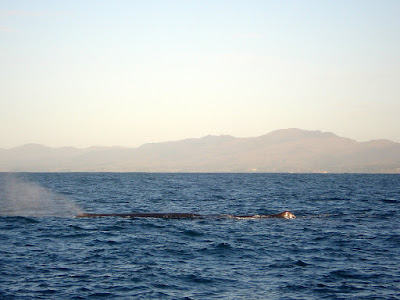
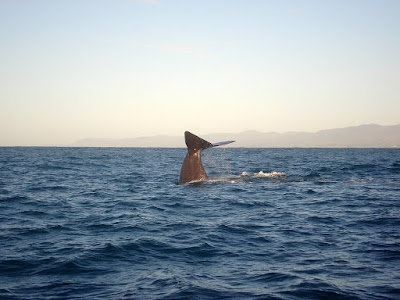
But I wasn't thinking any of these things on Thursday morning as we motored out of South Bay, and off the edge of the continental shelf, with the privately-owned Kaikoura Whalewatching company. All I was interested in was seeing some whales, and I got what I wanted. In two hours on the water we had three close encounters with Sperm Whales. The way we used to find them was the same hunting technique as formerly used by whalers. These mammals are deep divers, resting at the surface to breathe for 10-15 minutes, re-oxygenating their muscles, before diving for 30-40 minutes. They announced ithemselves with 2-meter spumes from their blowholes, giving us time to race over to them to watch their heads and torsos bob above the surface for a short while. Then finally, as they began their next dive, they lifted their powerful tails gracefully above the waterline, sinking out of sight and leaving a growing circle of flat water known as the whale's footprint.


When we drive along a coast road, we mistake the sea for its surface, and consider the waves and swell to be all there is. For the Sperm Whale, the surface is the place where it spends the least time, the place where it comes by necessity rather than choice. It's nothing more than a filling station. A necessary but inconvenient stop to fuel its deeper activities. It is also the interface where man and whale interact, where the whale becomes an agent in the human economy. I hope that its market as a target for the camera-shutter rather than the harpoon remains viable.

Sunday, June 1, 2008

Plans and their Enemies

"No plan of battle ever survives contact with the enemy". I've heard this quote a number of times and it makes sense to me. I thought we would learn how to roller-blade together in Sydney, ice-skate in Christchurch, and ski in Queenstown. But once we got to these places, things took their own course. But that's OK. The adage is meant to reassure that it's not so much the plan as the planning that really prepares you for the fight.

But what fight? What is the enemy in a round the world trip? It's the same one we all fight back home. Time. Eight months sounds like a long time, but it's not. It ambushes you each time you look at the calendar. Eventually you ask, so much time has passed already, and what do we have to show for it?

When we started traveling in China I was expecting chaos without, and turmoil within. But it wasn't like that. Despite our strange and sometimes chaotic surroundings, it was still us. We were still the Lawlors, operating as ever we did, dealing with new situations. And that was a good thing. Now, with two-thirds of the trip-of-a-lifetime behind us, living in a city that is similar (too similar?) to what we left behind, we are still the same family. And somehow that feels not so good anymore.

I was as certain as I could be about anything that this journey would change us as individuals and as a family. And yet I see no evidence of it. Perhaps we will only see the full picture in the rear-view mirror when this trip is behind us. Sometimes I think I catch a glimpse of fragments of that picture here and there, scattered along the road we are traveling, blurred by the speed at which we're moving. But probably it's just the product of a mind that demands signs and patterns even where there are none.

We're leaving Christchurch first thing tomorrow morning. It has been the perfect base from which to visit the rest of the island, and thanks to the home swap (which included the use of a car) we're slightly under budget, for a pleasant change. We're taking two days to get up to Wellington, and we expect to find a very different city there. It would be reasonable to say that Christchurch is more like a very big suburb than a city, and a conservative one at that. (One of the things that caught my attention here was - don't laugh - the length of school uniform skirts. The poor unfortunate girls of Christchurch have to wear ankle-length tartan curtains that to me seem practically Taliban. The length and the pattern give away the Scottish influence that I think lies behind this conservatism.)

Museums here in Christchurch were not up to much (especially the Science Museum), whereas Wellington is home to the famous Te Papa museum - walking distance from our apartment. For the first time since Shanghai we'll be living in the centre of a city, and the idea is very appealing.

There are some great cafes and restaurants here. Tonight, for example, we will have our last meal in a Sichuanese restaurant called Ginkgo, where we can enjoy the same dishes that we had in Chengdu: Kungpo Chicken, Mapo Tofu and 'fish-flavoured pork' (!).

Despite my various misgivings about the town itself, I'm still experiencing some pathetic sentimentality leaving it behind. This house has been a good home for us, and we will surely miss Willard and Satie, the two cats of the house, whose very different personalities mirror to some extent the differences between Nina and Sara.

Inevitably, the fact that we are already leaving another place behind serves as another irritating reminder of how quickly time is going by. In the end, time is all we really have, and that just makes it harder to watch it flow though our fingers.

Friday, May 30, 2008

Punakaiki

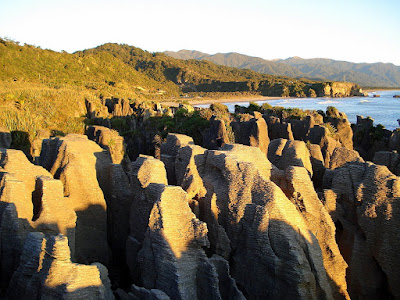
We packed our gold mining gains, and a souvenir pan (you never know) from Shantytown into the car, and continued northwards towards Greymouth and ultimately Punakaiki. This place is famous for its pancake rocks and its blowholes. The pancake rocks are a cliff formation peculiar to the area, formed underwater by marine animals obligingly turning into layers of limestone, sequentially and over a period of tens of millions of years. The finished product was thrust out of the sea by an earthquake, to form cliffs. The blowholes are holes (unsurprisingly) in the pancakes through which large volumes of liquid (maple syrup say, or perhaps just seawater) are squeezed at high tide. You can just see why people flock here. Just.

Punakaiki was the only other stop off on the West Coast that we thought was within easy striking distance and even vaguely interesting. Our expectations weren't high, and in one important way they were met: The food west of the Alps continued to disappoint. Had we eaten some of the pancake rocks themselves, rather than the disagreeable stodge for which we exchanged perfectly good real money in Punakaiki's only tavern, we would have been no worse off. If this is what the locals themselves regularly eat then clearly there is another variety of blowhole here whose eruptions are independent of the tide.

But all that was to come later.

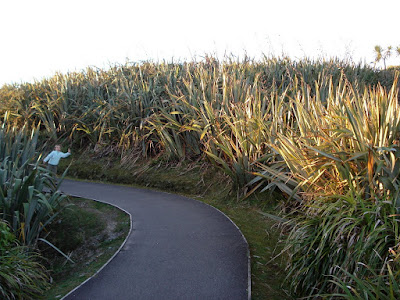
When we first arrived, we went straight to the rocks, and took the path that led in a circuit from the main road to the cliffs, through abundant flax growth, and back. It was close to sunset and Letizia started snapping away in light that perfectly displayed the strange formations. There was something strange in the atmosphere that at first I put down to the rocks themselves, the noise of the waves' impact underneath us, and to the isolation lent by the surrounding flax.


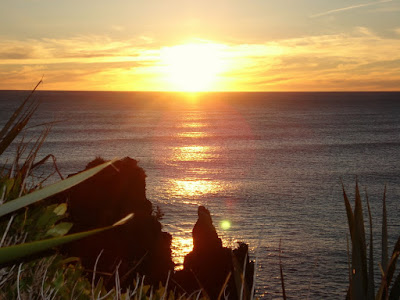
But after the light had faded and we had found our motel - situated on a tiny sliver of land with the darkened beach on one side and an even darker enormous cliff on the other - I realised what it was that had struck me as odd earlier on. Since leaving Cork, we've either travelled inland, or on the eastern seaboards of enormous landmasses. This family of islanders had just seen a sunset over the sea for the first time in 5 months.

Wednesday, May 28, 2008

MTV (Maori Television)

[Updated May 30th to sort out cut&paste problems in first paragraph]

When you switch on the telly for the first time in New Zealand, you'll find that one of your viewing choices will be in a language that you have probably only heard before on the rugby pitch, when the All-Blacks perform their famous haka. The Maori language is like nothing I've ever heard before, and strange to a European ear. But when James Cook (there he is again) made contact with the people of New Zealand in 1769, he had on board somebody who could understand these men, and could make himself understood. That man was called Tupaia, a Tahitian chief picked up during the first part of the Endeavour's voyage. The reason that Tupaia understood the Maori is because the Maori, like Tahitians, are Polynesians, and speak languages that come from the same sub-family of Austronesian. The Polynesian people swept eastwards across the Pacific from 1200BC until 1000AD, starting from Taiwan and inhabiting island after empty island, eventually doubling back to find Earth's last big true Terra Nullius, New Zealand. And they did it a good six to eight hundred years before Cook passed by.

When you first enter the country, even at the airport, you see the Maori language all around you. Like Ireland, official signage is always bilingual. Like Ireland, certain terms in the one language have found their way into the other. Most white Kiwis will know what mana is or what whakapapa means - not just words but even Maori concepts form part of New Zealand's shared vocabulary. The cross-fertilization works both ways. After Cook had moved on, and traders and whalers moved in, the Maori needed to expand their own language to deal with things they had never seen before, and they used transliterations, just like we've heard in the Chinese language a few months ago. For example hipi renders the idea of the then-unknown sheep and pata sounds like the foodstuff that the Maori had never know, due to the lack of large mammals on the islands: butter. (I have no idea where Lake Wanaka got it's name...)

Take all these things together - Maori Television, a single Maori language respected with dual signage, a keen sense from white New Zealanders (Pakeha) of Maori culture - and you get an outsider's feel for the difference between the situation of the Australian aboriginal and the New Zealand Maori. The Maori suffered under colonization, make no mistake. At one stage during the late 1800s most whites believed - many with regret - that this was a people doomed to extinction. But they survived conquest better than the Australian peoples, and adjusted with greater ease into an essentially European political framework.

Why?

At the moment, I'm reading another, older Jared Diamond book called Guns, Germs and Steel. Diamond offers an explanation for what he describes as the "broad pattern of history": how Europeans (or at least Eurasians) came to conquer the rest of the planet, rather than Africans, Native Americans, or Australians. I'll wait till I finish the book before trying to summarize it on this blog, why the fates of the Maori and the Australian First Owners have differed so much.

For now, let's look at another related New Zealand story that Guns, Germs, and Steel relates. The book starts with a discussion on the spread of the Polynesians across the Pacific. This is because that movement serves as a kind of Human History in a Nutshell, a small isolated example of what happened globally when anatomically modern Man spread from Africa to almost every corner of Earth. The islands that they conquered or filled varied enormously in climate, size, isolation and domesticatable plants and animals. Over the two millennia of exploration, the inhabitants of each of these islands tended to lose their cultural memory, forgetting where they had come from and simply adapting to conditions on each of the islands. The starkest lesson that can be gleaned from these adaptations lies in the story of the Moriori people of the Chatham Islands.

When they settled in New Zealand, the people who came to be known as the Maori brought with them some domesticated crops (the earliest Polynesians were already farmers). Some of the crops they had didn't thrive in the colder climate even on the North Island, but others did and the Maori people came to depend on agriculture more and more, especially after they hunted the larger flightless birds on New Zealand to extinction (the Moa being the most well-known example). By the time New Zealand was fully colonized by the Maori, they were organized into territorial tribes. At any moment in time, some tribes were at war with each other, while others cooperated (a perfectly normal state of human affairs). Some time before 1500, a group of Maori left NZ and settled the Chatham Islands, 800km East of where I'm sitting now in Christchurch. Life on the Chathams was not the same as where they had come from - it was too cold even for the few crops that remained to the Maori. But it was abundant in seafood. The Chatham Islanders reverted to a hunter-gatherer way of life and while this was the right choice (indeed their only choice) for survival in these conditions, it was the wrong choice geopolitically and it sealed the Moriori's fate.

In order to survive on an island that could support no more than 2000 people, they developed a strategy for dealing with conflict that excluded outright war. It wasn't strictly pacifist - you could still take a stick to your neighbour in a ritual fight. But once you drew blood, that was as far as you were allowed to go. There was no food surplus, nor way of storing it, that would in any case have provided for maintaining even temporary armies. There were precious few natural resources that could have provided for weapons. If the Chatham Islanders had kept up their Maori ways, they would have wasted what the islands had to offer, and died out.

When contact was next made with the Moriori people, by whaling and sealing ships around 1800, the word was brought back to the Maori in New Zealand of islands that were bountiful and inhabited only by a group of people who had no concept of weapons or war, and simply no idea how to defend themselves against outside aggression. A total of around 800 Maori chartered a European ship, and went to settle the Chathams. Those of the unfortunate Moriori who escaped slaughter tried repeatedly to negotiate their way to peace (it was all they knew) but merely ended up as the slaves of the Maori. The consequent genocide was practically complete in 1933 when the last full-blooded Moriori died.

By recounting this story I am not criticizing the Maori - what they did was in complete accordance with what they would have expected to suffer if they were defeated in war themselves. Nor am I saying that the Moriori are to be commended for their pacifism - their lack of defence was not a principled stand as such, but simply due to the fact that as a people they had forgotten how to fight. The real tragedy as I read it, is the fact that neither side understood that they were brothers, separated by just a few hundred years. And the immediate lesson that I take from it is that, if you extrapolate out the 2000 years of Polynesian colonization to the 40,000 years of the movement of modern Man, you are left with the similar conclusion that every one of the current wars raging on the planet right now is a war between brothers. That is not a liberal, bleeding-heart opinion. It is, to steal a phrase from Stephen Jay Gould, a contingent fact of history.

Tuesday, May 27, 2008

Flash in the Pan

We stayed a second night in the Glowworm cottages, and already traumatized by the truely awful food available in the local pubs, we decided to play it safe and 'take the soup' on offer from our hosts, and hang out in the lounge for the evening. The next morning we headed back north again on our way to Punakaiki - home of pancake rocks and blow holes (what now?)

But before arriving there, we stopped off in a place called Shantytown, just outside of Greymouth. Shantytown is a reconstruction of a goldmining town. So much of white New Zealand history is bound up with this metal. It's discovery secured the future of the then-colony, attracting tens of thousands of prospectors from all over the world. The most exciting activity in Shantytown by far (even more exciting than the ham and cheese sandwiches) was panning for gold. Here, you are guaranteed a find. You're given a pan with stone and a very small amount of real gold, and instructions on how to pan. I was helping Nina and Sara (by edging them out of the way in order to make sure that they didn't lose whatever miniscule amount was in the pan) and discovering how unnervingly addictive it could be to stare into a pan of gravel, looking for flashes of gold.

The place was very quiet - it is off season - and felt all the more twee for the lack of crowds. There was a ride on a steam train which went all of 100 meters in one direction, before reversing back again.

I'd like to say that 5 months on the road has raised Nina and Sara's expectations and standards when it comes to entertainment. But it hasn't - they loved this place. To be fair to them, they loved the fact that the found gold and got to take it away with them. And I suppose to be even fairer to them, deep down I really like that they can enjoy a place like this without turning their noses up at it.

Interestingly enough, when we were there we met a lady from Clare (where my dad is from) who lived in the UK now but who had a niece in Carrigaline (where we call home). So if you're from Carrigaline, and you have an auntie Bridie (who's married to a kiwi) - she says to say hello!

Monday, May 26, 2008

Walking on Water

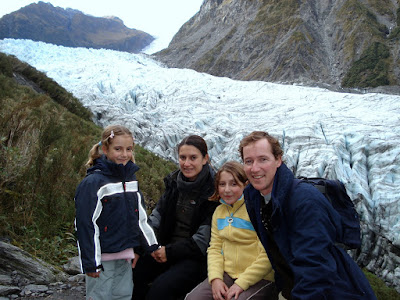
We shouldn't be let mind a dog, never mind two children. The night before our planned excursion on Fox Glacier, Sara gave her unsolicited opinion on the food in Arthur's Pass in the direct and physical way that we are used to from the girl: she barfed it all back up before bedtime. It wasn't looking good for the hike. To make matters worse - much worse - the following morning as we got up early and started to prepare ourselves the same child pointed out, again in the most direct way possible, that her stomach was empty and her sugars were low, by fainting in the bathroom. She didn't black out, but she ended up on her arse, murmuring slowly to herself, until we set her on the bed and put her head between her knees. Really - if anyone feels like reporting us, I'd almost encourage them.

But it gets worse again. Sara recovered quickly, and protested our decision to call off the glacier trip. She insisted that she wanted to do the hike and that she was fine now. We weren't buying it but set off to Fox Glacier (half an hour's drive from Franz Josef) to see if we could get a refund of the $100 deposit. When we got there, and explained Sara's alternating puking and swooning, Malcolm our guide-to-be told us that she'd be fine (these Kiwis are as good as the Aussies at shrugging off illness, danger and common-sense).

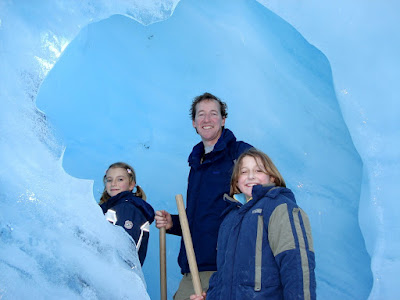
So, responsible parents that we are, we continued to increase Sara's sugar levels using fruit sweets and juice, fitted herself and Nina out with boots, and got on the bus with the guides that led to the start of the trail.

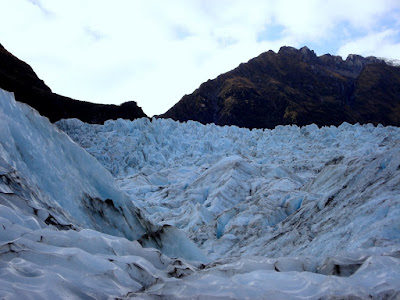
What's a glacier anyway?, I hear you ask (admittedly over the noise of those baying for our children to be removed for their own safetly). It's a river, really, that moves 100,000 times slower than normal rivers. Instead of water, flows ice. Instead of a spring, there's a snow-collecting basin (called a neve) over 3000m up the mountain, where today's snow compacts yesterday's and eventually compresses it into ice. The ice flows downhill under its own weight, moving on a layer of water formed where the ice meets the underlying rock, but also moving internally, in a plastic flow. At the bottom of the glacier, the terminal, where the higher temperatures defeats the pressure, the ice finally melts and runs off as cloudy green streams.

The way you get up onto Fox Glacier is to start near the terminal of the glacier and hike for the best part of an hour along the mountainside - the bank of this river of ice - until you reach a point where it's safe (in the I-have-signed-a-waiver sense of the word) to move onto the glacier itself. To reach this point, we had to climb a fair bit, as well as move along a narrow trail at the edge of a bluff. This last fact might alarm American or Antipodean readers. That's because they know what the hell a bluff is. A bluff in European English is a clever card-playing pretence, and very little else. So when we were told in advance that we would be walking along a bluff, I thought it odd but not much odder than anything else I've been told by a guide in the last 5 months. Halfway along our hike to the edge of the ice, we found out what a New Zealander means by a bluff. A bluff, so far as I can now tell, is a f**king great cliff with a 100m drop. It has a path alongside whose width is very much economy class. And by way of support for those who might have fainted that morning there is a chain and a red-bearded, grinning guide. (Social services numbers are in the Government section of the phone book, if you haven't found it yet).

We survived, and not having been killed are of course stronger (big chunks of ice bring out the Nietzsche in me). Nina and Sara dealt with the heights like two little girls who know what it feels to zip along on a flying fox at 7 meters, and we all went on to have a surreal and rewarding experience walking on top of a glacier for 90 minutes or so.

When we got to the edge of the glacier, we were handed poles, and told to put on our instep crampons. And then we walked on water. We stepped onto 12km of frozen but moving water. The surface was broken in a thousand different ways. Where it met the mountainside, it thrust upwards, trying to burst its banks. The centre of the flow moves faster than the edges, creating crevasses whose depths are disguised by the pools of water that fill them. We were walking in the melt zone of the glacier, where the liquid flow created other perfect imperfections on the icescape - archways, circular pools and waterfalls. From the mountain, the uppermost surface of the glacier is undulating but looks smooth. Up close, it is anything but. The ice looks like a snapshot of the choppy surface of a lake on a windy day.

On any trip, there are inevitably things that you wish you had kept your wallet closed for. You're probably glad you did them but you wished you didn't have to pay so much for it. We spent less than 100 euro in the backpackers in Franz Josef, and a little over 100 euros for the half-day trip on the Fox glacier. It was one of the best value highs we've had on the trip so far. If you come here with kids, be aware that there is practically nothing else to do in either Franz Josef or Fox Glacier. The evening activity is limited to going to the pub, and apparently they get quite boisterous. Our irresponsibility as parents doesn't extend to finding out in person.

Honest!!