There are more ancient civilizations in South American than I can hope to remember. They all had their time, location language and culture. Some of them spread out from their points of origin and submerged others, like the waves I watched racing to the sand on Iquique beach a few days ago. The winners are the ones that we tend to remember. In Peru, the last two big winning waves were those of the Inca and the Spanish Conquistadores. On my one healthy morning in Arequipa we got a close up view of the faces of both of these cultures.
Juanita, as she is known to us today, was an Inca noble. She was about 12 years old when she walked hundreds of kilometers from Cusco to the volcanic mountain called Ampatu, about 100km from Arequipa, in the company of adults. Priests. They all climbed this mountain of more than 6000m, in sandals, using rough paths previously laid out in straw. In reaching this height - challenging even for today's well-equiped mountaineers - they were entering the world of the mountain gods. The rarefied air and exhaustion had already altered their states of mind. For Juanita, the privilige of walking amongst the gods with the priests, and the thoughts of what lay ahead, took her even further into a state of trance.
When they eventually reached the summit, Juanita was given some chichi, a beer made by the Incas. In her weakened state, the chichi made her lose consciousness. She wouldn't have felt a thing when one of the priests made a single blow to the right side of her head, just above her eye. That was all it took to end her life. In all probability, she was always destined to die this way. As part of a noble Inca family, she would have been selected early and educated with others like her about her role. She was priviliged. Her fate was to join the gods themselves, who according to the Inca priests had an appetite for young, beautiful and pure children, especially girls.
Almost six hundred years later, in the Universidad Católica di Santa María, at the end of a well-guided tour, we came face to face with Juanita. She never made it to the realm of the mountain gods. She lives in a Japanese-designed transparent freezer unit, alternating between the display location and the reseach lab (a routine she shares with the remains of several other sacrificed children of Inca times). She still bears the marks of the final blow. And you can still tell that when she was alive, she was very beautiful.
Not long after Juanita's death, a new wave broke on the West coast of South America. The conquistadores were armed with better germs, weapons (including horses) and political organization administered through the written word. The Inca were swept away.
About four blocks away from the Universidad is the Convent of Santa Catalina. It was founded a mere 100 years after Juanita's death, as part of the cloistered Dominican order by a wealthy widow of Arequipa. Aristocratic Spanish families would pay massive dowries to have their second daughter accepted as novices as the age of 12. This daughter would remain enclosed within the ever expanding walls of Santa Catalina for the rest of her life. Once a month she would be allowed a monitored 15 minute conversation through opaque grills with her family. She was permitted no news of the outside world. If she considered leaving the convent, her shamed family would have disowned her. She had nowhere else to go. She would live a comfortable life, with servants and even slaves (some of the servents were lower-class, Indian nuns), silently praying, conversing only when sewing. When she finally died, she was laid out for a day in the mortuary before being buried in the convent's own graveyard. Her family was not invited to the funeral.
As I stood looking in though the mortuary door, with my own two daughters beside me, I noticed it was lined with the portraits of many nuns, each with their eyes closed. The guide explained that while they were still alive, it was considered vanity for the nuns to have their image painted. Only when they were dead was this permitted.
Then the portraits were sent to the dead woman's family.
This last detail hit me like rabbit punch. Up until now I had been scoffing my way through the tour, making all the predictable comments that you'd expect from an unbeliever when shown the harsh and pointless regime of a misguided cult. But sending the portrait of the freshly-deceased daughter to the family that had gone without her company since she was 12!? This seemed like the unholiest of cruelties. Spiteful. I remained silent for a while, trying to collect myself, and looked at my own second daughter, shuddering at the idea of her being born into another place or time than 21st century Europe. Into Juanita's time. Into the time of Santa Catalina.
Showing posts with label arequipa. Show all posts
Showing posts with label arequipa. Show all posts
Monday, July 28, 2008


Sunday, July 27, 2008
Hello Peru, Goodbye Stomach
I've been a bit quiet for the last few days - at least on this blog. In real life I've been making quite a variety of noises, most of which are associated with an infection of the digestive system. Yup - not twenty-four hours into Peru, I suffered the revenge of Atahualpa and two days later I'm starting to recover. The problem was made worse by a sequence of misdiagnoses. After a fantastic morning in Arequipa (more on that in a moment) I started to feel aching muscles and fatigue. Arequipa is at almost 2500m so I figured that this was the beginning of altitude sickness. I took one of the pills we had bought in Chile - the nuclear option of soroche remedies. It did absolutely nothing but demonstrate its most clearly posted side-effect as a diuretic. I then moved on to the sunstroke theory. We had spend much of the morning outdoors and I was wearing heavy clothes, a small rucksack, but no hat. It was only when the floodgates opened on all access points to my alimentary canal that I conceded that I must have eaten somthing rum. Quite possibly back in Chile, but I can't say for sure.
Thanks to the various wrong turns down the diagnostic decision tree I have taken more medicine in 2 days - both in terms of quantity and variety - than in the previous 2 years. I am not exaggerating. In fact all I have eaten over this period of time has been pills. I'm not a traveller, I'm a bleedin' astronaut. (The matter is made worse by the fact that according to Letizia the food here is excellent). The final insult was having to take a 6 hour bus trip from Arequipa to Puno, with a corresponding altitude increase of about 1300m. When all you want to do is sleep and return to the sensation of being human, being driven for 6 hours to a place that promises to starve you of oxygen is not high on the to-do list.
Like bungy-jumping, these things can be overcome simply by doing things one step at a time without overly morbid thought for what lies ahead. We are now in Puno, acclimatizing nicely to the altitude (though I still wheeze when I try to shave) and with a full day program laid out in front of us tomorrow: The floating Uros Islands on Lake Titicaca, and the nearby Temple of Fertility (which promises to make the Penis Forest of Waitomo Caves' stalacmites looks like a nunnery).
Medical bulletin concluded.
Arequipa is known as the White City because of the stone it is constructed from. Viewed from a landing plane it did not appear to live up to its name. On our approach, all we saw were shanty towns strewns across small canyons. Canyons can be very inspiring to look at, but when you're down that low, and all you really want to see is a runway, they lose some of their charm. The aircraft stormed over the ridge of one such canyon, swooped over the last few corrogated iron roofs, and landed with zero panache but considerable velocity. Welcome to Peru.
The Peruvian Paradox: Peru is a much poorer country than Chile, but if you are a tourist you'll find it easier to deal with. Tourism must be high on the national priority because everything seems geared to a much greater extent to visitors from abroad. So far we have found more english spoken in the hotels, airport pickups (which we normally consider to be options for octogenarians - that reminds me: Happy Birthdays Uncles Jerry and Micheal :-) are typically free, as is wifi (though the latter is also true of Chile). It's a lot cheaper here than Chile as well, and if you're not addicted to international hotel chains you will find many excellent hotels to choose from here, with excellent friendly service. These things matter a lot to the weary traveller.
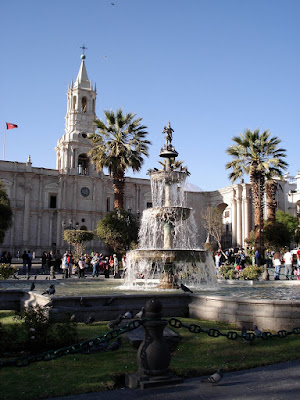
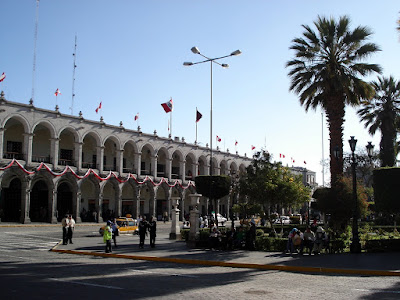
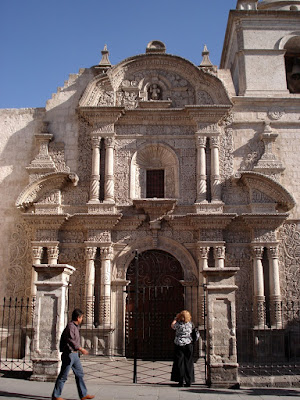
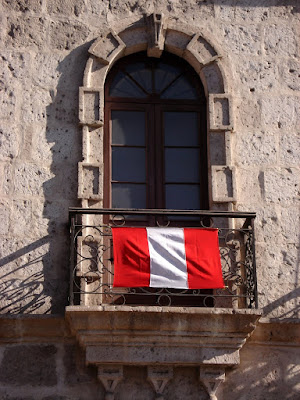
Our pickup from Arequipa airport was well organized (and I could even fit my Zimmer frame into the boot), and after ten minutes in the car we understood where the city got its name. The historical centre of Arequipa is eye-wateringly beautiful. When we hit the steets after checking in, every turn of a corner commanded a new photograph from Letizia. I should remind readers that every picture you'll see on this blog is taken by my talented wife, and the only role I play is to hold her coat and handbag, and get the hell out of the shot. Nina, Sara and I know the drill by heart now. Tenetemi questi e spostatevi.
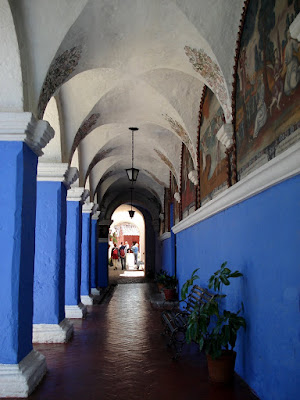
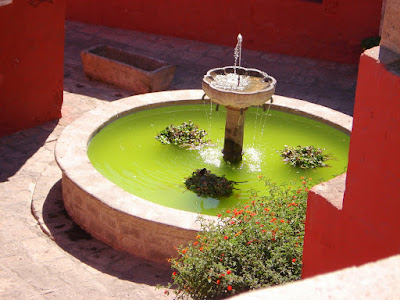
In my next post on Arequipa I will describe the fantastic morning we spent there before medical matters intervened. My memories of the place will be enduringly positive. In the meantime here are some of those photographs. Great credit must be given to the handbag holder.

Thanks to the various wrong turns down the diagnostic decision tree I have taken more medicine in 2 days - both in terms of quantity and variety - than in the previous 2 years. I am not exaggerating. In fact all I have eaten over this period of time has been pills. I'm not a traveller, I'm a bleedin' astronaut. (The matter is made worse by the fact that according to Letizia the food here is excellent). The final insult was having to take a 6 hour bus trip from Arequipa to Puno, with a corresponding altitude increase of about 1300m. When all you want to do is sleep and return to the sensation of being human, being driven for 6 hours to a place that promises to starve you of oxygen is not high on the to-do list.
Like bungy-jumping, these things can be overcome simply by doing things one step at a time without overly morbid thought for what lies ahead. We are now in Puno, acclimatizing nicely to the altitude (though I still wheeze when I try to shave) and with a full day program laid out in front of us tomorrow: The floating Uros Islands on Lake Titicaca, and the nearby Temple of Fertility (which promises to make the Penis Forest of Waitomo Caves' stalacmites looks like a nunnery).
Medical bulletin concluded.
Arequipa is known as the White City because of the stone it is constructed from. Viewed from a landing plane it did not appear to live up to its name. On our approach, all we saw were shanty towns strewns across small canyons. Canyons can be very inspiring to look at, but when you're down that low, and all you really want to see is a runway, they lose some of their charm. The aircraft stormed over the ridge of one such canyon, swooped over the last few corrogated iron roofs, and landed with zero panache but considerable velocity. Welcome to Peru.
The Peruvian Paradox: Peru is a much poorer country than Chile, but if you are a tourist you'll find it easier to deal with. Tourism must be high on the national priority because everything seems geared to a much greater extent to visitors from abroad. So far we have found more english spoken in the hotels, airport pickups (which we normally consider to be options for octogenarians - that reminds me: Happy Birthdays Uncles Jerry and Micheal :-) are typically free, as is wifi (though the latter is also true of Chile). It's a lot cheaper here than Chile as well, and if you're not addicted to international hotel chains you will find many excellent hotels to choose from here, with excellent friendly service. These things matter a lot to the weary traveller.
Our pickup from Arequipa airport was well organized (and I could even fit my Zimmer frame into the boot), and after ten minutes in the car we understood where the city got its name. The historical centre of Arequipa is eye-wateringly beautiful. When we hit the steets after checking in, every turn of a corner commanded a new photograph from Letizia. I should remind readers that every picture you'll see on this blog is taken by my talented wife, and the only role I play is to hold her coat and handbag, and get the hell out of the shot. Nina, Sara and I know the drill by heart now. Tenetemi questi e spostatevi.
In my next post on Arequipa I will describe the fantastic morning we spent there before medical matters intervened. My memories of the place will be enduringly positive. In the meantime here are some of those photographs. Great credit must be given to the handbag holder.
 |
| From Arequipa |
Subscribe to:
Posts (Atom)