I confess - before we left Europe, I couldn't tell the difference between an Australian accent and a New Zealand one. They seemed pretty much the same to me - regional variations at best. But our time spent in Oz has had a profound effect on our perception of accents, and this was revealed to us before our flight from Brisbane ever left the tarmac.
The male member of cabin cabin crew who was making the announcements seemed perfectly alright at first. He went through the normal patter that you associate with buckling into a metal cylinder that has no business moving, much less flying. Then we heard them. The Kiwi vowels. His sentences seemed to hit air turbulence on encountering 'u's and 'i's and 'e's, losing altitude without warning and leaving inexperienced listeners reeling. Then just carrying on as if nothing had gone wrong. We were being asked to stow our luggage in 'overhead buns', that our flight was due to land at 'sux muneets past ee-lee-veen'.
Letizia and I exchanged worried glances. What did he say? She was learning Spanish for South America, I had done my Mandarin duty in China, and we had native speaking guides in Australia to help us with the non-standard noun-ending (you're just getting the hang of stubby, barby, pozzy, and so on, and then they chuck bottle-o and slippery-dip at you). But we had not prepared ourselves, linguistically speaking, for the Kiwi vowels.
On landing in Christchurch, it only got worse of course. We were swimming in 'chully buns' (chilly bin = picnic cooler/esky), with only 'fush and chups' for company. There were many embarrassing episodes where I would turn the most delightfully helpful of waitresses or supermarket cashiers into frowning curmudgeons by the simple repeated use of the phrase "sorry, what did you say". A typical bout would see us locked in a vowel-wrestling hold for up to five repetitions of "sorry, what did you say", before we would break and retreat to our corners, frustrated that we had not understood each other, but relieved that it was over.
But I think I have got to the bottom of the matter now. It's all the Scots' fault. The New Zealanders say their 'u's like 'i's in exactly the same way (to my ear) that Scottish people do. I am well used to the latter accent, and I can totally understand 'Bully Connolly' when he speaks that way. But when you do the same vowel translation against a backdrop of what otherwise sounds reasonably similar to Australian (or 'Strain', as I have seen it defined), then the context throws me completely. So to understand Kiwi, I am using the following trick. I am assuming everyone here is really Scottish, and pretending to be from Australia. Or if that doesn't work, the other way around.
The Australian tone can be reproduced quite easily. Imagine the letter 'y', made out of some very springy, bouncy material. Every Aussie you will ever meet has had one of these (the size may vary) inserted into their mouths at birth. It stops the mouth closing around a simple word like 'no', transforming it instead into a 'noiiiii', the springy letter 'y' bouncing along like a flat stone on water in every decreasing stretches before finally sinking. Marry that elasticity of vowels to the chin-against-the-chest, mischievous murmurings of a Scot, and you have 80% of the Kiwi accent. After that, Mandarin will seem like a piece of puss.
(PS: Somebody armed with more facts and less inclination to parody has come up with a different analysis of the matter, but the Scottish element of my thesis is supported).
Showing posts with label australia. Show all posts
Showing posts with label australia. Show all posts
Monday, April 21, 2008


Monday, April 14, 2008
Uncool
It's a sin against nature for a child above a certain age to believe that their parents are cool, even worse to openly declare this belief. So imagine my concern when Nina (8-about-to-be-9, and therefore well past aforementioned certain age) suggested a few weeks ago that she had cool parents. When I challenged her on this she insisted somewhat impatiently: "Sure you're cool. You're taking us around the world, aren't you?".
This is a worry.
I had it all planned out - or at least confidently predicted - shortly after she was born. Nina has a software engineer for a dad, a doctor of law and stay-at-home mamma, but her Italian aunt Giovanna lives in Paris and moves between fashion/art photography to dealing in antiques without visible effort. It's her job to be cool. It's her job to be right where Letizia and I are wrong, and provide for the you just don't understand me like Giovanna does (slam!!!) moments. And of course when Nina is old enough, it'll be to Gio that Nina will go on holidays, and certainly not anywhere with her parents.
So this new-found coolness of ours is upsetting everything. And it is new-found, by the way. Before we left Ireland last December, if you had asked Nina about whether she was excited about the trip, she would have said "not really". She wanted to stay with her friends, and her cousins, and of course her classmates. Was there anything she was looking forward too? The Great Wall of China? The Great Barrier Reef? The Big (if not indeed also Great) Pineapple of Woombye? Nope. But if you caught her in one of her more adventurous moods, she would confess a certain curiosity for a pair of cats in Christchurch, New Zealand. You see the first leg of our New Zealand trip was to be a house-swap (arranged through HomeForExchange) with a English/Kiwi couple called Ray and Louise. An optional part of this swap included the company of Satie and Willard, the resident cats. So in a nutshell, Nina was begrudgingly allowing us to take her and her sister to 8 new countries, across 3 continents and 2 hemispheres, on a trail littered with World Heritage listings, diverse cultures and climates, stocked with a zoological cornucopia of exotica, on condition she could make friends with a pair of antipodean moggies.
Now this is the kind of infuriating, illogical, and downright ungrateful behaviour that I am most comfortable with. This was child-parent communication in a language I could understand. Then it all went horribly, horribly wrong: As the trip began, so both Nina and Sara began to enjoy it.
As the fog of jet lag cleared in Beijing, they got into their stride. It was hard for them not to love the pandas in Chengdu, or the sweet treats in Xi'an. But they also developed a taste for the Shanghai marketplace haggling and the strangeness of Chinese buildings. And they were seeing things with minds much less tainted by the false familiarity of TV documentaries than we were. When we reached Australia, where they could actively engage with their surroundings thanks to the language, where we weren't moving at such a frenetic pace, and where we were meeting many new (to them) friends, things kicked up a notch. They couldn't bear to leave Sydney, or then Melbourne, then they didn't want to move on from Cairns, and finally they didn't want to say goodbye to Simon, Leah and Caitlin in Brisbane (they didn't as it happened - more on that in a later blog entry). And somewhere in those 12 Aussie weeks, Nina used the c-word against me: Cool, she said. And she meant it.
Cool doesn't sit well with me. Cool leads to teenage conversations that start with what a great dad I am and end with car keys getting handed over. I've never been cool, and so I'm entirely unsure how to manage it, and if I get used to being cool then I'm sure I'll start worrying about losing the status (by not handing over car keys or similar acts of willful parental spite).
But I'm playing the long game. I'm quietly optimistic that it won't last, that it's a temporary aberration that time and continued exposure to 'daddy humour' will heal. There are indications of a return to normality. As I write this, Nina and Sara are fast asleep here in Christchurch, with Willard purring gently at the bottom of their bed, and Willard and Satie have proved themselves to be as big a highlight of the trip as anticipated. Tomorrow Nina turns 9 and Sara has just turned 7 (every year brings us closer to the very uncool parents years). And in two short days, Zia Giovanna flies in from Paris.
Cool doesn't stand a chance.
This is a worry.
I had it all planned out - or at least confidently predicted - shortly after she was born. Nina has a software engineer for a dad, a doctor of law and stay-at-home mamma, but her Italian aunt Giovanna lives in Paris and moves between fashion/art photography to dealing in antiques without visible effort. It's her job to be cool. It's her job to be right where Letizia and I are wrong, and provide for the you just don't understand me like Giovanna does (slam!!!) moments. And of course when Nina is old enough, it'll be to Gio that Nina will go on holidays, and certainly not anywhere with her parents.
So this new-found coolness of ours is upsetting everything. And it is new-found, by the way. Before we left Ireland last December, if you had asked Nina about whether she was excited about the trip, she would have said "not really". She wanted to stay with her friends, and her cousins, and of course her classmates. Was there anything she was looking forward too? The Great Wall of China? The Great Barrier Reef? The Big (if not indeed also Great) Pineapple of Woombye? Nope. But if you caught her in one of her more adventurous moods, she would confess a certain curiosity for a pair of cats in Christchurch, New Zealand. You see the first leg of our New Zealand trip was to be a house-swap (arranged through HomeForExchange) with a English/Kiwi couple called Ray and Louise. An optional part of this swap included the company of Satie and Willard, the resident cats. So in a nutshell, Nina was begrudgingly allowing us to take her and her sister to 8 new countries, across 3 continents and 2 hemispheres, on a trail littered with World Heritage listings, diverse cultures and climates, stocked with a zoological cornucopia of exotica, on condition she could make friends with a pair of antipodean moggies.
Now this is the kind of infuriating, illogical, and downright ungrateful behaviour that I am most comfortable with. This was child-parent communication in a language I could understand. Then it all went horribly, horribly wrong: As the trip began, so both Nina and Sara began to enjoy it.
As the fog of jet lag cleared in Beijing, they got into their stride. It was hard for them not to love the pandas in Chengdu, or the sweet treats in Xi'an. But they also developed a taste for the Shanghai marketplace haggling and the strangeness of Chinese buildings. And they were seeing things with minds much less tainted by the false familiarity of TV documentaries than we were. When we reached Australia, where they could actively engage with their surroundings thanks to the language, where we weren't moving at such a frenetic pace, and where we were meeting many new (to them) friends, things kicked up a notch. They couldn't bear to leave Sydney, or then Melbourne, then they didn't want to move on from Cairns, and finally they didn't want to say goodbye to Simon, Leah and Caitlin in Brisbane (they didn't as it happened - more on that in a later blog entry). And somewhere in those 12 Aussie weeks, Nina used the c-word against me: Cool, she said. And she meant it.
Cool doesn't sit well with me. Cool leads to teenage conversations that start with what a great dad I am and end with car keys getting handed over. I've never been cool, and so I'm entirely unsure how to manage it, and if I get used to being cool then I'm sure I'll start worrying about losing the status (by not handing over car keys or similar acts of willful parental spite).
But I'm playing the long game. I'm quietly optimistic that it won't last, that it's a temporary aberration that time and continued exposure to 'daddy humour' will heal. There are indications of a return to normality. As I write this, Nina and Sara are fast asleep here in Christchurch, with Willard purring gently at the bottom of their bed, and Willard and Satie have proved themselves to be as big a highlight of the trip as anticipated. Tomorrow Nina turns 9 and Sara has just turned 7 (every year brings us closer to the very uncool parents years). And in two short days, Zia Giovanna flies in from Paris.
Cool doesn't stand a chance.
Saturday, April 12, 2008
Leaving Oz
Oz. A suitable name for a place which is partly magical, partly fictional, and well, not Kansas. Before we came here, all I knew of Australia was what I had read, and what learned from Australians directly through a number of friendships. My impressions of the place were overwhelming positive. But now Australia has become much more - instead of the printed page and second-hand reports, I have personal memories that I will always be able to call on. Now my view on Australia is based on direct experience, distorted undoubtedly by baggage and the special atmosphere that accompanies a trip like this.
I'm heartbroken to leave the place, but at the same time, I'm already beginning to feel the excitement of arriving in a new destination, New Zealand. (I am a fickle bastard.) Letizia has done a wonderful job of summing up (in English) what we owe, and how meagerly we have paid, for the many kindnesses shown to us by so many people here in Australia. There is nothing I can add to what she has written, so instead I'll offer some last words on Australia. For what it's worth, here are my 2 Australian cents...
Australia is a particle collider. It takes elements from many different sources and bangs them together at high speed, each time creating something new. It is too diverse to define but still hangs together in a way that works, defying expectations.
They drive on the left here, they speak English, and many of them even look quite English (or a tanned version of English). Many of the cities have leafy suburbs that would easily blend into an English storyline. The coins have the profile of Queen Elisabeth II stamped on them, and the national sports include cricket and rugby. But this isn't England. Your bank manager might address you as 'dahl' (darling), you might think nothing of shopping in your bare feet - or at least not be too surprised to see somebody else do so. At the end of a busy day, you might relax on your balcony or veranda with an excellent local wine and listen to the amusical raspings of parrots, the insane guffaws of kookaburras, or any number of other birdsongs that you'll never hear in the UK. You might be able to set your watch by the first signs of rabbit-sized bats moving across the dusk sky. In short, Nature will make clear to you with every sight, sound and smell that you are somewhere very different to the old Mother country.
Despite the ties to an English way of life, this isn't some island orphan of a defunct sea-going empire. This is a nation of its own, born of Europe but long since grown up and moved out. And yet it has Europe in its DNA and a cultural and political heritage that anyone from Europe can recognise and bond with at once.
In the meantime, the older culture on this continent has been all but wiped out, and even if today some amends have been made, and some attempts are underway to conserve the wisdom of the Australian aboriginal, this is all being done within the social and economic context of the conqueror. The trip to Alice and Uluru set me thinking that any talk of a solution to the Aboriginal Problem is premature. The problem itself continues to unfold. 230 years is an instant in historical time, and the impact of the white invasion on the black population is still revealing itself in different ways. You can no more speak of a solution to it, than you can talk of rebuilding a city while the earthquake is still shaking it. I hope this doesn't sound to pessimistic, but that's how it seems to me. (It will be very interesting to compare the condition and fate of the Maori in New Zealand to that of the Australian First Owners.)
The many faces of Australia - natural, human, historical - are hard to bring together into one picture. Many of them seem unrelated while others quite simply clash. How can you say that tropical Queensland and downtown Melbourne belong together? Where is Australia? In the red sands of Uluru or in the golden dunes of Fraser Island? Is the whitefella a survivor, a pioneer, a refugee, or is he a conqueror, a thief, a murderer? Is the blackfella a sage, an ecologist, an artist? Or is he a drunk, a bum, a loser? These are ideas that are about as mutually compatible as urinals and open-toed sandals (though Australians seems to take that combination in their stride too!). But that's how it appears here - the fabric of this superficially young, but in reality ancient country is woven from impossibly different threads. It seems to me that those threads are held together by something other than knee-jerk nationalism. The stark isolation of Australia seems to have forced and forged a cohesion in this country that is the envy of many older nations in the Northern hemisphere. What makes Australia work? It's the people, stupid!
A few weeks back, when we were resting for two days in Depot Beach, I listened to a talk show on one of the national radio channels to an interview with an Australian moral philosopher. He was talking about a great many interesting things but eventually came to the subject of what made Australians different. By way of describing that difference, he told the story of a German Jewish refugee who was being interned in Australia during WWII (not because he was Jewish, but because he was German). The internment camp was in the middle of nowhere (they sure have plenty of nowhere here) and he was being marched at the tail end of a line of other internees towards the camp. All of a sudden, the soldier guarding him stopped, handed him his rifle and said "Here, hold this. I need to go for a piss". Australians in general have no respect for bad rules. (Above and beyond the point of the story itself, I just love the fact that in Australia, moral philosophers say "piss" on national radio.)
In a few hours we'll be landing in Christchurch, New Zealand, where we have a house-swap arranged for the coming weeks. It's also Sara's 7th birthday today, which we've celebrated in an orgy of sugar at the breakfast table - again thanks to Simon and Leah for organising balloons, cake and the other necessaries. Now Sara's going to do a Phil Collins on it, and jump on a plane to celebrate the rest of her birthday across the Tasman Sea. Next post from NZ.
I'm heartbroken to leave the place, but at the same time, I'm already beginning to feel the excitement of arriving in a new destination, New Zealand. (I am a fickle bastard.) Letizia has done a wonderful job of summing up (in English) what we owe, and how meagerly we have paid, for the many kindnesses shown to us by so many people here in Australia. There is nothing I can add to what she has written, so instead I'll offer some last words on Australia. For what it's worth, here are my 2 Australian cents...
Australia is a particle collider. It takes elements from many different sources and bangs them together at high speed, each time creating something new. It is too diverse to define but still hangs together in a way that works, defying expectations.
They drive on the left here, they speak English, and many of them even look quite English (or a tanned version of English). Many of the cities have leafy suburbs that would easily blend into an English storyline. The coins have the profile of Queen Elisabeth II stamped on them, and the national sports include cricket and rugby. But this isn't England. Your bank manager might address you as 'dahl' (darling), you might think nothing of shopping in your bare feet - or at least not be too surprised to see somebody else do so. At the end of a busy day, you might relax on your balcony or veranda with an excellent local wine and listen to the amusical raspings of parrots, the insane guffaws of kookaburras, or any number of other birdsongs that you'll never hear in the UK. You might be able to set your watch by the first signs of rabbit-sized bats moving across the dusk sky. In short, Nature will make clear to you with every sight, sound and smell that you are somewhere very different to the old Mother country.
Despite the ties to an English way of life, this isn't some island orphan of a defunct sea-going empire. This is a nation of its own, born of Europe but long since grown up and moved out. And yet it has Europe in its DNA and a cultural and political heritage that anyone from Europe can recognise and bond with at once.
In the meantime, the older culture on this continent has been all but wiped out, and even if today some amends have been made, and some attempts are underway to conserve the wisdom of the Australian aboriginal, this is all being done within the social and economic context of the conqueror. The trip to Alice and Uluru set me thinking that any talk of a solution to the Aboriginal Problem is premature. The problem itself continues to unfold. 230 years is an instant in historical time, and the impact of the white invasion on the black population is still revealing itself in different ways. You can no more speak of a solution to it, than you can talk of rebuilding a city while the earthquake is still shaking it. I hope this doesn't sound to pessimistic, but that's how it seems to me. (It will be very interesting to compare the condition and fate of the Maori in New Zealand to that of the Australian First Owners.)
The many faces of Australia - natural, human, historical - are hard to bring together into one picture. Many of them seem unrelated while others quite simply clash. How can you say that tropical Queensland and downtown Melbourne belong together? Where is Australia? In the red sands of Uluru or in the golden dunes of Fraser Island? Is the whitefella a survivor, a pioneer, a refugee, or is he a conqueror, a thief, a murderer? Is the blackfella a sage, an ecologist, an artist? Or is he a drunk, a bum, a loser? These are ideas that are about as mutually compatible as urinals and open-toed sandals (though Australians seems to take that combination in their stride too!). But that's how it appears here - the fabric of this superficially young, but in reality ancient country is woven from impossibly different threads. It seems to me that those threads are held together by something other than knee-jerk nationalism. The stark isolation of Australia seems to have forced and forged a cohesion in this country that is the envy of many older nations in the Northern hemisphere. What makes Australia work? It's the people, stupid!
A few weeks back, when we were resting for two days in Depot Beach, I listened to a talk show on one of the national radio channels to an interview with an Australian moral philosopher. He was talking about a great many interesting things but eventually came to the subject of what made Australians different. By way of describing that difference, he told the story of a German Jewish refugee who was being interned in Australia during WWII (not because he was Jewish, but because he was German). The internment camp was in the middle of nowhere (they sure have plenty of nowhere here) and he was being marched at the tail end of a line of other internees towards the camp. All of a sudden, the soldier guarding him stopped, handed him his rifle and said "Here, hold this. I need to go for a piss". Australians in general have no respect for bad rules. (Above and beyond the point of the story itself, I just love the fact that in Australia, moral philosophers say "piss" on national radio.)
In a few hours we'll be landing in Christchurch, New Zealand, where we have a house-swap arranged for the coming weeks. It's also Sara's 7th birthday today, which we've celebrated in an orgy of sugar at the breakfast table - again thanks to Simon and Leah for organising balloons, cake and the other necessaries. Now Sara's going to do a Phil Collins on it, and jump on a plane to celebrate the rest of her birthday across the Tasman Sea. Next post from NZ.
Wednesday, April 9, 2008
The Rock
Near the start of our 6-hour bus trip from Alice Springs to Uluru (Ayres Rock), our driver Gordon pointed out that if we were to get off the bus, leave the road and walk westwards, we would be more likely to encounter the Indian Ocean than to encounter another human being. And that'd be something like 2000km later, so much more likely again would be a lingering death in the desert. At first I didn't think too much about this - I've read a dozen similar parables from just about every book I've read on Australia. But now that I found myself in the desert for the first time, I looked at things a little closer. I imagined doing exactly what Gordon described. The thought occurred to me that even if I just wandered for 30-40 minutes westwards, I wouldn't be too sure that I could even make my way back to the road, as I could distinguish no landmarks. And if I couldn't find the road, then I might as well be half way to the Indian Ocean as far as my chances of survival are concerned. Northern Territory, where both Alice and Uluru lie, makes up a little shy of one fifth of Australia's area, but has a population of only 210,000 people. Or put another way, NT is 20 times bigger than Ireland, with 20 times fewer inhabitants. The very idea of providing universal mobile phone coverage here is preposterous, so anywhere outside of major population centres, you can forget about phoning for help.
And yet this road through the dead heart of Oz serves as the boundary between some of the various cattle stations (cow farms to you and me) that operate out here. These can encompass enormous areas - approaching the size of Belgium, or Connaught (and making the latter look like bounteous meadowlands). Occasionally we saw cattle, alone or bunched in twos or threes, meandering around the bush, grazing on who knows what. Maybe the word desert is misleading here. It's not the Sahara, with nothing but sand dunes as far as the eye can see. If you look from the road, you'll see lanky trees to a height of 4 or 5 metres in some places, bushes and scrub occupying the middle area, and course grasses in the foreground. Only occasional glimpses of red sand can be made out. But when you step into the landscape, you realise that all that vegetation is thinly spread out, and 80% of the space is bright oxidized red sand. This is why the cattle stations are so damn big - around here, a single head of cattle needs 2 square kilometers (200 hectares) to feed itself. This is almost the definition of marginal land. As we move closer and closer to Uluru, the cattle stations fall away. There's clearly just no point in trying.
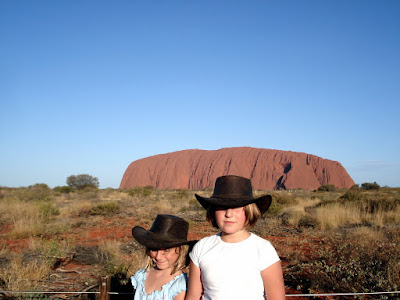
I'm glad we spent a night in that shithole of Alice Springs (there you go Dunc, self-censorship lifted ;-) if only because the journey by bus sets Uluru into context in a way that flying directly to its airport could never do. It's far away from everything and everywhere. We spent the next 2 days visiting two major sites: The Olgas (Kata Tjuta) and Ayres Rock (Uluru), and Letizia has outdone herself with the photographs this time. The walks we did were not terribly strenuous though in the heat, and constantly beset by flies, even small efforts took their toll. Poor Nina and Sara: they've been marched up and down over the last 3 months, but they are still going strong. What really helped their resilience this time was the purchase of two really cute hats that look like they're straight out of Crocodile Dundee. They couldn't believe their eyes when their normally cautious parents loosened the purse strings a little and treated them to these hats. They wore them proudly up the gorge between the Olgas, and around the base of Uluru at ungodly hours of the morning. A great investment. I suspect you won't see a single picture of them from here on in without the hats.
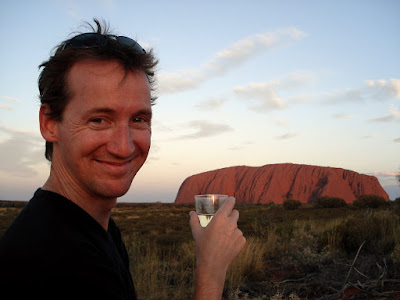
Sunset on the rock is truly beautiful, and it does change colour continuously as the sun reaches the horizon. The place where most people watch it from isn't too busy - you can certainly get away from the noise if you want to. But it's not a spiritual experience - and I'm not just saying that because I'm the crusty old Cartesian my wife describes me as. It's a beautiful sight, it's a relaxing experience, a great backdrop for a glass of wine and a stupid grin, but sunset from Fraser Island will remain with me forever.
Before coming to Uluru I had read of the handover of 1985, when the government of Bob Hawke decided to recognize the title of the indigenous people of Uluru (the Anangu) to this land. I was looking forward to seeing a part of Australia that was in the hands and under the management of the first owners. This was pretty naive of me. When the handover took place, Uluru was already a National Park at the time, not to mention a popular tourist destination. The deal reached between Hawke and the Anangu hinged on the condition that the Anangu lease the land back to the federal government for the next 99 years. There was no visible sign of black ownership anywhere. There were plenty of references to local culture and lore from the (white) guides and in the resorts literature. But then again, in modern Australia, such references are everywhere. You'll find Dreamtime stories related to the creation of the moon and the stars in Sydney Observatory but it hasn't been handed over to the long-eradicated Eora people. It seems that it will take many more generations - maybe longer than a 99-year lease will provide for - for the aboriginals to assume the real day-to-day management of this, or any other, large project.
The Anangu never lived around Uluru - it wouldn't support a permanent human presence. They visited for special occasions, like rites-of-passage ceremonies. They would also come after rainfall and make the best of the increase in edible flora and fauna (digging up honey ants seems to have been a favourite treat in this area), but like most aboriginals, they moved around to allow the earth to recover and regenerate, sometimes giving it a helping hand by setting fire to it before leaving. (In case this sounds a little crazy, firestick farming has only recently begun to be understood scientifically as an effective way to convert scrub into grazing - supporting the kind of wildlife that the aboriginals liked to hunt.) In a harsh environment like this, where man made no pretension to conquer nature by farming, but instead had to make do with living within its limitation, the aboriginal population itself rose and fell, matching the numbers of animals and plants that it fed on. It sounds primitive, but population control is a complicated matter, and one that modern societies would do well to learn (says the man with two kids).
To those who voted for us to go to Uluru, thank you. I'm very glad we went, and would have regretted missing it. In fact my only regret about going is that we didn't spend another night and go to see King's Canyon. But I think a 17% budget overrun is quite enough, don't you?
I've got one more blog in me before we leave for New Zealand on Saturday - something to summarize the Australian experience if that's possible. Thanks for continuing to follow the blog (or indeed thanks for visiting if you've just arrived).
Without any attempt to relate this to anything I've just written, spare a thought for this gentleman:

We encountered him on the road to Uluru from Alice. Those are camels that you can see there, and they are harnessed to the motor-less carcass of some old car. What you probably can't see are the solar panels on top, and the laptop inside. Apparently this guy has been wandering the backroads of Australia for over a decade now, sustaining himself with casual work wherever he stops. He's German apparently, and before the car, he had an old cart whose wheels were big enough to allow him to travel along the dried river beds. Now he has to content himself with sharing the road with the likes of us. For all I know, the chap has his own blog out there, but I'm stuffed if I can find it. Next time you think it's a crazy dream to up stakes with your family and travel around the world for no good reason, remember - there is always somebody out there crazier than you.
And yet this road through the dead heart of Oz serves as the boundary between some of the various cattle stations (cow farms to you and me) that operate out here. These can encompass enormous areas - approaching the size of Belgium, or Connaught (and making the latter look like bounteous meadowlands). Occasionally we saw cattle, alone or bunched in twos or threes, meandering around the bush, grazing on who knows what. Maybe the word desert is misleading here. It's not the Sahara, with nothing but sand dunes as far as the eye can see. If you look from the road, you'll see lanky trees to a height of 4 or 5 metres in some places, bushes and scrub occupying the middle area, and course grasses in the foreground. Only occasional glimpses of red sand can be made out. But when you step into the landscape, you realise that all that vegetation is thinly spread out, and 80% of the space is bright oxidized red sand. This is why the cattle stations are so damn big - around here, a single head of cattle needs 2 square kilometers (200 hectares) to feed itself. This is almost the definition of marginal land. As we move closer and closer to Uluru, the cattle stations fall away. There's clearly just no point in trying.
I'm glad we spent a night in that shithole of Alice Springs (there you go Dunc, self-censorship lifted ;-) if only because the journey by bus sets Uluru into context in a way that flying directly to its airport could never do. It's far away from everything and everywhere. We spent the next 2 days visiting two major sites: The Olgas (Kata Tjuta) and Ayres Rock (Uluru), and Letizia has outdone herself with the photographs this time. The walks we did were not terribly strenuous though in the heat, and constantly beset by flies, even small efforts took their toll. Poor Nina and Sara: they've been marched up and down over the last 3 months, but they are still going strong. What really helped their resilience this time was the purchase of two really cute hats that look like they're straight out of Crocodile Dundee. They couldn't believe their eyes when their normally cautious parents loosened the purse strings a little and treated them to these hats. They wore them proudly up the gorge between the Olgas, and around the base of Uluru at ungodly hours of the morning. A great investment. I suspect you won't see a single picture of them from here on in without the hats.
Sunset on the rock is truly beautiful, and it does change colour continuously as the sun reaches the horizon. The place where most people watch it from isn't too busy - you can certainly get away from the noise if you want to. But it's not a spiritual experience - and I'm not just saying that because I'm the crusty old Cartesian my wife describes me as. It's a beautiful sight, it's a relaxing experience, a great backdrop for a glass of wine and a stupid grin, but sunset from Fraser Island will remain with me forever.
Before coming to Uluru I had read of the handover of 1985, when the government of Bob Hawke decided to recognize the title of the indigenous people of Uluru (the Anangu) to this land. I was looking forward to seeing a part of Australia that was in the hands and under the management of the first owners. This was pretty naive of me. When the handover took place, Uluru was already a National Park at the time, not to mention a popular tourist destination. The deal reached between Hawke and the Anangu hinged on the condition that the Anangu lease the land back to the federal government for the next 99 years. There was no visible sign of black ownership anywhere. There were plenty of references to local culture and lore from the (white) guides and in the resorts literature. But then again, in modern Australia, such references are everywhere. You'll find Dreamtime stories related to the creation of the moon and the stars in Sydney Observatory but it hasn't been handed over to the long-eradicated Eora people. It seems that it will take many more generations - maybe longer than a 99-year lease will provide for - for the aboriginals to assume the real day-to-day management of this, or any other, large project.
The Anangu never lived around Uluru - it wouldn't support a permanent human presence. They visited for special occasions, like rites-of-passage ceremonies. They would also come after rainfall and make the best of the increase in edible flora and fauna (digging up honey ants seems to have been a favourite treat in this area), but like most aboriginals, they moved around to allow the earth to recover and regenerate, sometimes giving it a helping hand by setting fire to it before leaving. (In case this sounds a little crazy, firestick farming has only recently begun to be understood scientifically as an effective way to convert scrub into grazing - supporting the kind of wildlife that the aboriginals liked to hunt.) In a harsh environment like this, where man made no pretension to conquer nature by farming, but instead had to make do with living within its limitation, the aboriginal population itself rose and fell, matching the numbers of animals and plants that it fed on. It sounds primitive, but population control is a complicated matter, and one that modern societies would do well to learn (says the man with two kids).
To those who voted for us to go to Uluru, thank you. I'm very glad we went, and would have regretted missing it. In fact my only regret about going is that we didn't spend another night and go to see King's Canyon. But I think a 17% budget overrun is quite enough, don't you?
I've got one more blog in me before we leave for New Zealand on Saturday - something to summarize the Australian experience if that's possible. Thanks for continuing to follow the blog (or indeed thanks for visiting if you've just arrived).
Without any attempt to relate this to anything I've just written, spare a thought for this gentleman:
We encountered him on the road to Uluru from Alice. Those are camels that you can see there, and they are harnessed to the motor-less carcass of some old car. What you probably can't see are the solar panels on top, and the laptop inside. Apparently this guy has been wandering the backroads of Australia for over a decade now, sustaining himself with casual work wherever he stops. He's German apparently, and before the car, he had an old cart whose wheels were big enough to allow him to travel along the dried river beds. Now he has to content himself with sharing the road with the likes of us. For all I know, the chap has his own blog out there, but I'm stuffed if I can find it. Next time you think it's a crazy dream to up stakes with your family and travel around the world for no good reason, remember - there is always somebody out there crazier than you.
Tuesday, April 8, 2008
Mrs Todd's Billabong
Alice Springs started life as a telegraph station. It's half way between Adelaide in South Australia and Darwin in the Northern Territory. That is to say it's about 1500 km from both of them, and further again from the East and West coasts. Much further. In 1865, the British parliament approved the construction of a telegraph line to stretch from Port Augusta in Southern Australia, across the emptiness of Central Australia, to Darwin with the ambition of connecting eventually to the telegraph line in Java, and so on to Mother England. (Just 57 years earlier, it had taken a full year for the news of the Sydney mutiny against Governor Bligh to reach London - this was real progress.) Alice Springs was the halfway point and a repeater station for that telegraph line.
By the time we landed in Alice Springs airport, we had flown two and a half hours over, well, mostly nothing. Below us, the pale colours of uncharitable Australian farmland gave way to the completely unworkable sands that make up the Red Centre. Once we got off the aircraft and walked to the terminal building (it was well hidden belong scrub on the edge of the runway, giving us the impression of having landed on an abandoned airstrip), that red sand started to accumulate on our shoes. A brief but costly taxi ride through the unimaginatively named Gap to the centre of Alice Springs left us outside the Aurora hotel, ready to check in, unpack and explore.
Within one hour of getting there, I sent the following text to Simon back in Brisbane: "Alice is a hole". Nothing happened in the intervening hours of our stay to make me revise this opinion.
The town was originally called Stuart (as in Stuart highway - the road that follows the route opened up by explorer John Stuart) but was changed to Alice Springs in the 1930s. So who the flip is Alice? She was the wife of Sir Charles Todd, the top man in South Australia's postal service. The 'Springs' in question were in fact a Billabong - a seasonal and sometimes stagnant waterhole rather than a clean source of fresh water. The river through Alice was named the Todd river after Charles himself, but in these parts rivers are not the permanent fixtures that most of us are used to. The Todd river hasn't passed though Alice for more than two years. It's just a dried up riverbed, marked out by gum trees that can tap the remaining underground water. So both Alice and Charles were unfortunate enough to have given their names to geographic entities that, for most practical purposes, don't exist.
The Alice Springs that we were expecting doesn't exist either. The town that started life as a telegraph station is now home to a node on the US military communications network, and manned by as much as 2000 Americans (I saw none - perhaps they don't exist either). The technology has changed, but the function remains the same: take a signal from point A and forward it to point B. The Book of Lies (aka The Rough Guide to Australia) told us we would find a metropolitan atmosphere, in part thanks to the large US population. What we found was a flyblown, unwelcoming shambles, that didn't extend to any great extent beyond the central pedestrian section of Todd Street. Most of the aboriginals in sight were either propped like sacks of potatoes at the edge of the road, or wandering the public spaces aimlessly. Every now and then a group of young kids on BMX bikes flits across the road or path, like a small flock of birds, causing cars to brake suddenly. There's a piece of graffiti that reads "Fuck Racist Cops" where somebody has crossed out the first word and replaced it with "Support". Both of these sentiments seem to me in keeping with the atmosphere of this town.
All the aboriginal art dealerships we saw were in white hands. I heard English, Scottish, Australian and Dutch accents coming back across the desk at us, as we wandered from shop to shop looking for something that we'd like to buy. We eventually found some pieces that we liked - one for ourselves and another for Simon and Leah - in the Mbantua Gallery.
We left at 6am the following morning on a six hour bus trip to Uluru (more on that later). It's the first place we've been to in Australia that I have no desire to revisit.
By the time we landed in Alice Springs airport, we had flown two and a half hours over, well, mostly nothing. Below us, the pale colours of uncharitable Australian farmland gave way to the completely unworkable sands that make up the Red Centre. Once we got off the aircraft and walked to the terminal building (it was well hidden belong scrub on the edge of the runway, giving us the impression of having landed on an abandoned airstrip), that red sand started to accumulate on our shoes. A brief but costly taxi ride through the unimaginatively named Gap to the centre of Alice Springs left us outside the Aurora hotel, ready to check in, unpack and explore.
Within one hour of getting there, I sent the following text to Simon back in Brisbane: "Alice is a hole". Nothing happened in the intervening hours of our stay to make me revise this opinion.
The town was originally called Stuart (as in Stuart highway - the road that follows the route opened up by explorer John Stuart) but was changed to Alice Springs in the 1930s. So who the flip is Alice? She was the wife of Sir Charles Todd, the top man in South Australia's postal service. The 'Springs' in question were in fact a Billabong - a seasonal and sometimes stagnant waterhole rather than a clean source of fresh water. The river through Alice was named the Todd river after Charles himself, but in these parts rivers are not the permanent fixtures that most of us are used to. The Todd river hasn't passed though Alice for more than two years. It's just a dried up riverbed, marked out by gum trees that can tap the remaining underground water. So both Alice and Charles were unfortunate enough to have given their names to geographic entities that, for most practical purposes, don't exist.
The Alice Springs that we were expecting doesn't exist either. The town that started life as a telegraph station is now home to a node on the US military communications network, and manned by as much as 2000 Americans (I saw none - perhaps they don't exist either). The technology has changed, but the function remains the same: take a signal from point A and forward it to point B. The Book of Lies (aka The Rough Guide to Australia) told us we would find a metropolitan atmosphere, in part thanks to the large US population. What we found was a flyblown, unwelcoming shambles, that didn't extend to any great extent beyond the central pedestrian section of Todd Street. Most of the aboriginals in sight were either propped like sacks of potatoes at the edge of the road, or wandering the public spaces aimlessly. Every now and then a group of young kids on BMX bikes flits across the road or path, like a small flock of birds, causing cars to brake suddenly. There's a piece of graffiti that reads "Fuck Racist Cops" where somebody has crossed out the first word and replaced it with "Support". Both of these sentiments seem to me in keeping with the atmosphere of this town.
All the aboriginal art dealerships we saw were in white hands. I heard English, Scottish, Australian and Dutch accents coming back across the desk at us, as we wandered from shop to shop looking for something that we'd like to buy. We eventually found some pieces that we liked - one for ourselves and another for Simon and Leah - in the Mbantua Gallery.
We left at 6am the following morning on a six hour bus trip to Uluru (more on that later). It's the first place we've been to in Australia that I have no desire to revisit.
Thursday, April 3, 2008
Tangalooma: Close Encounters of the Preferred Kind
As an indication of how long we've been in Australia now (11 weeks), we think nothing of rolling off names like Tangalooma, Uluru, Wollongong, and so on. Wagga Wagga still solicits a gentle giggle, but even that's settling down now.
The aforementioned Tangalooma is a resort on the West coast of Moreton Island - another Sandy Island off the Queensland coast, but this time just a hour's boat trip from the Centre of Brisbane. Like Fraser, there's lots to do there, but where Fraser has dingos, Tangalooma has dolphins. Wild ones that swim to the beach most nights, and which you can get to feed under very controlled circumstances. We left Brizzy at 10:am and got back at 9:00 pm, and I'm hard pushed to account for much of what we did there. We didn't do the helicopter rides, we didn't do the quad biking, we didn't even walk as far as the wrecks that lie on the beach, preferring to just snorkel close to the resort itself. The most strenuous activity of the day was a half-hour kayaking which Nina really enjoyed, but Sara considered to be "a little bit boring actually". Partly we were saving money (it wouldn't do to turn up at Duncan's house expecting bed and board after skiting around in a helicopter a few days previously), but partly we were just kicking back and chilling out. As well as the four of us, there was Leah and little Caitlin who came along for the trip, so we six make camp on the edge of the beach within easy reach of sea and pool, and let the day stretch lazily (Leah was kept a little busy taking care of Caity but she a professional and found the time to send Simon - who is doing absurd hours in the office - a little picture of our surroundings. He replied with a picture from his desk. Two screens, he has! I was very jealous. Honestly.)
Another reason perhaps that we didn't run around trying to do everything available on the island is that we were there principally to experience the arrival of the 9 or so regular dolphin visitors to Tangalooma, and if possible, get to feed them. The dolphins come in at sunset, which in Queensland is around 6:00 pm (Queensland does not observe Daylight Saving/Summer time - something related to a morbid fear of sun-faded curtains). By this time we were all nicely sun-tired, and beach-faded, and I personally was experiencing a dramatically reduced attention span, hanging round the jetty, almost forgetting why I was there. Funny how a dorsal fin can change all that.
The dolphins could be seen making their unhurried way from the South, in the shallow water along the beach. There was a hydrophone in the water at this point, picking up the clicks and squeaks they were producing, and playing it to the crowd of 100 or so people waiting around the darkening jetty. There wasn't a single announcement, not a single explanation, from the marine biologists who were managing this event. They just let the dolphins do the talking, and it was sublime. The atmosphere was such that when the animals finally approached the jetty, and we could see them clearly though the shallow transparent water, I felt like I was in an alien encounter. A good 30 minutes passed where the 8 individuals who turned up that night did the talking and put on a beautiful display of swimming, hunting and good old-fashioned jack-assing in front of the delighted crowd. It was clear that some were younger than others, and at least one juvenile was inseparable from its mother. A group of 3 or 4 writhed about together for a while, right in front of where I stood with Nina, until they stopped, and one by one stuck an eye above the surface to look right at us. One family, gazing at another. Each as curious, it would appear, as the other.
At 6:30 it was time for the public to feed the dolphins, so we queued up on the beach, and followed the precise instructions of the biologists: rinse off any sun cream - it irritates the dolphins' eyes; wash hands thoroughly in disinfectant, and no touching the animals. When it was time for Nina and I to enter the water, we held the fish in the way we were told, put our hands under water, and watched spellbound as Storm and Silhouette rolled over, approached us, and very very gently relieved us of the fish that had been stinking up our hands in the queue.
I've never been one to get too excited about dolphins - I certainly would never ascribe to them the human level of intelligence that some New Age commentators seem to do. But this was unmistakably an encounter with intelligent, beautiful, graceful beasts, that will have a lasting effect on how I see them. Once more, in the age of TV, we feel like we've already seen everything. And it a way, we have. There was no surprise to me in their physical appearance, or in the grace and strength they displayed in the water. I've seen Jacques Cousteau documentaries since I was younger than Nina and Sara. But for some strange reason I was as excited and moved by the actual physical proximity to these 8 dolphins as were Nina and Sara. I can't quite say why, but I'm glad it felt that way.
Letizia has posted on Tangalooma, and as ever has included some great photos. All of the dolphin shots were taken by Leah, except for the ones with the resort logo in the corner.
If you find yourself in Brisbane, and don't have the time to go to Fraser, then make it as far as Tangalooma. You won't be sorry.
The aforementioned Tangalooma is a resort on the West coast of Moreton Island - another Sandy Island off the Queensland coast, but this time just a hour's boat trip from the Centre of Brisbane. Like Fraser, there's lots to do there, but where Fraser has dingos, Tangalooma has dolphins. Wild ones that swim to the beach most nights, and which you can get to feed under very controlled circumstances. We left Brizzy at 10:am and got back at 9:00 pm, and I'm hard pushed to account for much of what we did there. We didn't do the helicopter rides, we didn't do the quad biking, we didn't even walk as far as the wrecks that lie on the beach, preferring to just snorkel close to the resort itself. The most strenuous activity of the day was a half-hour kayaking which Nina really enjoyed, but Sara considered to be "a little bit boring actually". Partly we were saving money (it wouldn't do to turn up at Duncan's house expecting bed and board after skiting around in a helicopter a few days previously), but partly we were just kicking back and chilling out. As well as the four of us, there was Leah and little Caitlin who came along for the trip, so we six make camp on the edge of the beach within easy reach of sea and pool, and let the day stretch lazily (Leah was kept a little busy taking care of Caity but she a professional and found the time to send Simon - who is doing absurd hours in the office - a little picture of our surroundings. He replied with a picture from his desk. Two screens, he has! I was very jealous. Honestly.)
Another reason perhaps that we didn't run around trying to do everything available on the island is that we were there principally to experience the arrival of the 9 or so regular dolphin visitors to Tangalooma, and if possible, get to feed them. The dolphins come in at sunset, which in Queensland is around 6:00 pm (Queensland does not observe Daylight Saving/Summer time - something related to a morbid fear of sun-faded curtains). By this time we were all nicely sun-tired, and beach-faded, and I personally was experiencing a dramatically reduced attention span, hanging round the jetty, almost forgetting why I was there. Funny how a dorsal fin can change all that.
The dolphins could be seen making their unhurried way from the South, in the shallow water along the beach. There was a hydrophone in the water at this point, picking up the clicks and squeaks they were producing, and playing it to the crowd of 100 or so people waiting around the darkening jetty. There wasn't a single announcement, not a single explanation, from the marine biologists who were managing this event. They just let the dolphins do the talking, and it was sublime. The atmosphere was such that when the animals finally approached the jetty, and we could see them clearly though the shallow transparent water, I felt like I was in an alien encounter. A good 30 minutes passed where the 8 individuals who turned up that night did the talking and put on a beautiful display of swimming, hunting and good old-fashioned jack-assing in front of the delighted crowd. It was clear that some were younger than others, and at least one juvenile was inseparable from its mother. A group of 3 or 4 writhed about together for a while, right in front of where I stood with Nina, until they stopped, and one by one stuck an eye above the surface to look right at us. One family, gazing at another. Each as curious, it would appear, as the other.
At 6:30 it was time for the public to feed the dolphins, so we queued up on the beach, and followed the precise instructions of the biologists: rinse off any sun cream - it irritates the dolphins' eyes; wash hands thoroughly in disinfectant, and no touching the animals. When it was time for Nina and I to enter the water, we held the fish in the way we were told, put our hands under water, and watched spellbound as Storm and Silhouette rolled over, approached us, and very very gently relieved us of the fish that had been stinking up our hands in the queue.
I've never been one to get too excited about dolphins - I certainly would never ascribe to them the human level of intelligence that some New Age commentators seem to do. But this was unmistakably an encounter with intelligent, beautiful, graceful beasts, that will have a lasting effect on how I see them. Once more, in the age of TV, we feel like we've already seen everything. And it a way, we have. There was no surprise to me in their physical appearance, or in the grace and strength they displayed in the water. I've seen Jacques Cousteau documentaries since I was younger than Nina and Sara. But for some strange reason I was as excited and moved by the actual physical proximity to these 8 dolphins as were Nina and Sara. I can't quite say why, but I'm glad it felt that way.
Letizia has posted on Tangalooma, and as ever has included some great photos. All of the dolphin shots were taken by Leah, except for the ones with the resort logo in the corner.
If you find yourself in Brisbane, and don't have the time to go to Fraser, then make it as far as Tangalooma. You won't be sorry.
Tuesday, April 1, 2008
Update on Uluru
We're going. And as my father would say, to hell with poverty.
The whole trip will cost about 2 weeks' worth of Australia but will last just three nights. But in the end it was a no-brainer - and all the nicer that the poll results back us up (I should point out that things were neck-and-neck on Letizia's blog's poll, with the 'si' camp shading it). We both feel that if Uluru provides anything like the level of lasting impact that Fraser Island gave, then it will have been worth blowing the budget for (sorry, re-allocating funds - thanks Andrew).
Duncan, better start working on those blow-up matrasses.
Saturday, March 29, 2008
D - I - N - G - O (and dingo was his name-o)
To be sung to the tune of Bingo:
A wolf from Asia came to Oz, and dingo was its name-o.
D - I - N - G - O, D - I - N - G - O, D - I - N - G - O
And dingo was its name-o.
It came 5 thousand years ago, and traders were to blame-o,
D - I - N - G - O, D - I - N - G - O, D - I - N - G - O
And traders were to blame-o.
On Fraser Island we saw none, but did see a few cane-toads,
C - A - N - E (croak), C - A - N - E (croak), C - A - N - E (croak)
We did see a few cane-toads.
I could go on (believe me) but frankly, I'm boring myself here (as opposed to just boring you, which I can live with).
What I am getting at here is that after Australia Zoo, we continued North to Hervey Bay and stayed overnight, ready to catch a ferry the next morning to Kingfisher Bay Resort on Fraser Island. Fraser Island is known for many things, and one of them is the dingo - a wild dog, more like a wolf really. Anyone who knows Letizia and me will understand that we divide work between us based on interest and competence. Hence I am generally in charge of navigation, budget and boring the children with historical information, while Letizia is in charge of, well, everything else. And when it comes to being worried about Australian bities and beasties, Letizia takes the job very seriously indeed. Having recently survived a trip to the Great Barrier Reef without anyone succumbing to sharks, rays, stingers or marooning, and having passed through Australia Zoo without passing through Murray the Saltwater Crocodile's digestive tract, Letizia had plenty of time and energy to devote to anxiety over the Fraser Island dingos. I fulfilled my role of being insensitive and feckless (we really make a fine team).
On arrival to the resort, we made straight for the briefing room. We were given a talk on the island and some of its features, including the dingos. There we learned that dingos are a relatively recently introduced species. They came to the Australian continent in traders boats about 5000 years ago, and are more closely related to Asian wolves than to dogs. We were given advice on how to behave on seeing a dingo: stand your ground, stare it down, NEVER run. I knew straight away that Sara was not getting off the island alive. Three days previously I had watched her scream in hysterical circles on the black strand of Sandgate, an over-excited lapdog yelping along behind her.
Afterwards, we made our way to reception to check in. When all the usual business was out of the way, the young woman behind the desk made the mistake of asking "Anything else I can help you with?". Letizia grabbed the poor woman by the label, dragged her over the reception desk to within whispering distance and growled "What's the story with the dogs?" I thought I heard the poor woman squeak back something about them being wolves not dogs (they really are professional!) but she quickly moved on to tell us about the dingo-proof fence that surrounded the resort. This seemed to placate Letizia and we made our way to our accommodation.
We saw and learned so much over the two days of our stay (which included an 8 hour tour to some of the scenic spots) that I can't begin to do it justice. But let me point out some main points.
We stayed almost exactly 48 hours on the island without a single (independently substantiated) dingo sighting. And guess what - Letizia was disappointed!! :-)
We absolutely loved this place, and I could just as easily (for YOU, at least) have replaced the entire spiel above with one small word: Go!!!
A wolf from Asia came to Oz, and dingo was its name-o.
D - I - N - G - O, D - I - N - G - O, D - I - N - G - O
And dingo was its name-o.
It came 5 thousand years ago, and traders were to blame-o,
D - I - N - G - O, D - I - N - G - O, D - I - N - G - O
And traders were to blame-o.
On Fraser Island we saw none, but did see a few cane-toads,
C - A - N - E (croak), C - A - N - E (croak), C - A - N - E (croak)
We did see a few cane-toads.
I could go on (believe me) but frankly, I'm boring myself here (as opposed to just boring you, which I can live with).
What I am getting at here is that after Australia Zoo, we continued North to Hervey Bay and stayed overnight, ready to catch a ferry the next morning to Kingfisher Bay Resort on Fraser Island. Fraser Island is known for many things, and one of them is the dingo - a wild dog, more like a wolf really. Anyone who knows Letizia and me will understand that we divide work between us based on interest and competence. Hence I am generally in charge of navigation, budget and boring the children with historical information, while Letizia is in charge of, well, everything else. And when it comes to being worried about Australian bities and beasties, Letizia takes the job very seriously indeed. Having recently survived a trip to the Great Barrier Reef without anyone succumbing to sharks, rays, stingers or marooning, and having passed through Australia Zoo without passing through Murray the Saltwater Crocodile's digestive tract, Letizia had plenty of time and energy to devote to anxiety over the Fraser Island dingos. I fulfilled my role of being insensitive and feckless (we really make a fine team).
On arrival to the resort, we made straight for the briefing room. We were given a talk on the island and some of its features, including the dingos. There we learned that dingos are a relatively recently introduced species. They came to the Australian continent in traders boats about 5000 years ago, and are more closely related to Asian wolves than to dogs. We were given advice on how to behave on seeing a dingo: stand your ground, stare it down, NEVER run. I knew straight away that Sara was not getting off the island alive. Three days previously I had watched her scream in hysterical circles on the black strand of Sandgate, an over-excited lapdog yelping along behind her.
Afterwards, we made our way to reception to check in. When all the usual business was out of the way, the young woman behind the desk made the mistake of asking "Anything else I can help you with?". Letizia grabbed the poor woman by the label, dragged her over the reception desk to within whispering distance and growled "What's the story with the dogs?" I thought I heard the poor woman squeak back something about them being wolves not dogs (they really are professional!) but she quickly moved on to tell us about the dingo-proof fence that surrounded the resort. This seemed to placate Letizia and we made our way to our accommodation.
We saw and learned so much over the two days of our stay (which included an 8 hour tour to some of the scenic spots) that I can't begin to do it justice. But let me point out some main points.
- The island is listed as a World Heritage Site under 2 categories, one of which is geomorphology: the place contains a huge variety of different landscapes and is constantly changing in a number of interesting ways, due to the fact that it's entirely composed of sand (the largest such island in the world.)
- There is an aquifer under the island that produces freshwater lakes and streams. It holds 30 times more water than Sydney Harbour, and can be safely consumed straight from the streams. The water you drink has been slowly filtered through the islands sand from rain that fell over a hundred years ago.
- The streams run over sand (of course) which means that although they run quickly, they also run completely silently. You can walk from rainforest to new growth forest, alongside a creek, and not even know it's there.
- We went to swim in Lake Mckenzie, a perfect, clear freshwater paradise. You might be asking yourself, how do you get a lake on a sandy island, sand being not much good for holding water. There are differently kinds of lakes on Fraser and McKenzie is called a perched lake. It sits on top of a layer of coffee rock, which isn't rock at all, but compressed organic material that becomes impervious to water. You can see this all over the beaches as well, and it really does look like rock. Till you pick it up and grind it with your hands. You end up with powder and coffee-coloured stains on your hands.
- The dingos on the island are almost 100% genetically pure. Most dingos on mainland Australia are less than 50% pure having mixed with domestic dogs brought by Europeans. It's interesting to note that if the dingo had been introduced by the white man 200 years ago, ecologists would probably be trying to destroy it (as we saw them do to the Cane Toad) rather than protect it.
- The sunsets from the pier at the resort were breathtaking, and Letizia has done a great job of capturing them on her Fraser Island blog post - with lots of other photos from different parts of the island.
- The East (Pacific) Coast of the island is mostly taken up with one big beach called the Seventy Five Mile Beach. It's Sixty Five Miles (100km) long. Go figure. It's also the main highway of the island, where most rules of the road apply, though you can drive on either side of it as long as you indicate to oncoming traffic which side you intend to pass them on. Oh - and you have to yield to planes that take off and land.
- The rest of the island road system consists of trails that are passed only with difficulty using 4wd vehicles.
- The island was heavily logged for more than 100 years. Of particular interest were the Satinay trees that became highly valued when it was discovered that they were immune to the rot caused by salt water bugs. Fraser Island Satinay was used to rebuild London docks after WWII and to line the sides of the Suez. The reason logging was eventually stopped was that the Queensland government were persuaded that the island was worth more as an eco-tourism destination than as a source of timber. This is an interesting, though probably rare, example of how the tourism industry can actually work to increase conservationism rather than to reduce it. No tourists = loggers.
We stayed almost exactly 48 hours on the island without a single (independently substantiated) dingo sighting. And guess what - Letizia was disappointed!! :-)
We absolutely loved this place, and I could just as easily (for YOU, at least) have replaced the entire spiel above with one small word: Go!!!
Crikey! Australia Zoo!
Steve Irwin died on September 6 2006 when he and a camera man apparently boxed in a stingray which then sank its barb into Irwin's heart. The reaction was global, most of it in praise of the man, some saying that he had pretty much been asking for it.
The news reached our home in Cork of course, and Nina and Sara were put out, and not a little puzzled, by the fact that the Crocodile Hunter they enjoyed watching on TV was dead. 18 months later (on Sunday last) we headed North from Brisbane on the the Bruce Highway, turning off onto the recently renamed Steve Irwin Way to visit Australia Zoo, the home of the Irwin family, and the place where many scenes from the Croc Files were shot. You could hardly tell the poor guy was dead.
Posters and billboards of Steve were everywhere - outside, inside, on the huge 2-level Australia Zoo coaches in the car park. Big cardboard Crikeys all over the shop. The zoo literature made no mention of his death, and of course inside everything was business as usual. I didn't expect black armbands, but the experience was a little eerie none the less.
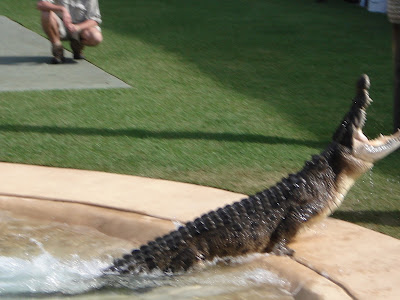
We spent about 5 hours in the zoo itself, 2 hours of which was taken up by a spectacle in the Crocoseum - a 3000 seater stadium-like structure in the heart of the zoo - where we saw a bird show, snakes, elephants and of course crocodiles. Well, a crocodile. A bloody great saltwater beast that would make you shiver:
The show had a very strong conservationist message in it, as well as pointing out just
how easily the threat of crocodiles is dealt with compared to many other predators. I think this is what Irwin was interested in getting across: they might look like monsters, but they've been around for a very long time, they've earned their place in the ecosystem, and we should give them the respect and protection they're due. And finally we heard phrases like "Steve's memory" and saw a wall of khaki shirts with messages of condolence and support. And in fairness to the Australia Zoo, it was all done in a positive, upbeat way - like applause at an actors funeral.
Other notable sights in the zoo were wombats that actually moved around. We've been to three other places where wombats were potentially available to be seen. In each and every place the said wombat was comatose and arse to the window. In Australia Zoo, the wombats were frolicking with the staff, practically playing catch. I asked a keeper how this was so, and she explained that their wombats were effectively trained to stay awake during the day, and would sleep all night, which struck me as a strange thing for a zoo to do to a nocturnal animal.
Another creature that was more lively here than elsewhere was the koala. These fellas get so little energy from they gum leaves they eat that they can barely stay awake for more than 6 hours a day. They make Giant Pandas look like gym nazis by comparison. But here, our jaws dropped to see koalas moving around trees (despite the fact that there were plenty of perfectly fine leaves to be had where they were) and on one occasion, get down onto the ground and move to a different tree. I suspect genetically modified eucalyptus trees, with caffeine added.
We also had another close look at a kookaburra, and I got a picture to show readers of this blog why having three of them perched at your shoulder and eyeing up your beef lasagne can be a disconcerting experience. Take a look at the bill on this guy:

The girls had a good day out, and learned lots. They dwelt a while on the unfairness of Irwin's sudden death, feeling very sorry for Bindi, his daughter who would be about Nina's age. Life can be desperately unfair, and it's good to learn that early on. It either prepares you for what can be thrown at you, or makes you damn glad of what you have.
The news reached our home in Cork of course, and Nina and Sara were put out, and not a little puzzled, by the fact that the Crocodile Hunter they enjoyed watching on TV was dead. 18 months later (on Sunday last) we headed North from Brisbane on the the Bruce Highway, turning off onto the recently renamed Steve Irwin Way to visit Australia Zoo, the home of the Irwin family, and the place where many scenes from the Croc Files were shot. You could hardly tell the poor guy was dead.
Posters and billboards of Steve were everywhere - outside, inside, on the huge 2-level Australia Zoo coaches in the car park. Big cardboard Crikeys all over the shop. The zoo literature made no mention of his death, and of course inside everything was business as usual. I didn't expect black armbands, but the experience was a little eerie none the less.
We spent about 5 hours in the zoo itself, 2 hours of which was taken up by a spectacle in the Crocoseum - a 3000 seater stadium-like structure in the heart of the zoo - where we saw a bird show, snakes, elephants and of course crocodiles. Well, a crocodile. A bloody great saltwater beast that would make you shiver:
The show had a very strong conservationist message in it, as well as pointing out just
how easily the threat of crocodiles is dealt with compared to many other predators. I think this is what Irwin was interested in getting across: they might look like monsters, but they've been around for a very long time, they've earned their place in the ecosystem, and we should give them the respect and protection they're due. And finally we heard phrases like "Steve's memory" and saw a wall of khaki shirts with messages of condolence and support. And in fairness to the Australia Zoo, it was all done in a positive, upbeat way - like applause at an actors funeral.
Other notable sights in the zoo were wombats that actually moved around. We've been to three other places where wombats were potentially available to be seen. In each and every place the said wombat was comatose and arse to the window. In Australia Zoo, the wombats were frolicking with the staff, practically playing catch. I asked a keeper how this was so, and she explained that their wombats were effectively trained to stay awake during the day, and would sleep all night, which struck me as a strange thing for a zoo to do to a nocturnal animal.
Another creature that was more lively here than elsewhere was the koala. These fellas get so little energy from they gum leaves they eat that they can barely stay awake for more than 6 hours a day. They make Giant Pandas look like gym nazis by comparison. But here, our jaws dropped to see koalas moving around trees (despite the fact that there were plenty of perfectly fine leaves to be had where they were) and on one occasion, get down onto the ground and move to a different tree. I suspect genetically modified eucalyptus trees, with caffeine added.
We also had another close look at a kookaburra, and I got a picture to show readers of this blog why having three of them perched at your shoulder and eyeing up your beef lasagne can be a disconcerting experience. Take a look at the bill on this guy:
The girls had a good day out, and learned lots. They dwelt a while on the unfairness of Irwin's sudden death, feeling very sorry for Bindi, his daughter who would be about Nina's age. Life can be desperately unfair, and it's good to learn that early on. It either prepares you for what can be thrown at you, or makes you damn glad of what you have.
Friday, March 28, 2008
Another Story
Brizzy, Brisvegas or plain old Brisbane. Whatever you want to call it, that's what we're calling home right now. We're being hosted in a Queenslander style house owned by Simon and Leah. This kind of house, as you may have guessed from the name, is typical of the area and it's main feature in the past was its raised nature. Back before air-conditioning was invented, the folks around here built their houses off the ground, to allow air to get underneath, and keep the temperature down indoors. Nowadays, modern versions of the style keep the idea of the 'raised' house, but use the space downstair too for extra rooms. Lucky us, because it's thanks to this space and Simon and Leah's bravery/foolhardiness, that we are able to stay here for the last weeks of our time in Australia.
Simon and Leah's reckless generosity and meticulous hospitality have made our time here a delight. Leah in particular combines a Monica-like effortless efficiency with a Phoebe-like devil-may-care coolness. And while Simon exudes Chandler-like wit, as readers of this blog will already have noted, he comes from the Joey Tribbiani school of acting (though he does a better German accent than Joey).
We're spending the time here in a leisurely enough way. We've been to the city a few times - we're based in Sandgate which is a 30 min train ride to Brisbane's central station - and have just spent 5 days on the road between Brisbane and Fraser Island, but that's another story.
The city of Brisbane is experiencing something of a boom at the moment. Simon told me that there were adverts circulating London calling on emigrant Queenslanders to return: 'the shops are open longer and men can drink wine outdoors'. Sounds like Ireland about 10 years ago (though I've just been told that it's all going tits over arse at the moment).
Brisbane, and Queensland in general, has a reputation among other Australians, as being a backwater. And I get the feeling that Queensland People are doing their best to dispel the idea. Queensland went through what looks like a grim time back in the 70s and 80s under a premier called Johannes Bjelke-Petersen who aside from being uber-conservative and racist was also lucky not to be jailed for corruption. And as I'm on the subject of no-subject-at-all-just-meandering-trivia, it's worth pointing out that the current premier of Queensland is called Anna Bligh, and is the great-great-great-great-granddaughter of Captain William Bligh, the unfairly maligned and mutineered commander of the Bounty who was also Sydney's fourth governor (where the poor sod once more found himself at the pointy end of a mutiny, this time leading to a two year 'rebel republic' in New South Wales). I've just finished a book called Captain Bligh's Other Mutiny, so I could go on, but that's another story.
On our first trip to the city, we got off at central, grabbed a bite to eat in a food court, before wandering down Elisabeth Street (the shopping area and Central Business District is in a little peninsular grid of its own, with female streets running east-west and male ones - George Street for example - running north-south.) This route took us through The Mall, which isn't a mall at all, but has wall-to-wall malls all around. (I'm beginning to read like Dr. Seuss - perhaps I ought to go to bed.) The CBD in Brisbane sports a few more adventurous architectural experiments some of which are pulled off nicely, but down near the Riverside ferry stop, the highrises are less imaginative and a little grim despite being evidently brand spanking new. Eventually we crossed the River Brisbane by the Victoria bridge, which leads to the Cultural Center: a riverside quarter that houses an art gallery, a science museum, library, and centre for the performing arts. The Australian skill of creating great museums, like in Melbourne, Sydney and Canberra, is also well in evidence here in Brisbane.

Story Bridge with Brisbane CBD and Botanic Gardens in background.
At the time of our visit there was an Andy Warhol exhibition. I'm an ignoramus of the visual arts, (but to my credit, I'm not proud of it) and the part of the gallery that I liked the most was the children's Warhol exhibition, and not just because it was free. It was set up to make learning about the artist as effortless and interesting as possible. Both Nina and Sara are into their art, so this was a big hit with them, but bloody hell I learned a lot about the man myself. One of the cooler things to do there was create your own Warhol-esque silk-screen portraits. I've included a few at the end of this post.
An interesting moment during the main Warhol exhibition: One wall was taken up with a series of portraits of a famous former statesman. Nina and Sara recognised him at once as being Mao Zedong. I doubt very much that they would have known that face before our trip to China, and even if they had, they wouldn't really be able to place him geographically or historically. It was a little bit of clumsy but concrete evidence to support the idea that they really are learning something about the world they live in during this trip. (On matters Chinese, two readers have asked me if I have anything to say about what's going on in China and Tibet at the moment. I do. But that's another story).
Nina
 Sara
Sara
 "Silly Daddy"
 I was trying to looked terrified but in the end I just look like I'm trying to impersonate a moose. A terrified moose perhaps. A moose, for example, who has just heard how much it would cost him to go to Uluru from Brisbane. But that, like much of this post, is another story.
Simon and Leah's reckless generosity and meticulous hospitality have made our time here a delight. Leah in particular combines a Monica-like effortless efficiency with a Phoebe-like devil-may-care coolness. And while Simon exudes Chandler-like wit, as readers of this blog will already have noted, he comes from the Joey Tribbiani school of acting (though he does a better German accent than Joey).
We're spending the time here in a leisurely enough way. We've been to the city a few times - we're based in Sandgate which is a 30 min train ride to Brisbane's central station - and have just spent 5 days on the road between Brisbane and Fraser Island, but that's another story.
The city of Brisbane is experiencing something of a boom at the moment. Simon told me that there were adverts circulating London calling on emigrant Queenslanders to return: 'the shops are open longer and men can drink wine outdoors'. Sounds like Ireland about 10 years ago (though I've just been told that it's all going tits over arse at the moment).
Brisbane, and Queensland in general, has a reputation among other Australians, as being a backwater. And I get the feeling that Queensland People are doing their best to dispel the idea. Queensland went through what looks like a grim time back in the 70s and 80s under a premier called Johannes Bjelke-Petersen who aside from being uber-conservative and racist was also lucky not to be jailed for corruption. And as I'm on the subject of no-subject-at-all-just-meandering-trivia, it's worth pointing out that the current premier of Queensland is called Anna Bligh, and is the great-great-great-great-granddaughter of Captain William Bligh, the unfairly maligned and mutineered commander of the Bounty who was also Sydney's fourth governor (where the poor sod once more found himself at the pointy end of a mutiny, this time leading to a two year 'rebel republic' in New South Wales). I've just finished a book called Captain Bligh's Other Mutiny, so I could go on, but that's another story.
On our first trip to the city, we got off at central, grabbed a bite to eat in a food court, before wandering down Elisabeth Street (the shopping area and Central Business District is in a little peninsular grid of its own, with female streets running east-west and male ones - George Street for example - running north-south.) This route took us through The Mall, which isn't a mall at all, but has wall-to-wall malls all around. (I'm beginning to read like Dr. Seuss - perhaps I ought to go to bed.) The CBD in Brisbane sports a few more adventurous architectural experiments some of which are pulled off nicely, but down near the Riverside ferry stop, the highrises are less imaginative and a little grim despite being evidently brand spanking new. Eventually we crossed the River Brisbane by the Victoria bridge, which leads to the Cultural Center: a riverside quarter that houses an art gallery, a science museum, library, and centre for the performing arts. The Australian skill of creating great museums, like in Melbourne, Sydney and Canberra, is also well in evidence here in Brisbane.
Story Bridge with Brisbane CBD and Botanic Gardens in background.
At the time of our visit there was an Andy Warhol exhibition. I'm an ignoramus of the visual arts, (but to my credit, I'm not proud of it) and the part of the gallery that I liked the most was the children's Warhol exhibition, and not just because it was free. It was set up to make learning about the artist as effortless and interesting as possible. Both Nina and Sara are into their art, so this was a big hit with them, but bloody hell I learned a lot about the man myself. One of the cooler things to do there was create your own Warhol-esque silk-screen portraits. I've included a few at the end of this post.
An interesting moment during the main Warhol exhibition: One wall was taken up with a series of portraits of a famous former statesman. Nina and Sara recognised him at once as being Mao Zedong. I doubt very much that they would have known that face before our trip to China, and even if they had, they wouldn't really be able to place him geographically or historically. It was a little bit of clumsy but concrete evidence to support the idea that they really are learning something about the world they live in during this trip. (On matters Chinese, two readers have asked me if I have anything to say about what's going on in China and Tibet at the moment. I do. But that's another story).
Nina
 Sara
Sara "Silly Daddy"
 I was trying to looked terrified but in the end I just look like I'm trying to impersonate a moose. A terrified moose perhaps. A moose, for example, who has just heard how much it would cost him to go to Uluru from Brisbane. But that, like much of this post, is another story.
Thursday, March 20, 2008
Cairns Part III: Cape Tribulation
The Cairns story so far: We had spent a day just hanging around the city, lounging around the fantastic Lagoon in the city centre, which is an public outdoor pool set up on the shoreline. The second day we checked out Kuranda, the third day we were (happily) rained into the hostel and sat out the day with books, nintendo and talking shite to the neighbours on 'our' bench, and the fourth day we went to the reef.
What I didn't mention is that in Cairns, as in Sydney and Melbourne, we had contacts. My brother-in-law Ivor's uncle (tenuous, I know) is living there with his wife and daughter, and when we made contact, Joe and Pauline very kindly invited us round for a barbie, picking us up from the hostel. The best thing, bar none, about traveling is meeting people, and Joe, Pauline, Finola and Jason were fantastic company and great hosts. I know Pauline is reading this blog - so thanks a million once more Pauline. You guys really helped to make our experience of Cairns more interesting, more fun, and very tasty (we had a roast beef dinner the second night! We thought we wouldn't see another one of those before Cork). 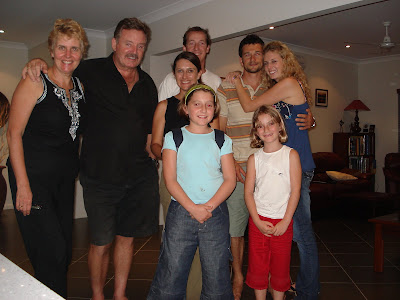
Our last big adventure in Far North Queensland was a trip - or an attempted trip - to Cape Tribulation. It got its name, as have many landmarks on the East coast of Australia, from Captain Cook, when the Endeavour came a cropper on the reef, and looked like it would go down. The dots were really joining up for me now - in Sydney's Maritime Museum a few weeks earlier, Nina and I were able to touch a big chunk of metal ballast that was recovered from the waters of Cape Tribulation. It, along with many other heavy items, were thrown overboard the Endeavour in an attempt to raise her in the water and get her off the reef. Captain Cook's tribulations ended well enough: using a technique called fothering, the damaged hull was effectively bandaged with a sail - enough for the ship to be brought to shore and repaired more thoroughly. It turns out that some of the coral that holed the hull had broken off and partially plugged the gap it had made. The crew had been very lucky indeed.
Our tribulations that day were less dramatic. The rain was coming down in sporadic but heavy cloudbursts, making driving conditions difficult (by now we had hired a small car with Cruising car rentals across the road from the hostel, and I can really recommend these guys). This was the second day of rain, and so we were concerned about getting trapped up on the Cape due to road closures. In the end, we made it into the Daintree rainforest, by crossing the Daintree river by ferry, but we only got as far as Cooper Creek:
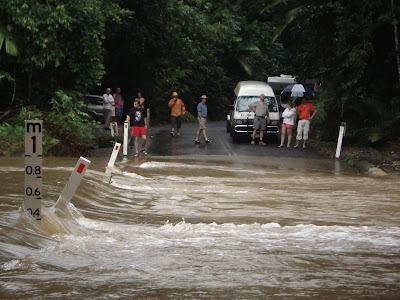 |
| From Daintree |
In our little Daihatzu Getz (again, I have to wonder who thinks up the names here, or what the world's greatest saxophonist has to do with 2-door hatchbacks) we weren't going anywhere. Better to get blocked on the hostel side of the road, than to be stranded (like the folks in the picture) on the far side. We turned back and headed to the Daintree Discovery Centre a few kilometers back. This a great place to stop off in and check out the flora (and if you're lucky some fauna - this is Cassowary country) of this particular rainforest.
Gary, when we were back in Sydney, had told us about something called the Stinging Tree. It would appear that even the plant life on this continent can be really mean. Well in the Discovery Centre - which was a treetops-and-trail tour of the forest - we got to see this plant up close. It's an innocuous looking thing, with fruit that look like raspberries, but each leaf is covered with tiny slivers of silicon (yes, glass) each with a chemical irritant. If you even lightly brush off these leaves, countless poison needles will embed themselves under your skin and hurt like hell. For months! There is no antidote. The information in the Discovery Centre talks of folks throwing themselves to their deaths from clifftops rather than deal with the pain anymore. There is even a story, (perhaps urban legend, if that term can be applied to the wild) of a soldier on manoevers who uses a leaf to wipe his backside. Now that's tribulation.
The rain continued to come down for the rest of our stay in Cairns, keeping us from venturing to any of the other sights like the crater lake, or the crystal cascades. Letizia and I promised each other that we'd come back. In the dry season. But for now, we found ourselves once more on a plane, this time flying South along the East coast of Australia, towards Brisbane.
After a few hours, the left-hand portholes where Letizia and Sara sat were in almost complete darkness. On the right, I could see the clearest, longest and most perfect sunset I have ever experienced. For thirty minutes, I watched the fires burning in rainbow colours along an endless and featureless horizon, the emotion heightened by the knowledge of how far into the distance the continent extended and knowing too that the sun's light which for me was just an afterglow, was now heating the African Cape. The shadow from the left spread under the plane and over the land below until it oozed to the horizon itself where, just as we reached Brisbane, it extinguished the distant fires.
Our airborne hops seem to have the same effect each time. As we leave one place, it is only with reluctance, but as we near our next destination, the anticipation is impossible to stifle. I suppose it is because in our journey so far, we have never gone 'home', we are always traveling to somewhere we have never been before, gradually moving eastwards, into the darkness.
Wednesday, March 19, 2008
Cairns Part II: The Reef
We didn't know it at the time, but the Tuesday that we picked to go out on the reef was the last bit of suitable weather that we'd see for the rest of our stay in Cairns. Lucky indeed, because the trip, with Passions of Paradise, was an unforgettable experience. It was a journey to a different planet, that even if it happened over a week ago, still replays vividly in my mind as I write this.
The weather wasn't perfect though. By the time we got to Michaelmas Cay (a cay is formed over thousands of years by the deposits of sediment on top of coral, as opposed to an island which is basically an underwater mountain), two hours out of Cairns, I was a little green around the gills. Odd really - I normally don't get sea-sick. I never got as bad as another Irishman on board, one of four lads from Wexford, who blew nautical chunks off the back of our 25m catamaran for the whole trip out (apparently he didn't know that day 3 of his tour involved boats). But despite the slight nausea, I was still up for the first dive of the day, the first dive of my life in fact (I did ask one of the crew what happened if you threw up into a regulator).
Our briefing from Simon was entertaining and informative. There were a few things to learn before getting under:
- Remember to keep breathing. Sounds obvious, but it's not such a smart idea to maintain two lungfulls of air and then move from a high to low pressure environment.
- Equalize. This does not involve helping innocent folks fight battles again powerful baddies or anything else that requires you to pretend to be Edward Woodward. It simply means holding your nose and blowing, just like on the plane, to balance the pressure on the eardrum.
- Clear your regulator. Once under water, but before the dive proper, we would have to demonstrate that we could take out the regulator (mouthpiece), put it back in, and clear the water from it by saying 'two', loudly into it.
- Clear your mask. Another underwater test. This time we would have to deal with water in our masks by holding on to the top of it, tilting our heads back, and exhaling though our noses. Again, the dive would only begin when we could demonstrate our ability to do this.
- Hand-signals: The side-to-side motion of an outstretched, down-facing palm - something you would use on dry land to mean 'so-so' - means 'Huston, we have a problem'. You can augment this with a subsequent indication as to where the problem is. You could point to your ear for example, to say that you are having problems impersonating Edward Woodward. Or to your ring-finger, to indicate that you were having relationship problems. Endless possibilities there, for idle sea-bed chit-chat.
So let's recap. I was about to embark on an activity for which I am biologically ill-adapted - it has been many millions of years since our ancestors emerged from the water (apologies to any creationists out there: I'm sorry you believe that crap). It could kill me faster than a shoe full of funnelwebs. But all I had to demonstrate was an ability to breathe, pinch my nose, say 'two', blow bubbles out my nose, and wiggle my hand. In short, I needed no skill whatsoever other than a complete inability to evaluate risk. THIS WAS FOR ME!!!!
The moment came. The instructors were models of poise and good humour. It was just a matter of walking off the end of the boat. Wearing a load in excess of the combined weight of our two samsonites. So that's what I did.
What I experienced is hard to describe: a combination of the excitement of the new, the weightless and speed of being underwater with fins, fireworks of coral and other aquatic life (fish, rays, giant clams, turtles, sea cucumbers) and yet a perfect ease that I felt down there. The overall impression I was left with was a craving for more. Despite spending 2 hours on the way back to Cairns with my eyes closed and my stomach in my mouth, wondering if I was going to join the Wexford man on the back of the boat.
But before I finish, let me just add that what I saw under the water may be all gone in 50-100 years time thanks to the combined effect of trawling, and you guessed it, global warming. I can't tell you how much more that sucks close up in real life than on paper.
Tuesday, March 18, 2008
Cairns, Part I
The decision to go to Cairns was a last-minute brainchild of Letizia. We were able to fit it into the air miles of the round-the-world tickets, without too much extra expense. Having spent 8 days there, I can say that it would have been a travesty if we had not gone there. It's so different to anything we had seen in NSW or Victoria, and shouldn't be passed over. We're already wondering when we're going to get back.
Our Quantas flight swooped in over rainforested hills and came to a stop next to a very small airport. It could have been Africa (well, I've never been, but the couple next to me, who had been, agreed with my suggestion). When we got off the plane, the humidity hit us immediately, but it wasn't anything too severe, comparable to Sardinia.
The bus from Castaways Backpackers, driven by Amanda (from England) came to pick us up, and 10 minutes later we were moving in to room number 17. We don't look very backpacker (especially not with 2 samsonites along with the 2 rucksacks, various knapsacks and of course two daughters) but the place felt like home very quickly. And when I found out the price, we were to pay I was even happier with the arrangement. It was the cheapest room since Sim's Cozy Guesthouse in Chengdu, China. AU$55 dollars for a family room, with its own ensuite. Mind you, we did have to kill the previous occupant of room 17 - a secretive individual by the name of Periplaneta Australiasiae.
We had only one mission in Cairns - get out on the reef. Like getting a tattoo, you can either do this well, or do it cheaply. Not both. So while we took some time picking a day and a tour operator, we headed on a day trip to Kuranda, a tourist town on the Atherton tablelands West of Cairns. The idea was to amuse ourselves around the town's markets, visit the butterfly sanctuary, and take a scenic tour down. I wasn't expecting too much from the day - it was just a filler after all. But it turned out to be a fantastic time, mostly because of this:
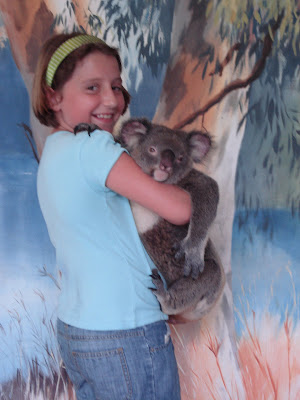
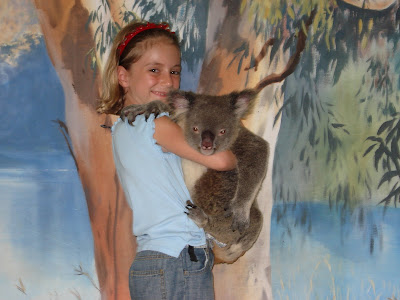
We had come close to koalas in Sydney, but touching was out of the question, let alone cuddling. It took a very long time for Nina and Sara's smiles to fade after this experience.
Kuranda is definitely a tourist town (I hesitate to say trap) but a pleasant one. The atmosphere is still very calm, and there are plenty of things to do, including a 45 minute cable car ride up (we didn't do this), an easy rainforest walk, and a scenic train ride back down to Cairns that leads past the Barron Falls.
The falls were beautiful, but I would have been happy for the train to have taken half the time it did. We were well cooked by the time we reached the city and headed back by foot to Castaways. As we did, the rainclouds gathered. We were rained in for the entire next day but that was just fine with us. After a dash up the Victoria and NSW coasts, then the flight to Cairns, we were more than ready for some down time. We sat on 'our' bench outside room 17 and got to know our neighbours - 2 Canadian girls from Edmonton, Alberta. They very patiently listened to a whole load of crap from me - must have made venturing out into the heavy rain start to seem appealing.
The next day - our third - the weather was due to be better. So we finally settled on a reef tour operator. We were going to Michaelmas Cay with Passions of Paradise, to get our heads underwater. More of that in Part II.
A little audience participation, please...
We have a hard decision to make. We've left visiting Uluru (Ayer's Rock) until the last moment, and it wasn't such a smart move. It costs a lot to get there from Brisbane. So we are on the horns of a dilemma: Do we go there, and blow the Australian budget by about 2000 euros, or do we let it go and leave Australia without having seen one of its most iconic sights?
There's a survey gadget on the right of this blog, so feel free to vote. In the end, we'll make up our own minds, but we'll take on board your advice. If you have detailed comments to make, rather than just a vote, feel free to attach them to this post.
Please be aware that if you vote 'yes', and we become destitute as a result, you may have to give us food and shelter on our return.
Monday, March 17, 2008
Southern Hemisphere Physics Experiment
Silly season is back.
I really meant to run this experiment as soon as we got into our apartment in Sydney, but I guess I needed somebody as, well, daft as myself to give me that extra push. We're staying with Simon and Leah Pett in Brisbane right now (some of you in DSI may remember him), and guess what? Simon fits the bill perfectly!
The more detailed, and let's face it, boring details that confirm our findings can be found here.
Soon to come: If I am standing on the Southern Hemisphere, do I fall off? (Hint: no)
I really meant to run this experiment as soon as we got into our apartment in Sydney, but I guess I needed somebody as, well, daft as myself to give me that extra push. We're staying with Simon and Leah Pett in Brisbane right now (some of you in DSI may remember him), and guess what? Simon fits the bill perfectly!
The more detailed, and let's face it, boring details that confirm our findings can be found here.
Soon to come: If I am standing on the Southern Hemisphere, do I fall off? (Hint: no)
Sunday, March 16, 2008
Melbourne to Sydney via the coast
Our first stop was Bega. They make cheese there, but it doesn't smell. Neither the cheese nor the town. It was just somewhere to stay to break up the journey to Depot Beach further North. There's not much else I can tell you about the place other than it was an 8 hour drive from Melbourne. Despite the name of the route, you don't see a whole lot of coast for most of the time. Actually it's really called Princes Highway, but you don't see any of them either.
It's a great drive though, much more interesting than the more direct Hume Highway. The landscape changed from red earth to dairy pasture as we moved though towns along the way, stopping every 150km or so for coffee or a meal: Yarragon, Lake's Entrance, and Cann River, before finally pulling up outside the Grand Hotel in Bega. Now the word 'hotel' in Australia usually means 'pub, with some rooms upstairs'. And we knew that and had no inflated expectations. But in this case the word 'grand' was not intended to mean 'Large and impressive in size, scope, or extent; magnificent'. It carried the more Irish meaning, as in 'ah feck it, it'll do grand'. I don't think I even took the car out of gear (let alone the gear out of the car) - we headed back to the motel we saw as we entered the town, the Southtown Motor Inn, a family-run operation, where we were very well looked after. The hundred dollar family room included the ability to watch videos, so the girls settled in to watch George of the Jungle, a truly abysmal movie which the girls duly gave the thumbs up.(I spent most of it trying to remember where else I had seen the actor who played the vain and stupid bad guy Kyle - before remembering that he played the vain and stupid trying-to-be-good guy Jack in the truly excellent Sideways).
The morning we checked out, I was sharing a joke with the lady of the house. She told me that she was from the New South Wales outback, near the dish in Parkes. They packed in everything to start up the hotel in Bega. She was clearly getting itchy feet again, but wasn't sure that she could convince her husband and son to make another move. "Have you seen any snakes?" she asked. Before I could answer, she presented me with a jam-jar containing a baby snake - dead and floating in meths - to show Nina and Sara. The cat had killed it recently. It was a Brown Snake, which despite the innocuous name is a highly venomous killer. When Letizia heard the story she was well impressed with the cat.
From Bega, we had a very short drive of about 120km to Bateman's Bay, and than beyond to Depot Beach, where Jamie had organized two nights in a beachside cabin. The drive was entertaining. I'm used to winding roads from back home in Cork, but here there were two extra elements: the up and down of the hills, and road cambers angled like the Indianapolis racetrack. It had everything that air travel can offer: pitch, roll and yaw.
Depot Beach has a great far-away feel to it, without actually needing to go the the GAFA (see glossary). It's run by the National Park which means that during the week, and outside of school holidays, the two-bedroom chalet only cost 100 dollars (70 euro) per night. We arrived to discover that our front garden was where all the roos like to sun themselves during the day. There were 10 or so of them, in various stages of languid indifference to the surroundings. The sight of a carload of pouchless, tiny-footed omnivores (ahem, that's us) didn't change anything.
During our stay in Depot Beach we played a game of Monopoly (a 'discovery' made by Nina and Sara in the Threadbo Youth Hostel) which lasted for 2 nights and finished with Letizia and I going bankrupt. I hope this doesn't presage our financial position when this trip is over (I don't think so - we are still on budget). Even if we do go bust, based on Nina and Sara's property speculation skills, and ruthless business practices, we should at least get a reasonably comfortable senior citizens' home.
We collected shells on Depot and Pebbly Beaches, when the rock pools are stunning. On either side of these sandy beaches lie flat tables of sedimentary rock (see Letizia's post for pictures). At least I think that's what you'd call this fruit-cake rock with currents of gravel and large stones, embedded into a dark substrate. The tide has been steadily undoing the stone so that now, the table is run through with fissures and pocked with holes, some perfectly circular, that hold on to the seawater when the tide is out. Each rockpool is decked out in its own way - some seem like carefully arranged compositions - and they all contain their own miniature landscapes. While the girls mostly searched for shells, I allowed myself to become transfixed by one rockpool after another, taking my time on each one. We weren't going anywhere in any hurry and I could spend as much time as I liked, almost in a trance. It had the advantage of being cheaper and less risky than using controlled substances.
We met or spoke to nobody during out time in Depot Beach, but at mealtimes on the veranda we did have company: the kangaroos came even closer, and the parrots joined us for dinner. They landed on my shoulders and wandered down my arm in search of food. Nina and Sara eventually hand-fed them crackers. The party was broken up by the local ruffians: three kookaburras buzzed us, flying across our table, wingtips in our faces, taking up positions on the railings of the veranda, centimeters away. The parrots legged it (well, winged it really). Kookaburras are big buggers, and carnivores too. They couldn't give a damn about the crackers and were more interested in the beef lasagne. There was a very uneasy standoff for a while - just picture big hairy bikers turning up at the vicar's village fete. I finally took the situation in hand by wielding my trusty foil - actually a roll of tinfoil - in the beaks of the gatecrashing birds. It was pathetic. Despite timourous nudging, the beasts remained unfazed, perhaps even a bit emboldened. I tried a different approach. According to Billy Connelly, the one thing in the jungle that lions fear is the chair. That's why lion tamers are seldom seen in the cage without them. I applied the same pristine logic to the kookaburras with moderate success. I was able to give the girls enough cover ("back, back I tell you") to clear the dishes indoors. We closed the sliding doors to the veranda and continued our meal inside. The birds watched us in our glass cage for a while, unlaughing, before getting bored, and presumably hungry, and flying off. I, in my role as indignant vicar, began to smoothen my ruffled feathers.
Princes Highway rolls through the highways, mercifully bypassing Wollongong (current home to a sordid financial and sexual political scandal), and traffic-lighting its way though Sydney's Southern suburbs, before finishing up in Newtown and leading onto King's Road, where Duncan had previously given us a tour. We had a coffee at Duncan's local there (texting him a thumbed nose as he was working in Melbourne that day) and continued to Rozelle where we were staying with Ludi and Gary (later to be joined by the previously insulted Duncan, fresh from the airport) for our Sydney last supper. Our last evening in Sydney was passed in the best possible way - in the warm glow of friendships that have survived time and distance. And not a kookaburra to be seen.
Saturday, March 15, 2008
Melbourne
After 5 weeks in Sydney, and a palate-cleansing four days on the road, it was time to taste the delights of Melbourne. Comparisons are odious, but so is this blog, so I'm not going to avoid comparing the two cities. But before I do, let me point out how wildly inaccurate any of my conclusions are bound to be. (You probably knew that though.) We were to spend a paltry 5 days in Melbourne, we were mostly interested in catching up with our friends Jamie and Francesca (who also kindly hosted us for the duration of our stay, and for whom those 5 days must have been anything but paltry - thanks again guys) rather than 'doing' Melbourne. I also had the pleasure of catching up with my first cousin Carol, her husband Andy and daughter Jasmine. And on top of that, we also had the undiluted pleasure of Darragh Ballesty's company, and his friend Caroline. What I'm trying to say is that our stay was all about meeting friends, and Melbourne in a sense was merely the backdrop.
We were based in Albert Park, a city suburb named for its principal feature: the public park that once a year plays host to the F1 Grand Prix (this weekend in fact). I never did get to drive the course in my rented Hyundai Elantra (where do they come UP with these car names!!?) but I did walk across it on the way to the playground with the kids. If you had asked me ten years ago, I would have given you very long odds indeed on such a reversal of priorities.
The city feels entirely different to Sydney and simply doesn't make that kind of instant emotional impact we experienced in Circular Quay. How could it? There may be no other city on the planet capable of that effect. I am told by those who should know (and whom I unquestioningly believe) that you need to live in Melbourne to appreciate it. It offers a different pace of life to Sydney, but at the same time a higher percentage of cultural and artistic activities. To me, it seemed much more like a town with a British identity. The St. Kilda sorts the kind of pier you'd expect to find in Blackpool or Brighton (and not the Brighton located a few km south in Melbourne itself).
Walking around the city centre, near Federation Square and Collins Street, the difference with Sydney is clear. The people are whiter, the pretty buildings are prettier, (the ugly buildings are uglier), the streets are narrower and more intimate. Cafes are tucked into the even narrower alleyways, so you never quite know what you are going to see next: A jazz band, a street performer, another ethnic eatery (Melbourne's cuisine is reputed to be the best in the Southern Hemisphere). Trams move up and down the streets - as opposed to Sydney's trannys - some of them old and beautiful, others modern and menacing (the trams, not the trannys).
I had heard about Melbournes megalomaniac trams, that brook no resistence and take no prisoners from cars or pedestrians. Their absolute priority at some junctions has led to strange right-hand turn rules for cars. In Oz, you drive on the left, but instead of waiting on the innermost lane to turn right, you pull all the way over to the left, leaving space for the dreaded trams, until the traffic lights allow you to complete your manoevre. The detail that I was missing was that the signal to complete the righthand turn is the amber light. This means that if you are going straight on through a Melbourne traffic light, you better not do it on amber. I got a brake-screeching, heart-flopping lesson in Melbourne's rules of the road on our first day. Our rental car had Queensland plates - I think I haven't done the reputation of that state any favours.
We were based in Albert Park, a city suburb named for its principal feature: the public park that once a year plays host to the F1 Grand Prix (this weekend in fact). I never did get to drive the course in my rented Hyundai Elantra (where do they come UP with these car names!!?) but I did walk across it on the way to the playground with the kids. If you had asked me ten years ago, I would have given you very long odds indeed on such a reversal of priorities.
Jamie and Francesca's house is located on a street that has everything they need: park, school, shops, cafes. In this regard, life in Melbourne is very much like that in Sydney - people tend to stick to their own village. J&F can't go beyond the front door without meeting people they know. Walking from their front door to the bottleshop (off-license) and back with Jamie, I felt I had been caught up in a scene from West Wing. Characters came in from the left, words were exchanged on the hoof, then exit, stage right. All we were missing was a steadi-cam operator in front of us - and probably, let's face it Jamie, a sharper dialogue ;-)
Like Sydney - and Canberra - Melbourne has a lot of excellent museums. Regular readers of this blog might think that we - especially the children - have had our fill of museums, but nothing could be further from the truth. The quality and variety of museums here is very high, but the cost is low, in some cases zero. In a county like Ireland, with a wealth of social and natural history behind it, and hopefully a future tied to high technology in front of it, there really should be a lot of public money put into creating environments like these. Especially for kids.
In Cork, there is one small science museum, and a new observatory museum in Blackrock. But there are a dozen or more indoor playgrounds which dwarf these museums. On a rainy day, wouldn't it be wonderful to check out an undiscovered corner of a museum as a viable alternative to a playground? The entry price of Aussie - and especially Melbournian - museums makes this possible. Kids get in for free in many places, and adults pay just 6 australian dollars (4 euros). A museum, which despite the name can be an exciting place for kids if built and run properly, can inspire researchers of the future.
We left Melbourne on a Monday morning, the first Monday of March (have we really been on the road since December!?) and headed back to Sydney, this time via the coastal route of Princes Highway. It would take 3 nights to get to Sydney where we would get to spend one last evening before heading to Queensland.
Tuesday, March 11, 2008
Out of Sequence: Inner Space
We're in Cairns, and I haven't even blogged on Melbourne and what came after yet. But I couldn't resist: We've just come off the Great Barrier Reef, and I've experienced scuba-diving for the first time. For a change, I'll just let some pictures do the talking.
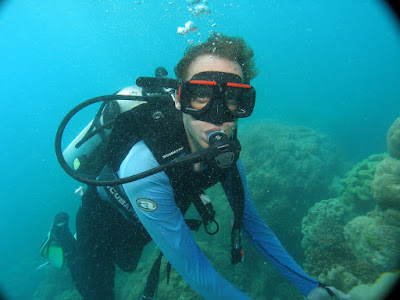
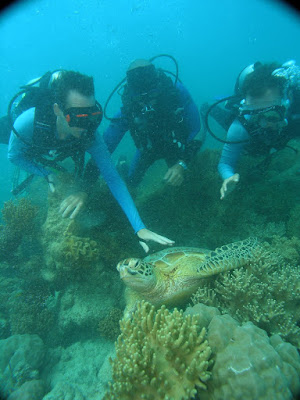
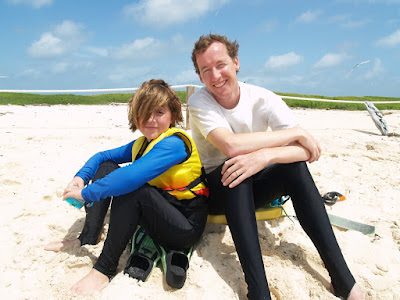
Thursday, March 6, 2008
Sydney, looking back.
(This blog entry is dedicated to my good friend Darragh Ballesty, who met up with us in Melbourne, and took the opportunity to point out how pretentious my blog was getting. As it happens, pretentious is precisely the tone I am aiming for, but it was great to get confirmation in person from a devoted reader. Darragh, this note's for you... ;)
Travelling at the stern of a boat, you get a blinkered view of what's about you. New scenery arrives fully formed and out of nowhere, rather than slowly evolving from a distant speck. You are granted time to sit and consider what you see as it moves gently away from you. There is a certain thrill of course, of standing at the bow instead, with the wind in your face and 180 degrees of possible directions, but it leads to the irisistably tempting belief that you have some control over your destination.
Travelling at the stern of a boat, you get a blinkered view of what's about you. New scenery arrives fully formed and out of nowhere, rather than slowly evolving from a distant speck. You are granted time to sit and consider what you see as it moves gently away from you. There is a certain thrill of course, of standing at the bow instead, with the wind in your face and 180 degrees of possible directions, but it leads to the irisistably tempting belief that you have some control over your destination.
We sat on the back of the ferry a couple of Mondays ago on our way to Manly, on Sydney's North Shore. Manly was famously named by Arthur Phillip himself, on seeing some particularly virile looking Aboriginal standing there. Looking to the other bank, this position is helping me confirm my feel for Sydney's Southside geography. The city is a gently rolling low-rise disc with the Central Business District acting as the centre and skyscraping axis that holds it all together. This is the great unsettling confusion I feel in Sydney. I don't know whether I'm in a city or a small town, or a beach resort, or a great port. The skyscrapers live easily alongside the spectacular harbour, and the gardens and parks. The small villages of Newtown and Rozelle still have an urban atmosphere - that unmistakeable mix of self-confidence, and relaxed openness. Bronte and Coogee beaches are teeming with surfers, swimmers and posers, generating an ambiance of their own. Enormous cruiseliners pull into the very heart of the city, towering above the quayside buildings, but dwarfed by the harbour itself. All of these Sydneys are linked by buses and trains that bind this spinning disk together, and allow it to remain as one.
Once you head too far south, west or north, I imagine the city life loses much of its appeal. The energy and expense required to sample the delights I've mentioned above become prohibitive, and you make do with your own local amenities. The cost of property with even a glimpse of water is enormous and so those who live in the real Sydney still have to make great sacrifices for that pleasure. But I can't think of a city in the world to match it. "Ah - but it's so far away from everywhere else!" people say. No. Everywhere else is so far away from it.
In Manly, we strolled down the pedestrian street that links the harbour beach to the ocean beach, and settled down for lunch next to a Scotish couple who had made Sydney their home a long time ago. Like almost all Sydneysiders we met, they were very happy with the place, other than the high rent. They used to live in Manly itself, but moved up North to get a bigger living space. How did they deal with the presence of creepy-crawlies, I wondered, given that they were not born into it. "It's the lizards I can't stand" said the lady, much to my surprise. I told her how even in Europe we had lizards (thinking of the gekkos in Sardinia) and then went on to boast about how they didn't bother me at all. Surely I was prime Aussie material. "Well these lizards ate my pet rabbit" she mentioned (get back in your box, Paddy).
At the end of our day in Manly, we took the ferry South and West towards Circular Quay, still at the back of the boat (actually, the boat had bows on either end, a water-going pushme-pullyou). Looking back, North Head and Watson's Point at the mouth of the harbour seemed to converge from opposite shores, and eventually join. Nostalgia, that unrequitable love for a time and place gone by, is the other great Irish disease. I couldn't help but interpret the effect as a last embrace from the city we were about to leave.
How's that for being up myself, Darragh ;-)
Wednesday, February 27, 2008
Melbourne, via the Snowy Mountains
It's been a fast and almost completely offline 4 days from Sydney to Melbourne, via Canberra, Threadbo and Rutherglen. But we're in Melbourne now for a few days - enough to collect our thoughts about the stay in Sydney and the trip from there to here.
Canberrra was surreal. It's name means Meeting Place in some unspecified Aboriginal language, and it was build out of nowhere when the newly federated states of Australia, in search of a capital, couldn't chose between Sydney and Melbourne. Our first impression of the place was 'where is it!?'. We were approaching the city, about 7km out according to our map, and all we could see was bush. Then, when we rounded a corner, we say the Telstra tower on Black Mountain poking from over a hilltop. Five minutes late we were in downtown Canberra. It's not a particularly small place (300,000 residents) - it's just, well, sudden. The city is a motorist's dream and a pedestrian's nightmare. I'm not surprised it wore out Bill Bryson. There are arterial avenues spreading into every district (in fact the borders of the districts are very clearly delineated by those avenues) from which then spread neat and, where possible orthogonal streets, all lined with houses or occasionally businesses. We booked two nights in a quarter of the city called Kingston - apparently one of the livelier ones with a good cafe scene. We found the block of cafes and restaurants not far from our B&B, but it really was nothing special. Windswept, predictable and without any atmosphere.
After checking in, we went to see the truly wonderful National Museum of Australia, where my favourite section was the one entitled Nation. One corner was dedicated to the way Aussies speak English. Letizia has already blogged on some of her favourite items of Australian vocabulary, and here was a museum exhibit that showed, in interactive and multimedia formats, many of these items, and even their etymology (I learned that the famous 'Sheila', meaning 'woman' came from the Irish name Sile). The building itself, its layout, design and interior made it a pleasure just to be there.
On day two in Canberra - a Sunday - we started with a visit to another excellent museum, this time the Questacon. It's a science museum, the kind that Nina and Sara claim to like the most. It was very good indeed, and we passed 3 hours in there with ease, but in the end, the best museum of it's kind that I've ever brought the kids to is Edinburgh's Our Dynamic Earth (though I haven't been to London's much acclaimed science museum.
While I'm on this subject, I'm reminded of our trip to Shanghai's equivalent, which was a terrible disappointment. Much of the content was given over to manned space flight, now that China has entered this exclusive club, but all the interesting related exhibits were closed. What remained felt like propaganda. There was an exhibit on pollution, which caught our attention. I was interested to see what official China had to say about the matter. I was shocked - the section on air pollution talked about the poor quality of air in London and Los Angeles. We had just spluttered in from Chengdu where visibility was down to 5 blocks for the duration of our 4-day stay. The only mention of Chinese pollution was the issue of the Suzhou Creek, and even that exhibit was all about the great strides that had been made to reclaim it.
Anyway, for the rest of Sunday we wandered around the Australian Commonwealth's capital looking for all the people (cue Madacascar: 'We bozos got the people, but they're not a very lively bunch'). We found them eventually, split over two groups. About 40 of the them spread around 4 cafe's in the corner of the central pedestrian zone. Mostly students, probably half of them visitors. At this point, Canberra reminded us of Stuttgart after 5pm before they liberalized the shopping laws. Concrete, empty, clean, and with a few well-hidden corners with some life stubbornly clinging on. The rest of Canberra was visiting the Sunday market in the Old Bus Depot right on the edge of Kingston. It was clear from the faces of those perusing the stalls (containing the largest variety of materials and styles for toilet roll holders that I have ever seen) that they were there not to be amused, but to be consoled. Consoled that neither Sydney nor Melbourne had been chosen to be the capital of Australia.
NEXT!
Threadbo. This isn't so much a town as a resort. Nestled at 1300m in the Snowy Mountains, it's a ski resort during Winter and a bush-walking centre in the Summer. We took a skilift, and then walked for 2km to reach a height of 2000m from where we could see the highest point in Australia - Mount Kosciuszko (2200m approx). Another 4km walking would have taken us to the summit, but most likely to the hospital as well, so we admired it from a distance. My Polish neighbours (hi Pavel and Gosia!) will recognize the name - it's a Polish hero general. The mountain was given its name by a Polish explorer as he felt the peak resembled the tomb of the general. As peaks go, it's not terribly high, but this is an indication of how ancient this continent is - how geologically stable it's been. The peaks would have soared much higher after their birth, but eons of wind and rain have worn them away. A similar erosion of your budget and patience will take place if you hang round in Threadbo too long. We had one meal there, put paid as if we had three. My pizza both tasted and cost as if I had scraped the contents of my wallet onto a pizza base. Other choices were similarly unhappy. Try as we might to rearrange our plates between the four of us, we could find no configuration that would satisfy more than one person around the table (i.e. whoever ended up with the Chicken Schnitzel).
The scenery around Threadbo and on the road from Threadbo to our next stop, Rutherglen, was out of this world. Almost literally. We moved from deep eucalyptus forest, with the occasional roo or wallaby peering through the treeline, to red earth and bare trunks (and the strange view of Lake Hume, very low, dotted with tree trunks, similar to a lake on the road between Cork and Guganbarra) and then eventually vineyards and pasture land. We pulled into Rutherglen 3 hours after departing Threadbo, looking forward to slowly sampling some of the local wines. And that's exactly what we did. We picked a motel (which turned out to be the cleanest, most comfortable and best value accommodation of the 4 days, Motel Woongarra) and went to two local wineries (there are about 20 to choose from). After a quick splash in the pool, we headed into town for a simple but filling meal in the Poacher's Paradise, and had even more wine.
So we're in Melbourne, looking forward to converting another abstract name into a real place, and building up a mental model of life here. After this, we'll return to Sydney by the coastal route, for one night, before taking a flight to Cairns. I hope to blog once more on the Sydney experience soon.
PS: In order to spread the pain of this blog even further, I've started writing a once-fortnightly article for the Carrigdhoun - a local newspaper that covers a lot of south county Cork. The first one, on Beijing, came out on Tuesday.
Subscribe to:
Posts (Atom)