Since we've left Ireland almost 6 months ago, the Irish people gave Bertie Aherne an early bath, albeit indirectly, and now have rejected the Lisbon Treaty as well. The best political commentator I know (that's you Jim if you're reading) predicted a year ago or more that Bertie would finally have to go if and when the economy started to splutter, and I'm in no doubt that he was right on this. I wonder if the fact that it continues to splutter, belch and occasionally fart is partly responsible for the treaty's rejection as well. In any case, the Irish had the opportunity to decide whether the Treaty was a good idea or not, and their voice was duly heard, even it it's hard to tell what it's saying.
The Lisbon treaty was negotiated and redrafted over years by expert civil servants and lawyers, translated into every official European language by dedicated teams of polyglots, and debated for months by various national parliaments and the Irish electorate. The Treaty of Waitangi (1840) by contrast was drafted in 4 days by three men (and not one of them a lawyer), translated badly by a missionary, and debated by a subset of Maori chiefs, none of whom really had the authority to sign it on behalf of their people, and for whom many of the concepts of modern statecraft meant nothing. But sign it they did, and in so doing transferred sovereignty of the islands of New Zealand, considered at that point to lie in the hands of the United Tribes of New Zealand, to Queen Victoria of England.
That the United Tribes of New Zealand was non-existent in any functional sense didn't seem to matter. There was no political union under Maori - the Maori name for New Zealand (Aotearoa) was unlikely to have been used by Maori, and was probably a romantic invention of European missionaries. The very word Maori was only coined by Maori as a way to distinguish themselves from the Pakeha (Europeans), and means simply 'ordinary' or 'normal'.
That key words from the treaty like, em, sovereignty for example, were translated badly (and inconsistently with previous English/Maori documents), was overlooked or ignored.
British motives behind the treaty are interesting to look at. It's easy to imagine the Treaty as the product of rapacious imperialism, but the kind of people behind its creation (James Stephen, Lord Glenelg) were those who pushed successfully for an end to slavery in the British Empire. Conditions for the Maori had become particularly difficult since whalers had started operating from New Zealand's shores, and it was felt that something had to be done to protect and conserve New Zealand for the Maori. But the unseemly haste, which made the treaty such a flawed document, was driven by baser motives: a race against time to prevent The New Zealand Company from seeing though its plans of 'Systematic [private] Colonisation' of the islands. And the way in which colonisation was seen through was far from the 'New Zealand for the Maori' sentiments nurtured by the Treaty's creators and sponsors. Settlers and Crown authorities often interpreted the treaty in ways that favoured Pakeha over Maori, or else disregarded the provisions of the Treaty entirely.
The very fact that there was a treaty at all is another indication of the difference between the fates of Australian aboriginal and Maori societies (no - I'm not through with this topic yet). A treaty was required because New Zealand, unlike Australia, was not deemed to be Terra Nullius by the British. It was occupied and defended in a way that Europeans could related to. Farming was well established, and a continuous state of war between tribes, with alliances chopping and changing regularly, meant that the technology and organisation available to Maori for their first contacts with Europeans was enough to keep them at arms length for quite a while.
Tasman arrived in 1642, lost four sailors to Maori spears, and buggered off. A full 127 years passed before the next European explorer, James Cook, passed by, and despite his famous ability to negotiate with locals, and the advantage of a Polynesian language speaker on board, still managed to get into several skirmishes. Although the Maori came off worst in these clashes, the belligerence of the natives was reported back to London and surely had some influence on the selection of New South Wales over New Zealand as a suitable place to set up a penal colony. And that relative proximity of a British outpost in Sydney just 10 years after Cook's voyage allowed the Maori to build up a relationship with London gradually. Sixty years passed between the settlement of Sydney and the Treaty of Waitangi, during which there was much trade and exchange of people, and the gradual establishment of private whaling stations on New Zealand coasts.
For the first New Zealanders, almost 200 years passed between first contact with Europe and final colonisation. Compare that with 10 years for the Eora people of Sydney, and consider also that Australian colonisation took place without a treaty, and with complete and total disregard for the First Owners of Australia. No provision was made for the protection of their rights or property, as happened in New Zealand. Although technically subjects of the Crown, those who attempted to repel the invasion of their lands were officially considered on a par with enemies of the state. This ambiguity in law left the Aboriginals to the tender mercy of settlers, by whom they were considered at best competition, and at worst, vermin. I've already mentioned the fact that Australian aboriginals were still hunter-gathers, given Jared Diamond's reasons for why this was so, and outlined how this left the Aboriginal less prepared, technologically and socially, for invasion and sustained warfare. This lack of preparedness, the speed of colonisation, and its ferocity, meant that Aboriginal societies in Australia (and in the case of Tasmania, even the population itself) were destroyed. And it's not at all clear to me if they will ever recover. It was an exact analogue of what happened to the Moriori of the Chatham islands, except in this case the both the aggressors and the vanquished were Polynesians. The Maori suffered terribly but were able to defend themselves better and their society was not dealt quite the same killer blow and in the case of Australian aboriginals.
Through a mixture of base and noble purposes, the Treaty of Waitangi was more or less thrust upon the Maori, but I wonder what would have happened if it had not? The fates of other Polynesian peoples, under the "broad sweep of history" that Jared Diamond describes in Guns, Germs and Steel which I blogged about recently, was varied and ranged from absolute annihilation to a retained and functioning independence. There's no safe assumption that things would have been any better for the Maori without Waitangi.
The unity of Europe was conceived with noble reasons - to end the wars that had raged between the constantly switching alliances of European tribes, to protect itself from external aggression, and to create and environment suitable for mutual prosperity (some of which seems remarkably similar to the situation that pertained amongst Maori before Waitangi). Europe has rejected unity attempted in the past by horse, sword and panzer, until it's more recent acquiescence to the pen. The Treaty of Lisbon, written in dense legalese and referring to many other previous treaties, may have been effectively just as open to misinterpretation (and misrepresentation) to Irish voters as Waitangi was to the Maori. It might have been put in force over the heads of all EU countries other then Ireland. I'm happy we had our opportunity to vote on it, but I think that the arguments for the treaty was made very badly indeed, and I'm not sure sure that we'll be any better off for having rejected it.
Showing posts with label aboriginals. Show all posts
Showing posts with label aboriginals. Show all posts
Monday, June 16, 2008


Monday, June 9, 2008
How not to be a Racist
When Europeans first went sailing around the globe, and bumped into (or more accurately, collided with) other more primitive societies, they asked themselves the question "How is it that we have the ships, guns, horses, writing and all the other trappings of civilization that allow us to conquer those others who have little of none of these advantages?". In the absence of any scientific explanation of how Man came to spread himself over the earth, Europe explained its success in terms of racial superiority, or believing in the 'right' God, or both. Five hundred years later, the same science that developed the ships and guns finally delivered the answer to that question.
It has been the consensus for some time now, and expressed in an accessible way by writers like Stephen Jay Gould and Luigi Luca Cavalli-Sforza, that all currently living members of the genus Homo are, genetically speaking, brothers. We are Homo Sapiens sapiens, distinguished from our ancestors (say some) by our faculty for language, and we probably first appeared in Africa about 100,000 years ago. If you read Jared Diamond's Guns, Germs and Steel you'll find a patiently paced description of the "broad sweep of history": the initial many colonizations of the globe by Homo Sapiens sapiens, and the more recent one that led to the Eurasian conquest of the rest of the planet (the result of which is clearly visible both here in New Zealand and back in Australia).
If you don't read Diamond's book, let me try to lay out its thesis in a nutshell. It was Europeans' guns, ships, germs, horses and political/societal size and sophistication that led to its victory over North- and South-Americans, SE Asians, Polynesians, Africans and Australian Aboriginals. These are the self-evident proximate causes of conquest. The ultimate causes lie in Eurasia's early transition from a hunter-gatherer lifestyle to farming. The production of excess food created a positive feedback loop with increased population densities - the more food, the more people, the more labour, the more food. This led to a necessary stratification in society: chiefdoms and kingdoms - a means by which strangers living in close proximity could co-exist more or less in peace, with the kingdom acting as arbiter, and central point of trade. (Smaller societies, based around the tribe structure, kept the peace and managed trade through personal ties and reputation: Everyone knew everyone else, perhaps even related.) Stratification led to a specialised craftsman class, freed from the direct production of food, able to invest energy inventing better tools, methods, metallurgy and so on. This was the initial vector whose trajectory finally brought literacy, science and technology.
The domestication of animals, and their subsequent living in close quarters with man (very close, according to what Australians say about New Zealanders ;-) ) led to the co-evolution of epidemic diseases, and partial human immunity in farming populations. Most of the fatalities in subsequent collisions between Old and New Worlds were due to disease rather than warfare.
So that's a very basic description of the connection between the switch to farming and its consequences in terms of the proximate causes of Eurasian conquest.
So the question now can be reduced to: how and why did Eurasians switch to farming earlier than their global cousins? Those disposed to race-based answered will have the opportunity here to insist that Eurasians were simply smarter than their cousins. This is an easy solution but there is no reputable evidence for this. Diamond's gives an extremely comprehensive answer that can be reduced to one word: luck. Culo. Bald, unearned fortune. The more extended answer, in three words, is location, location, location. The fertile crescent and the Yangtze and Yellow rivers where agriculture first began, were home to the great bulk of those wild cereals, roots fruit and animals that firstly lent themselves to domestication and secondly provided enough calories in a single 'package' to compete with and displace hunter-gatherer modes of existence. While Man experimented globally with farming, Eurasia was by a wide margin the best-equipped laboratory (and also has a geographical axis that was best disposed to a transmission of newly domesticated crops, animals and techniques).
Maori vs Australian Aboriginal
Some peoples suffered more than others during the Eurasian conquest. Few fell apart quite as much as the Australian Aboriginal. In a later post, I'll finally try to make a comparison between what happened here in New Zealand to the Maori, and what happened in Australia, based on what I've seen in both places and what I've been reading since hitting the road. This much is clear to me: there's no need to lean on race as an explanation.
If some day, science finds that Europeans are genetically so different from Australian Aboriginals as to indicate that we do not come from the same stock - that we are effectively different species - then the government of Australia will have a very difficult ethical issue on its hands. How can you apply Man's law and confer human rights on a race other than the human one? But it would make some things simpler for the likes of you and me. It would give rational expression to that part of us that looks at the state of the Aboriginals today and asks "what the hell is wrong with them anyway?".
Luckily for moral philosophers and Aussie lawmakers, there is no such challenge to face. The rest of us have to get our heads around a more complex, but ultimately more satisfying, answer to silence that persistent suspicion that they are not like us.
It has been the consensus for some time now, and expressed in an accessible way by writers like Stephen Jay Gould and Luigi Luca Cavalli-Sforza, that all currently living members of the genus Homo are, genetically speaking, brothers. We are Homo Sapiens sapiens, distinguished from our ancestors (say some) by our faculty for language, and we probably first appeared in Africa about 100,000 years ago. If you read Jared Diamond's Guns, Germs and Steel you'll find a patiently paced description of the "broad sweep of history": the initial many colonizations of the globe by Homo Sapiens sapiens, and the more recent one that led to the Eurasian conquest of the rest of the planet (the result of which is clearly visible both here in New Zealand and back in Australia).
If you don't read Diamond's book, let me try to lay out its thesis in a nutshell. It was Europeans' guns, ships, germs, horses and political/societal size and sophistication that led to its victory over North- and South-Americans, SE Asians, Polynesians, Africans and Australian Aboriginals. These are the self-evident proximate causes of conquest. The ultimate causes lie in Eurasia's early transition from a hunter-gatherer lifestyle to farming. The production of excess food created a positive feedback loop with increased population densities - the more food, the more people, the more labour, the more food. This led to a necessary stratification in society: chiefdoms and kingdoms - a means by which strangers living in close proximity could co-exist more or less in peace, with the kingdom acting as arbiter, and central point of trade. (Smaller societies, based around the tribe structure, kept the peace and managed trade through personal ties and reputation: Everyone knew everyone else, perhaps even related.) Stratification led to a specialised craftsman class, freed from the direct production of food, able to invest energy inventing better tools, methods, metallurgy and so on. This was the initial vector whose trajectory finally brought literacy, science and technology.
The domestication of animals, and their subsequent living in close quarters with man (very close, according to what Australians say about New Zealanders ;-) ) led to the co-evolution of epidemic diseases, and partial human immunity in farming populations. Most of the fatalities in subsequent collisions between Old and New Worlds were due to disease rather than warfare.
So that's a very basic description of the connection between the switch to farming and its consequences in terms of the proximate causes of Eurasian conquest.
So the question now can be reduced to: how and why did Eurasians switch to farming earlier than their global cousins? Those disposed to race-based answered will have the opportunity here to insist that Eurasians were simply smarter than their cousins. This is an easy solution but there is no reputable evidence for this. Diamond's gives an extremely comprehensive answer that can be reduced to one word: luck. Culo. Bald, unearned fortune. The more extended answer, in three words, is location, location, location. The fertile crescent and the Yangtze and Yellow rivers where agriculture first began, were home to the great bulk of those wild cereals, roots fruit and animals that firstly lent themselves to domestication and secondly provided enough calories in a single 'package' to compete with and displace hunter-gatherer modes of existence. While Man experimented globally with farming, Eurasia was by a wide margin the best-equipped laboratory (and also has a geographical axis that was best disposed to a transmission of newly domesticated crops, animals and techniques).
Maori vs Australian Aboriginal
Some peoples suffered more than others during the Eurasian conquest. Few fell apart quite as much as the Australian Aboriginal. In a later post, I'll finally try to make a comparison between what happened here in New Zealand to the Maori, and what happened in Australia, based on what I've seen in both places and what I've been reading since hitting the road. This much is clear to me: there's no need to lean on race as an explanation.
If some day, science finds that Europeans are genetically so different from Australian Aboriginals as to indicate that we do not come from the same stock - that we are effectively different species - then the government of Australia will have a very difficult ethical issue on its hands. How can you apply Man's law and confer human rights on a race other than the human one? But it would make some things simpler for the likes of you and me. It would give rational expression to that part of us that looks at the state of the Aboriginals today and asks "what the hell is wrong with them anyway?".
Luckily for moral philosophers and Aussie lawmakers, there is no such challenge to face. The rest of us have to get our heads around a more complex, but ultimately more satisfying, answer to silence that persistent suspicion that they are not like us.
Wednesday, April 9, 2008
The Rock
Near the start of our 6-hour bus trip from Alice Springs to Uluru (Ayres Rock), our driver Gordon pointed out that if we were to get off the bus, leave the road and walk westwards, we would be more likely to encounter the Indian Ocean than to encounter another human being. And that'd be something like 2000km later, so much more likely again would be a lingering death in the desert. At first I didn't think too much about this - I've read a dozen similar parables from just about every book I've read on Australia. But now that I found myself in the desert for the first time, I looked at things a little closer. I imagined doing exactly what Gordon described. The thought occurred to me that even if I just wandered for 30-40 minutes westwards, I wouldn't be too sure that I could even make my way back to the road, as I could distinguish no landmarks. And if I couldn't find the road, then I might as well be half way to the Indian Ocean as far as my chances of survival are concerned. Northern Territory, where both Alice and Uluru lie, makes up a little shy of one fifth of Australia's area, but has a population of only 210,000 people. Or put another way, NT is 20 times bigger than Ireland, with 20 times fewer inhabitants. The very idea of providing universal mobile phone coverage here is preposterous, so anywhere outside of major population centres, you can forget about phoning for help.
And yet this road through the dead heart of Oz serves as the boundary between some of the various cattle stations (cow farms to you and me) that operate out here. These can encompass enormous areas - approaching the size of Belgium, or Connaught (and making the latter look like bounteous meadowlands). Occasionally we saw cattle, alone or bunched in twos or threes, meandering around the bush, grazing on who knows what. Maybe the word desert is misleading here. It's not the Sahara, with nothing but sand dunes as far as the eye can see. If you look from the road, you'll see lanky trees to a height of 4 or 5 metres in some places, bushes and scrub occupying the middle area, and course grasses in the foreground. Only occasional glimpses of red sand can be made out. But when you step into the landscape, you realise that all that vegetation is thinly spread out, and 80% of the space is bright oxidized red sand. This is why the cattle stations are so damn big - around here, a single head of cattle needs 2 square kilometers (200 hectares) to feed itself. This is almost the definition of marginal land. As we move closer and closer to Uluru, the cattle stations fall away. There's clearly just no point in trying.
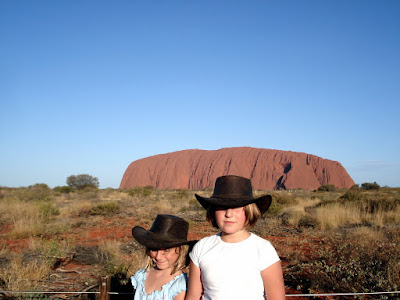
I'm glad we spent a night in that shithole of Alice Springs (there you go Dunc, self-censorship lifted ;-) if only because the journey by bus sets Uluru into context in a way that flying directly to its airport could never do. It's far away from everything and everywhere. We spent the next 2 days visiting two major sites: The Olgas (Kata Tjuta) and Ayres Rock (Uluru), and Letizia has outdone herself with the photographs this time. The walks we did were not terribly strenuous though in the heat, and constantly beset by flies, even small efforts took their toll. Poor Nina and Sara: they've been marched up and down over the last 3 months, but they are still going strong. What really helped their resilience this time was the purchase of two really cute hats that look like they're straight out of Crocodile Dundee. They couldn't believe their eyes when their normally cautious parents loosened the purse strings a little and treated them to these hats. They wore them proudly up the gorge between the Olgas, and around the base of Uluru at ungodly hours of the morning. A great investment. I suspect you won't see a single picture of them from here on in without the hats.
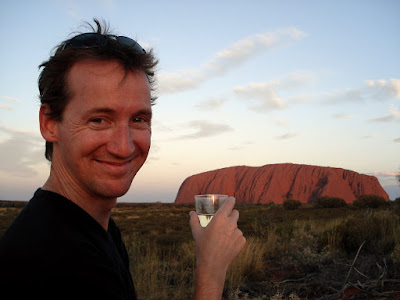
Sunset on the rock is truly beautiful, and it does change colour continuously as the sun reaches the horizon. The place where most people watch it from isn't too busy - you can certainly get away from the noise if you want to. But it's not a spiritual experience - and I'm not just saying that because I'm the crusty old Cartesian my wife describes me as. It's a beautiful sight, it's a relaxing experience, a great backdrop for a glass of wine and a stupid grin, but sunset from Fraser Island will remain with me forever.
Before coming to Uluru I had read of the handover of 1985, when the government of Bob Hawke decided to recognize the title of the indigenous people of Uluru (the Anangu) to this land. I was looking forward to seeing a part of Australia that was in the hands and under the management of the first owners. This was pretty naive of me. When the handover took place, Uluru was already a National Park at the time, not to mention a popular tourist destination. The deal reached between Hawke and the Anangu hinged on the condition that the Anangu lease the land back to the federal government for the next 99 years. There was no visible sign of black ownership anywhere. There were plenty of references to local culture and lore from the (white) guides and in the resorts literature. But then again, in modern Australia, such references are everywhere. You'll find Dreamtime stories related to the creation of the moon and the stars in Sydney Observatory but it hasn't been handed over to the long-eradicated Eora people. It seems that it will take many more generations - maybe longer than a 99-year lease will provide for - for the aboriginals to assume the real day-to-day management of this, or any other, large project.
The Anangu never lived around Uluru - it wouldn't support a permanent human presence. They visited for special occasions, like rites-of-passage ceremonies. They would also come after rainfall and make the best of the increase in edible flora and fauna (digging up honey ants seems to have been a favourite treat in this area), but like most aboriginals, they moved around to allow the earth to recover and regenerate, sometimes giving it a helping hand by setting fire to it before leaving. (In case this sounds a little crazy, firestick farming has only recently begun to be understood scientifically as an effective way to convert scrub into grazing - supporting the kind of wildlife that the aboriginals liked to hunt.) In a harsh environment like this, where man made no pretension to conquer nature by farming, but instead had to make do with living within its limitation, the aboriginal population itself rose and fell, matching the numbers of animals and plants that it fed on. It sounds primitive, but population control is a complicated matter, and one that modern societies would do well to learn (says the man with two kids).
To those who voted for us to go to Uluru, thank you. I'm very glad we went, and would have regretted missing it. In fact my only regret about going is that we didn't spend another night and go to see King's Canyon. But I think a 17% budget overrun is quite enough, don't you?
I've got one more blog in me before we leave for New Zealand on Saturday - something to summarize the Australian experience if that's possible. Thanks for continuing to follow the blog (or indeed thanks for visiting if you've just arrived).
Without any attempt to relate this to anything I've just written, spare a thought for this gentleman:

We encountered him on the road to Uluru from Alice. Those are camels that you can see there, and they are harnessed to the motor-less carcass of some old car. What you probably can't see are the solar panels on top, and the laptop inside. Apparently this guy has been wandering the backroads of Australia for over a decade now, sustaining himself with casual work wherever he stops. He's German apparently, and before the car, he had an old cart whose wheels were big enough to allow him to travel along the dried river beds. Now he has to content himself with sharing the road with the likes of us. For all I know, the chap has his own blog out there, but I'm stuffed if I can find it. Next time you think it's a crazy dream to up stakes with your family and travel around the world for no good reason, remember - there is always somebody out there crazier than you.
And yet this road through the dead heart of Oz serves as the boundary between some of the various cattle stations (cow farms to you and me) that operate out here. These can encompass enormous areas - approaching the size of Belgium, or Connaught (and making the latter look like bounteous meadowlands). Occasionally we saw cattle, alone or bunched in twos or threes, meandering around the bush, grazing on who knows what. Maybe the word desert is misleading here. It's not the Sahara, with nothing but sand dunes as far as the eye can see. If you look from the road, you'll see lanky trees to a height of 4 or 5 metres in some places, bushes and scrub occupying the middle area, and course grasses in the foreground. Only occasional glimpses of red sand can be made out. But when you step into the landscape, you realise that all that vegetation is thinly spread out, and 80% of the space is bright oxidized red sand. This is why the cattle stations are so damn big - around here, a single head of cattle needs 2 square kilometers (200 hectares) to feed itself. This is almost the definition of marginal land. As we move closer and closer to Uluru, the cattle stations fall away. There's clearly just no point in trying.
I'm glad we spent a night in that shithole of Alice Springs (there you go Dunc, self-censorship lifted ;-) if only because the journey by bus sets Uluru into context in a way that flying directly to its airport could never do. It's far away from everything and everywhere. We spent the next 2 days visiting two major sites: The Olgas (Kata Tjuta) and Ayres Rock (Uluru), and Letizia has outdone herself with the photographs this time. The walks we did were not terribly strenuous though in the heat, and constantly beset by flies, even small efforts took their toll. Poor Nina and Sara: they've been marched up and down over the last 3 months, but they are still going strong. What really helped their resilience this time was the purchase of two really cute hats that look like they're straight out of Crocodile Dundee. They couldn't believe their eyes when their normally cautious parents loosened the purse strings a little and treated them to these hats. They wore them proudly up the gorge between the Olgas, and around the base of Uluru at ungodly hours of the morning. A great investment. I suspect you won't see a single picture of them from here on in without the hats.
Sunset on the rock is truly beautiful, and it does change colour continuously as the sun reaches the horizon. The place where most people watch it from isn't too busy - you can certainly get away from the noise if you want to. But it's not a spiritual experience - and I'm not just saying that because I'm the crusty old Cartesian my wife describes me as. It's a beautiful sight, it's a relaxing experience, a great backdrop for a glass of wine and a stupid grin, but sunset from Fraser Island will remain with me forever.
Before coming to Uluru I had read of the handover of 1985, when the government of Bob Hawke decided to recognize the title of the indigenous people of Uluru (the Anangu) to this land. I was looking forward to seeing a part of Australia that was in the hands and under the management of the first owners. This was pretty naive of me. When the handover took place, Uluru was already a National Park at the time, not to mention a popular tourist destination. The deal reached between Hawke and the Anangu hinged on the condition that the Anangu lease the land back to the federal government for the next 99 years. There was no visible sign of black ownership anywhere. There were plenty of references to local culture and lore from the (white) guides and in the resorts literature. But then again, in modern Australia, such references are everywhere. You'll find Dreamtime stories related to the creation of the moon and the stars in Sydney Observatory but it hasn't been handed over to the long-eradicated Eora people. It seems that it will take many more generations - maybe longer than a 99-year lease will provide for - for the aboriginals to assume the real day-to-day management of this, or any other, large project.
The Anangu never lived around Uluru - it wouldn't support a permanent human presence. They visited for special occasions, like rites-of-passage ceremonies. They would also come after rainfall and make the best of the increase in edible flora and fauna (digging up honey ants seems to have been a favourite treat in this area), but like most aboriginals, they moved around to allow the earth to recover and regenerate, sometimes giving it a helping hand by setting fire to it before leaving. (In case this sounds a little crazy, firestick farming has only recently begun to be understood scientifically as an effective way to convert scrub into grazing - supporting the kind of wildlife that the aboriginals liked to hunt.) In a harsh environment like this, where man made no pretension to conquer nature by farming, but instead had to make do with living within its limitation, the aboriginal population itself rose and fell, matching the numbers of animals and plants that it fed on. It sounds primitive, but population control is a complicated matter, and one that modern societies would do well to learn (says the man with two kids).
To those who voted for us to go to Uluru, thank you. I'm very glad we went, and would have regretted missing it. In fact my only regret about going is that we didn't spend another night and go to see King's Canyon. But I think a 17% budget overrun is quite enough, don't you?
I've got one more blog in me before we leave for New Zealand on Saturday - something to summarize the Australian experience if that's possible. Thanks for continuing to follow the blog (or indeed thanks for visiting if you've just arrived).
Without any attempt to relate this to anything I've just written, spare a thought for this gentleman:
We encountered him on the road to Uluru from Alice. Those are camels that you can see there, and they are harnessed to the motor-less carcass of some old car. What you probably can't see are the solar panels on top, and the laptop inside. Apparently this guy has been wandering the backroads of Australia for over a decade now, sustaining himself with casual work wherever he stops. He's German apparently, and before the car, he had an old cart whose wheels were big enough to allow him to travel along the dried river beds. Now he has to content himself with sharing the road with the likes of us. For all I know, the chap has his own blog out there, but I'm stuffed if I can find it. Next time you think it's a crazy dream to up stakes with your family and travel around the world for no good reason, remember - there is always somebody out there crazier than you.
Tuesday, April 8, 2008
Mrs Todd's Billabong
Alice Springs started life as a telegraph station. It's half way between Adelaide in South Australia and Darwin in the Northern Territory. That is to say it's about 1500 km from both of them, and further again from the East and West coasts. Much further. In 1865, the British parliament approved the construction of a telegraph line to stretch from Port Augusta in Southern Australia, across the emptiness of Central Australia, to Darwin with the ambition of connecting eventually to the telegraph line in Java, and so on to Mother England. (Just 57 years earlier, it had taken a full year for the news of the Sydney mutiny against Governor Bligh to reach London - this was real progress.) Alice Springs was the halfway point and a repeater station for that telegraph line.
By the time we landed in Alice Springs airport, we had flown two and a half hours over, well, mostly nothing. Below us, the pale colours of uncharitable Australian farmland gave way to the completely unworkable sands that make up the Red Centre. Once we got off the aircraft and walked to the terminal building (it was well hidden belong scrub on the edge of the runway, giving us the impression of having landed on an abandoned airstrip), that red sand started to accumulate on our shoes. A brief but costly taxi ride through the unimaginatively named Gap to the centre of Alice Springs left us outside the Aurora hotel, ready to check in, unpack and explore.
Within one hour of getting there, I sent the following text to Simon back in Brisbane: "Alice is a hole". Nothing happened in the intervening hours of our stay to make me revise this opinion.
The town was originally called Stuart (as in Stuart highway - the road that follows the route opened up by explorer John Stuart) but was changed to Alice Springs in the 1930s. So who the flip is Alice? She was the wife of Sir Charles Todd, the top man in South Australia's postal service. The 'Springs' in question were in fact a Billabong - a seasonal and sometimes stagnant waterhole rather than a clean source of fresh water. The river through Alice was named the Todd river after Charles himself, but in these parts rivers are not the permanent fixtures that most of us are used to. The Todd river hasn't passed though Alice for more than two years. It's just a dried up riverbed, marked out by gum trees that can tap the remaining underground water. So both Alice and Charles were unfortunate enough to have given their names to geographic entities that, for most practical purposes, don't exist.
The Alice Springs that we were expecting doesn't exist either. The town that started life as a telegraph station is now home to a node on the US military communications network, and manned by as much as 2000 Americans (I saw none - perhaps they don't exist either). The technology has changed, but the function remains the same: take a signal from point A and forward it to point B. The Book of Lies (aka The Rough Guide to Australia) told us we would find a metropolitan atmosphere, in part thanks to the large US population. What we found was a flyblown, unwelcoming shambles, that didn't extend to any great extent beyond the central pedestrian section of Todd Street. Most of the aboriginals in sight were either propped like sacks of potatoes at the edge of the road, or wandering the public spaces aimlessly. Every now and then a group of young kids on BMX bikes flits across the road or path, like a small flock of birds, causing cars to brake suddenly. There's a piece of graffiti that reads "Fuck Racist Cops" where somebody has crossed out the first word and replaced it with "Support". Both of these sentiments seem to me in keeping with the atmosphere of this town.
All the aboriginal art dealerships we saw were in white hands. I heard English, Scottish, Australian and Dutch accents coming back across the desk at us, as we wandered from shop to shop looking for something that we'd like to buy. We eventually found some pieces that we liked - one for ourselves and another for Simon and Leah - in the Mbantua Gallery.
We left at 6am the following morning on a six hour bus trip to Uluru (more on that later). It's the first place we've been to in Australia that I have no desire to revisit.
By the time we landed in Alice Springs airport, we had flown two and a half hours over, well, mostly nothing. Below us, the pale colours of uncharitable Australian farmland gave way to the completely unworkable sands that make up the Red Centre. Once we got off the aircraft and walked to the terminal building (it was well hidden belong scrub on the edge of the runway, giving us the impression of having landed on an abandoned airstrip), that red sand started to accumulate on our shoes. A brief but costly taxi ride through the unimaginatively named Gap to the centre of Alice Springs left us outside the Aurora hotel, ready to check in, unpack and explore.
Within one hour of getting there, I sent the following text to Simon back in Brisbane: "Alice is a hole". Nothing happened in the intervening hours of our stay to make me revise this opinion.
The town was originally called Stuart (as in Stuart highway - the road that follows the route opened up by explorer John Stuart) but was changed to Alice Springs in the 1930s. So who the flip is Alice? She was the wife of Sir Charles Todd, the top man in South Australia's postal service. The 'Springs' in question were in fact a Billabong - a seasonal and sometimes stagnant waterhole rather than a clean source of fresh water. The river through Alice was named the Todd river after Charles himself, but in these parts rivers are not the permanent fixtures that most of us are used to. The Todd river hasn't passed though Alice for more than two years. It's just a dried up riverbed, marked out by gum trees that can tap the remaining underground water. So both Alice and Charles were unfortunate enough to have given their names to geographic entities that, for most practical purposes, don't exist.
The Alice Springs that we were expecting doesn't exist either. The town that started life as a telegraph station is now home to a node on the US military communications network, and manned by as much as 2000 Americans (I saw none - perhaps they don't exist either). The technology has changed, but the function remains the same: take a signal from point A and forward it to point B. The Book of Lies (aka The Rough Guide to Australia) told us we would find a metropolitan atmosphere, in part thanks to the large US population. What we found was a flyblown, unwelcoming shambles, that didn't extend to any great extent beyond the central pedestrian section of Todd Street. Most of the aboriginals in sight were either propped like sacks of potatoes at the edge of the road, or wandering the public spaces aimlessly. Every now and then a group of young kids on BMX bikes flits across the road or path, like a small flock of birds, causing cars to brake suddenly. There's a piece of graffiti that reads "Fuck Racist Cops" where somebody has crossed out the first word and replaced it with "Support". Both of these sentiments seem to me in keeping with the atmosphere of this town.
All the aboriginal art dealerships we saw were in white hands. I heard English, Scottish, Australian and Dutch accents coming back across the desk at us, as we wandered from shop to shop looking for something that we'd like to buy. We eventually found some pieces that we liked - one for ourselves and another for Simon and Leah - in the Mbantua Gallery.
We left at 6am the following morning on a six hour bus trip to Uluru (more on that later). It's the first place we've been to in Australia that I have no desire to revisit.
Tuesday, February 19, 2008
Blackfella, Whitefella
James Cook was chosen to captain the Endeavour in large part due to his famous abilities as a cartographer. The resulting charts of New Zealand for example, were in use right up to the 1990s. But he incorrectly reported the east coast of what is now Australia to be almost uninhabited, and only then by nomadic tribes with no fixed towns. This allowed the legal pretense of terra nullius - uninhabited land - which formed the basis of subsequent English colonization. Nowadays, the estimate for the aboriginal population of 1788 is something in the order of 750,000. Today it stands at about 400,000, or 2% of the Australian population. In Sydney, however, that population is almost nowhere to be seen. On Circular Quay, you will find a didgeridoo busker, sitting cross-legged in the shade, creating hypnotic sounds that dance tracks in the background. At Central Station I saw a grey-bearded busker, folded in two over a battered guitar, giving a soulful rendition of Neil Young's Hey Hey, My My. "It's better to burn out, than to fade away". It seems that in Sydney at least, the Aboriginal is doing both. If you want to see his disintegration in progress, it's a matter of getting the train to Redfern to see The Block - an aboriginal ghetto of inner Sydney that I have never seen, and with the children in tow, never will. The rampant alcoholism and unemployment among the First Australians (or First Owners as they are also now called) only serves to further isolate them from mainstream society.
But if Aborigines are almost invisible on the streets, these days they never seem to be far away from the headlines. The new Labor government under Kevid Rudd has just dragged a reluctant opposition into a bi-partisan apology on behalf of goverments gone by, to those Aborigines known as the Stolen Generation. From the 1920s, and for a period of about 50 years, children of Aboriginal mother but white fathers were taken away from their mothers and placed into foster care, or into state institutions (see the film Rabbit Proof Fence for a taste of the damage done). There are still those who argue today that many of these kids were done a great service. But to my mind this misses the point entirely. Any modern state reserves the right to protect children from bad parents by making them wards of the state. But in the Australia of the early and mid 20th century, every Aborigine was already a ward of the state - not a citizen - and decisions like taking an Aboriginal child out of its natural family could be made at a local administrative level rather than a legal one. This led to institutionalized racism where the grounds for breaking up a family were based only on the race of the children and not to the quality of the parenting. The thinking of the time was that the Aborigines were doomed to extinction - the same type of social Darwinism had infected many minds the world over - and it was a case of breeding them out.
The official apology was the latest in a line of symbolic gestures that began in 1967 when white Australian voted overwhelmingly in favour of granting full citizenship on every Australian Aboriginal. I watched Rudd live on TV - every channel carried the scenes from the parliament in Canberra. All the preconceptions I held of testosterone-fuelled, macho Australian politics fell to pieces at the sight of the Prime Minister and the leader of the opposition take turns in delivering deeply emotional speeches describing instances of past wrongs and saying Sorry, Sorry, Sorry. And meaning it, I'll swear. On the day, any building with a flagpole made space for the Aboriginal flag. Anyone with a public noticeboard seemed to use it to apologise. On my bus route I could see an untidily diagonal 'sorry' slotted into place, letter by plastic letter, on a board where scriptural quotes would normally appear (Surry Hills Presbytarian Church, whose admirably modest ambition is "Christian Hope for Every Resident of Surry Hills"). Gestures like this have come and gone. Marches over the Harbour Bridge, "Freedom Rides" through New South Wales. Billions have been spent, but the returning numbers show that little has changed. Aboriginal lifespans are 15-20 years less than other Australians. Although only 2% of the national population, make 20% of the prison population. The infant mortality rate is three times the national average. 'Sorry' is a good place to start, but if it doesn't lead somewhere, it will make things worse: it will trivialize the emotions so clearly on display in these days, it will make the word 'sorry' seem almost camp in its absurdity when compared to the reality, and it will make it harder to pick up the pieces of another failed initiative and start again.
How did it all go wrong for the Blackfella? In simple terms it was Cook, or the sealed orders of the British Admiralty that sent him in search of new lands after the public business of scientific study (the transit of Venus) was done. Or perhaps is was Arthur Phillip, captain of the first fleet and first governor of New South Wales, or more precisely the Home Office that sent him with instructions to establish a prison settlement in Cook's Botany Bay. And it was the subsequent masses, who quite literally ate the Blackfella out of house and home.
Ironically, these two first Whitefellas were men of the world who made no assumptions about the inferiority of any native - quite the contrary. But yet both of them oversaw the illegal dispossesion of the First Owners. They did what they did to further their careers and ambitions, but if it hadn't been them, it would have been somebody else. At least they were both, especially Phillip, able to cushion the blow of the British foreign policy of the time. But the logic of empire is simple, and in the long run, a series of imperfect but relentless implementations of that logic will eventually see it through almost perfectly. Those who formulated that policy, and the officers who executed it, must share the lion's share of the blame for bringing the Aboriginal and European into conflict. Everything that's happened since then has been a direct consequence of this first step.
Most of the first Whitefellas were, famously, prisoners - many Irish amongst them - whose conditions both before and after transportation were more wretched than any Eora. Like the modern Aborigine driven into the city and disconnected from his heritage, many on board the prison ships were country folk who were driven into English cities by changes in the laws governing use of 'commons' land. There they fell into crime - mostly petty - it didn't take much to be earn a hanging or transportation in those days. Subsequent waves of immigrants (perhaps excluding those drawn by the gold rushes) were themselves fleeing persecution or poverty brought about by warring . A trip to the Maritime Museum in Darling Harbour will make this clear. While it was the sheer mass of new bodies to be fed from the land that pushed the Aboriginals to the margins - from where they have not returned - it was the policies that put the Whitefella here that are to blame.
British imperialism is long since dead (I don't what to hear it - the British conceded that they have no strategic interests in Northern Ireland more than 15 years ago) and thanks to a successful transplantation of some of the more postive aspects of European economic and political thought, there's room and food enough on this continent for everyone. In principal there is no remaining point of conflict between the Blackfella and the Whitefella. The latter is now at pains to make amends, and to change the sense of what it means to be Australian (and this has the added bonus of laying the blame, much as I've just done, at the door of the Poms). The policy changes that follow the apology will have to make it possible for the Blackfella to come back in from the margins and live easily alongside the former conqueror.
Subscribe to:
Posts (Atom)