Showing posts with label puno. Show all posts

Sunday, August 3, 2008

End of the Line


Cusco is not our last stop on this 8-month journey, but in many ways it is our ultimate destination. After here, we have Lima and Buenos Aires to look forward to, but in both cases they are necessary stopping points on the way home. Cusco (and Macchupicchu) have been in our sights since the start. As a destination, it was all the more meaningful because waiting for us at Cusco train station was Livia, Letizia's mother. She's been coming here for 10 years or so, working on a very special project. But more on that in a later blog.

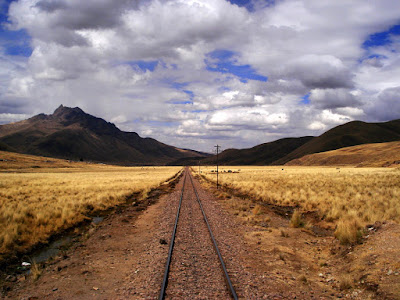
Being such a significant point in our trip, we travelled to Cusco in style. There is a train service operated by PeruRail called the Andean Explorer, which runs three or four times a week from Puno to Cusco. We booked it while we were still in Chile, and while it came in at almost 300 euro for a oneway trip, it was money well spent. For a number of reasons, it was the most spectacular train journey of my life. Never have 10 hours of any form of transport gone by with such ease.

The Andean Explorer is a colonial Gentleman's Club on wheels, trundling across an Andean wilderness, where the seats are real armchairs placed on the carpeted floors, the bathroom is a welcoming environment of dark wood and marble, and the table service is performed in a synchronised swirl of black and white uniforms. We were in the second-last car, and behind us lay the train car to end all train cars - a bar and observation deck. The elegant bar served Pisco Sours to window-side tables. The observation deck was almost completely enclosed in glass, except for the very last section - a brass rail in the open air.

Trains in Europe are hermetically sealed high-speed tubes that bullet through the landscape and skirt around cities. The Andean Explorer lets you breathe the air of the land you are passing through and instead of bypassing towns it runs right through them. When we first pulled out of Puno, I was leaning against the brass rails, ready to enjoy the receding lakeside scenery. Instead I found myself in a traffic jam in the city centre, cars on either side of me, kids and adults alike looking up at the spectacle of a badly-dressed gringo leaning out the back of the train. (Just think of the last scene from Dumbo, but with a less endearing cast). At first we just grinned at each other. Then the kids started to wave. Naturally I waved back. Nina and Sara joined me for a while, and the three of us waved at anything that moved. The girls got bored and left, but I was just getting warmed up. After 15 minutes or so I had the hang of things. Men prefered a dignified nod and a respectful smile. Adolescent males were to be saluted with a single raised hand ONLY if they initiated. Adolescent females - actually all women - appreciated a vigourous wave and a cheekily raised eyebrow. These rules applied not just for Puno but for Juliaca and every other town we passed through. My jaws were sore from smiling after the first 4 hours.

In many of the towns we passed through there were markets. It appeared that the markets formed either side of the rail and the railway line itself acted as the main thoroughfare through the stalls. Or it did until our train arrived. Business was suspended as we slowed down and squeezed past stalls selling everything from fruit to car-parts, never further away from the market tables than then length of a 20 soles note. The waving, nodding and smiling continued unabated. The relationship between those on board the train and those looking from the ground was one of mutual curiousity, neither party quite believing what was happening. I'm convinced that I saw more of Peruvian Altiplano life in those few hours than I had in the previous five days spent in Peru.

Another aspect of our train ride that made the day especially memorable for me was the company. Imagine that you're sitting on a luxury train, fresh from experiences of deprivation and sleeplessness. You've paid top dollar to be there, and just as you start to settle in, you watch a family of four lurch towards your table and proceed to surround you. Hell, right? Well Kim from Ottawa suffered exactly this fate as the four of us piled into the Andean Explorer and took up postions all around her that pretty much excluded all chance of escape. A lesser woman would have taken refuge in a book or a tall alcoholic drink, notwithstanding the hour. Kim, and her friend Janet (who was an entire merciful car away but who occasionally came to comfort Kim) handled our 'company' with the tolerance and good humour for which Canadians are deserved respected. (Kim: May there be many, many mountains. Your stories kept us on the edge of our, erm, seats.)

The reception we received in Cusco train station, and afterwards in the lobby of the Hospedaje San Blas, involved flowers, confetti and much shaking of hands and kissing. We deserved none of it, but were instead basking in the reflected glory of Livia Rosetti, my mother-in-law, who has helped to make a real difference to the lives of the people of the parish of Belen here in Cusco. I'll tell you exactly what I mean by that over the next couple of blogs.

It's been 5 days since we arrived here in Cusco, and the experience has been so full-on that it's only now that I'm catching up with the blog. I'll introduce you to a whole host of new characters over the next few days, and tell you about what we've seen since we got here. In the meantime, I should have been asleep an hour ago. Goodnight.

Thursday, July 31, 2008

And on the Third Day, They Rose Again

It was always part of the plan. The first two days in Puno were supposed to be all about getting an altitude attitude. The third day was to be all business: Onto the Lake Titicaca to see the floating Uros Islands, and then by land to the so-called Temple of Fertility in nearby Chucuito.

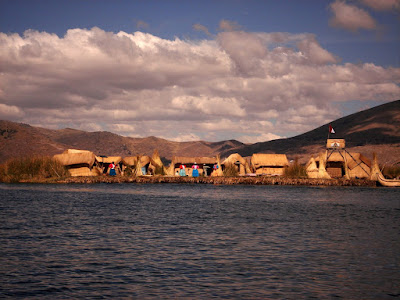
It was clear as soon as we arrived in Puno that it was nothing like Arequipa. If Arequipa is the White City, then Puno is the Brown City. Its bleak look is reinforced by the universal use of corrugated iron roofs. Nothing says shanty-town like those wavy lines. But we weren't here for the city - we were here for the lake. Lake Titicaca is the highest navigable lake in the world, shared between Peru and Bolivia. Its most curious feature, at least for me, is the group of 42 islands floating half-an-hour off the the coast of Puno, called the Uros.

The name of these islands derives from the the name of the people who inhabit them. The Uros people lived happily alongside their other neighbours on the patch of land that is now the northern edges of Puno. Then the Inca came. The Uros felt the need to put some space between themselves and the spreading influence of the Inca, a reaction that can be readily understood. The only space they could find, however, was on the lake itself. At first they took to boats, then built little houses on those boats. In the case of both the boats and the houses, their primary construction material was the totora - a reed that is found growing in the waters all around the edges of the lake - right out as far as the current location of the islands themselves. In an excellent example of making the best of what you have, the Uros people used this reed for food as well. They took things further again - one might argue in a somewhat obsessive way - to devise a mechanism for constructing floating platforms from large blocks of roots of the totora. The Uros islands are a 600-year-old refugee camp.


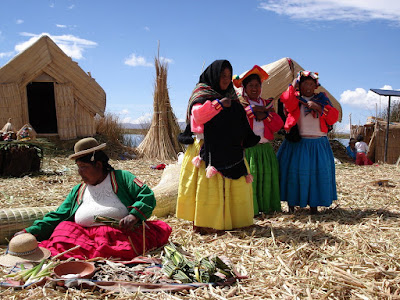
Today, most Uros leave the islands at school age and don't come back. Why would they? There's no running water, precious little electricity (a few solar panels) and in any case, the Inca have been gone for quite some time. Those who remain on the islands live mostly by grace of the tourism they generate. Conservationism, this time of a unique human culture rather than an endangered species, owes much to the positive power of tourist dollars. There was no pretence in our encounters with the Uros. It was clear that they were used to boatloads of visitors, and they greeted us with song, dressed in colours that were sure to dazzle. They showed us, though the interpretations of the guide (they spoke neither Spanish nor English, but a pre-Incan dialect called Aymara) how they lived, what they ate, and with whom they traded. The experience was choreographed, neatly arranged for easy consumption. But there was no getting over the fact - we were on a floating island. We visited three of them in fact. It was home to these people. This was a way of life that was very real, totally unique and had been in place for 600 years or so.

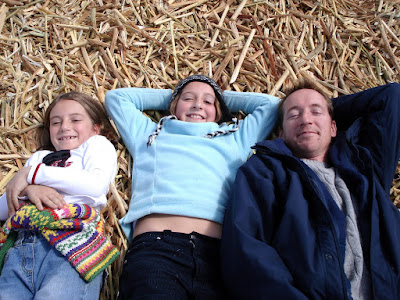
Nina and Sara loved it. The softness of the upper layers of reed underfoot was a delight. What could be cooler than a place where you could do the jackass as much as you want and fall flat on your back with impunity. Dry land seemed unreasonably hard and unforgiving after a few hours with the Uros.


Sara is usually the dressing-up kind, but this time it was Nina who volunteered to try out the Uros traditional dress.


The islands are a living museum, a tribute to innovation in the face of adversity, and a simple undiluted pleasure for visitors.

Our afternoon program took us south of Puno, along the shores of the lake to a small town called Chucuito. There are a lot of interesting corners to this otherwise quiet and neglected town. There is the church of Our Lady of the Assumption, from where the local platoon of the Inquisition maintained adherence to accepted orthodoxy on the part of the colonising Spanish, much like the Gestapo kept the National Socialist line in Wehrmacht outposts a few centuries later. It occured to me that I wouldn't have fared very well in Chucuito at that time. Not for my agnosticism in particular, but because of my perverse ideas on what constitutes humour: Sooner or later I would have thought it a jolly jape to ask the Grand Inquisitor exactly what it was that Our Lady was Assuming.


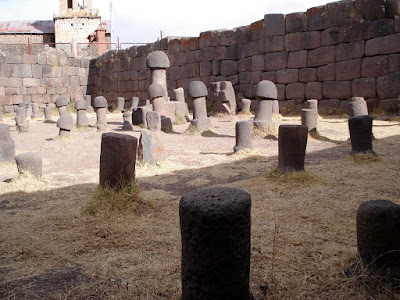
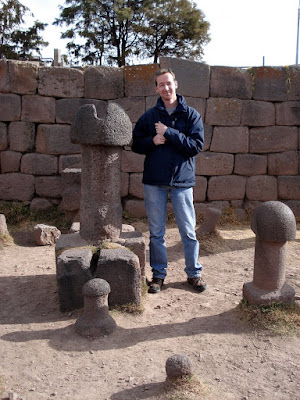
My daughters, who if they could would have built their own Uros islands a long time ago to take refuge from my 'jokes', were less impressed with this part of the days activities. Not even a field of stone penises could impress them. The Inca Uyo, sometimes known as the Temple of Fertility, is actually a solar observatory which was probably built to indicate the beginning of important moments in the agricultural calendar. The dozens of stone phalluses seem out of place (well, yeah!) and were perhaps taken from elsewhere and put into the Inca Uyo by well-meaning locals trying to reconstruct Inca heritage destroyed by the conquistadores. As such, they stand there in an act of defiance - one bunch of pricks against another.


But the idea of the Temple of Fertility stuck. Even today there are reports of women who visit the place in order to increase their chance of getting pregnant. The reports don't mention if they take their partners with them (which would seem like a sensible backup plan). Whatever erotic charge the temple might posess is undone by the belfry of the church of Santo Domingo, which peers in from across the road, silently outraged but too elderly to quite remember why.

Tuesday, July 29, 2008

Caption Competition


Perhaps I can get the ball rolling (npi) with "Spot the Difference".

(Get stuck in - this chance will hardly come again)