When Europeans first went sailing around the globe, and bumped into (or more accurately, collided with) other more primitive societies, they asked themselves the question "How is it that we have the ships, guns, horses, writing and all the other trappings of civilization that allow us to conquer those others who have little of none of these advantages?". In the absence of any scientific explanation of how Man came to spread himself over the earth, Europe explained its success in terms of racial superiority, or believing in the 'right' God, or both. Five hundred years later, the same science that developed the ships and guns finally delivered the answer to that question.
It has been the consensus for some time now, and expressed in an accessible way by writers like Stephen Jay Gould and Luigi Luca Cavalli-Sforza, that all currently living members of the genus Homo are, genetically speaking, brothers. We are Homo Sapiens sapiens, distinguished from our ancestors (say some) by our faculty for language, and we probably first appeared in Africa about 100,000 years ago. If you read Jared Diamond's Guns, Germs and Steel you'll find a patiently paced description of the "broad sweep of history": the initial many colonizations of the globe by Homo Sapiens sapiens, and the more recent one that led to the Eurasian conquest of the rest of the planet (the result of which is clearly visible both here in New Zealand and back in Australia).
If you don't read Diamond's book, let me try to lay out its thesis in a nutshell. It was Europeans' guns, ships, germs, horses and political/societal size and sophistication that led to its victory over North- and South-Americans, SE Asians, Polynesians, Africans and Australian Aboriginals. These are the self-evident proximate causes of conquest. The ultimate causes lie in Eurasia's early transition from a hunter-gatherer lifestyle to farming. The production of excess food created a positive feedback loop with increased population densities - the more food, the more people, the more labour, the more food. This led to a necessary stratification in society: chiefdoms and kingdoms - a means by which strangers living in close proximity could co-exist more or less in peace, with the kingdom acting as arbiter, and central point of trade. (Smaller societies, based around the tribe structure, kept the peace and managed trade through personal ties and reputation: Everyone knew everyone else, perhaps even related.) Stratification led to a specialised craftsman class, freed from the direct production of food, able to invest energy inventing better tools, methods, metallurgy and so on. This was the initial vector whose trajectory finally brought literacy, science and technology.
The domestication of animals, and their subsequent living in close quarters with man (very close, according to what Australians say about New Zealanders ;-) ) led to the co-evolution of epidemic diseases, and partial human immunity in farming populations. Most of the fatalities in subsequent collisions between Old and New Worlds were due to disease rather than warfare.
So that's a very basic description of the connection between the switch to farming and its consequences in terms of the proximate causes of Eurasian conquest.
So the question now can be reduced to: how and why did Eurasians switch to farming earlier than their global cousins? Those disposed to race-based answered will have the opportunity here to insist that Eurasians were simply smarter than their cousins. This is an easy solution but there is no reputable evidence for this. Diamond's gives an extremely comprehensive answer that can be reduced to one word: luck. Culo. Bald, unearned fortune. The more extended answer, in three words, is location, location, location. The fertile crescent and the Yangtze and Yellow rivers where agriculture first began, were home to the great bulk of those wild cereals, roots fruit and animals that firstly lent themselves to domestication and secondly provided enough calories in a single 'package' to compete with and displace hunter-gatherer modes of existence. While Man experimented globally with farming, Eurasia was by a wide margin the best-equipped laboratory (and also has a geographical axis that was best disposed to a transmission of newly domesticated crops, animals and techniques).
Maori vs Australian Aboriginal
Some peoples suffered more than others during the Eurasian conquest. Few fell apart quite as much as the Australian Aboriginal. In a later post, I'll finally try to make a comparison between what happened here in New Zealand to the Maori, and what happened in Australia, based on what I've seen in both places and what I've been reading since hitting the road. This much is clear to me: there's no need to lean on race as an explanation.
If some day, science finds that Europeans are genetically so different from Australian Aboriginals as to indicate that we do not come from the same stock - that we are effectively different species - then the government of Australia will have a very difficult ethical issue on its hands. How can you apply Man's law and confer human rights on a race other than the human one? But it would make some things simpler for the likes of you and me. It would give rational expression to that part of us that looks at the state of the Aboriginals today and asks "what the hell is wrong with them anyway?".
Luckily for moral philosophers and Aussie lawmakers, there is no such challenge to face. The rest of us have to get our heads around a more complex, but ultimately more satisfying, answer to silence that persistent suspicion that they are not like us.
Showing posts with label collapse. Show all posts
Showing posts with label collapse. Show all posts
Monday, June 9, 2008


Friday, June 6, 2008
How much for the whale?
If you get into a boat in Kaikoura and head East for just a few minutes, you will go over the edge of a vertical cliff with a drop of about 800 meters. The drop leads down further to a canyon 1300m at its deepest point. Within easy sight of the shore, you are off the continental shelf and into deep ocean water. The combination of the deep canyon and the intersection of two opposing ocean currents in these waters, brings nutrient rich deep-water closer to the surface, creating an ecosystem all of its own. The krill and plankton attract the fish, the fish attract the squid, the squid attract the whales and the whales attract the tourists.
They used to attract the whaling industry of course, but in New Zealand that all came to an end at the end of the 1970s. Apart from the ecological considerations behind the decision to ban whaling in NZ waters, the economic results are interesting. Whales in Kaikoura are like the trees on Fraser Island in Queensland, in that they are worth more alive than dead. The tourist industry here in New Zealand isn't just about bungy jumping and tequila slamming. It's about hiking through nature reserves and observing wildlife in its natural context. Conservation-based tourism is big business. Just about every reserve or animal encounter we have seen on the South Island is in private hands, and in each case the result of tourism is increased stocks and greater understanding of the creatures in question. The inclusion of wildlife in the global money-go-round seems to be working to the mutual benefit of economy and ecology alike. Economic pressures tend to operate in favour of conservation at the moment, but what happens in the case of a downturn?
Take the yellow-eyed penguins we saw on the Otago Peninsula. They are the rarest penguins in the world and their fate is now inextricably linked to the bottom line in the privately-owned Penguin Parade, and by extension to the global human economy. In this case, Penguin Parade isn't just an organization that brings you to see the animals in their natural environment, they are the animals' landlords. They own the patch of land that is the Yellow-Eyed Penguins' remaining breeding colony. Any number of international conservation charities would happily contribute towards the stabilization of Yellow-Eyed Penguin numbers, but Penguin Parade prefers NOT to take their money in order to continue running the business as they see fit. To be fair, they put their money into replanting the tree and shrub cover whose loss originally led to the dwindling number of this rarest of penguins. But if Penguin Parade ever goes out of business (perhaps tourist numbers will drop in the future thanks to increasing costs in flying?) then the penguins are on their own again. Or worse - evicted from their only remaining habitat in order for that land to realise a greater economic value. Many want to see the environmental cost of flying reflected in the cost of airfares. But economies can be as complicated as ecologies, and one side-effect of this move might be the collapse of global wildlife-based tourism, with consequent collapses in conservation efforts. I have no idea of course - I'm just speculating.
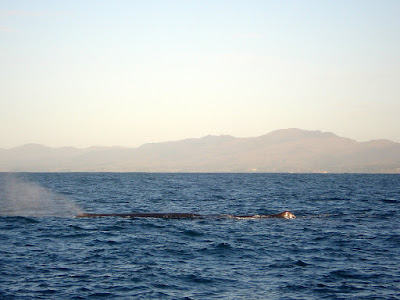
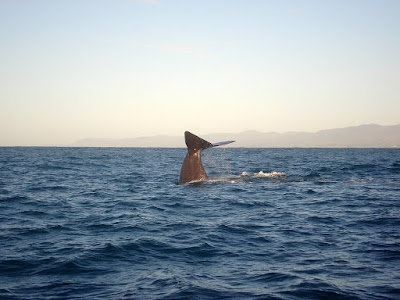
But I wasn't thinking any of these things on Thursday morning as we motored out of South Bay, and off the edge of the continental shelf, with the privately-owned Kaikoura Whalewatching company. All I was interested in was seeing some whales, and I got what I wanted. In two hours on the water we had three close encounters with Sperm Whales. The way we used to find them was the same hunting technique as formerly used by whalers. These mammals are deep divers, resting at the surface to breathe for 10-15 minutes, re-oxygenating their muscles, before diving for 30-40 minutes. They announced ithemselves with 2-meter spumes from their blowholes, giving us time to race over to them to watch their heads and torsos bob above the surface for a short while. Then finally, as they began their next dive, they lifted their powerful tails gracefully above the waterline, sinking out of sight and leaving a growing circle of flat water known as the whale's footprint.
When we drive along a coast road, we mistake the sea for its surface, and consider the waves and swell to be all there is. For the Sperm Whale, the surface is the place where it spends the least time, the place where it comes by necessity rather than choice. It's nothing more than a filling station. A necessary but inconvenient stop to fuel its deeper activities. It is also the interface where man and whale interact, where the whale becomes an agent in the human economy. I hope that its market as a target for the camera-shutter rather than the harpoon remains viable.
They used to attract the whaling industry of course, but in New Zealand that all came to an end at the end of the 1970s. Apart from the ecological considerations behind the decision to ban whaling in NZ waters, the economic results are interesting. Whales in Kaikoura are like the trees on Fraser Island in Queensland, in that they are worth more alive than dead. The tourist industry here in New Zealand isn't just about bungy jumping and tequila slamming. It's about hiking through nature reserves and observing wildlife in its natural context. Conservation-based tourism is big business. Just about every reserve or animal encounter we have seen on the South Island is in private hands, and in each case the result of tourism is increased stocks and greater understanding of the creatures in question. The inclusion of wildlife in the global money-go-round seems to be working to the mutual benefit of economy and ecology alike. Economic pressures tend to operate in favour of conservation at the moment, but what happens in the case of a downturn?
Take the yellow-eyed penguins we saw on the Otago Peninsula. They are the rarest penguins in the world and their fate is now inextricably linked to the bottom line in the privately-owned Penguin Parade, and by extension to the global human economy. In this case, Penguin Parade isn't just an organization that brings you to see the animals in their natural environment, they are the animals' landlords. They own the patch of land that is the Yellow-Eyed Penguins' remaining breeding colony. Any number of international conservation charities would happily contribute towards the stabilization of Yellow-Eyed Penguin numbers, but Penguin Parade prefers NOT to take their money in order to continue running the business as they see fit. To be fair, they put their money into replanting the tree and shrub cover whose loss originally led to the dwindling number of this rarest of penguins. But if Penguin Parade ever goes out of business (perhaps tourist numbers will drop in the future thanks to increasing costs in flying?) then the penguins are on their own again. Or worse - evicted from their only remaining habitat in order for that land to realise a greater economic value. Many want to see the environmental cost of flying reflected in the cost of airfares. But economies can be as complicated as ecologies, and one side-effect of this move might be the collapse of global wildlife-based tourism, with consequent collapses in conservation efforts. I have no idea of course - I'm just speculating.
But I wasn't thinking any of these things on Thursday morning as we motored out of South Bay, and off the edge of the continental shelf, with the privately-owned Kaikoura Whalewatching company. All I was interested in was seeing some whales, and I got what I wanted. In two hours on the water we had three close encounters with Sperm Whales. The way we used to find them was the same hunting technique as formerly used by whalers. These mammals are deep divers, resting at the surface to breathe for 10-15 minutes, re-oxygenating their muscles, before diving for 30-40 minutes. They announced ithemselves with 2-meter spumes from their blowholes, giving us time to race over to them to watch their heads and torsos bob above the surface for a short while. Then finally, as they began their next dive, they lifted their powerful tails gracefully above the waterline, sinking out of sight and leaving a growing circle of flat water known as the whale's footprint.
When we drive along a coast road, we mistake the sea for its surface, and consider the waves and swell to be all there is. For the Sperm Whale, the surface is the place where it spends the least time, the place where it comes by necessity rather than choice. It's nothing more than a filling station. A necessary but inconvenient stop to fuel its deeper activities. It is also the interface where man and whale interact, where the whale becomes an agent in the human economy. I hope that its market as a target for the camera-shutter rather than the harpoon remains viable.
Saturday, March 29, 2008
D - I - N - G - O (and dingo was his name-o)
To be sung to the tune of Bingo:
A wolf from Asia came to Oz, and dingo was its name-o.
D - I - N - G - O, D - I - N - G - O, D - I - N - G - O
And dingo was its name-o.
It came 5 thousand years ago, and traders were to blame-o,
D - I - N - G - O, D - I - N - G - O, D - I - N - G - O
And traders were to blame-o.
On Fraser Island we saw none, but did see a few cane-toads,
C - A - N - E (croak), C - A - N - E (croak), C - A - N - E (croak)
We did see a few cane-toads.
I could go on (believe me) but frankly, I'm boring myself here (as opposed to just boring you, which I can live with).
What I am getting at here is that after Australia Zoo, we continued North to Hervey Bay and stayed overnight, ready to catch a ferry the next morning to Kingfisher Bay Resort on Fraser Island. Fraser Island is known for many things, and one of them is the dingo - a wild dog, more like a wolf really. Anyone who knows Letizia and me will understand that we divide work between us based on interest and competence. Hence I am generally in charge of navigation, budget and boring the children with historical information, while Letizia is in charge of, well, everything else. And when it comes to being worried about Australian bities and beasties, Letizia takes the job very seriously indeed. Having recently survived a trip to the Great Barrier Reef without anyone succumbing to sharks, rays, stingers or marooning, and having passed through Australia Zoo without passing through Murray the Saltwater Crocodile's digestive tract, Letizia had plenty of time and energy to devote to anxiety over the Fraser Island dingos. I fulfilled my role of being insensitive and feckless (we really make a fine team).
On arrival to the resort, we made straight for the briefing room. We were given a talk on the island and some of its features, including the dingos. There we learned that dingos are a relatively recently introduced species. They came to the Australian continent in traders boats about 5000 years ago, and are more closely related to Asian wolves than to dogs. We were given advice on how to behave on seeing a dingo: stand your ground, stare it down, NEVER run. I knew straight away that Sara was not getting off the island alive. Three days previously I had watched her scream in hysterical circles on the black strand of Sandgate, an over-excited lapdog yelping along behind her.
Afterwards, we made our way to reception to check in. When all the usual business was out of the way, the young woman behind the desk made the mistake of asking "Anything else I can help you with?". Letizia grabbed the poor woman by the label, dragged her over the reception desk to within whispering distance and growled "What's the story with the dogs?" I thought I heard the poor woman squeak back something about them being wolves not dogs (they really are professional!) but she quickly moved on to tell us about the dingo-proof fence that surrounded the resort. This seemed to placate Letizia and we made our way to our accommodation.
We saw and learned so much over the two days of our stay (which included an 8 hour tour to some of the scenic spots) that I can't begin to do it justice. But let me point out some main points.
We stayed almost exactly 48 hours on the island without a single (independently substantiated) dingo sighting. And guess what - Letizia was disappointed!! :-)
We absolutely loved this place, and I could just as easily (for YOU, at least) have replaced the entire spiel above with one small word: Go!!!
A wolf from Asia came to Oz, and dingo was its name-o.
D - I - N - G - O, D - I - N - G - O, D - I - N - G - O
And dingo was its name-o.
It came 5 thousand years ago, and traders were to blame-o,
D - I - N - G - O, D - I - N - G - O, D - I - N - G - O
And traders were to blame-o.
On Fraser Island we saw none, but did see a few cane-toads,
C - A - N - E (croak), C - A - N - E (croak), C - A - N - E (croak)
We did see a few cane-toads.
I could go on (believe me) but frankly, I'm boring myself here (as opposed to just boring you, which I can live with).
What I am getting at here is that after Australia Zoo, we continued North to Hervey Bay and stayed overnight, ready to catch a ferry the next morning to Kingfisher Bay Resort on Fraser Island. Fraser Island is known for many things, and one of them is the dingo - a wild dog, more like a wolf really. Anyone who knows Letizia and me will understand that we divide work between us based on interest and competence. Hence I am generally in charge of navigation, budget and boring the children with historical information, while Letizia is in charge of, well, everything else. And when it comes to being worried about Australian bities and beasties, Letizia takes the job very seriously indeed. Having recently survived a trip to the Great Barrier Reef without anyone succumbing to sharks, rays, stingers or marooning, and having passed through Australia Zoo without passing through Murray the Saltwater Crocodile's digestive tract, Letizia had plenty of time and energy to devote to anxiety over the Fraser Island dingos. I fulfilled my role of being insensitive and feckless (we really make a fine team).
On arrival to the resort, we made straight for the briefing room. We were given a talk on the island and some of its features, including the dingos. There we learned that dingos are a relatively recently introduced species. They came to the Australian continent in traders boats about 5000 years ago, and are more closely related to Asian wolves than to dogs. We were given advice on how to behave on seeing a dingo: stand your ground, stare it down, NEVER run. I knew straight away that Sara was not getting off the island alive. Three days previously I had watched her scream in hysterical circles on the black strand of Sandgate, an over-excited lapdog yelping along behind her.
Afterwards, we made our way to reception to check in. When all the usual business was out of the way, the young woman behind the desk made the mistake of asking "Anything else I can help you with?". Letizia grabbed the poor woman by the label, dragged her over the reception desk to within whispering distance and growled "What's the story with the dogs?" I thought I heard the poor woman squeak back something about them being wolves not dogs (they really are professional!) but she quickly moved on to tell us about the dingo-proof fence that surrounded the resort. This seemed to placate Letizia and we made our way to our accommodation.
We saw and learned so much over the two days of our stay (which included an 8 hour tour to some of the scenic spots) that I can't begin to do it justice. But let me point out some main points.
- The island is listed as a World Heritage Site under 2 categories, one of which is geomorphology: the place contains a huge variety of different landscapes and is constantly changing in a number of interesting ways, due to the fact that it's entirely composed of sand (the largest such island in the world.)
- There is an aquifer under the island that produces freshwater lakes and streams. It holds 30 times more water than Sydney Harbour, and can be safely consumed straight from the streams. The water you drink has been slowly filtered through the islands sand from rain that fell over a hundred years ago.
- The streams run over sand (of course) which means that although they run quickly, they also run completely silently. You can walk from rainforest to new growth forest, alongside a creek, and not even know it's there.
- We went to swim in Lake Mckenzie, a perfect, clear freshwater paradise. You might be asking yourself, how do you get a lake on a sandy island, sand being not much good for holding water. There are differently kinds of lakes on Fraser and McKenzie is called a perched lake. It sits on top of a layer of coffee rock, which isn't rock at all, but compressed organic material that becomes impervious to water. You can see this all over the beaches as well, and it really does look like rock. Till you pick it up and grind it with your hands. You end up with powder and coffee-coloured stains on your hands.
- The dingos on the island are almost 100% genetically pure. Most dingos on mainland Australia are less than 50% pure having mixed with domestic dogs brought by Europeans. It's interesting to note that if the dingo had been introduced by the white man 200 years ago, ecologists would probably be trying to destroy it (as we saw them do to the Cane Toad) rather than protect it.
- The sunsets from the pier at the resort were breathtaking, and Letizia has done a great job of capturing them on her Fraser Island blog post - with lots of other photos from different parts of the island.
- The East (Pacific) Coast of the island is mostly taken up with one big beach called the Seventy Five Mile Beach. It's Sixty Five Miles (100km) long. Go figure. It's also the main highway of the island, where most rules of the road apply, though you can drive on either side of it as long as you indicate to oncoming traffic which side you intend to pass them on. Oh - and you have to yield to planes that take off and land.
- The rest of the island road system consists of trails that are passed only with difficulty using 4wd vehicles.
- The island was heavily logged for more than 100 years. Of particular interest were the Satinay trees that became highly valued when it was discovered that they were immune to the rot caused by salt water bugs. Fraser Island Satinay was used to rebuild London docks after WWII and to line the sides of the Suez. The reason logging was eventually stopped was that the Queensland government were persuaded that the island was worth more as an eco-tourism destination than as a source of timber. This is an interesting, though probably rare, example of how the tourism industry can actually work to increase conservationism rather than to reduce it. No tourists = loggers.
We stayed almost exactly 48 hours on the island without a single (independently substantiated) dingo sighting. And guess what - Letizia was disappointed!! :-)
We absolutely loved this place, and I could just as easily (for YOU, at least) have replaced the entire spiel above with one small word: Go!!!
Wednesday, March 19, 2008
Cairns Part II: The Reef
We didn't know it at the time, but the Tuesday that we picked to go out on the reef was the last bit of suitable weather that we'd see for the rest of our stay in Cairns. Lucky indeed, because the trip, with Passions of Paradise, was an unforgettable experience. It was a journey to a different planet, that even if it happened over a week ago, still replays vividly in my mind as I write this.
The weather wasn't perfect though. By the time we got to Michaelmas Cay (a cay is formed over thousands of years by the deposits of sediment on top of coral, as opposed to an island which is basically an underwater mountain), two hours out of Cairns, I was a little green around the gills. Odd really - I normally don't get sea-sick. I never got as bad as another Irishman on board, one of four lads from Wexford, who blew nautical chunks off the back of our 25m catamaran for the whole trip out (apparently he didn't know that day 3 of his tour involved boats). But despite the slight nausea, I was still up for the first dive of the day, the first dive of my life in fact (I did ask one of the crew what happened if you threw up into a regulator).
Our briefing from Simon was entertaining and informative. There were a few things to learn before getting under:
- Remember to keep breathing. Sounds obvious, but it's not such a smart idea to maintain two lungfulls of air and then move from a high to low pressure environment.
- Equalize. This does not involve helping innocent folks fight battles again powerful baddies or anything else that requires you to pretend to be Edward Woodward. It simply means holding your nose and blowing, just like on the plane, to balance the pressure on the eardrum.
- Clear your regulator. Once under water, but before the dive proper, we would have to demonstrate that we could take out the regulator (mouthpiece), put it back in, and clear the water from it by saying 'two', loudly into it.
- Clear your mask. Another underwater test. This time we would have to deal with water in our masks by holding on to the top of it, tilting our heads back, and exhaling though our noses. Again, the dive would only begin when we could demonstrate our ability to do this.
- Hand-signals: The side-to-side motion of an outstretched, down-facing palm - something you would use on dry land to mean 'so-so' - means 'Huston, we have a problem'. You can augment this with a subsequent indication as to where the problem is. You could point to your ear for example, to say that you are having problems impersonating Edward Woodward. Or to your ring-finger, to indicate that you were having relationship problems. Endless possibilities there, for idle sea-bed chit-chat.
So let's recap. I was about to embark on an activity for which I am biologically ill-adapted - it has been many millions of years since our ancestors emerged from the water (apologies to any creationists out there: I'm sorry you believe that crap). It could kill me faster than a shoe full of funnelwebs. But all I had to demonstrate was an ability to breathe, pinch my nose, say 'two', blow bubbles out my nose, and wiggle my hand. In short, I needed no skill whatsoever other than a complete inability to evaluate risk. THIS WAS FOR ME!!!!
The moment came. The instructors were models of poise and good humour. It was just a matter of walking off the end of the boat. Wearing a load in excess of the combined weight of our two samsonites. So that's what I did.
What I experienced is hard to describe: a combination of the excitement of the new, the weightless and speed of being underwater with fins, fireworks of coral and other aquatic life (fish, rays, giant clams, turtles, sea cucumbers) and yet a perfect ease that I felt down there. The overall impression I was left with was a craving for more. Despite spending 2 hours on the way back to Cairns with my eyes closed and my stomach in my mouth, wondering if I was going to join the Wexford man on the back of the boat.
But before I finish, let me just add that what I saw under the water may be all gone in 50-100 years time thanks to the combined effect of trawling, and you guessed it, global warming. I can't tell you how much more that sucks close up in real life than on paper.
Saturday, January 19, 2008
Being There
You can read all the books and watch all the TV you want, but there are some views that can only be appreciated in the round, and some experiences can only be had in person. You just have to be there.
I didn't manage to hear the erhu played well (I heard it played, alright). I didn't get around to tasting snake either. But as far as my three themes for this trip are concerned, I can tick two of the boxes. I did learn a lot about my wife and daughters in these three weeks. They are quite an amazing band of fellow travellers. They are flexible, positive, patient and funny. We drive each other daft regularly, and there is a lot being asked of the kids in terms of endless walking, eating and uprooting. But they seem genuinely happy and at ease within the newly mobile family unit, and extremely adaptable to the new conditions. Letizia, who went along only reluctantly with my desire to see China, embraced the experience fully. I couldn't have asked for better company.
On the topic of 'Collapse' I've seen some things with my own eyes that previously I had only read about: on the Yangtze, in the countryside and in the cities. Diamond's 'Lurching Giant' is indeed a colossus. The scale of the country and the speed of its journey from poverty to prosperity is hard to take in. The Irish government, in their own little way, have been doing a fairly patchy job of managing growth for the benefit of the many, over the last two decades. And that has been with all the advantages (yes, they are advantages) of a free press, and independant judiciary and centuries of growing up as a part (albeit neglected or abused) of Britain's modern economy and society.
China is trying the same thing on a scale that is three orders of magnitude greater than Ireland's, with a political history of unbending autocracy for 3 millennia. I would put money on the wheels coming off within a decade or so, though I hope it will be a temporary setback.
This trip has changed the face of China for me. It was an iconic abstraction before, defined in terms of numbers, names and dates. Now it has a human face. It's not always pretty, but I can relate to it. I can see the young ambitious faces of people working in tourism, the kind smiling faces of grandparents looking at Nina and Sara, cheeky teenage grins and shouts of 'Laowei' from behind steaming pots on Xi'an streets, earnestly attentive taxi drivers trying to figure out where the hell this foreigner wants to go, unctuous salesmen and saleswomen of overpriced tat, the haughty countenances of young Shanghainese women on the Huaihai Lu, and the openly curious expressions of Chinese children.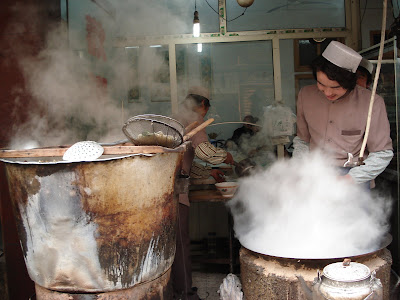
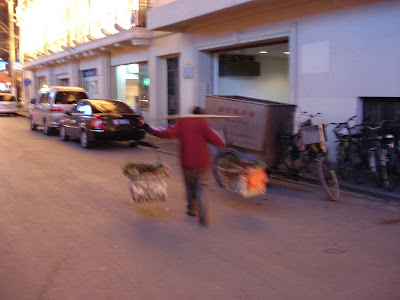
Sting only wrote one decent lyric after the Police broke up (monkeys, typewriters etc.): "I hope the Russians love their children too". However closed the Chinese government remains to international scrutiny and censure, much less to democratic reforms, the Chinese people as a group are open and welcoming, curious and interested. Yes, they love their children too, and you, if you are reading this from outside this fascinating country, have to come and meet them.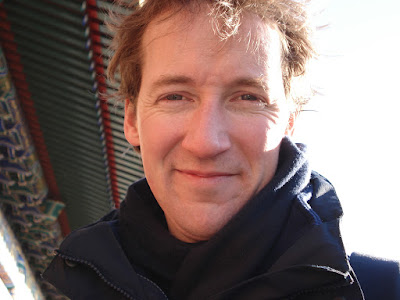
Thursday, January 17, 2008
Ghosts of the Yangtze
Our first stop on the cruise was the town of Fengdu. It's known as the City of Ghosts because it is to here that all Chinese must return when they die, even those living abroad (did you hear that, xiao Wang?), to be judged by the King of the Underworld. The good go to red heaven, and the bad go to blue hell.
There are ghosts aplenty here - some very recent ones. Almost all the temples in the Fengdu complex were destroyed by the Red Guard during the Cultural Revolution. The fact that these officially sanctioned hooligans were scared of destroying the temple of the King of the Underworld himself, gives an idea of the amount of power that was handed - locally at least - to the ignorant and superstitious, all just for the sake of a powerplay back in the capital. The Red Guard was motivated by violence and petty power. Maoist principles were just a lick of red paint on the shithouse wall.
This wasn't a Chinese problem. The parallels are easily seen with the early SA in inter-war Germany, the blackshirts under Mussolini, and the pickup-driving, Kalashnikov-wielding Taliban. Ignorance and violence are a natural match. The repeating pattern of unholy alliances between destructive and arrogant youth and cynical manipulative experience makes me very angry - and very frightened too when I think of what kind of circumstances could bring about the same pattern for me or my daughters. Because despite what some bestsellers say, I don't think anyone can really believe that history is over.
The other ghost that haunts this part of the Yangtze lies a few hundred kilometers downstream - the Three Gorges Dam. 
There is a background eeriness in the many references to what has already been submerged under the rising waters of the dam, and what awaits the final phase of the project in a few months time. Life around the Yangtze is coloured by numbers: 156 metres above sea level - the current height of the water here. 175 metres - the final dry season level. 13 cities, 140 towns, the homes of 1.4 million people - all under water when the project is complete. Everything that we look at has a question mark over it: Will it still be here in a year's time? Everything we see can be compared dramatically with pictures of 10 years ago or so. The river banks today are unnatural - their ecology needs time to adapt to the new reality.
The spell of numbers and levels is only broken when we finally move through the locks of the great dam itself. The landscape is once more fixed and reliable. No more disappearing towns. But just before that happened, there was time for one more moment of surreality. The the boat made its way through the 5 chambers of the shiplock, snow began to fall. Nina, Sara and I went uptop, along with the Australian/Indonesian family we shared the dinner table with, and had a snowball fight under the cold glow of the locks neon lights, while moving slowly through the belly of the largest dam in the world. If you ask the girls what they remember most about the cruise, they will probably say the snowball fight. Me too, actually.

Should the dam have been built or not? This is the question that was posed by Luther, our Yangtze Guide on the Victoria Star, after a powerpoint presentation on the pros and cons of the project. He left the question open, and left plenty of room for both sides of the argument in his talk. He raised negative consequences of the dam that I hadn't thought of or heard about before. Most importantly, he avoided the temptation to be didactic or propagandist on the matter.
My own impression is that although national pride is noted as one of the minor reasons for the project, it has at least as much to do with the decision to build as the three major ones: Flood control, Power generation and Improved navigability. I don't know what decision I would have made, but I'm uneasy with the knowledge that only a political system of almost absolute centralized power could decide to relocate 1.4 million souls, and that this very same monopoly on power has led to the kind of corruption that can jeopardise the safety and viability of a megaproject such as the Three Gorges Dam
See www.ctgpc.cn and www.threegorgesprode.org (banned in China).
Make up your own mind.
Sunday, January 13, 2008
Inside China, Outside Beijing
Blog's been a bit quiet for the last few days. Connectivity in Chengdu wasn't great, and then we had 3 nights on board the Victoria Star on the Yangtze where we decided to stay away from the 'net. More on both Chengdu and teh Yangtze later. For now, here's my musings on some of the grimmer and grimier sides to China. (Don't worry Mr. Clancy - it's still a great place to visit and you do well to extend your stay.)
...
...
In the soft-seat waiting room of the Chengdu North railway station, and damn glad there were no hard seats available on our T888 to Chongqing. Chengdu was a good place to relax, to save money, and to eat good food. We saw the two main things we planned to see, and had the good sense not to run around too much. Sim's Cozy Guesthouse was our oasis - it's bar especially - and given that the city itself had nothing much to recommend it, and the cloud of pollution (or was it really fog?) made it even less attractive, we felt no pressure to leave Sim's without good reason.
In the last few days we have seen a very different side of China. We've taken more public transport, got much further outside the city limits, and seen the countryside, through a dense cloud of ever-present smog. The tidiness we noticed in Beijing remains - there is no shortage of people who can be employed to sweep the streets clean. But Beijing now appears relatively organized compared with here in Chengdu. When you hear about the increasing inefficiency of the Chinese economy, and the fact that it needs more and more investment to extract the same level of growth, you feel you can almost see the physical manifestation of this on the streets. The country is creaking under the weight of its own success. It clearly needs some period of consolidation to concentrate on doing things smarter, laying the way for future, more sustainable growth.
(In software terminology, the country needs some time to refactor itself. It has rushed headlong to meet its deadlines, but the economy has probably lost so much of its shape as a consequence that it cannot be further built upon for much longer without losing its ability to return on any investment.)
Some ideas and practices will have to be thrown away (how can entrepreneurs feel secure about their efforts if basic issues like private property are so nebulous?) and others will have to be modified (can the one-child policy be sustained in the face of an aging population and a widening gender imbalance?). It's hard to change the behaviours and mindsets of even a modest-sezed group of people - I have no idea how you go about doing it with 1.2 billion people.
Here's some concrete signs of an unstable economic platform that, for want of a better term, I'll call sino-sprawl:
1) The traffic:
It's not that there aren't any rules - it's just that they're not the same as the ones that are presumeably written down somewhere. You get the feeling that the roads have outgrown the old rules and have evolved new ones. The result is a kind of intelligent system, but one which is firstly not amenable to any kind of further planning or rationalization, and secondly is teaching a new generation of road users all the wrong things. I will never EVER complain about Italian drivers again. Their somewhat ambivilant attitude to lane discipline is just a change in accent compared to the indecipherable language of Chinese driving.
2) Pollution:
I haven't seen a blue sky since our first day in Xi'an. "So what" say the Irish readers, "we haven't seen one since September". Well, let me put it differently: I haven't seen more that 5 city blocks into the distance in these past few days. Some locals here have defended the situation by saying to me "What about the famous London fog?" Well I think it might still have been around in Sherlock Holmes' time, and I suspect that this is why it's so famous. But I seem to remember that even this 'fog' was a product of England's industry rather than its climate. Suffice to say that certain part of China seem to be choking themselves, and there are surely kids around here who have never known anything else.
3)
Construction:
In Beijing we marvelled at the newness and the growth. In Cork, the tallest building in the Republic of Ireland is nearing completion,but it would be lost in scale, and long forgotten in construction time, if it had been build in Beijing. All very impressive, until you look at the skyline of Chengdu. There are a great many successful large building projects underway here, but there are also some skeletal remains of buildings that have run out of financing - and some eyesores that you kind of wish had suffered the same fate. China is building fast, yes, but also loose.
4)
Labour:
This is only a superficial observation (well of course all these observations are), but if I were a foreman on Shopfloor China, I'd like to ask half my workers what the hell they were doing. A lot of jobs seem to involve hanging round a lot, or playing cards waiting for something to happen. I wouldn't like to get up on the scaffolding I saw being erected in downtown Xi'an by 4 lads, 2 of whom were blindly banging their spanners against joints, looking at the passing city crowds instead of concentrating on the job in hand. I've never worked on a building site, so perhaps I've got it all wrong. Maybe it wasn't dangerous - just inefficient. But I think this is the whole point. When you have enough people available to work at low wages, you can afford to be inefficient. China has appears to have allowed herself to go this way.
Monday, December 17, 2007
Australia: Even Their Farts Don't Smell
I love this. The search for reduced emissions can lead to some really interesting places - a kangaroo's backside being one of them. Kangaroo stomachs are not only much more efficient than those of cows (getting up to 15% more energy from the same input) but there is no methane byproduct as part of their digestion process. An enormous 15% of Australia's greenhouse emissions are produced by cattle and sheep (in New Zealand it's more like 50%!!) so this problem is serious.
The solution is obvious: eat kangaroos!(*) Apparently that idea isn't very palatable to most. Some undoubtedly don't like the idea because they find kangaroos cute (my daughters - no strangers to methane production themselves - fall into this category). Others won't touch the stuff because kangaroos are, effectively, giant rodents (the Chinese for a kangaroo translates literally as "pocket rat"). But a growing percentage of Australians consider the meat of this iconic animal to be not only tastier, but healthier, than beef.
But what if the idea caught on, and everyone started eating their national symbols. Would we see Roasted Eagle on American tables? Braised Bulldog on sale in English gourmet pubs? Frogs served in French restaurants (oh - hang on...)
But back to greenhouse gas emission - what are we going to do about Guinness drinkers...?
(*) Apparently not obvious enough for some scientists, who think the most logical approach is to put kangaroo stomachs into cows and sheep. I wonder if any of these guys were on the EJB committee (Nerd Humour - ignore at will)
Wednesday, November 21, 2007
Chinese Recycling and Travelling by Moral Submarine
It seems that in eco-vandal China, there might be more recycling going on in than in right-on Europe, even if folks there don't separate their rubbish. But as the article points out, there's plenty of fly-tipping going on too.
On matters environmental, Letizia has an interesting article over on her blog (italian and english versions) about the modern day equivalent of the medieval practice of selling indulgences: offsetting your own carbon emissions.
I must admit that I'm torn on this issue. I confessed (blimey - even more antiquated religious behaviour!) up front on this blog a long time ago, that our trip is indefensible from an ecological point of view. Folks who sail around the world with their kids (they exist!) are safely on the moral higher ground here. Given my lack of sailing expertise, I'm happier for us to travel physically well above sea-level even if we're in a moral submarine. (That was one of the more contorted metaphors you are likely to read this week. Altogether now - We All Live in a Moral Submarine...). But I do like the idea of a building the environmental impact of an activity into its price, and letting market pressures do the rest. Of course the marketplace only works well if there is transparency and trust in place - elements that are usually underwritten by national governments or international bodies. There's no sign yet of any standards being put in place, or met, by private sellers of carbon offsets. And that means more time in purgatory for me. Pass the chestnuts, will you?
Tuesday, November 20, 2007
Welcome to Australia. Wipe your feet.
Once upon a time, the largest animal that inhabited Australia was the kangaroo. Now, that iconic creature is relegated to 13th place, behind a whole host of newly introduced species. Most of these newcomers have made themselves at home a little too well, put their feet up on the furniture, and emptied the fridge. Some of this has been inevitable. The first stowaway on the First Fleet was altogether smaller, but devastating for the locals: Smallpox wiped out an estimated 50% of the Eora population. There was nothing inevitable about the rabbits, cats, cows and even camels that now run feral in the Australian outback.
Not only Jared Diamond's Collapse but even Blll Bryson's Down Under make mention of how rabbits were deliberately indeed carefully added. Nobody really had any idea of the catastrophic effect of introducing species into an environment that had been geologically isolated for 65,000 years. Australia provided no natural predators for the large mammals that colonialists saw fit to offload.
These days, the Australian authorities are not taking any chances. There is the now-famous Australian baptism: pesticide spray that the cabin crew will bless you with as you arrive in Oz. There is also a whole range of things that you can't bring in to the country (above and beyond what you'd expect)and the penalties include anything from confiscation through AUS$220 on-the-spot fines, all the way up to 10 year in jail. You even have to make sure that your hiking boots aren't muddy. It's a different twist on the idea of putting out the welcoming mat. But of course I see the need.
But it took a little bit of googling and browsing to come across the list of prohibited imports. I wonder, if I hadn't been forewarned by colleagues who have been to Oz already, at what point would I have found out? When I was forced to bin expensive Chinese tea or souvenir erhu on arrival to Sydney?
[Added later: An inquiry to AQIS (Australian Quarantine and Inspection Service) pointed me at an online database where travellers can check specifically what conditions apply to specific good. Looks like I can bring in tea after all :-) ]
Tuesday, November 6, 2007
Ryanair: Climate Change - It's All In Your Head
I have a certain respect for Michael O'Leary, CEO of Ryanair - Europe's largest airline (by passenger number). It's a very specialized kind of respect - the kind I have for older people who say what they think, wear what they want and don't give a damn about who they might offend. I like to think that some day I'll be that irresponsible.
My respect doesn't extend to the actual opinions that O'Leary regularly and flamboyantly expresses (nor to those of octogenarian anarchists for that matter). One of the reasons for the timing of our trip is that in 10 years, thanks to the price of oil going only one direction and and increasing popular and political attention being paid to climate change, it may not be economically feasible to make this kind of trip. O'Leary thinks that this kind of concern is just a "middle-class, mid-life crisis" preoccupation.
Correct on both counts: I am approaching mid-life, harbouring an unhealthy curiosity about the eventual nature of my crisis. And even a cursory glance at me confirms 'middle class' (a closer look would prompt a swift revision downwards). So far, from a single-sample, anecdotal point of view, O'Leary would appear to be spot on. So is he right?
Let's look more closely. Here's the detail on Michael's keen analysis of the situation:
"China and India are laughing at us while they build more coal-fired power stations. The European middle classes are having a mid-life crisis and the sooner we wake up and say so the better."
Leaving the mangled metaphors to one side for a moment, there is not even the slightest attempt on O'Leary's part to make intelligent comment on the matter. The thrust of the sentence seems to be 'China and India are catching up and overtaking Europe and the US on the CO2 front so the whole climate change thing is a delusion reinforced by our delicate suburban sensibilities'. Sorry? What's that now? You get the feeling that he might have said just about anything, depending on what he first hit his head off that morning.
In Europe and the US we tend to lend weight to the opinions of our business leaders. The reasoning is sound enough: if you can run a company successfully then you're smart and deserve our attention. The reality is that there are different types of businesses with different breadths of view, and there are varying grades of business people as well. But the typical business leader isn't looking as far ahead into the future as the Nobel winners who are trying to inform the public about climate change. And when business does look ahead, it usually squints.
I think the most insightful view on Michael O'Leary's real view of the future of cheap aviation was given in the last line of that Guardian article:
Mr O'Leary reiterated his determination to stand down in "two or three years" but said he was no nearer setting up his own long-haul airline.
Maybe Micheal is heading for an earlier than expected move to the land of high waistbands, optional hygiene and swearing at clergy.
Thursday, August 23, 2007
Hey Mister Hu , What did I do?
Dunno - I think I got myself on the wrong side of the Great Firewall of China. According to Google Analytics I don't have any Chinese readership (although to be fair, I don't have much of a readership any which way you look at it). And my friend in Chengdu couldn't access this blog. My blog on learning Chinese does however, so it's not some kind of blanket Blogspot firewalling. Maybe my excerpts from a chapter of Collapse did the trick. Hey - if you're reading this from the PRC - let me know!
[Addendum: Paranoid. Severely Paranoid. I checked Google Analytics (properly this time) and I do have a Chinese readership after all. Chengdu and Shanghai both appeared on my map.]
[Addendum: Paranoid. Severely Paranoid. I checked Google Analytics (properly this time) and I do have a Chinese readership after all. Chengdu and Shanghai both appeared on my map.]
Tuesday, April 3, 2007
Review of Jared Diamond’s Book "Collapse"
This book makes gripping and important reading. It is balanced and builds a cohesive model of the parameters that can predict our own success or failure as a society.
Rated as /5 on Apr 03 2007 by Brendan Lawlor


One of the really refreshing things about this book and this author is that he is playing to nobody’s tune but his own. He acknowledges from the outset that what he has to say will please neither those who assume that modern technological society is inherently wicked, nor those who feel it is blameless for our current state of affairs, ecologically speaking.
The book charts the success or failure of various human societies in the past and the modern age, compares them, and asks the question “What makes the difference between sociatal life and death?”. The author extrapolates 6 variables from past societies that, he argues, can be used to predict our own fortunes.
Most of the content is, it has to be said, disturbing. But Diamond insists that the jury is still out in our own case. He offers, as an appendix, a common sense list of things that every single one of us can do to play our part in addressing current problems that could lead, if unchecked, to the demise of our society as we know it.
I’m really glad that I read this book, and it’s one of the few books that I will undoubtedly re-read.
[Note that this blog entry was published through an exciting new (still in beta) service called Louder Voice - well worth checking out.]
Rate this review at LouderVoice
Saturday, February 10, 2007
Collapse: China, Lurching Giant
I've just re-read Collapse's chapter on China. There are only 20 pages there, but it is a torrent of bad news. Diamond does manage to finish on a hopeful note, and I don't doubt his sincerity, but there was no sign of that optimism in the preceding 19 pages.
When it comes to environmental problems, you name it, China has it in spades. Air and water pollution, soil erosion and salinization, 20% of it's native species endangered, habitat destruction due to a number of factors, and on top of all this, what Diamond calls megaprojects (Three Gorges Dam, South-to-North Water Diversion Project). Complete the picture, if you will, with an image of the most populous nation on Earth moving towards First World living standards, growing its economy at 10% pa, but achieving all this through desperately inefficient use of its resources.
I wonder how much of this we'll actually witness first hand while there. Will the air be so bad in Beijing that we'll be learning the Mandarin for face mask? Will we experience one of the infamous duststorms that plague the capital from the soil-eroded plains to the North? As we approach Xi'an on the train from Beijing, will we see the lunar landscape of the Loess Plateau, which is 70% eroded? We certainly hope to set eyes on theThree Gorges Dam which is due to be complete in 2008/9. And what about the water shortages - I doubt we'll see any halts in the flow of the Yellow River, seeing as we'll be there in Winter.
There was a very interesting Will Hutton article in the Guardian a few weeks back that described the tension that exists between the huge growth in the economy, and the fact (at least according to Hutton) that the Chinese market was still very much managed, and very much in the hands of the Chinese government - in other words the Communist Party. His thesis is that due to the enormous problem of corruption within that party - thanks to the lack of the western structures and freedoms whereby the government might itself be governed - the Chinese rush to riches will end up in either civil strife, or industrial collapse.
There are echoes of Collapse in that article too, but Diamond overall sees the unique control that the Chinese government still holds as being a cause for optimism (a style that he refers to somewhat euphemistically as Top-Down). Only in China could the population growth be reduced to 1.3% (the One-Child policy). Only the public ownership of all land could allow the easy establishment of 1757 natural reserves (13% of China's area), an outright ban on logging, enormous reforestation and reclaiming of desert.
The metaphor that Diamond finishes the chapter with, is one that he uses throughout the book: a race. There is a race between the destructive and remedial powers of humankind and our ingenuity. China itself is lurching between these positive and negative tendancies, but doing so with a momentum that makes it unique amonst nations. A momentum that makes it uniquely responsible.
When it comes to environmental problems, you name it, China has it in spades. Air and water pollution, soil erosion and salinization, 20% of it's native species endangered, habitat destruction due to a number of factors, and on top of all this, what Diamond calls megaprojects (Three Gorges Dam, South-to-North Water Diversion Project). Complete the picture, if you will, with an image of the most populous nation on Earth moving towards First World living standards, growing its economy at 10% pa, but achieving all this through desperately inefficient use of its resources.
I wonder how much of this we'll actually witness first hand while there. Will the air be so bad in Beijing that we'll be learning the Mandarin for face mask? Will we experience one of the infamous duststorms that plague the capital from the soil-eroded plains to the North? As we approach Xi'an on the train from Beijing, will we see the lunar landscape of the Loess Plateau, which is 70% eroded? We certainly hope to set eyes on theThree Gorges Dam which is due to be complete in 2008/9. And what about the water shortages - I doubt we'll see any halts in the flow of the Yellow River, seeing as we'll be there in Winter.
There was a very interesting Will Hutton article in the Guardian a few weeks back that described the tension that exists between the huge growth in the economy, and the fact (at least according to Hutton) that the Chinese market was still very much managed, and very much in the hands of the Chinese government - in other words the Communist Party. His thesis is that due to the enormous problem of corruption within that party - thanks to the lack of the western structures and freedoms whereby the government might itself be governed - the Chinese rush to riches will end up in either civil strife, or industrial collapse.
There are echoes of Collapse in that article too, but Diamond overall sees the unique control that the Chinese government still holds as being a cause for optimism (a style that he refers to somewhat euphemistically as Top-Down). Only in China could the population growth be reduced to 1.3% (the One-Child policy). Only the public ownership of all land could allow the easy establishment of 1757 natural reserves (13% of China's area), an outright ban on logging, enormous reforestation and reclaiming of desert.
The metaphor that Diamond finishes the chapter with, is one that he uses throughout the book: a race. There is a race between the destructive and remedial powers of humankind and our ingenuity. China itself is lurching between these positive and negative tendancies, but doing so with a momentum that makes it unique amonst nations. A momentum that makes it uniquely responsible.
Wednesday, January 3, 2007
Collapse: A Theme
There is nothing good, from an environmental point of view, from going around the world by airplane. I know this, and I acknowledge that our trip's Carbon Footprint is somewhat jackboot-shaped. I don't know whether what I have to say next makes things better or worse.
A few months ago I finished Jared Diamond's most recently published book, Collapse. It describes the success and failure of numerous human societies across time and geography, attempting to distinguish those factors, including the society's own behaviour, that decided whether the population collapsed or prospered. We will be visiting a lot of the countries that Diamond talked about - and seeing evidence of other societies that failed (the Inca for example). So I'd like to make this one of a number of themes for this trip, learning first hand about the ecological and political issues that touch the stability of our increasingly overlapping societies in each of the places we visit.
There's a whole chapter devoted to Australia in Collapse, and a section on China. I expecgt it's going to be hard to see anything except the tourist side of China, but may in Oz I'll have better luck seeing first hand some of the issues that Diamond talks about.
A few months ago I finished Jared Diamond's most recently published book, Collapse. It describes the success and failure of numerous human societies across time and geography, attempting to distinguish those factors, including the society's own behaviour, that decided whether the population collapsed or prospered. We will be visiting a lot of the countries that Diamond talked about - and seeing evidence of other societies that failed (the Inca for example). So I'd like to make this one of a number of themes for this trip, learning first hand about the ecological and political issues that touch the stability of our increasingly overlapping societies in each of the places we visit.
There's a whole chapter devoted to Australia in Collapse, and a section on China. I expecgt it's going to be hard to see anything except the tourist side of China, but may in Oz I'll have better luck seeing first hand some of the issues that Diamond talks about.
Subscribe to:
Posts (Atom)