Since we've left Ireland almost 6 months ago, the Irish people gave Bertie Aherne an early bath, albeit indirectly, and now have rejected the Lisbon Treaty as well. The best political commentator I know (that's you Jim if you're reading) predicted a year ago or more that Bertie would finally have to go if and when the economy started to splutter, and I'm in no doubt that he was right on this. I wonder if the fact that it continues to splutter, belch and occasionally fart is partly responsible for the treaty's rejection as well. In any case, the Irish had the opportunity to decide whether the Treaty was a good idea or not, and their voice was duly heard, even it it's hard to tell what it's saying.
The Lisbon treaty was negotiated and redrafted over years by expert civil servants and lawyers, translated into every official European language by dedicated teams of polyglots, and debated for months by various national parliaments and the Irish electorate. The Treaty of Waitangi (1840) by contrast was drafted in 4 days by three men (and not one of them a lawyer), translated badly by a missionary, and debated by a subset of Maori chiefs, none of whom really had the authority to sign it on behalf of their people, and for whom many of the concepts of modern statecraft meant nothing. But sign it they did, and in so doing transferred sovereignty of the islands of New Zealand, considered at that point to lie in the hands of the United Tribes of New Zealand, to Queen Victoria of England.
That the United Tribes of New Zealand was non-existent in any functional sense didn't seem to matter. There was no political union under Maori - the Maori name for New Zealand (Aotearoa) was unlikely to have been used by Maori, and was probably a romantic invention of European missionaries. The very word Maori was only coined by Maori as a way to distinguish themselves from the Pakeha (Europeans), and means simply 'ordinary' or 'normal'.
That key words from the treaty like, em, sovereignty for example, were translated badly (and inconsistently with previous English/Maori documents), was overlooked or ignored.
British motives behind the treaty are interesting to look at. It's easy to imagine the Treaty as the product of rapacious imperialism, but the kind of people behind its creation (James Stephen, Lord Glenelg) were those who pushed successfully for an end to slavery in the British Empire. Conditions for the Maori had become particularly difficult since whalers had started operating from New Zealand's shores, and it was felt that something had to be done to protect and conserve New Zealand for the Maori. But the unseemly haste, which made the treaty such a flawed document, was driven by baser motives: a race against time to prevent The New Zealand Company from seeing though its plans of 'Systematic [private] Colonisation' of the islands. And the way in which colonisation was seen through was far from the 'New Zealand for the Maori' sentiments nurtured by the Treaty's creators and sponsors. Settlers and Crown authorities often interpreted the treaty in ways that favoured Pakeha over Maori, or else disregarded the provisions of the Treaty entirely.
The very fact that there was a treaty at all is another indication of the difference between the fates of Australian aboriginal and Maori societies (no - I'm not through with this topic yet). A treaty was required because New Zealand, unlike Australia, was not deemed to be Terra Nullius by the British. It was occupied and defended in a way that Europeans could related to. Farming was well established, and a continuous state of war between tribes, with alliances chopping and changing regularly, meant that the technology and organisation available to Maori for their first contacts with Europeans was enough to keep them at arms length for quite a while.
Tasman arrived in 1642, lost four sailors to Maori spears, and buggered off. A full 127 years passed before the next European explorer, James Cook, passed by, and despite his famous ability to negotiate with locals, and the advantage of a Polynesian language speaker on board, still managed to get into several skirmishes. Although the Maori came off worst in these clashes, the belligerence of the natives was reported back to London and surely had some influence on the selection of New South Wales over New Zealand as a suitable place to set up a penal colony. And that relative proximity of a British outpost in Sydney just 10 years after Cook's voyage allowed the Maori to build up a relationship with London gradually. Sixty years passed between the settlement of Sydney and the Treaty of Waitangi, during which there was much trade and exchange of people, and the gradual establishment of private whaling stations on New Zealand coasts.
For the first New Zealanders, almost 200 years passed between first contact with Europe and final colonisation. Compare that with 10 years for the Eora people of Sydney, and consider also that Australian colonisation took place without a treaty, and with complete and total disregard for the First Owners of Australia. No provision was made for the protection of their rights or property, as happened in New Zealand. Although technically subjects of the Crown, those who attempted to repel the invasion of their lands were officially considered on a par with enemies of the state. This ambiguity in law left the Aboriginals to the tender mercy of settlers, by whom they were considered at best competition, and at worst, vermin. I've already mentioned the fact that Australian aboriginals were still hunter-gathers, given Jared Diamond's reasons for why this was so, and outlined how this left the Aboriginal less prepared, technologically and socially, for invasion and sustained warfare. This lack of preparedness, the speed of colonisation, and its ferocity, meant that Aboriginal societies in Australia (and in the case of Tasmania, even the population itself) were destroyed. And it's not at all clear to me if they will ever recover. It was an exact analogue of what happened to the Moriori of the Chatham islands, except in this case the both the aggressors and the vanquished were Polynesians. The Maori suffered terribly but were able to defend themselves better and their society was not dealt quite the same killer blow and in the case of Australian aboriginals.
Through a mixture of base and noble purposes, the Treaty of Waitangi was more or less thrust upon the Maori, but I wonder what would have happened if it had not? The fates of other Polynesian peoples, under the "broad sweep of history" that Jared Diamond describes in Guns, Germs and Steel which I blogged about recently, was varied and ranged from absolute annihilation to a retained and functioning independence. There's no safe assumption that things would have been any better for the Maori without Waitangi.
The unity of Europe was conceived with noble reasons - to end the wars that had raged between the constantly switching alliances of European tribes, to protect itself from external aggression, and to create and environment suitable for mutual prosperity (some of which seems remarkably similar to the situation that pertained amongst Maori before Waitangi). Europe has rejected unity attempted in the past by horse, sword and panzer, until it's more recent acquiescence to the pen. The Treaty of Lisbon, written in dense legalese and referring to many other previous treaties, may have been effectively just as open to misinterpretation (and misrepresentation) to Irish voters as Waitangi was to the Maori. It might have been put in force over the heads of all EU countries other then Ireland. I'm happy we had our opportunity to vote on it, but I think that the arguments for the treaty was made very badly indeed, and I'm not sure sure that we'll be any better off for having rejected it.
Showing posts with label abel tasman. Show all posts
Showing posts with label abel tasman. Show all posts
Monday, June 16, 2008


Wednesday, May 14, 2008
Campervan: Day 3
Abel Tasman Park, in the northwest of NZ's South Island, is accessible from a number of points, one of which is a town called Marahau 60km from Nelson City. There's a coastal walk that leads from the Wainui at the tip all the way back to Marahau which takes about 3 days to complete. Some day I'm going to do that. But for now we were content to do a half-day walk, facilitated by Aquataxi. More like a bus service these guys will take you to one of 5 or 6 points along the coastal walk, and pick you up from another. The walks are all well maintained and marked. It couldn't be easier.
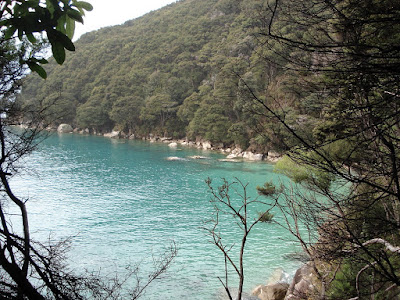
When we set off from Bark Bay, with a 7.7km walk to Torrent Bay, Nina was in bullish mood. "This is too easy!" she insisted. The trail was mostly covered by the canopy of the trees above us, but it did follow the coast and climb up above it too. Every now and then we could look out over the water, or down to an inlet, and curse the fact that you didn't pack your swimmers - or to hell with swimmers, at least a towel! One hour later, when the gradient had asserted itself a little, Nina's attitude had changed: "Why does the trail have to go UP?", she asked in pained tones. Where do you start with a question like that? Poor Nina and Sara. We've calculated that since we left Cork, they have hiked around 75km. Those are real hikes, not including city walks and general traipsing around. They have both had plenty of practice of hiking in Cork, and plenty of notice about what might await them on this trip.
Why does the trail have to go up?
Oh my wonderful little Nina, the trail will go up, and the trail will go down. And sometimes it will wind around on the level for so long that you will forget that you are even on a journey. And at the moment when it gets really tough you might be surprised by a stupendous view afforded only to those who put in the effort. The trail goes up because that's what the trail does. And when it goes down, it goes down because it already went up. Make your peace with the fact that sometimes it will be harder than others, and that all you have to do is keep putting one foot in front of the other and know that sooner or later, it will get better. We all know that the good stuff doesn't last, but not even the bad stuff does.
On a less chocolate-box philosophy note: The temperature has improved tremendously - enough so that Letizia was able to sleep without her beanie! There's an unconscionable and irresistable provocation if ever there were one.
When we set off from Bark Bay, with a 7.7km walk to Torrent Bay, Nina was in bullish mood. "This is too easy!" she insisted. The trail was mostly covered by the canopy of the trees above us, but it did follow the coast and climb up above it too. Every now and then we could look out over the water, or down to an inlet, and curse the fact that you didn't pack your swimmers - or to hell with swimmers, at least a towel! One hour later, when the gradient had asserted itself a little, Nina's attitude had changed: "Why does the trail have to go UP?", she asked in pained tones. Where do you start with a question like that? Poor Nina and Sara. We've calculated that since we left Cork, they have hiked around 75km. Those are real hikes, not including city walks and general traipsing around. They have both had plenty of practice of hiking in Cork, and plenty of notice about what might await them on this trip.
Why does the trail have to go up?
Oh my wonderful little Nina, the trail will go up, and the trail will go down. And sometimes it will wind around on the level for so long that you will forget that you are even on a journey. And at the moment when it gets really tough you might be surprised by a stupendous view afforded only to those who put in the effort. The trail goes up because that's what the trail does. And when it goes down, it goes down because it already went up. Make your peace with the fact that sometimes it will be harder than others, and that all you have to do is keep putting one foot in front of the other and know that sooner or later, it will get better. We all know that the good stuff doesn't last, but not even the bad stuff does.
On a less chocolate-box philosophy note: The temperature has improved tremendously - enough so that Letizia was able to sleep without her beanie! There's an unconscionable and irresistable provocation if ever there were one.
Subscribe to:
Posts (Atom)