Thursday, August 7, 2008

Meet the Cast

We are not alone. For the first time since saying goodbye to Giovanna waaaaay back on the South Island of New Zealand, we find our family unit once more broken open. It's not just because Letizia's mother Livia is with us. Our cast of characters has expanded much further. Before I begin to introduce you to them, let me explain a little further.

Cusco has become a home from home for Livia over the last 10 years. Back then, she was introduced to Padre Nicanor, the mercurial parish priest of Belen in Cusco. In a ramshackle building, this man had managed to put together by sheer force of will and strength of personality, a medical center for his flock. The Peruvian economy is rapidly improving now, but back then the state was woefully absent when it came to public health. Livia is a doctor, with a strength of personality all of her own. The combined personalities of Padre Nicanor and Livia Rosetti have driven forward a project right here in Cusco that has improved the quality of life for many hundreds of Cusceños. The Medical Centre of the Parish of Belen is like no other institution in Cusco. Spread across three floors, it boasts a pharmacy, dental health suites, psychological services, gynacological services, alternative herbal medicine and much more. For those who can pay there is a small fee. For everyone else it is free. And it would never have happened had my mother-in-law not dedicated so much of her time and energy, collaborating with German colleagues, cajoling money from many different charitable fonts, and simply being there herself.

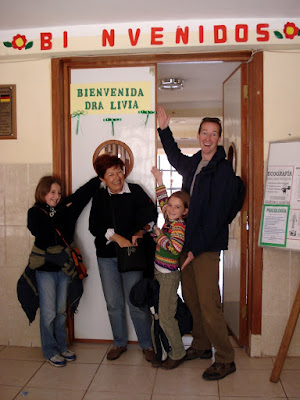
I've heard about this place for quite some time, obviously. I have to admit that while I admired what Livia had achieved, it was all so very abstract. Even when Livia collaborated with my mother's circle of friends back home in Carrigaline to raise money for the centre, it remained a distant and vague concept to me. I really had no idea of the importance of what had been achieved until I got here. When we stepped down from the train in Cusco, Livia was already there to meet us. She was accompanied by Señora Paulina, one of the administrative staff of the medical centre, who covered all four of us in confetti. Minutes after our arrival into our hotel/hostal in the San Blas district, another car load of new faces arrived, armed with even more confetti, as well as flowers and flags for the girls. By the time the fuss died down, and we were left to settle into our room, the lobby was strewn with petals, confetti, and emptied cups of coca tea. We were left to contemplate this whirlwind of welcome.

I have done nothing, not a damn thing, to help towards the creation of the Medical Centre here. The only reason I was afforded such a welcome was because I am Livia Rosetti's son-in-law. The intensity of this reflected glory gives an idea of the esteem in which Livia herself is held by the Belen Parish community. Since that first evening, I have seen much more with my own eyes. As well as the very intense tourist activities we've been submerged in (my lame excuse for such a poor rate of blogging this past week) we've visited the Medical Centre and gone in-country with some of the doctors as they visited remote villages around Cusco. The sight-seeing, and the first-hand view of the Medical Centre and its work, have replaced the abstraction that was Cusco with a flesh-and-blood reality that I will take back home with me and never lose.

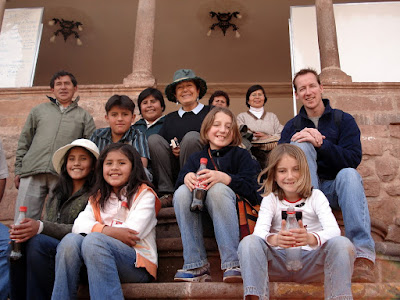
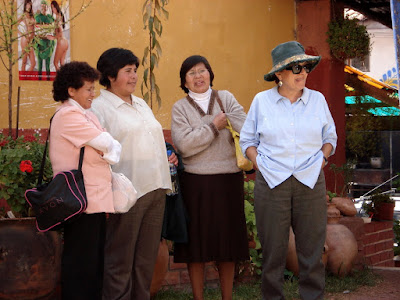
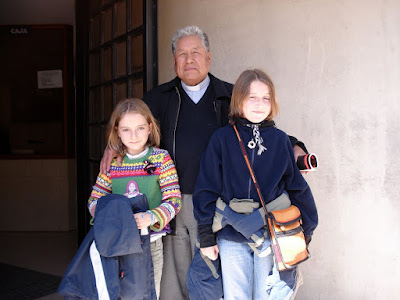
I'll blog on both of these aspects of our Cusco experience in the coming days, but for now, I'd like you to see some of the faces that appear regularly in our day-to-day lives. I wish I could somehow make these photographs appear more than a collection of faces. I wish you could somehow be here and get to know La Hermana Mathilde, or José and Concepción and their wonderful daughters. I'd like you to know what it feels like to be in a room with the explosive Padre Nicanor, or wander through the floors of the Medical Centre of the Parish of Belen and feel the pulse of activity that pervades like an Andean drumbeat. Maybe, if I do my job right, over the next few blog entries you will get to know these people a little better, and get a sense of this place. In the meantime, here are some of the faces that populate my waking hours during this very special time in Cusco.


Sunday, August 3, 2008

End of the Line


Cusco is not our last stop on this 8-month journey, but in many ways it is our ultimate destination. After here, we have Lima and Buenos Aires to look forward to, but in both cases they are necessary stopping points on the way home. Cusco (and Macchupicchu) have been in our sights since the start. As a destination, it was all the more meaningful because waiting for us at Cusco train station was Livia, Letizia's mother. She's been coming here for 10 years or so, working on a very special project. But more on that in a later blog.

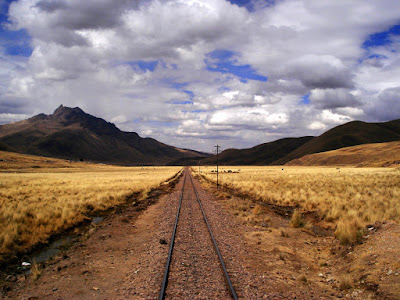
Being such a significant point in our trip, we travelled to Cusco in style. There is a train service operated by PeruRail called the Andean Explorer, which runs three or four times a week from Puno to Cusco. We booked it while we were still in Chile, and while it came in at almost 300 euro for a oneway trip, it was money well spent. For a number of reasons, it was the most spectacular train journey of my life. Never have 10 hours of any form of transport gone by with such ease.

The Andean Explorer is a colonial Gentleman's Club on wheels, trundling across an Andean wilderness, where the seats are real armchairs placed on the carpeted floors, the bathroom is a welcoming environment of dark wood and marble, and the table service is performed in a synchronised swirl of black and white uniforms. We were in the second-last car, and behind us lay the train car to end all train cars - a bar and observation deck. The elegant bar served Pisco Sours to window-side tables. The observation deck was almost completely enclosed in glass, except for the very last section - a brass rail in the open air.

Trains in Europe are hermetically sealed high-speed tubes that bullet through the landscape and skirt around cities. The Andean Explorer lets you breathe the air of the land you are passing through and instead of bypassing towns it runs right through them. When we first pulled out of Puno, I was leaning against the brass rails, ready to enjoy the receding lakeside scenery. Instead I found myself in a traffic jam in the city centre, cars on either side of me, kids and adults alike looking up at the spectacle of a badly-dressed gringo leaning out the back of the train. (Just think of the last scene from Dumbo, but with a less endearing cast). At first we just grinned at each other. Then the kids started to wave. Naturally I waved back. Nina and Sara joined me for a while, and the three of us waved at anything that moved. The girls got bored and left, but I was just getting warmed up. After 15 minutes or so I had the hang of things. Men prefered a dignified nod and a respectful smile. Adolescent males were to be saluted with a single raised hand ONLY if they initiated. Adolescent females - actually all women - appreciated a vigourous wave and a cheekily raised eyebrow. These rules applied not just for Puno but for Juliaca and every other town we passed through. My jaws were sore from smiling after the first 4 hours.

In many of the towns we passed through there were markets. It appeared that the markets formed either side of the rail and the railway line itself acted as the main thoroughfare through the stalls. Or it did until our train arrived. Business was suspended as we slowed down and squeezed past stalls selling everything from fruit to car-parts, never further away from the market tables than then length of a 20 soles note. The waving, nodding and smiling continued unabated. The relationship between those on board the train and those looking from the ground was one of mutual curiousity, neither party quite believing what was happening. I'm convinced that I saw more of Peruvian Altiplano life in those few hours than I had in the previous five days spent in Peru.

Another aspect of our train ride that made the day especially memorable for me was the company. Imagine that you're sitting on a luxury train, fresh from experiences of deprivation and sleeplessness. You've paid top dollar to be there, and just as you start to settle in, you watch a family of four lurch towards your table and proceed to surround you. Hell, right? Well Kim from Ottawa suffered exactly this fate as the four of us piled into the Andean Explorer and took up postions all around her that pretty much excluded all chance of escape. A lesser woman would have taken refuge in a book or a tall alcoholic drink, notwithstanding the hour. Kim, and her friend Janet (who was an entire merciful car away but who occasionally came to comfort Kim) handled our 'company' with the tolerance and good humour for which Canadians are deserved respected. (Kim: May there be many, many mountains. Your stories kept us on the edge of our, erm, seats.)

The reception we received in Cusco train station, and afterwards in the lobby of the Hospedaje San Blas, involved flowers, confetti and much shaking of hands and kissing. We deserved none of it, but were instead basking in the reflected glory of Livia Rosetti, my mother-in-law, who has helped to make a real difference to the lives of the people of the parish of Belen here in Cusco. I'll tell you exactly what I mean by that over the next couple of blogs.

It's been 5 days since we arrived here in Cusco, and the experience has been so full-on that it's only now that I'm catching up with the blog. I'll introduce you to a whole host of new characters over the next few days, and tell you about what we've seen since we got here. In the meantime, I should have been asleep an hour ago. Goodnight.

Thursday, July 31, 2008

And on the Third Day, They Rose Again

It was always part of the plan. The first two days in Puno were supposed to be all about getting an altitude attitude. The third day was to be all business: Onto the Lake Titicaca to see the floating Uros Islands, and then by land to the so-called Temple of Fertility in nearby Chucuito.

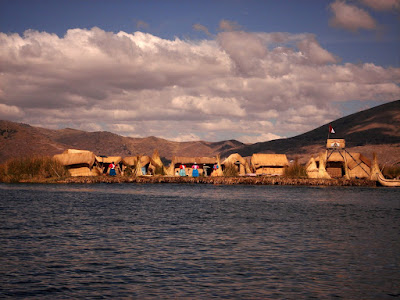
It was clear as soon as we arrived in Puno that it was nothing like Arequipa. If Arequipa is the White City, then Puno is the Brown City. Its bleak look is reinforced by the universal use of corrugated iron roofs. Nothing says shanty-town like those wavy lines. But we weren't here for the city - we were here for the lake. Lake Titicaca is the highest navigable lake in the world, shared between Peru and Bolivia. Its most curious feature, at least for me, is the group of 42 islands floating half-an-hour off the the coast of Puno, called the Uros.

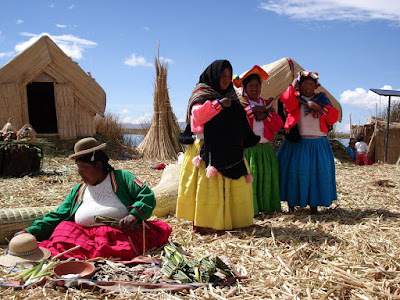
The name of these islands derives from the the name of the people who inhabit them. The Uros people lived happily alongside their other neighbours on the patch of land that is now the northern edges of Puno. Then the Inca came. The Uros felt the need to put some space between themselves and the spreading influence of the Inca, a reaction that can be readily understood. The only space they could find, however, was on the lake itself. At first they took to boats, then built little houses on those boats. In the case of both the boats and the houses, their primary construction material was the totora - a reed that is found growing in the waters all around the edges of the lake - right out as far as the current location of the islands themselves. In an excellent example of making the best of what you have, the Uros people used this reed for food as well. They took things further again - one might argue in a somewhat obsessive way - to devise a mechanism for constructing floating platforms from large blocks of roots of the totora. The Uros islands are a 600-year-old refugee camp.


Today, most Uros leave the islands at school age and don't come back. Why would they? There's no running water, precious little electricity (a few solar panels) and in any case, the Inca have been gone for quite some time. Those who remain on the islands live mostly by grace of the tourism they generate. Conservationism, this time of a unique human culture rather than an endangered species, owes much to the positive power of tourist dollars. There was no pretence in our encounters with the Uros. It was clear that they were used to boatloads of visitors, and they greeted us with song, dressed in colours that were sure to dazzle. They showed us, though the interpretations of the guide (they spoke neither Spanish nor English, but a pre-Incan dialect called Aymara) how they lived, what they ate, and with whom they traded. The experience was choreographed, neatly arranged for easy consumption. But there was no getting over the fact - we were on a floating island. We visited three of them in fact. It was home to these people. This was a way of life that was very real, totally unique and had been in place for 600 years or so.

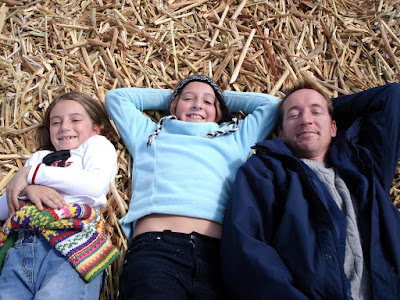
Nina and Sara loved it. The softness of the upper layers of reed underfoot was a delight. What could be cooler than a place where you could do the jackass as much as you want and fall flat on your back with impunity. Dry land seemed unreasonably hard and unforgiving after a few hours with the Uros.


Sara is usually the dressing-up kind, but this time it was Nina who volunteered to try out the Uros traditional dress.


The islands are a living museum, a tribute to innovation in the face of adversity, and a simple undiluted pleasure for visitors.

Our afternoon program took us south of Puno, along the shores of the lake to a small town called Chucuito. There are a lot of interesting corners to this otherwise quiet and neglected town. There is the church of Our Lady of the Assumption, from where the local platoon of the Inquisition maintained adherence to accepted orthodoxy on the part of the colonising Spanish, much like the Gestapo kept the National Socialist line in Wehrmacht outposts a few centuries later. It occured to me that I wouldn't have fared very well in Chucuito at that time. Not for my agnosticism in particular, but because of my perverse ideas on what constitutes humour: Sooner or later I would have thought it a jolly jape to ask the Grand Inquisitor exactly what it was that Our Lady was Assuming.


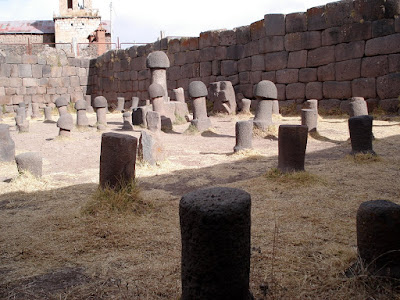
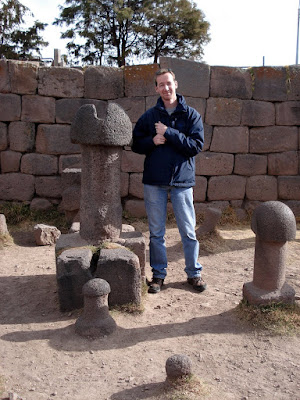
My daughters, who if they could would have built their own Uros islands a long time ago to take refuge from my 'jokes', were less impressed with this part of the days activities. Not even a field of stone penises could impress them. The Inca Uyo, sometimes known as the Temple of Fertility, is actually a solar observatory which was probably built to indicate the beginning of important moments in the agricultural calendar. The dozens of stone phalluses seem out of place (well, yeah!) and were perhaps taken from elsewhere and put into the Inca Uyo by well-meaning locals trying to reconstruct Inca heritage destroyed by the conquistadores. As such, they stand there in an act of defiance - one bunch of pricks against another.


But the idea of the Temple of Fertility stuck. Even today there are reports of women who visit the place in order to increase their chance of getting pregnant. The reports don't mention if they take their partners with them (which would seem like a sensible backup plan). Whatever erotic charge the temple might posess is undone by the belfry of the church of Santo Domingo, which peers in from across the road, silently outraged but too elderly to quite remember why.

Tuesday, July 29, 2008

Caption Competition


Perhaps I can get the ball rolling (npi) with "Spot the Difference".

(Get stuck in - this chance will hardly come again)

Monday, July 28, 2008

Waves

There are more ancient civilizations in South American than I can hope to remember. They all had their time, location language and culture. Some of them spread out from their points of origin and submerged others, like the waves I watched racing to the sand on Iquique beach a few days ago. The winners are the ones that we tend to remember. In Peru, the last two big winning waves were those of the Inca and the Spanish Conquistadores. On my one healthy morning in Arequipa we got a close up view of the faces of both of these cultures.

Juanita, as she is known to us today, was an Inca noble. She was about 12 years old when she walked hundreds of kilometers from Cusco to the volcanic mountain called Ampatu, about 100km from Arequipa, in the company of adults. Priests. They all climbed this mountain of more than 6000m, in sandals, using rough paths previously laid out in straw. In reaching this height - challenging even for today's well-equiped mountaineers - they were entering the world of the mountain gods. The rarefied air and exhaustion had already altered their states of mind. For Juanita, the privilige of walking amongst the gods with the priests, and the thoughts of what lay ahead, took her even further into a state of trance.

When they eventually reached the summit, Juanita was given some chichi, a beer made by the Incas. In her weakened state, the chichi made her lose consciousness. She wouldn't have felt a thing when one of the priests made a single blow to the right side of her head, just above her eye. That was all it took to end her life. In all probability, she was always destined to die this way. As part of a noble Inca family, she would have been selected early and educated with others like her about her role. She was priviliged. Her fate was to join the gods themselves, who according to the Inca priests had an appetite for young, beautiful and pure children, especially girls.

Almost six hundred years later, in the Universidad Católica di Santa María, at the end of a well-guided tour, we came face to face with Juanita. She never made it to the realm of the mountain gods. She lives in a Japanese-designed transparent freezer unit, alternating between the display location and the reseach lab (a routine she shares with the remains of several other sacrificed children of Inca times). She still bears the marks of the final blow. And you can still tell that when she was alive, she was very beautiful.

Not long after Juanita's death, a new wave broke on the West coast of South America. The conquistadores were armed with better germs, weapons (including horses) and political organization administered through the written word. The Inca were swept away.

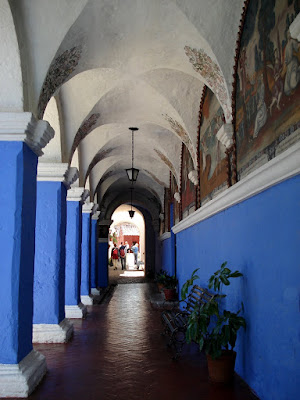
About four blocks away from the Universidad is the Convent of Santa Catalina. It was founded a mere 100 years after Juanita's death, as part of the cloistered Dominican order by a wealthy widow of Arequipa. Aristocratic Spanish families would pay massive dowries to have their second daughter accepted as novices as the age of 12. This daughter would remain enclosed within the ever expanding walls of Santa Catalina for the rest of her life. Once a month she would be allowed a monitored 15 minute conversation through opaque grills with her family. She was permitted no news of the outside world. If she considered leaving the convent, her shamed family would have disowned her. She had nowhere else to go. She would live a comfortable life, with servants and even slaves (some of the servents were lower-class, Indian nuns), silently praying, conversing only when sewing. When she finally died, she was laid out for a day in the mortuary before being buried in the convent's own graveyard. Her family was not invited to the funeral.

As I stood looking in though the mortuary door, with my own two daughters beside me, I noticed it was lined with the portraits of many nuns, each with their eyes closed. The guide explained that while they were still alive, it was considered vanity for the nuns to have their image painted. Only when they were dead was this permitted.

Then the portraits were sent to the dead woman's family.

This last detail hit me like rabbit punch. Up until now I had been scoffing my way through the tour, making all the predictable comments that you'd expect from an unbeliever when shown the harsh and pointless regime of a misguided cult. But sending the portrait of the freshly-deceased daughter to the family that had gone without her company since she was 12!? This seemed like the unholiest of cruelties. Spiteful. I remained silent for a while, trying to collect myself, and looked at my own second daughter, shuddering at the idea of her being born into another place or time than 21st century Europe. Into Juanita's time. Into the time of Santa Catalina.

Sunday, July 27, 2008

Hello Peru, Goodbye Stomach

I've been a bit quiet for the last few days - at least on this blog. In real life I've been making quite a variety of noises, most of which are associated with an infection of the digestive system. Yup - not twenty-four hours into Peru, I suffered the revenge of Atahualpa and two days later I'm starting to recover. The problem was made worse by a sequence of misdiagnoses. After a fantastic morning in Arequipa (more on that in a moment) I started to feel aching muscles and fatigue. Arequipa is at almost 2500m so I figured that this was the beginning of altitude sickness. I took one of the pills we had bought in Chile - the nuclear option of soroche remedies. It did absolutely nothing but demonstrate its most clearly posted side-effect as a diuretic. I then moved on to the sunstroke theory. We had spend much of the morning outdoors and I was wearing heavy clothes, a small rucksack, but no hat. It was only when the floodgates opened on all access points to my alimentary canal that I conceded that I must have eaten somthing rum. Quite possibly back in Chile, but I can't say for sure.

Thanks to the various wrong turns down the diagnostic decision tree I have taken more medicine in 2 days - both in terms of quantity and variety - than in the previous 2 years. I am not exaggerating. In fact all I have eaten over this period of time has been pills. I'm not a traveller, I'm a bleedin' astronaut. (The matter is made worse by the fact that according to Letizia the food here is excellent). The final insult was having to take a 6 hour bus trip from Arequipa to Puno, with a corresponding altitude increase of about 1300m. When all you want to do is sleep and return to the sensation of being human, being driven for 6 hours to a place that promises to starve you of oxygen is not high on the to-do list.

Like bungy-jumping, these things can be overcome simply by doing things one step at a time without overly morbid thought for what lies ahead. We are now in Puno, acclimatizing nicely to the altitude (though I still wheeze when I try to shave) and with a full day program laid out in front of us tomorrow: The floating Uros Islands on Lake Titicaca, and the nearby Temple of Fertility (which promises to make the Penis Forest of Waitomo Caves' stalacmites looks like a nunnery).

Medical bulletin concluded.

Arequipa is known as the White City because of the stone it is constructed from. Viewed from a landing plane it did not appear to live up to its name. On our approach, all we saw were shanty towns strewns across small canyons. Canyons can be very inspiring to look at, but when you're down that low, and all you really want to see is a runway, they lose some of their charm. The aircraft stormed over the ridge of one such canyon, swooped over the last few corrogated iron roofs, and landed with zero panache but considerable velocity. Welcome to Peru.

The Peruvian Paradox: Peru is a much poorer country than Chile, but if you are a tourist you'll find it easier to deal with. Tourism must be high on the national priority because everything seems geared to a much greater extent to visitors from abroad. So far we have found more english spoken in the hotels, airport pickups (which we normally consider to be options for octogenarians - that reminds me: Happy Birthdays Uncles Jerry and Micheal :-) are typically free, as is wifi (though the latter is also true of Chile). It's a lot cheaper here than Chile as well, and if you're not addicted to international hotel chains you will find many excellent hotels to choose from here, with excellent friendly service. These things matter a lot to the weary traveller.

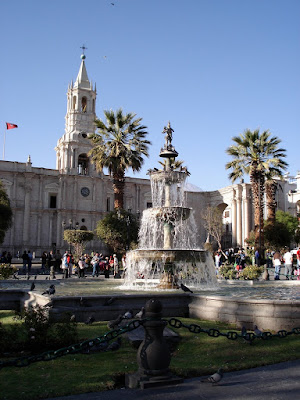
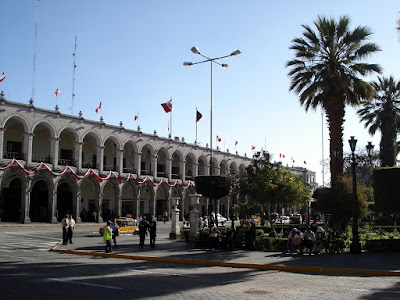
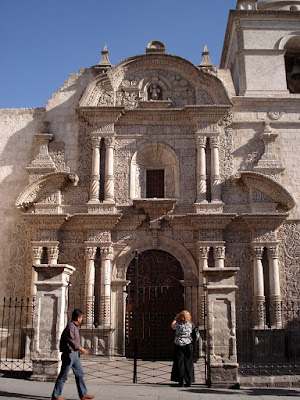
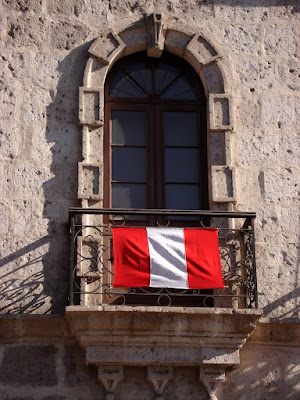
Our pickup from Arequipa airport was well organized (and I could even fit my Zimmer frame into the boot), and after ten minutes in the car we understood where the city got its name. The historical centre of Arequipa is eye-wateringly beautiful. When we hit the steets after checking in, every turn of a corner commanded a new photograph from Letizia. I should remind readers that every picture you'll see on this blog is taken by my talented wife, and the only role I play is to hold her coat and handbag, and get the hell out of the shot. Nina, Sara and I know the drill by heart now. Tenetemi questi e spostatevi.

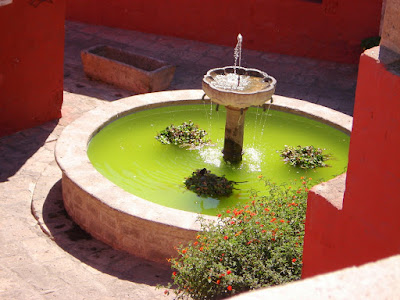
In my next post on Arequipa I will describe the fantastic morning we spent there before medical matters intervened. My memories of the place will be enduringly positive. In the meantime here are some of those photographs. Great credit must be given to the handbag holder.


From Arequipa

Saturday, July 26, 2008

Recuerdos de l'Atacama

The Valley of the Moon doesn't need any words from me: