Wednesday, April 30, 2008

Milford Sound

The far southwest corner of New Zealand's South Island is known as fiordland. If you take a look at a road map of the island you'll see that this is the place where all roads come to an abrupt halt. From Queenstown we drove to Te Anau, a small little town that serves as a way-station for the fiordland. From where we could either move down to Manapouri and get a boat-bus combination to Doubtful Sound, or else drive up and slightly east to Milford where boats could take us directly out on the waters. We opted for Milford Sound - it was further away and would involve retracing our steps to move on, but it was much less expensive than getting to the more isolated Doubtful Sound.

We never regretted our choice, both the drive there and the 3 hour catamaran cruise around the sound were spectacular. During our week's ramble around these parts we were very lucky with the weather. It's well into Autumn here in the Southern hemisphere, and we've had a lot of rain or cloud cover in Christchurch. On the road we had almost unbroken sunshine. Even though Milford Sound is one of the wettest places on the planet (6.5 m of rain a year; one day in two it rains; a drought is 9 days without rain), the only time we got wet was when the skipper one of the waterfalls that lines the steep sides of the sound. Autumn sunshine brings another great advantage in this part of the world - a variety of leaf colours that are hard to imagine. Every hue possible between gold and deepest red presented itself sooner or later, often as part of a breathtaking natural composition set into the steep mountainsides.

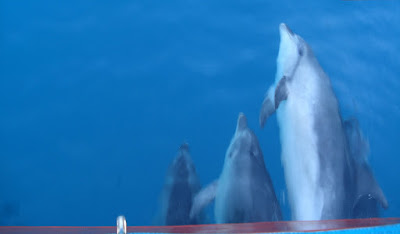
The cruise brought us out to the edge of the sound, to the Tasman Sea. The last time we looked on this body of water it was from the other side - from Sydney. I feel nostalgic for that city more than any I've ever visited, so much so that even looking at the Tasman Sea was a boost. On cue, more than a dozen huge southern bottlenosed dolphins came alongside and in front of the catamaran and surfed on its bow waves. The wild dolphins we fed in Tangalooma seemed even more delicate and alien when compared to these robust creatures. But the same mutual curiousity defined the 10 minutes or so we spend in each other's company. These individuals turned on their sides to look up at us, and reacted enthusiastically when we waved back at them.
From Milford sound

We got back into the car and made a dash south to get to Invercargill in good time for dinner. We would use this town as a launchpad for the Catlins Coast - the southern drive that takes in fossiled forests, and a place called Cannibal bay - on our way to Dunedin. More on that tomorrow.

Duncan from Sydney join us tomorrow for a few days, bringing our number up to 6! Letizia and I realised that in our trip so far we four have never really been alone for long periods. In Sydney and Brisbane we had friends around us (in Brizzy it was more like being part of a big family with the Petts!). China was the place where we relying most on each other's company. We will return to that state when Giovanna leaves us in a few weeks, and things are likely to stay that way until near the end of our trip when we meet up hopefully with Letizia's mum in Peru. We will see, by and by, what kind of challenges that isolation might present.

We're Being Followed!

I don't know how to explain this, but a certain Mr Smiss and his long-time-companion Pernod (an assumed name if ever I heard one), seem to be following in our footsteps. And so closely as to make the experience distinctly uncomfortable for us.

I'll be keeping a close eye on matters.

Queenstown Part II

What goes up, must come down. Newton's fictional apple did, and so did a whole bunch of very real people when they chucked themselves off a perfectly good, and very pretty, bridge just outside of Queenstown. People have been chucking themselves off Kawarau bridge now for quite some time all beccause about 20 years ago, a kiwi gentleman called AJ Hackett decided that he would replicate the Vanuatu ritual of throwing oneself from a tower, with each ankle tied by a vine rope. Using elastic 'bungy's instead of vines, he was able to make a potentially fatal but thrilling experience available to a paying public and he demonstrated its efficacy by doing an unapproved bungy jump from the Eiffel Tower in 1987. Since then, at least 18 people have been killed doing similar jumps, but none of them, as far as I can tell, with AJ Hackett.

I had no interest in doing a jump before coming to NZ (though I am partial to the idea of jumping out of an airplane). The bungy was Letizia's gig. To be more precise, it was Letizia and Simon's gig. We were supposed to meet Si and Leah in Queenstown, but unfortunately it wasn't to be. Little Caitlin discovered a 200km car journey limit, the outer bounds of which were defined by copious amounts of projectile vomit. The Pett family was staying in the North of the South Island, and Letizia was stranded in Queenstown without a jumping buddy.

I offered. I did really offer. And I meant it too. But the sudden change in circumstances rattled Letizia's resolve, and after watching a dozen or so people (all apparently part of the same Japanese family) demonstrate the various ways in which one should, and should not, fall from a height, she opted not to jump. But watch this space. I feel the story has still got legs.

With Christchurch behind us, the planned part of our journey was over. What lay ahead, we would make up as we went along.

Saturday, April 26, 2008

Traveling in the 4th Dimension

Try the following thought experiment. Wherever you are sitting right now, relax and close your eyes. Remind yourself that you not moving - that your position is fixed (it's easy to ignore the planetary motion, expansion of the universe etc). Now imagine a clock's pendulum swinging, complete with a tic, toc, tic background noise. Each passing second represents the journey through the fourth dimension that we are all on, like it or not. We are all traveling.

When you move around in space, the passing of time seems to be even more noticeable. Letizia and I spend many's the year moving around the IT contracting trail in Europe before coming back to Ireland, and the longest we stayed put was around 2 years. A byproduct of all this relocation, leaving behind friends and surroundings that had become familiar and comforting, was a reminder that time was slipping by as well. Memories of just a year previously can seem very distant in time if they are also distant geographically, and most of our memories were of that nature. When you stay in the same physical place, the passing of time has a way of creeping up on you.

We're at the halfway point, more or less, of our 8-month trip (hence the admittedly somewhat maudlin tone of this blog). Beijing seems like a very, very long time ago. Just a few days ago, we visited Slope Point - which is not just the southernmost point of New Zealand's South Island, but also the Southernmost point of our journey. Beijing was the northernmost. So at the halfway point of our trip, having spanned the latitudinal extremes of the planned itinerary, who did we meet at Slope Point? A group of Chinese people (from Chengdu in fact), the 'leader' of which lived currently in Australia. I love impromptu living metaphors like this. They're meaningless of course, but I can still have some harmless fun building some meaning around them. The meaning in this case just boils down to a terrible cliche: Time flies when you're having fun. Of course time flies even if you're not - you just don't notice it so much.

The other truth that I was forced to face was how quickly my modest level of basic Mandarin can crumble through lack of use. It's time for me to get back to my studies on Chinesepod (Liping - keep a place for me in class when I get back). So much to do, to see, to learn. And so little time. Better get to it. While stocks last.

Friday, April 25, 2008

Traveling in Cars with Girls

Nina and Sara have been mixing Enid Blyton with JK Rowling over the trip (with an assortment of other good books that we find along the way - Nina is currently reading Maori legends - thanks Ian!). They are reading Famous Five and Secret Seven from Blyton - she still manages to win young readers all this time later. And it does have some entertaining results:

As we march them up yet another bleedin' hill somewhere, just to see what it looks like from the top, they can imagine themselves on Kirrin Island, dealing with some combination of smugglers or spies.

The discovery of Ginger Beer first in print and then in reality (Bundaberg Ginger Beer is readily available all over Queensland) was a big hit. They loved the idea of being able to taste what fuelled the adventures of Julian, Dick, Anne, George - and presumably Timmy the Dog. Unfortunately the novelty couldn't mask the sad fact that they just didn't like the taste so much. Another few months on 'Kirrin Island' should sort that out.

Sara has always had very clear speech - at least we have always been able to clearly make out her words even if, when assembled, they don't always make a lot of sense. Now in addition to precise diction, under the influence of the Famous Five she regularly talks about things being 'quite astonishing' or 'rather exciting'. This sounds odd from a 7-year-old with an Italian mother and an Irish accent.

We've clocked up 1600 km in the last week - it'll be 2000km when we return to Christchurch tomorrow. That's a lot of time for two young girls to stay in a car, so I'll explain how they manage to keep sane. The basic tools of the trade are books and Nintendos DSs. The latter can be overdone (Nina has been seen in the back with a fleece over her head to prevent reflections on her screen - while we drive past some of the most spectacular scenery NZ has to offer), but thankfully batteries tend to wear out so they are forced into a bit of variety. Every now and then we have to intervene and get the girls to engage with their surroundings. No magic going on here - just the usual combination of cajoling and bossing, trying to help them make something personal out of what they are seeing. Nina, for example, loves to get her hands on the camera. Thank goodness for digital photography - she can snap away as much as she wants (ish) and often sees things that we miss.

All of this requires regular stops of course, and that's an important factor. Except for rare occasions when we really have to make point B by a specific time, we take most photo opportunities that present themselves. And here, there is one around each corner. We also use a technique that has been known for a generation in one family (as it is now in ours) as an 'Irene's Safari' (thanks Ludi!). More often than not we take at least one packed lunch - or the ingredients thereof - in the car with us. The weather here has been very kind, and we've had more than one lunch out of the boot of the car. Somehow it's just more fun (and saves a lot of money over even a short amount of time) than stopping in one cafe after another.

When all else fails - and only when all else fails - we resort to singing. Sara specializes in tear-jerkers from Annie the Musical. Nina gives vent to her attitude by belting out Skaterboy by Avril Lavigne. I join in both, in an exaggerated operatic voice. But only in order to bring proceedings to a close. Works every time.

Thursday, April 24, 2008

Queenstown Part I

Our new dynamic is very interesting. Letizia and Giovanna take turns at sitting up front, and both of them have their guide books open. Letizia has the book of lies, Giovanna has a french guide. They cross-check accommodation, restaurants and activities for the next stop on the Magical Mystery Tour. Nina and Sara, as ever, divide their attention between books, Nintendo DSs and the scenery. My job, apart from driving and navigation, is to occasionally bore the crap out of everyone by delivering historical sermons based on whatever I've been reading recently on New Zealand. I take this job seriously, and so try to maintain a kind of plummy, condescending tone. Don't feel so smug - it'll be your turn next.

The stop-off in Lake Tekapo was just intended to break up the journey from Christchurch to Queenstown, but it was worth the trip. The lake view from our motel included a backdrop of mountain peaks, recently coated with light snowfall. Down the road from us was a tiny little stone chapel whose alter was backed by a large window that looked out onto the lake. Guidebooks informed us that the perspective on the lake from that window was unique, but the church was in use during our visit. So we, and all the other visitors to the lake that evening, had to make do with the infinity of other unique perspectives on the lake that were on offer. I found the fixation with the church quite odd. The was a concentration of tourist buses which parked outside this little chapel - which really was no bigger than a motel bedroom - so that visitors could pile into a little stone hut and look out on a lake which, if they would just come back out of the stone hut, they would see just as well and without any obstruction (other than that of the little stone hut itself).

We reached Queenstown on day 2, in the darkness, after a relaxed drive that included many stops for photo opportunities. It seemed that around every corner was a different country, and Letizia and Giovanna were kept busy. As ever, on Letizia's blog you'll see plenty of excellent photos of where we've been, and if you read italian (or indeed use Google's site translation service) you'll be able to follow here unique perspective on our trip (without having to file into a little stone church). At this point I have to confess, that whatever the results of the poll on Kiwi extreme activities might result in, we're likely to just go ahead and do (or not do) our own thing. So which Jet Boating is coming in last on the poll, that's what we did first. Not just Jet Boating, but a day trip that took us out to Glenorchy (West of Queenstown and on the same lake), included a 4wd drive to a nearby forest, a short guided walk through that forest, and then a jetboat run up and back down the Dart River. It was money very well spent. Apart from the fact that it was a group activity, we also learned a lot of interesting things as we went along.

The forest that we visited includes a tree called the Red Beech which has some interesting behaviour (if a tree can be said to exhibit behaviour). There's very little topsoil around Glenorchy, and competition between trees can be fierce. The forest has a high and full canopy so the only chance for young trees to stake their own claim is when an older tree falls and leaves a gap up there. The saplings then have to grow upwards like crazy, with no thought for stability, in order to be first to reach the sun. Only when they get there do they start to put on a bit of weight - new growth takes place around the thin girth of the successful sapling. Because it grows from the inside, it also dies from the inside. Old trees are completely hollow all the way up their lengths by the time they finally expire. A byproduct of this race is the saplings ability to stay young and small for years, keeping its powder dry until that vital gap opens up. There have been examples of little 'saplings' that are more than 50 years old.

Part of the bushwalk included a vist to a mocked up Maori encampment, where we were shown a thing or two about bushcraft. One thing that caught my attention was a trick for moving fire embers from one camp to another (saves on lighter fluid I guess). A kind of large fungus (about the same shape and dimensions as a casserole dish) that grows on the sides of trees was buried under the campfire. In the morning it was dug up and was cold enough to handle. But when making camp again that evening, the Maori would break open the fungus where the ember of the previous night's heat still glowed. Some clever bugger figured that one out a long time ago.

We left the forest and drove across the river bed to where the jetboat was waiting to knock all that education out of us. We were able to drive across, as the rivers in these parts are of a type known as braided river systems (only found in NZ, Australia and another country whose name got dislodged from my memory during the subsequent jetboat ride). Again, because of the poor topsoil, the rivers here spread themselves wide rather than digging in. They rise after rainfall, but when the levels fall away again, the river settles down each time into different channels through the mostly dry river bed. The name 'braided' is a good way to describe the visual effect: a stone and gravel strip with rivulets of water weaving back and forth across the its width. The water in places is only ankle deep - but that's all a jetboat needs. Invented in New Zealand not as an extreme sport but as a way for landowners to navigate otherwise unnavigable rivers, they are simple but clever machines. There are no outer propellers. The titanium hull has a water inlet facing forwards and a directable nozzle facing back. Water is sucked from one point to the other at a rate of hundreds of litres a second, creating an extremely directional propulsive force. A picture or two demonstrates the effect of being on board for an hour and a half.
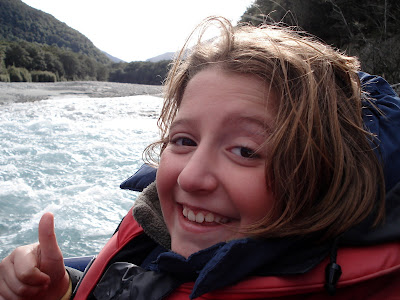
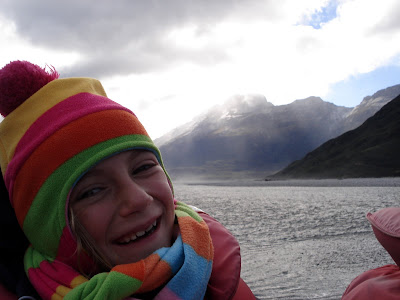
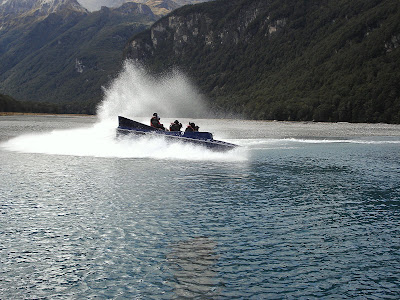


We chilled out, and dined out, in Queenstown that evening, but only after an hour spent watching people throw themselves off a bridge just outside the town. Some decisions had to be made. Would Letizia jump?

More soon.
Wednesday, April 23, 2008

And Then There Were 5

We're on a magical mystery tour at the moment. Giovanna joined us in Christchurch and after an Olympian effort to overcome jetlag, we went on the road 2 days later. So far we've been to Lake Tekapo, Queenstown, Te Anau, Milford Sound and we're now in Invercargill. The plan is being made as we go along - something that I'm particularly enjoying.

For such a relatively small country (compared to where we've just come from) New Zealand looks very big. The mountains and plains go on and on, and around every corner there's a different landscape. The mountainous centre of the South Island is completely different to the coast - the latter looking very much like the UK and Ireland. The scale of the Southern Alps is immense. If you want to feel small, come to New Zealand.

Lake Tekapo was a half-way stop on the way to Queenstown, but a good one. And the road that leads from it to Queenstown is a spectacular collection of turquoise lakes, shadowy passes and snowdusted mountains. You can tell you're getting closer to Queenstown because the traffic (what little of it there might be) speeds up. Queenstown is the adrenalin-soaked heart of the area, fuelled by bungy, whitewater, jetboating, skydiving and much else, and it seems to siphon in tourists and spit them out at high speed on the arterial roads that lie on either side. We indulged in a little extreme activity - more on that in a Queenstown post - and two days later we were on the road again. This time to Milford Sound.

I'm getting into blog-debt. I can't do Milford Sound justice without dedicating a post specifically to it. For now, let me say that it was a 300 km trip from Queenstown to Milford Sound, for a 3-hour tour of the waters there. And it was worth every kilometer. That was yesterday. We finished up the day in Milford with a 300km dash to Invercargill (the route brought us close enough to Queenstown again to slingshot off it's heighted energy and reach the South coast). Here, we're positioned for a run along the Southern Scenic Drive (Catlins Coast) to Dunedin, with the option of stopping off overnight if we find something that interests us enough (and weather to enjoy it in - so far we've been extremely lucky on that count).

The dynamic of our group has changed, slightly and effortlessly, with the arrival of Zia Giovanna. This is a group that has worked well in Ireland, Italy and France, so it's no surprise that we get on so well this far from home. As well as being so popular with Nina and Sara, Gio adds two extra camera lenses to the group. Watch here for some of the results (when we get back to Christchurch.