Showing posts with label museums. Show all posts

Saturday, July 12, 2008

Previously, on Lost

The story so far: Our time in New Zealand is almost up. We spent 4 days in Auckland, headed to Fiji for a week, and we're now back in Auckland for one night before heading East again, across the Pacific Ocean to Chile. I'll try to compress the days since the glowworm caves into this one blog entry...

Auckland gets a bad rap in tourist lore. Just another city. Concrete Jungle. Fly in and move on. Based on this reputation, we decided to book a motel near the airport and shuttle in and out to the city centre as we wanted/needed. Our first impression of Auckland was confirming our prejudices. We pulled up outside our motel - the Travel Air Motel - and got a sinking feeling. We're not so picky. We have only run away from one other hotel in 6 months. But when we saw our rooms, we realised that we had been completely misled. If I had thought of it in time, I would have taken pictures for you to compare to their website. We got into the car again, leaving some of our our luggage, with a plan to see the city and look for alternative accommodation for the following nights, and were very pleasantly surprised by what we say. It's a bigger city than anything else we've seen in NZ. Bigger and more built up than the capital, Wellington. But it was pretty. There was a nice rolling feel to the streets (a bit like parts of Wellie), nice views out over the water, and parkland easily visible from parts of the built-up centre. With the help of i-Site, at the base of Auckland's famous Sky Tower, we found a great deal for a luxurious hotel right in the centre. We figured that the relaxing part of our trip (Fiji) could start a few days early.

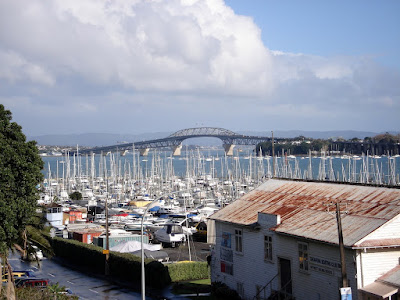
And that's how it came to pass. We went back to the fleapit near the airport, paid $20 penalty for late cancellation, picked up our luggage and left in a cloud of dust and relief. That was the easy part. Then came the walk of shame. When you're staying in a posh hotel, it seems bad form to trail across it's wide lobby, dressed for the road and with laden down with bags of groceries and knicknacks. But when you have to do it, do it with your chin up. We must have made a fine sight, Cheerios poking out of the plastic bags, a dusty single file of noses in the air. We shopped a little, took a spin across harbour bridge to Devonport for a walk and a few photos, ate on Ponsonby Road, and checked out Auckland Museum (again, an excellent example of how museums should be put run).



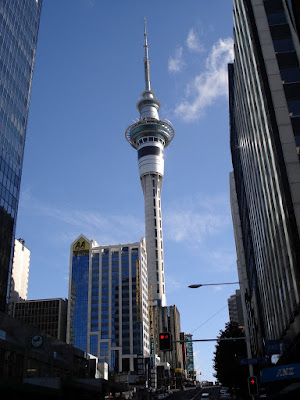
If I hadn't bungied in Taupo, I would have considered jumping off the Sky Tower, but luckily all that was out of my system. Instead we hand a poolside view of the jumpers from the fifth floor of our hotel. The tower itself is a beautiful feature of the city, and I was surprised to learn that it was so new - built in 1995. It dominates the cityscape, and gives the place a focus and an identity. It's hard to imagine Auckland without the Sky Tower. That's the best test for any new structure (I wonder if Dubliners have yet come to the same conclusion about the Spire).


During our 12 weeks in New Zealand, I've learned that this is not just a smaller, colder version of Australia, nor are Kiwis indistinguishable from Aussies. There is something very different going on here, and these two new countries have very different histories despite their superficial similarities. I have at least one other blog in me about those differences, and the part they play in explaining the gap between Maori and Australian Aboriginal. It's unfortunate, but probably unavoidable, to describe New Zealand by contrasting it with its bigger neighbour. But the fact remains that the differences really are surprising. If history had taken a very slightly different turn (for example if NZ didn't take part in the Boer War, and thereby find itself afterwards in a period of intense nationalist sentiment), New Zealand just might have been federated alongside New South Wales, Queensland, Victoria and the others into what became Australia. The fact that it didn't, and has continued in many different political, social and cultural ways to plough its own furrow, has added to the diversity of this region, and provided the world with some truly worthwhile examples.

I'm going to miss the place, but I'm more than ready to move on. We've been too long in English-speaking countries which, for all their differences, are clearly not going to be as different as China was, or as Chile, Bolivia, Peru and Argentina are likely to be. The next six weeks might be viewed as our homeward leg. We're going to cross the International Date Line within an hour of taking off tomorrow. For those of you in Europe it means that, like a coin moving invisibly between a magician's hands, we'll appear on the other side of your screen. From 12 hours ahead of you, we'll suddenly be just 5 hours behind you. Having lost hours with each move to the east, we'll be paid back in bulk (and in advance for future time zones crossed) by being given the chance to live parts of the 11th and 12th of July twice. We're getting closer to home, and we can now say that next month, we'll be back in Ireland.

It might be viewed as our homeward leg. But I'll play every mental trick that I can to remind myself that six weeks is a looooong vacation, even if it comes as the last six weeks of an eight month trip. I'm gasping for the kind of discomfort that comes with moving through non-English speaking territory, and the chance for Nina and Sara to see a whole other way of life.

Saturday, March 15, 2008

Melbourne

After 5 weeks in Sydney, and a palate-cleansing four days on the road, it was time to taste the delights of Melbourne. Comparisons are odious, but so is this blog, so I'm not going to avoid comparing the two cities. But before I do, let me point out how wildly inaccurate any of my conclusions are bound to be. (You probably knew that though.) We were to spend a paltry 5 days in Melbourne, we were mostly interested in catching up with our friends Jamie and Francesca (who also kindly hosted us for the duration of our stay, and for whom those 5 days must have been anything but paltry - thanks again guys) rather than 'doing' Melbourne. I also had the pleasure of catching up with my first cousin Carol, her husband Andy and daughter Jasmine. And on top of that, we also had the undiluted pleasure of Darragh Ballesty's company, and his friend Caroline. What I'm trying to say is that our stay was all about meeting friends, and Melbourne in a sense was merely the backdrop.


The city feels entirely different to Sydney and simply doesn't make that kind of instant emotional impact we experienced in Circular Quay. How could it? There may be no other city on the planet capable of that effect. I am told by those who should know (and whom I unquestioningly believe) that you need to live in Melbourne to appreciate it. It offers a different pace of life to Sydney, but at the same time a higher percentage of cultural and artistic activities. To me, it seemed much more like a town with a British identity. The St. Kilda sorts the kind of pier you'd expect to find in Blackpool or Brighton (and not the Brighton located a few km south in Melbourne itself).


Walking around the city centre, near Federation Square and Collins Street, the difference with Sydney is clear. The people are whiter, the pretty buildings are prettier, (the ugly buildings are uglier), the streets are narrower and more intimate. Cafes are tucked into the even narrower alleyways, so you never quite know what you are going to see next: A jazz band, a street performer, another ethnic eatery (Melbourne's cuisine is reputed to be the best in the Southern Hemisphere). Trams move up and down the streets - as opposed to Sydney's trannys - some of them old and beautiful, others modern and menacing (the trams, not the trannys).


I had heard about Melbournes megalomaniac trams, that brook no resistence and take no prisoners from cars or pedestrians. Their absolute priority at some junctions has led to strange right-hand turn rules for cars. In Oz, you drive on the left, but instead of waiting on the innermost lane to turn right, you pull all the way over to the left, leaving space for the dreaded trams, until the traffic lights allow you to complete your manoevre. The detail that I was missing was that the signal to complete the righthand turn is the amber light. This means that if you are going straight on through a Melbourne traffic light, you better not do it on amber. I got a brake-screeching, heart-flopping lesson in Melbourne's rules of the road on our first day. Our rental car had Queensland plates - I think I haven't done the reputation of that state any favours.


We were based in Albert Park, a city suburb named for its principal feature: the public park that once a year plays host to the F1 Grand Prix (this weekend in fact). I never did get to drive the course in my rented Hyundai Elantra (where do they come UP with these car names!!?) but I did walk across it on the way to the playground with the kids. If you had asked me ten years ago, I would have given you very long odds indeed on such a reversal of priorities.


Jamie and Francesca's house is located on a street that has everything they need: park, school, shops, cafes. In this regard, life in Melbourne is very much like that in Sydney - people tend to stick to their own village. J&F can't go beyond the front door without meeting people they know. Walking from their front door to the bottleshop (off-license) and back with Jamie, I felt I had been caught up in a scene from West Wing. Characters came in from the left, words were exchanged on the hoof, then exit, stage right. All we were missing was a steadi-cam operator in front of us - and probably, let's face it Jamie, a sharper dialogue ;-)


Like Sydney - and Canberra - Melbourne has a lot of excellent museums. Regular readers of this blog might think that we - especially the children - have had our fill of museums, but nothing could be further from the truth. The quality and variety of museums here is very high, but the cost is low, in some cases zero. In a county like Ireland, with a wealth of social and natural history behind it, and hopefully a future tied to high technology in front of it, there really should be a lot of public money put into creating environments like these. Especially for kids.


In Cork, there is one small science museum, and a new observatory museum in Blackrock. But there are a dozen or more indoor playgrounds which dwarf these museums. On a rainy day, wouldn't it be wonderful to check out an undiscovered corner of a museum as a viable alternative to a playground? The entry price of Aussie - and especially Melbournian - museums makes this possible. Kids get in for free in many places, and adults pay just 6 australian dollars (4 euros). A museum, which despite the name can be an exciting place for kids if built and run properly, can inspire researchers of the future.

We left Melbourne on a Monday morning, the first Monday of March (have we really been on the road since December!?) and headed back to Sydney, this time via the coastal route of Princes Highway. It would take 3 nights to get to Sydney where we would get to spend one last evening before heading to Queensland.

Wednesday, February 27, 2008

Melbourne, via the Snowy Mountains

It's been a fast and almost completely offline 4 days from Sydney to Melbourne, via Canberra, Threadbo and Rutherglen. But we're in Melbourne now for a few days - enough to collect our thoughts about the stay in Sydney and the trip from there to here.


Canberrra was surreal. It's name means Meeting Place in some unspecified Aboriginal language, and it was build out of nowhere when the newly federated states of Australia, in search of a capital, couldn't chose between Sydney and Melbourne. Our first impression of the place was 'where is it!?'. We were approaching the city, about 7km out according to our map, and all we could see was bush. Then, when we rounded a corner, we say the Telstra tower on Black Mountain poking from over a hilltop. Five minutes late we were in downtown Canberra. It's not a particularly small place (300,000 residents) - it's just, well, sudden. The city is a motorist's dream and a pedestrian's nightmare. I'm not surprised it wore out Bill Bryson. There are arterial avenues spreading into every district (in fact the borders of the districts are very clearly delineated by those avenues) from which then spread neat and, where possible orthogonal streets, all lined with houses or occasionally businesses. We booked two nights in a quarter of the city called Kingston - apparently one of the livelier ones with a good cafe scene. We found the block of cafes and restaurants not far from our B&B, but it really was nothing special. Windswept, predictable and without any atmosphere.


After checking in, we went to see the truly wonderful National Museum of Australia, where my favourite section was the one entitled Nation. One corner was dedicated to the way Aussies speak English. Letizia has already blogged on some of her favourite items of Australian vocabulary, and here was a museum exhibit that showed, in interactive and multimedia formats, many of these items, and even their etymology (I learned that the famous 'Sheila', meaning 'woman' came from the Irish name Sile). The building itself, its layout, design and interior made it a pleasure just to be there.


On day two in Canberra - a Sunday - we started with a visit to another excellent museum, this time the Questacon. It's a science museum, the kind that Nina and Sara claim to like the most. It was very good indeed, and we passed 3 hours in there with ease, but in the end, the best museum of it's kind that I've ever brought the kids to is Edinburgh's Our Dynamic Earth (though I haven't been to London's much acclaimed science museum.


While I'm on this subject, I'm reminded of our trip to Shanghai's equivalent, which was a terrible disappointment. Much of the content was given over to manned space flight, now that China has entered this exclusive club, but all the interesting related exhibits were closed. What remained felt like propaganda. There was an exhibit on pollution, which caught our attention. I was interested to see what official China had to say about the matter. I was shocked - the section on air pollution talked about the poor quality of air in London and Los Angeles. We had just spluttered in from Chengdu where visibility was down to 5 blocks for the duration of our 4-day stay. The only mention of Chinese pollution was the issue of the Suzhou Creek, and even that exhibit was all about the great strides that had been made to reclaim it.


Anyway, for the rest of Sunday we wandered around the Australian Commonwealth's capital looking for all the people (cue Madacascar: 'We bozos got the people, but they're not a very lively bunch'). We found them eventually, split over two groups. About 40 of the them spread around 4 cafe's in the corner of the central pedestrian zone. Mostly students, probably half of them visitors. At this point, Canberra reminded us of Stuttgart after 5pm before they liberalized the shopping laws. Concrete, empty, clean, and with a few well-hidden corners with some life stubbornly clinging on. The rest of Canberra was visiting the Sunday market in the Old Bus Depot right on the edge of Kingston. It was clear from the faces of those perusing the stalls (containing the largest variety of materials and styles for toilet roll holders that I have ever seen) that they were there not to be amused, but to be consoled. Consoled that neither Sydney nor Melbourne had been chosen to be the capital of Australia.


NEXT!


Threadbo. This isn't so much a town as a resort. Nestled at 1300m in the Snowy Mountains, it's a ski resort during Winter and a bush-walking centre in the Summer. We took a skilift, and then walked for 2km to reach a height of 2000m from where we could see the highest point in Australia - Mount Kosciuszko (2200m approx). Another 4km walking would have taken us to the summit, but most likely to the hospital as well, so we admired it from a distance. My Polish neighbours (hi Pavel and Gosia!) will recognize the name - it's a Polish hero general. The mountain was given its name by a Polish explorer as he felt the peak resembled the tomb of the general. As peaks go, it's not terribly high, but this is an indication of how ancient this continent is - how geologically stable it's been. The peaks would have soared much higher after their birth, but eons of wind and rain have worn them away. A similar erosion of your budget and patience will take place if you hang round in Threadbo too long. We had one meal there, put paid as if we had three. My pizza both tasted and cost as if I had scraped the contents of my wallet onto a pizza base. Other choices were similarly unhappy. Try as we might to rearrange our plates between the four of us, we could find no configuration that would satisfy more than one person around the table (i.e. whoever ended up with the Chicken Schnitzel).


The scenery around Threadbo and on the road from Threadbo to our next stop, Rutherglen, was out of this world. Almost literally. We moved from deep eucalyptus forest, with the occasional roo or wallaby peering through the treeline, to red earth and bare trunks (and the strange view of Lake Hume, very low, dotted with tree trunks, similar to a lake on the road between Cork and Guganbarra) and then eventually vineyards and pasture land. We pulled into Rutherglen 3 hours after departing Threadbo, looking forward to slowly sampling some of the local wines. And that's exactly what we did. We picked a motel (which turned out to be the cleanest, most comfortable and best value accommodation of the 4 days, Motel Woongarra) and went to two local wineries (there are about 20 to choose from). After a quick splash in the pool, we headed into town for a simple but filling meal in the Poacher's Paradise, and had even more wine.


So we're in Melbourne, looking forward to converting another abstract name into a real place, and building up a mental model of life here. After this, we'll return to Sydney by the coastal route, for one night, before taking a flight to Cairns. I hope to blog once more on the Sydney experience soon.


PS: In order to spread the pain of this blog even further, I've started writing a once-fortnightly article for the Carrigdhoun - a local newspaper that covers a lot of south county Cork. The first one, on Beijing, came out on Tuesday.