- I would like to rent a car. Completely useless as I have no plans to hire one in South America.
- May I pay with a credit card? Completely pointless as almost nobody accepts them in Peru.
- Look out for the shit. Well, I've used it once.
I met José and his family on the confetti-strewn evening of our arrival. Livia worked with his wife Concepción in the medical centre, and even though Conceptión no longer works there, they have remained the best of friends. Their two daughters Ana and Guadalupe are slightly older than Nina and Sara but have been such good friends to the girls, and friends is what they miss the most from home. Since that first evening, we've had the pleasure of the Cruz family's company on two occasions; one day trip in the countryside around Cusco, and a meal in José's home.
The day trip to Huasau was supposed to coincide with a festival of thanks to the Pachamama, the god of the earth, fertility and prosperity. But when we arrived, the main plaza was empty. We were out by one day. Undeterred, José used the downtime to introduce me to the ancient and widespread practice of visiting the curandero, to have my fortune told using coca leaves.
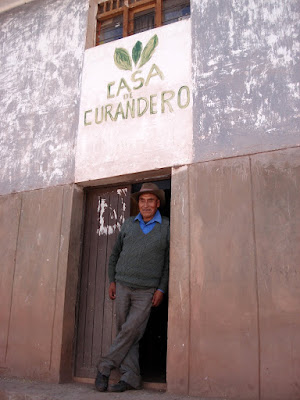
In the name of journalistic enquiry, and because there was clearly bugger all else going on in downtown Huasau, I jumped at the chance. When I was led through the door into Señor Reimundo's clinic, it didn't take long for my eyes to adjust to the darkness. It took my brain a great deal longer to adjust to the strangeness of my situation. While the curandero normally permits only those seeking consultation to enter, it was clear that some translation would be required (unless of course the details of my future consisted entirely of rented cars, credit cards and turds) so Hermana Mathilde was allowed in too - she could understand my Italian and I could just about understand her Spanish. If being in a dark room with a witchdoctor and a nun weren't enough, it became clear that the curandero's Spanish was almost as limited as mine. José was called in to translate from Quechua to Spanish. Letizia joined us as well - I'm not sure under what pretext but I expect that she wanted to hear about my future first-hand, rather than hear my version of it (it's interesting that with all the potential for mistranslation in this situation, the widest semantic gap lay between male and female modes of communication).
So with an amphitheatre of spectators present, and at least three channels of communication in place, the consultation began. Señor Raimundo uncovered his selection of coca leaves, handed me one and got me to breathe on it. According to the real-time translation committee, I was going to hear about my work, my most significant relationship and my health. Work was looking good apparently, which struck me as odd given that I haven't written a line of code in 8 months. Perhaps this was Raimundo's way of telling me that my absense from the office was increasing productivity there (a tenable suggestion, I have to admit). Then, in a cruel blow for Letizia, all assembled were told that she was pretty much stuck with me for life. When it came to my health, things started to go a little less to plan. Raimundo had been cheerfully tossing coca leaves onto the table and rattling off the good news (good, unless you are married to me that is). When it came to my health, he slowed down and put his hand on his chin. There ensued a long conversation in Quechua between José and Raimundo, José's normally jocular expression giving way to concern. When the exchange finally finished, I looked at José. Está bien, he said. She'll be apples.
Balls to that, I thought, though I offered a more diplomatic version out loud. How do 2 minutes of brow-furrowing Quechua translate into 'you're fine'? Either the language is somewhat inefficient, or something was being held back. José finally came clean. Health-wise I am actually doing fine, apparently (so Letizia's life sentence is without parole). I have a certain amount of supressed anger however, that I need to keep an eye on. I was a bit taken aback, I have to say. Not by the news that I have hidden anger - I'm quite comfortable with that (I look forward to meeting the catholic-raised Irish male who doesn't have many hectares of rancour ploughed into his soul). What surprised me was that this was considered news at all. I found it a little bit Oprah for such a rustic setting. I wasn't expecting such sensibility from a curandero, and I was beginning to fear that he might prescribe a good cry for myself there and then, in that dark room that seemed to be getting fuller all the time.
I need not have worried. I didn't have to do a thing. The diagnosis was discussed in Quechua, Spanish, Italian and occasionally English by everyone but myself, and with very little need for any intervention on my part. I fished out twenty soles, thanked Raimundo, and headed for the crack of light that I correctly interpreted as the way out.
Despite, or perhaps because of, my anger issues, José invited us around for dinner a few nights later. By this stage, Nina and Sara had become great friends with Ana and Lupe. Any limitations in the intersection between my daughters' Italian and José's daughters' Spanish were more than compensated for by exchanges of gifts and mischiveous grins. So by the time we hit dessert, the kids had disappeared upstairs and I was left to fend off endless bottles of beer from José.
There is something very special about being invited to somebody else's house for dinner. The breaking of bread can put a budding friendship onto a different level, or nourish an old friendship - especially if the food is as good as what Concepción prepared for us. Around a table you can take your time - nobody grows old there according to one Italian saying. When language threatens to stand in the way of understanding, a shared meal, a clinking glass and an exchange of smiles can smoothen the way. It helps to have your wife on one side and your mother-in-law on the other to translate your gems of wit to your hosts as well. And two bottles of Cusceña beer can bring out the ability to speak Quechua as well as Spanish.
There isn't a credit card in the world that can pay for a night like that.

