Showing posts with label return. Show all posts

Wednesday, September 10, 2008

Half a World Away

Today I was trading notes with a friend who spent some time in New Zealand. Before ever we left, he and I had talked a little about his time there, spent exclusively on the South Island. Interested though I was back then, it was an entirely different conversation this second time. Once again, being there makes all the difference. The abstract concept that I had mentally filed and labelled 'New Zealand' a year ago has been erased, and in its place are memories of a real country.

I never did find the time in South America to come back to the topic of New Zealand on this blog, so I hope you'll indulge me in a little reverie and soapboxing now.

Two images come immediately to mind when I think back on our time in NZ - especially on the South Island - that were constants in an otherwise ever-changing landscape. Firstly, the braided river systems. Wide stretches of rockstrewn flatlands through which trickled a few inches of water. Every time we drove over a bridge, we saw another one. The second, was the permanent company of birds of prey which hovered over every road we travelled like an Unholy Spirit. Both of these images bring me back immediately to the sensation of motoring though thousands of kilometers of breath-taking New Zealand beauty, and I once again experience the sense of mission and common purpose that seemed to travel with us during those weeks and months.

I'm happy to say, once more, that nostalgia plays no part in these memories, because nostalgia suggests some element of regret. And we regret nothing about NZ - not even saying goodbye when the time came. We had an unforgettable time there, made some new friends (I will email Dee - I really will!), and in 12 weeks we got to almost every angle of those amazing islands. We got, if I can be so mercenary, what we came for.

That said, I can't pretend to really understand New Zealand in any profound way, because I didn't get to understand any New Zealanders very well. They are a welcoming, hospitable people who nevertheless retain a degree of reserve that differentiates them from Australians. This is emphatically not a criticism, just an observation from somebody who has acquired the Irish habit of assuming everybody wants to be his best friend. 'Reserve', to an Irishman, is something one does to a hotel room.

It could be that the difference between Australians and New Zealanders (and in a very tenuous way the difference between the treatment meted out to the Aboriginals and the Maori) can be partly explained by the kind of people who travelled from these islands to those ones, around 150 years ago, to populate the new colony. If Australia was the dumping ground for the criminal class, New Zealand was the Ark that would carry those who wished to leave the iniquities of Britain and found a new Better Britain in the south seas. Christchurch, for example, was founded by an association presided over by the Archbishop of Canterbury and whose advertising...

(taken from here)

...sought diligent labourers who could be vouched for by their local clergy. It was altogether a different way of making up the numbers than the policies that were been pursued in Australia. And this goes some way towards explaining why the percentage of Irish in New Zealand has always been much lower in New Zealand than in Australia, English and Scottish being the two dominant colonising cultures. Many generations have come and gone of course, and gold rushes in particular must have changed the composition of the population, but I feel that something of that original conservative and religious character remains around the South Island in general and Christchurch in particular (remember those absurdly long school uniform skirts!?).

But here's the kicker: I suspect that it was because of that streak of religious conservatism that New Zealand established practices that today would be considered the work of liberals. New Zealand was famously the first country in the world (yes, the whole world) to give women the vote. It was also the first, as far as I know, to set up something like social security. It was, in short, a great big open-air social experiment, and Kiwis knew it and were proud of it. They were driven not by a modern radical spirit, but out of a modern application of widely-shared christian values. That coin's other face showed itself too, for example in a relatively late acceptance of legalized homosexuality (1986) - seven years before Ireland, it should be noted, but still tardily at odds with NZ trail-blazing in other matters.

And of course I can't help but wonder whether this deliberately worthy approach to social mores, informed as it was by christian charity, might not have shielded the Maori from some of the worst excesses seen in Tasmania and mainland Australia. Don't get me wrong - the Maori had it bad and for a while it looked like they and their culture wouldn't last. But since 1867 New Zealand provided for Maori representation in parliament. It was only four seats to be sure, a sop with little political power, but it was four more than in any Australian colony, and these crumbs were enough to feed the political ambitions of certain sections of the Maori community, Apirana Ngata perhaps the most famous of these, his bust on prominent display in the foyer of the House of Parliament in Wellington. Mere gestures like those four seats, even if made cynically and in a paternalistic spirit, are made in any case because there is public support for the ideals that they feign. And once institutionalized, they can grow in significance over generations until they finally become what they first only pretended to be.

Today in New Zealand Maori culture is strong. There are problems for sure, but the situation is incomparable to that of the Australian Aboriginal. Anne, whom we met at a Wellington Bookcrosser meeting, told me that Maori in Australia (and there are many) find communicating with Aboriginals there to be as hard as talking with Martians. Some Maori idealists of Anne's acquaintance returned from missions in the Oz outback bitter and even racist.

As I suggested in an earlier blog entry, the Maori themselves were certainly better prepared for Europe's arrival, thanks to their agriculture and all that it led to in terms of social structures and complexity. This social and cultural similarity with Europeans meant that in times of war the Maori were able to fight back and in times of peace there was a great deal of intermarriage. But it was the nature of those who came to settle their lands too, which had an influence on the fate of the Maori, cushioning what might have been a mortal blow.

---

Back in Europe now, and trying to cushion the blow of returning to normal life (a term I can't take seriously), we can't help but look for signs of change and growth in ourselves but especially our kids. Yesterday, Sara demonstrated her new ability to pick things out on our globe here at home. She found all the countries we had been to with relative ease, immediated heading south of the equator, and generally showing a certain ease with the planet that she simply didn't have before we left. Letizia told her to put one index finger on New Zealand and the other on Ireland. Wow! She couldn't get over how far away these two points were from each other - they couldn't possibly be further. It's half a world away. And yet for as long as those braided rivers continue to trickle through my thoughts, and the birds of prey haunt my memory, it will always feel very, very near.

Now, before I disappear up my own artistry, here's a demonstration of how NOT to perform the haka, which I made to the collective embarassment of my family and the combined ridicule of three tables of Japanese tourists in a Rotorua hotel:


Em - that's me on the right, in case you weren't sure.

Saturday, September 6, 2008

Family Recreation

I'm a man of my word - a few too many words if truth be told. Back in Chile I promised the kids that on our return to Cork I would invest in a game of table soccer (or taca-taca as the Chileans had it). Yesterday, already a bit ragged from my first week's work, I stopped off in Lidl supermarket to buy their special offer. That Lidl had table soccer as a special offer was in itself a sign. It was meant to be. This sport of kings, now our official family sport, was destined to work its way into our home.

Who would have thought that the buggers weighed so much, though. Even with a strapping Pole by the name Piotr helping me to carry it out of the shop, I nearly became the first fatality ever recorded in the annals of the sport of taca-taca, almost flattened by a flatpack. It would have been an honourable exit to be sure, but somewhat premature in my table-soccer career (ah yes I remember Lawlor, they would say, full of promise but never made it out of the carpark).

It seems that fragments of our journey are trying to make their way back to us. After I finished putting together the table, I headed out to buy some beer. What should wink at me from the shelf but a six-pack of James Boag - a fine and flavourful Tasmanian beer which kept us good company on many's the evening in Oz. Let me tell you now that there are very few things as satisfying as a good beer to wash down a resounding taca-taca victory over people half your size and a quarter your age.

This isn't just recreation, it's a recreation of our journey. The fastest, most chaotic way to play taca-taca is in four - the speed is a multiple of a two-person game. When the four of us are around the table we are suddenly back on the road, back in our Fiji sandals or our Chilean boots, screaming our heads off.

It's not that I'm suffering from nostalgia for the road - at least not yet. The only thing I really miss since we came back - and especially since I returned to the office - is my girls. They were the stars of this show. It wasn't perfect - there were many problems along the way. But it was real. By the time our journey was over we had a slightly different way of communicating - a better one. A number of people have asked us, since our return, how we coped with the logistics of travelling with children for so long. The truth is that logistics is what we do at home. During what little time that I can afford each day with Nina and Sara, I typically spend it managing them. Telling them what to do. Mealtimes, tidying up, bedtime - family life can be very regimented. Of course we had to do these things on the road as well, but there was always loads of time left over. Time to explore together places where none of us know what we would see. Time to talk through problems and disagreements rather than to just issue parental diktats on the way out the door. Time to just hang out and begin to actually enjoy each other's company, and learn a little more about each other as people.

These are things that cannot survive the return home in their entirety. There's too much competition. The girls want to spend time with their friends, and I'm missing 40 hours a week. But we've noticed some changes. Since we got back, Nina and Sara are willing to spend a little more time with us, forgoing time with their mates. And with the memory of the trip as a reference point, a living example, we can reach for other, better ways of communicating rather than the rushed staccato set-pieces of the past.

So when it is just the four of us, around the taca-taca table, screaming, twisting, punching the air in triumph or burying our faces in our hands - we could be anywhere. It doesn't really matter where we are. The spirit of the trip returns with a speed and strength that makes me think that it will never be far from the surface.

Thursday, August 28, 2008

Navel Gazing

If you ask Nina what were her favourite places we visited, she would answer Sydney and Cusco. Nina and I are very alike.

It's been two weeks since we left Cusco, and I haven't yet blogged on the town itself, even if I have mentioned it obliquely a number of times. Time and distance, if I give them the chance, are waiting to rob me of my memories of this wonderful town, and so before that happens I'd like to take you on a walk.

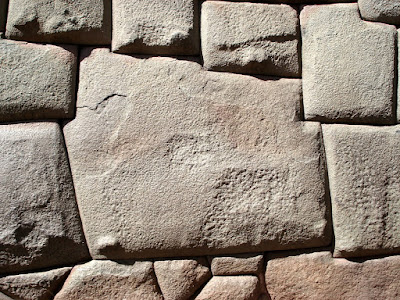
When you turn left at the door to the Hospedaje San Blas, you walk downhill on the narrow and impossibly slippery footpaths of Cuesta San Blas. The cobbled road is wide enough for one car, and it's rarely free of traffic. At the end of the road, you cross to the pedestrianised route that leads past the famous 12-cornered stone, expertly set in place by the Incas and now supporting the Archbishop's Palace.


That's the story of Cusco: It was the capital city of the Inca Empire (its name means navel in Quechua - it was the bellybutton of their world) and most of it was torn down by the Spanish and used as a platform to built the city that you see today. At this corner you might see a very tall gringo, smiling and holding up a copy of a small magazine.

In his US accent he might call out something like:"Cusco Times*. Summer edition. Get it while it's hot!"

You may want to intervene at this point. I certainly did.

Short Frowning Gringo (Me): "That's a bit Northern Hemisphere of you isn't it? Summer Edition? It's the middle of Winter here!"

Tall Smiling Gringo: "Yeah - but it's so warm and sunny here that it just feels like Summer".

This seemed like a weak pretext on which to attempt to impose - once more - Northern Hemisphere order on a Southern Hemisphere people. But the Tall Smiling Gringo really did have a nice smile and my frown was starting to falter.

SFG: "Hmm. How long have you been here?".

TSG: "I got here 8 months ago, but now Cusco is my home. We're putting this magazine together in English and Spanish, and the proceeds are going toward helping out some of the poorer locals."

I had promises to keep and I had no change to buy the magazine so I promised the Tall Smiling Gringo that I'd buy the next time I passed by.

Walk past the TSG and the Archbishop's Palace and you will arrive at the prettiest plaza I have seen in South America. It's big but not vast. It's beautiful but not imposing. It's green, but not overgrown. Lively, but not overrun. Each side has its own character, but they all seem to get on with each other.

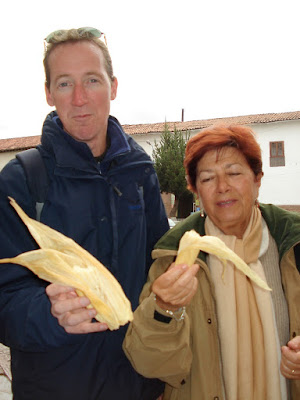
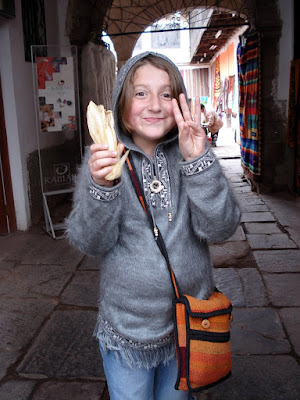
If you are lucky, to your left you will find somebody selling tamales. You can buy both sweet and savoury versions of this delicious street food - just make sure you try at least one.


Oh go on then - have three:


To your right stand three churches all attached to each other, the central and biggest of which is the cathedral. Inside, you will find more gold and silver than any European church you have ever seen. The tour guide will point out what you otherwise probably won't be able to see for yourself - that the artwork in these churches, created by indigenous artists commissioned by the clergy, contains hints of the religion that preceded christianity in these parts: the worship of the Sun, of the moon, but above all, of Pachamamma. In Cusco, most of what's on the surface is Spanish, but underneath, it's still Inca.

Around the main plaza (yes, called Plaza de Armas) there are many other plazas and streets worth visiting, especially to the north where a little road leads up to the Plaza Nazarene where the famously luxurious Hotel Monesterio is located. We could afford to have an aperitivo of Pisco Sours here, but not to stay. (One night in their junior suite costs the same as the 12 nights we spent in our modest hostel). On the way up, you'll pass a little street called Purgatorio - it would appear that Purgatory is a pedestrianized street (which makes sense given the relative hell of Peruvian traffic).

Heading east of here, we do a loop on our way back to Cuesta San Blas (that was a short walk, wasn't it? but with the lack of oxygen and the upward slope on the return journey, you're still puffed out I bet).

One one such return trip that I took, it was actually raining lightly. As I approached the Cuesta, there again was my tall smiling friend, still selling his magazines.

Me: "Summer edition my ass" I offered.

TSG: "Yeah! I know. Now I'm telling folks 'Get it while it's wet!'"

Nothing got this guy down. And I think that some of this must have rubbed off on me. I've been back for over a week now, and the routine of moving from place to place has washed right off us like it was never there. And I still feel great. I know the trip is over, but it'll never be gone.

(*I can't actually remember what the name of the magazine is, as I forgot the copy that I bought.)

Monday, August 18, 2008

Last Tango in Buenos Aires

Tonight is the last night. I can scarcely believe it. I know that I have said in previous posts that I was ready to come home, but it seems we have barely arrived in Buenos Aires and now it is already time to leave. This time tomorrow, all going well, we will be on board a British Airways flight to London, and with a connecting Aer Lingus flight we'll be in Cork at about 11am on Wednesday morning. The level of anticipation, and disbelief that the moment is here, is almost equivalent to that of our first flight, almost 8 months ago, to Beijing.

If you have enjoyed reading this blog, please stay tuned as I will be posting for a few weeks to come. I have memories of Cusco, Lima and BA that are still to be recorded, and of course even the homecoming itself and the effect it will have on all of us is a subject that might interest you. Especially if you are thinking of doing something similar yourself.

About halfway though our trip, when we got to New Zealand, it started to dawn on me that 8 months isn't very long at all. Time is the enemy, marching imperiously on without a backward glance upon the destruction it leaves behind. We did this trip now, as opposed to being sensible and waiting until the kids were older, because we had no idea of how long this life, this planet, or our freedom to travel around in it, might last. It's a cliche, but a fine one, that the right time to do something that you need to do is probably right now (adding on a year or two for planning!). While stocks last. But now our stock of eight months has been used up.

Time always wins.

But in two ways, we might have pulled the wool over its eyes for a while. Firstly, the memories of this trip will last me and Letizia for the rest of our lives. I hope that the same is true for Nina and Sara. And more: I hope that what they have experienced over the last 8 months will serve them forever. Not just to give them a taste for travel, but so that they might always remain certain that whatever life shows them, there is always something else out there. That they should never feel that they have seen everything. That they should not assume that what they see around them is the only way to live. That they should never feel trapped by illusary limits.

Secondly, even if time is the enemy, the greatest gift we had during these 8 months was the time we spent together. It is unlikely (though not impossible) that the four of us will ever share quarters in quite so intense a fashion as during this trip. I spent about 3 years worth of free time with my children, when compared to the time that I would normally have had with them at home. While this has been challenging at times - above all for Nina and Sara - it has also helped me to understand a little better who they are and what I need to do to be a better parent. The trip hasn't been about seeing the world as much as it has been about living a more intense family life, with China and much of the Southern Hemisphere as the backdrop. I should be clear about this: I am no better a father now than I was when we started. In many ways Nina and Sara got to see some aspects of my character that they might have been better off shielded from. (For example, I swear a lot. I normally offload my daily dose of profanity in the office, and I'm ueber-careful at home. Not on the road, though.) But I think we understand each other a little better, and even if that doesn't automatically lead to a better relationship, it can pave the way. We simply wouldn't have had this time together, and this opportunity to see more of each others' personalities, if it weren't for the trip.

A number of readers have suggested that there is a book in this blog. I'm inclined to agree, if for no other reasons than a vanity on my part to think I might be able to write one, but also for the fact that the experience can be best understood and appreciated in retrospect, as a whole, rather than in this diary form. Writing the blog has helped me digest our experiences as we've travelled along, to untangle at least in an initial way, the many threads that were spun each day. To write a book, to see the entire 8 months from the more stable platform of so-called normal life, would be a way of securing the memories, and of giving the trip some enduring meaning for my family. Writing is one thing, and publishing another entirely. If anyone out there knows of or can recommend either a publisher or a literary agent that would be willing to take us on, please let me know.

Tonight over dinner in the beautiful and big-hearted city of Buenos Aires, the four of us toasted our trip and our return home. To those of you who have followed, once or regularly, especially to those who have commented or emailed; to those of you who helped make this trip possible with help or understanding; and to those of you who showed us hospitality along the way; I raise my glass and drink to your health.


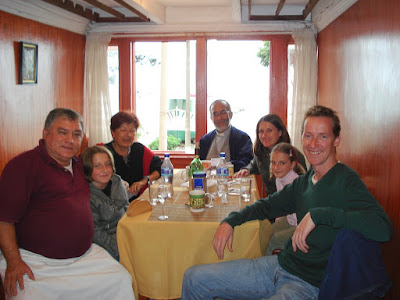
(Picture taken in Lima, but as you might tell from my big red face, plenty of Pisco Sours were drunk to many healths).