Showing posts with label history. Show all posts

Saturday, August 9, 2008

Driving the Parish Priest's Car

I was named after my uncle the priest. At the time, Father Brendan was blazing an ecclesiastical trail in the US, hotly tipped (at least within our family) to be the first Irish pope. The reasoning behind my name was that I would inherit the fortune of the parish priest (at least). But shortly after being honoured with a namesake, with not a thought for the future of his nephew, Father Brendan left the priesthood, and all of a sudden I had to make my own way in the world.

Now, many many years later, Father Brendan is once more a priest (you can take the boy out of the God, but...) and finally the fortune of the parish priest is starting to faintly show its lustre. Last weekend, again through Livia's good offices, Padre Nicanor gave us the use of one of the Medical Centre's 4-wheel-drive pickups and we took to the countryside around Cusco.
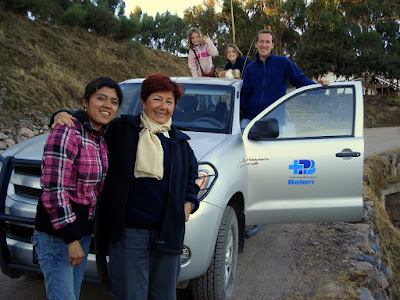


The new face in the picture above is Natalie, tour guide and niece of SeƱora Paulina from the Medical Centre (nothing here is done without contacts - I feel like I'm back in Italy). It's all very well having your own wheels, but they're not much good if you don't know where to point them. Natalie guided us around the area that can roughly be described as the Sacred Valley for the entire weekend, helping us work out a good itinerary and giving us her insights into the history of the Inca. In some sense it was a magical mystery tour. Our ambitions in Cusco centred entirely around the city itself and Machu Picchu, and we had little or no research done on what else there was to see. Idiots. The land around Cusco is rich in magnificant historic remnants of the Inca Empire, and with Natalie's guidance we took in some of the more important ones.

First stop was a place called Moray which won't show up on many maps, and in effect doesn't have much of a road. We crawled our way up the gravel track, having already spent over an hour on sealed roads, stopping off to pick up locals who flagged us down for a lift. We parked (some of our passengers offered to pay for the lift - a humbling experience given their clearly meagre resourses) and walked to the edge, to where the ground seemed to fall away, still not sure exactly what awaited us...
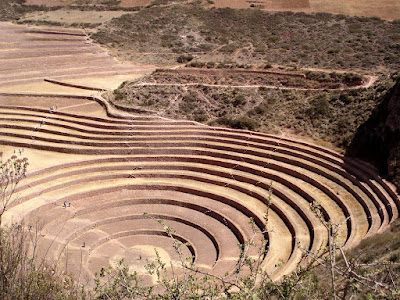


These beautifully executed and wonderfully restored concentric circles, leading down to a depth of 30 meters or so, formed the world's first greenhouse according to Natalie. What you are looking at is an experiment in agriculture. A system that created different micro-climates, allowing Inca society to grow various crops all year round, and even to develop different varieties. Most importantly, this was the larder that filled the stomach on which the Inca army marched. During the phase of imperial expansion, this experiment was undertaken to help build up the surplus of food that must precede every military advance.

Nowadays it has another function. This site is considered by some as an important point of energy on the Earth's surface. When I hear the word 'energy' being used in this loose context, often by practicioners of alternative healing, I become immediately suspicious. But after climbing down to the very centre, still dealing with the altitude and heat, I was too breathless to put up a fight when Natalie suggested that we make a family offering to Pachamama. We didn't have coca leaves, we weren't inclined to sacrifice either of our daughters (given that they were well behaved that day) so we settled for one of the sweets that I constantly carry around in my pocket (we get them with the bill in Karl-Heinz's wonderful restaurant La Granja de Heidi across the road from our hotel - more on that in a later post). The Inca preferred even numbers apparently, so Natalie excluded herself from our offering. We buried the sweet, made a collective wish (which will remain as buried as the sweet itself until such time as it comes true), and struggled back to the edge of this enormous and breath-taking structure. Using steps like this...
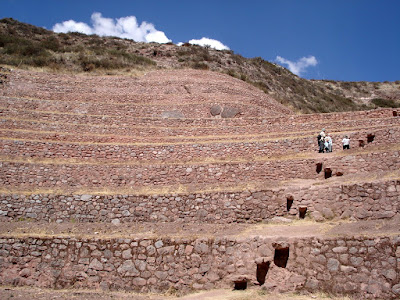


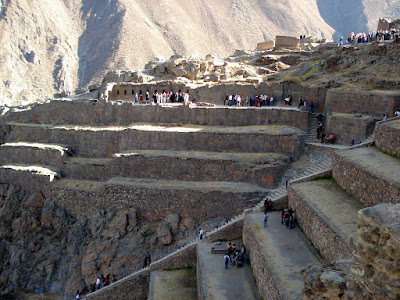
Next on the itinerary was Ollantaytambo, another hours drive away. Guide books will often describe this as a fortress on the edge of a town, but Natalie began to show herself to be something of a maverick when it comes to interpreting Inca history. This time, the road was more civilised. We drove over the cobbles of the town and parked in the main plaza. So far it looked like a pretty, lively place. It's where the train to Machu Picchu leaves from, so there was quite a bit of tourist activity about. It wasn't until we left the plaza and walked north to the edge of the town that the vast ladder of terraces that characterized these ruins suddenly came into view. It took our already faint breath completely away. Twice in one day we had been ambushed by the Inca, despite the fact that they were swept away 500 years ago. Imagine the impression that this civilization must have made on those who lived in it, and those who came to conquer it.

We had lunch first, to prepare for the climb upwards, during which Natalie continued to give us her particular views on the nature of the Inca. She was slow to even use the word 'empire', and portrayed the way of life as a golden age for Peruvians. Nobody went hungry, the empire itself was build up by good example rather than at the end of the sword, everything was just dandy until the bloodthirsty Spaniards turned up. In our trip so far, we have seen the stamp of imperialism in every country we visited, and I feel I can say that the imprint is the same regardless of culture. The rationale behind empire, and many of its methodologies, are distinctly human and shared by British, Spanish, Papal, Mandarin, Mongol and Maori. I have learned to mistrust historical explanations that insist on exceptions to normal human behaviour. (In case this sounds fatalistic, and too pessimistic of human nature itself, I will try to give a fuller picture of what I mean in a later blog. I like to spread the pain - your pain that is - over time.)

Nina and Sara, faced with another climb, spat the dummy. So Livia volunteered to stay with them (quite happily, as she has seen all this before) while Letizia, Natalie and I hiked upwards.
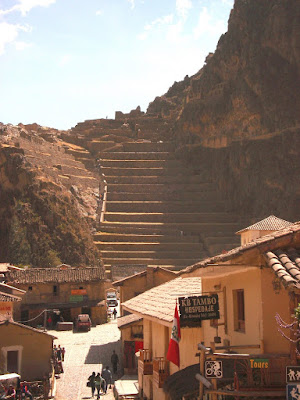


In fairness to Natalie, it is hard to see the Ollantaytambo ruins as a fortress, given the lovely unguarded set of steps that run right up the middle of the terraces. The terraces themselves hold historical record of agriculture, just like back at Moray. Natalie's depiction of the site as a mixture of temple, agriculture and normal habitation made sense as she guided us up and across the structure. Always in the back of my mind, however, is the thought that only a centralized and powerful state, with endless cheap labour at its disposal, and methods of enforcing its will, can hope to construct edifices like this and Moray.

But I remain an ignoramus on all South American history and cultures, so I will have to wait until I read much, much more and compare what I have read to what I have seen, before offering anything other than these generalized and broad-sweep opinions.


Padre Nicanor has something of a reputation as a fast driver. Livia calls him Il Pirata (the pirate). Given that this was my first Peruvian driving experience, I was taking it nice and handy. I made sure, on returning the car at the end of the day, to apologise to the Padre, thorugh Livia, for destroying his reputation by tootling around the Cusco countryside like a pensioner, in a car marked with the Centro Medico de Belen. He laughed out loud and beamed at me. But there was something unpredictable and flammable about his glee, like an American caricature of a mafia godfather. I handed back the keys nervously and promised to do better the following day.

Wednesday, May 28, 2008

MTV (Maori Television)

[Updated May 30th to sort out cut&paste problems in first paragraph]

When you switch on the telly for the first time in New Zealand, you'll find that one of your viewing choices will be in a language that you have probably only heard before on the rugby pitch, when the All-Blacks perform their famous haka. The Maori language is like nothing I've ever heard before, and strange to a European ear. But when James Cook (there he is again) made contact with the people of New Zealand in 1769, he had on board somebody who could understand these men, and could make himself understood. That man was called Tupaia, a Tahitian chief picked up during the first part of the Endeavour's voyage. The reason that Tupaia understood the Maori is because the Maori, like Tahitians, are Polynesians, and speak languages that come from the same sub-family of Austronesian. The Polynesian people swept eastwards across the Pacific from 1200BC until 1000AD, starting from Taiwan and inhabiting island after empty island, eventually doubling back to find Earth's last big true Terra Nullius, New Zealand. And they did it a good six to eight hundred years before Cook passed by.

When you first enter the country, even at the airport, you see the Maori language all around you. Like Ireland, official signage is always bilingual. Like Ireland, certain terms in the one language have found their way into the other. Most white Kiwis will know what mana is or what whakapapa means - not just words but even Maori concepts form part of New Zealand's shared vocabulary. The cross-fertilization works both ways. After Cook had moved on, and traders and whalers moved in, the Maori needed to expand their own language to deal with things they had never seen before, and they used transliterations, just like we've heard in the Chinese language a few months ago. For example hipi renders the idea of the then-unknown sheep and pata sounds like the foodstuff that the Maori had never know, due to the lack of large mammals on the islands: butter. (I have no idea where Lake Wanaka got it's name...)

Take all these things together - Maori Television, a single Maori language respected with dual signage, a keen sense from white New Zealanders (Pakeha) of Maori culture - and you get an outsider's feel for the difference between the situation of the Australian aboriginal and the New Zealand Maori. The Maori suffered under colonization, make no mistake. At one stage during the late 1800s most whites believed - many with regret - that this was a people doomed to extinction. But they survived conquest better than the Australian peoples, and adjusted with greater ease into an essentially European political framework.

Why?

At the moment, I'm reading another, older Jared Diamond book called Guns, Germs and Steel. Diamond offers an explanation for what he describes as the "broad pattern of history": how Europeans (or at least Eurasians) came to conquer the rest of the planet, rather than Africans, Native Americans, or Australians. I'll wait till I finish the book before trying to summarize it on this blog, why the fates of the Maori and the Australian First Owners have differed so much.

For now, let's look at another related New Zealand story that Guns, Germs, and Steel relates. The book starts with a discussion on the spread of the Polynesians across the Pacific. This is because that movement serves as a kind of Human History in a Nutshell, a small isolated example of what happened globally when anatomically modern Man spread from Africa to almost every corner of Earth. The islands that they conquered or filled varied enormously in climate, size, isolation and domesticatable plants and animals. Over the two millennia of exploration, the inhabitants of each of these islands tended to lose their cultural memory, forgetting where they had come from and simply adapting to conditions on each of the islands. The starkest lesson that can be gleaned from these adaptations lies in the story of the Moriori people of the Chatham Islands.

When they settled in New Zealand, the people who came to be known as the Maori brought with them some domesticated crops (the earliest Polynesians were already farmers). Some of the crops they had didn't thrive in the colder climate even on the North Island, but others did and the Maori people came to depend on agriculture more and more, especially after they hunted the larger flightless birds on New Zealand to extinction (the Moa being the most well-known example). By the time New Zealand was fully colonized by the Maori, they were organized into territorial tribes. At any moment in time, some tribes were at war with each other, while others cooperated (a perfectly normal state of human affairs). Some time before 1500, a group of Maori left NZ and settled the Chatham Islands, 800km East of where I'm sitting now in Christchurch. Life on the Chathams was not the same as where they had come from - it was too cold even for the few crops that remained to the Maori. But it was abundant in seafood. The Chatham Islanders reverted to a hunter-gatherer way of life and while this was the right choice (indeed their only choice) for survival in these conditions, it was the wrong choice geopolitically and it sealed the Moriori's fate.

In order to survive on an island that could support no more than 2000 people, they developed a strategy for dealing with conflict that excluded outright war. It wasn't strictly pacifist - you could still take a stick to your neighbour in a ritual fight. But once you drew blood, that was as far as you were allowed to go. There was no food surplus, nor way of storing it, that would in any case have provided for maintaining even temporary armies. There were precious few natural resources that could have provided for weapons. If the Chatham Islanders had kept up their Maori ways, they would have wasted what the islands had to offer, and died out.

When contact was next made with the Moriori people, by whaling and sealing ships around 1800, the word was brought back to the Maori in New Zealand of islands that were bountiful and inhabited only by a group of people who had no concept of weapons or war, and simply no idea how to defend themselves against outside aggression. A total of around 800 Maori chartered a European ship, and went to settle the Chathams. Those of the unfortunate Moriori who escaped slaughter tried repeatedly to negotiate their way to peace (it was all they knew) but merely ended up as the slaves of the Maori. The consequent genocide was practically complete in 1933 when the last full-blooded Moriori died.

By recounting this story I am not criticizing the Maori - what they did was in complete accordance with what they would have expected to suffer if they were defeated in war themselves. Nor am I saying that the Moriori are to be commended for their pacifism - their lack of defence was not a principled stand as such, but simply due to the fact that as a people they had forgotten how to fight. The real tragedy as I read it, is the fact that neither side understood that they were brothers, separated by just a few hundred years. And the immediate lesson that I take from it is that, if you extrapolate out the 2000 years of Polynesian colonization to the 40,000 years of the movement of modern Man, you are left with the similar conclusion that every one of the current wars raging on the planet right now is a war between brothers. That is not a liberal, bleeding-heart opinion. It is, to steal a phrase from Stephen Jay Gould, a contingent fact of history.