Showing posts with label danger. Show all posts

Saturday, March 29, 2008

D - I - N - G - O (and dingo was his name-o)

To be sung to the tune of Bingo:

A wolf from Asia came to Oz, and dingo was its name-o.
D - I - N - G - O, D - I - N - G - O, D - I - N - G - O
And dingo was its name-o.

It came 5 thousand years ago, and traders were to blame-o,
D - I - N - G - O, D - I - N - G - O, D - I - N - G - O
And traders were to blame-o.

On Fraser Island we saw none, but did see a few cane-toads,
C - A - N - E (croak), C - A - N - E (croak), C - A - N - E (croak)
We did see a few cane-toads.


I could go on (believe me) but frankly, I'm boring myself here (as opposed to just boring you, which I can live with).


What I am getting at here is that after Australia Zoo, we continued North to Hervey Bay and stayed overnight, ready to catch a ferry the next morning to Kingfisher Bay Resort on Fraser Island. Fraser Island is known for many things, and one of them is the dingo - a wild dog, more like a wolf really. Anyone who knows Letizia and me will understand that we divide work between us based on interest and competence. Hence I am generally in charge of navigation, budget and boring the children with historical information, while Letizia is in charge of, well, everything else. And when it comes to being worried about Australian bities and beasties, Letizia takes the job very seriously indeed. Having recently survived a trip to the Great Barrier Reef without anyone succumbing to sharks, rays, stingers or marooning, and having passed through Australia Zoo without passing through Murray the Saltwater Crocodile's digestive tract, Letizia had plenty of time and energy to devote to anxiety over the Fraser Island dingos. I fulfilled my role of being insensitive and feckless (we really make a fine team).

On arrival to the resort, we made straight for the briefing room. We were given a talk on the island and some of its features, including the dingos. There we learned that dingos are a relatively recently introduced species. They came to the Australian continent in traders boats about 5000 years ago, and are more closely related to Asian wolves than to dogs. We were given advice on how to behave on seeing a dingo: stand your ground, stare it down, NEVER run. I knew straight away that Sara was not getting off the island alive. Three days previously I had watched her scream in hysterical circles on the black strand of Sandgate, an over-excited lapdog yelping along behind her.

Afterwards, we made our way to reception to check in. When all the usual business was out of the way, the young woman behind the desk made the mistake of asking "Anything else I can help you with?". Letizia grabbed the poor woman by the label, dragged her over the reception desk to within whispering distance and growled "What's the story with the dogs?" I thought I heard the poor woman squeak back something about them being wolves not dogs (they really are professional!) but she quickly moved on to tell us about the dingo-proof fence that surrounded the resort. This seemed to placate Letizia and we made our way to our accommodation.

We saw and learned so much over the two days of our stay (which included an 8 hour tour to some of the scenic spots) that I can't begin to do it justice. But let me point out some main points.

  • The island is listed as a World Heritage Site under 2 categories, one of which is geomorphology: the place contains a huge variety of different landscapes and is constantly changing in a number of interesting ways, due to the fact that it's entirely composed of sand (the largest such island in the world.)
  • There is an aquifer under the island that produces freshwater lakes and streams. It holds 30 times more water than Sydney Harbour, and can be safely consumed straight from the streams. The water you drink has been slowly filtered through the islands sand from rain that fell over a hundred years ago.
  • The streams run over sand (of course) which means that although they run quickly, they also run completely silently. You can walk from rainforest to new growth forest, alongside a creek, and not even know it's there.
  • We went to swim in Lake Mckenzie, a perfect, clear freshwater paradise. You might be asking yourself, how do you get a lake on a sandy island, sand being not much good for holding water. There are differently kinds of lakes on Fraser and McKenzie is called a perched lake. It sits on top of a layer of coffee rock, which isn't rock at all, but compressed organic material that becomes impervious to water. You can see this all over the beaches as well, and it really does look like rock. Till you pick it up and grind it with your hands. You end up with powder and coffee-coloured stains on your hands.
  • The dingos on the island are almost 100% genetically pure. Most dingos on mainland Australia are less than 50% pure having mixed with domestic dogs brought by Europeans. It's interesting to note that if the dingo had been introduced by the white man 200 years ago, ecologists would probably be trying to destroy it (as we saw them do to the Cane Toad) rather than protect it.
  • The sunsets from the pier at the resort were breathtaking, and Letizia has done a great job of capturing them on her Fraser Island blog post - with lots of other photos from different parts of the island.
  • The East (Pacific) Coast of the island is mostly taken up with one big beach called the Seventy Five Mile Beach. It's Sixty Five Miles (100km) long. Go figure. It's also the main highway of the island, where most rules of the road apply, though you can drive on either side of it as long as you indicate to oncoming traffic which side you intend to pass them on. Oh - and you have to yield to planes that take off and land.
  • The rest of the island road system consists of trails that are passed only with difficulty using 4wd vehicles.
  • The island was heavily logged for more than 100 years. Of particular interest were the Satinay trees that became highly valued when it was discovered that they were immune to the rot caused by salt water bugs. Fraser Island Satinay was used to rebuild London docks after WWII and to line the sides of the Suez. The reason logging was eventually stopped was that the Queensland government were persuaded that the island was worth more as an eco-tourism destination than as a source of timber. This is an interesting, though probably rare, example of how the tourism industry can actually work to increase conservationism rather than to reduce it. No tourists = loggers.
As well as learning all this (from our excellent guide Chris) we still had time during our stay to just splash about in the resort pool, or chill out with a glass of wine in front of the sunset over the mainland. For me, the sunsets have the effect of detaching me completely from my thoughts and circumstances. When I watch them, I don't care where I've come from, where I'm going, or what happens next. I stop trying to plan. I just know it'll all work out one way or the other. I've just reached the grand old age of 39 (spent on the road back to Brizzy), and I'm feeling good about Life, Part II as much as I'm feeling good about the second half of of the trip.

We stayed almost exactly 48 hours on the island without a single (independently substantiated) dingo sighting. And guess what - Letizia was disappointed!! :-)

We absolutely loved this place, and I could just as easily (for YOU, at least) have replaced the entire spiel above with one small word: Go!!!

Thursday, March 20, 2008

Cairns Part III: Cape Tribulation

The Cairns story so far: We had spent a day just hanging around the city, lounging around the fantastic Lagoon in the city centre, which is an public outdoor pool set up on the shoreline. The second day we checked out Kuranda, the third day we were (happily) rained into the hostel and sat out the day with books, nintendo and talking shite to the neighbours on 'our' bench, and the fourth day we went to the reef.


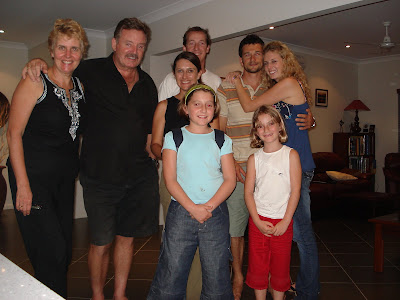
What I didn't mention is that in Cairns, as in Sydney and Melbourne, we had contacts. My brother-in-law Ivor's uncle (tenuous, I know) is living there with his wife and daughter, and when we made contact, Joe and Pauline very kindly invited us round for a barbie, picking us up from the hostel. The best thing, bar none, about traveling is meeting people, and Joe, Pauline, Finola and Jason were fantastic company and great hosts. I know Pauline is reading this blog - so thanks a million once more Pauline. You guys really helped to make our experience of Cairns more interesting, more fun, and very tasty (we had a roast beef dinner the second night! We thought we wouldn't see another one of those before Cork).


Our last big adventure in Far North Queensland was a trip - or an attempted trip - to Cape Tribulation. It got its name, as have many landmarks on the East coast of Australia, from Captain Cook, when the Endeavour came a cropper on the reef, and looked like it would go down. The dots were really joining up for me now - in Sydney's Maritime Museum a few weeks earlier, Nina and I were able to touch a big chunk of metal ballast that was recovered from the waters of Cape Tribulation. It, along with many other heavy items, were thrown overboard the Endeavour in an attempt to raise her in the water and get her off the reef. Captain Cook's tribulations ended well enough: using a technique called fothering, the damaged hull was effectively bandaged with a sail - enough for the ship to be brought to shore and repaired more thoroughly. It turns out that some of the coral that holed the hull had broken off and partially plugged the gap it had made. The crew had been very lucky indeed.


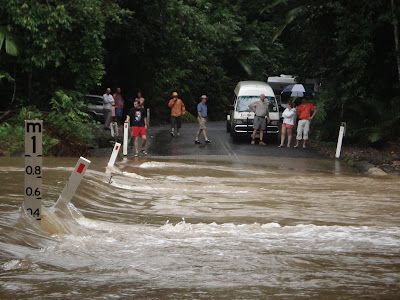
Our tribulations that day were less dramatic. The rain was coming down in sporadic but heavy cloudbursts, making driving conditions difficult (by now we had hired a small car with Cruising car rentals across the road from the hostel, and I can really recommend these guys). This was the second day of rain, and so we were concerned about getting trapped up on the Cape due to road closures. In the end, we made it into the Daintree rainforest, by crossing the Daintree river by ferry, but we only got as far as Cooper Creek:


From Daintree


In our little Daihatzu Getz (again, I have to wonder who thinks up the names here, or what the world's greatest saxophonist has to do with 2-door hatchbacks) we weren't going anywhere. Better to get blocked on the hostel side of the road, than to be stranded (like the folks in the picture) on the far side. We turned back and headed to the Daintree Discovery Centre a few kilometers back. This a great place to stop off in and check out the flora (and if you're lucky some fauna - this is Cassowary country) of this particular rainforest.


Gary, when we were back in Sydney, had told us about something called the Stinging Tree. It would appear that even the plant life on this continent can be really mean. Well in the Discovery Centre - which was a treetops-and-trail tour of the forest - we got to see this plant up close. It's an innocuous looking thing, with fruit that look like raspberries, but each leaf is covered with tiny slivers of silicon (yes, glass) each with a chemical irritant. If you even lightly brush off these leaves, countless poison needles will embed themselves under your skin and hurt like hell. For months! There is no antidote. The information in the Discovery Centre talks of folks throwing themselves to their deaths from clifftops rather than deal with the pain anymore. There is even a story, (perhaps urban legend, if that term can be applied to the wild) of a soldier on manoevers who uses a leaf to wipe his backside. Now that's tribulation.


The rain continued to come down for the rest of our stay in Cairns, keeping us from venturing to any of the other sights like the crater lake, or the crystal cascades. Letizia and I promised each other that we'd come back. In the dry season. But for now, we found ourselves once more on a plane, this time flying South along the East coast of Australia, towards Brisbane.


After a few hours, the left-hand portholes where Letizia and Sara sat were in almost complete darkness. On the right, I could see the clearest, longest and most perfect sunset I have ever experienced. For thirty minutes, I watched the fires burning in rainbow colours along an endless and featureless horizon, the emotion heightened by the knowledge of how far into the distance the continent extended and knowing too that the sun's light which for me was just an afterglow, was now heating the African Cape. The shadow from the left spread under the plane and over the land below until it oozed to the horizon itself where, just as we reached Brisbane, it extinguished the distant fires.


Our airborne hops seem to have the same effect each time. As we leave one place, it is only with reluctance, but as we near our next destination, the anticipation is impossible to stifle. I suppose it is because in our journey so far, we have never gone 'home', we are always traveling to somewhere we have never been before, gradually moving eastwards, into the darkness.

Thursday, January 24, 2008

Sara the Jellyfish Magnet

I swore I wouldn't do this, but 'events, dear boy, events'. There are two things about Australia that you need to know, and luckily for you, somebody else has already gone to the trouble of hammering these things home for you. If you read Bill Bryson's hilarious and sometimes accurate Down Under, you will remember for the rest of your life that Australia is
  1. Huge!
  2. Full of things that not only want to kill you, but have every possible evolutionary advantage imaginable to see this ambition through.


I promised myself solemnly (I wasn't smirking or anything) that I would simply refer once to Mr Bryson and never mention anything about vast deserts or inconceivable concentrations of venom.


Then we went to Coogee.


Sara has been stung by jellyfish in the past - Sardinian ones. She didn't exactly enjoy it, but Mediterranean jellyfish don't have the same work ethic as their South Pacific counterparts. Like the gentle waters of the Med itself, the jellyfish that Sara previously attracted were just making a bit of a show of being nasty - their heart just wasn't in it.


Coogee Bluebottles (for that is the local vernacular) on the other hand, are nasty little bastards who take this whole stinging business very seriously indeed. We arrived at Coogee beach at about 11:45, and by 11:50 or so I was carrying the inconsolable Sara for first aid at the lifeguard station just behind us. You have to understand my state of mind at this point: I was calm, but I was working under the assumption that my youngest daughter was in danger of meeting a horrible end if she wasn't whisked away pronto in something with sirens. We were in Australia, Sara had just been stung by something with an innocuous Aussie slang term, therefore I assumed death was imminent. Thank you Bill Bryson.


Matters weren't helped by the fact that the lifeguard didn't share my sense of urgency on the matter. This brings me to two things that one can say about the Australians: Lifeguards are, as a group, greatly respected. Seems fair, considering the number of lives they save each year - very often those of tourists who didn't heed Bryson's many warnings. I was all primed to show deference, and to be awed by their derring do. The other thing about Australians is their tendency towards understatement. Take our friend Gary here in Sydney. Last night over dinner (thanks again Ludi and Gary - it was excellent catching up) Gary explained the difference between saltwater and freshwater crocs. While the salties are viscious monsters and therefore should be afforded some respect, freshies are harmless and you'd have to practically stand on one to force it to give you a 'bit of a nip'. It was news to me that crocs did 'nips'. Pekinese dogs do 'nips'. A terrapin, if handled inexpertly, will give you a 'bit of a nip'. Crocs do not nip. At least not in Hiberno-English, or indeed just about any dialect of the English language. Except Australian.


So when I presented poor Sara to the lifeguard, I expected him to manfully take over and burst into action. Instead he offered me directions to the showers, and told me to come back for some ice packs. He did, in fairness, also pluck off one of the remaining tentacles from Sara's right leg, protecting his fingers with his sleeve - something I should have done myself. But as far as first aid was concerned, we were getting nothing but water. A shower and some ice.


Compare this to what happened on the beach in Santa Margherita di Pula in Sardinia when Sara last got stung by a jellyfish. The 50 or so people on either side of us went straight into action, organizing themselves wordlessly into teams:

  • One team dived into their beachbags and retrieved every form of medicine that can be legally purchased over the counter in Italy (which is a lot, by the way) - and given the number of doctors on the beach, we also had a choice of prescription-only products. Ammoniac, antihistamines, cortisone creams, pain-killers - you name it, somebody was running towards us holding fistfuls of it.
  • Another team moved swiftly towards the part of the sea where the offending creature was presumed to be, armed with buckets, nets and, most probably, more drugs.
  • A third team, lets call them the 4th estate, set up an impromptu incident centre through which all information related to the 'attack' was relayed, compared to similar incidences, and analysed based on severity, age of the victim, profession of the parents, and of course the likely efficacy of the drugs being used.


I'm not saying that the Italian approach is necessarily the correct one, but I must confess I would have preferred it to the stoic 'No worries mate, a bit of ice and she'll be apples' attitude that I was getting. I'm all for being stoic, taking it on the chin, grinning and bearing etc. I'm not so keen on it being expected of my 6-year-old baby girl.


This all happened more than 24 hours ago now, and in the meantime, Sara is just, well, 'apples' (she did get the ammoniac and anti-histamine treatment from her mother's mobile pharmacy, mind). We visited the superb Sydney Aquarium today where we read, apropos bluebottles, that the best course of action is rinsing with fresh water and applying ice-packs. I didn't have a felt-tip pen to hand, so I couldn't add some extra helpful hints or pharmaceutical product names.


It might have been worse. Gary told us that when he was just a few years older than Sara, and visiting Sydney from his native Melbourne, he got stung right across the chest. His uncle proved even more rugged (and unhelpful) than our Coogee lifeguard: "Just rub sand into it and you'll be right". You just know how that particular 'cure' came about: Gotta do something - now what have we got to hand? I mean when you stung yourself with nettles as a child, and instantly grabbed a fist of 'Doc' leaves and rubbed them into the sting, did you ever stop to think that 1) they never NEVER made the slightest difference and 2) they were always growing next to the nettles. No? Me neither.


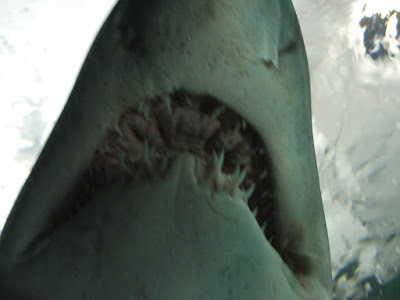
Anyhow, all's well and tomorrow we'll return to Coogee, though we'll stick to Wylies' saltwater pool there. Below is a photo from today's trip to the aquarium. Look our for these buggers - apparently they can give you a 'bit of a nip'.