Showing posts with label north island. Show all posts

Saturday, July 12, 2008

Previously, on Lost

The story so far: Our time in New Zealand is almost up. We spent 4 days in Auckland, headed to Fiji for a week, and we're now back in Auckland for one night before heading East again, across the Pacific Ocean to Chile. I'll try to compress the days since the glowworm caves into this one blog entry...

Auckland gets a bad rap in tourist lore. Just another city. Concrete Jungle. Fly in and move on. Based on this reputation, we decided to book a motel near the airport and shuttle in and out to the city centre as we wanted/needed. Our first impression of Auckland was confirming our prejudices. We pulled up outside our motel - the Travel Air Motel - and got a sinking feeling. We're not so picky. We have only run away from one other hotel in 6 months. But when we saw our rooms, we realised that we had been completely misled. If I had thought of it in time, I would have taken pictures for you to compare to their website. We got into the car again, leaving some of our our luggage, with a plan to see the city and look for alternative accommodation for the following nights, and were very pleasantly surprised by what we say. It's a bigger city than anything else we've seen in NZ. Bigger and more built up than the capital, Wellington. But it was pretty. There was a nice rolling feel to the streets (a bit like parts of Wellie), nice views out over the water, and parkland easily visible from parts of the built-up centre. With the help of i-Site, at the base of Auckland's famous Sky Tower, we found a great deal for a luxurious hotel right in the centre. We figured that the relaxing part of our trip (Fiji) could start a few days early.

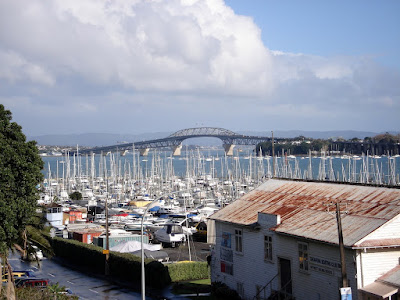
And that's how it came to pass. We went back to the fleapit near the airport, paid $20 penalty for late cancellation, picked up our luggage and left in a cloud of dust and relief. That was the easy part. Then came the walk of shame. When you're staying in a posh hotel, it seems bad form to trail across it's wide lobby, dressed for the road and with laden down with bags of groceries and knicknacks. But when you have to do it, do it with your chin up. We must have made a fine sight, Cheerios poking out of the plastic bags, a dusty single file of noses in the air. We shopped a little, took a spin across harbour bridge to Devonport for a walk and a few photos, ate on Ponsonby Road, and checked out Auckland Museum (again, an excellent example of how museums should be put run).



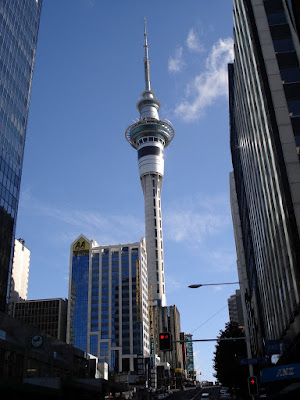
If I hadn't bungied in Taupo, I would have considered jumping off the Sky Tower, but luckily all that was out of my system. Instead we hand a poolside view of the jumpers from the fifth floor of our hotel. The tower itself is a beautiful feature of the city, and I was surprised to learn that it was so new - built in 1995. It dominates the cityscape, and gives the place a focus and an identity. It's hard to imagine Auckland without the Sky Tower. That's the best test for any new structure (I wonder if Dubliners have yet come to the same conclusion about the Spire).


During our 12 weeks in New Zealand, I've learned that this is not just a smaller, colder version of Australia, nor are Kiwis indistinguishable from Aussies. There is something very different going on here, and these two new countries have very different histories despite their superficial similarities. I have at least one other blog in me about those differences, and the part they play in explaining the gap between Maori and Australian Aboriginal. It's unfortunate, but probably unavoidable, to describe New Zealand by contrasting it with its bigger neighbour. But the fact remains that the differences really are surprising. If history had taken a very slightly different turn (for example if NZ didn't take part in the Boer War, and thereby find itself afterwards in a period of intense nationalist sentiment), New Zealand just might have been federated alongside New South Wales, Queensland, Victoria and the others into what became Australia. The fact that it didn't, and has continued in many different political, social and cultural ways to plough its own furrow, has added to the diversity of this region, and provided the world with some truly worthwhile examples.

I'm going to miss the place, but I'm more than ready to move on. We've been too long in English-speaking countries which, for all their differences, are clearly not going to be as different as China was, or as Chile, Bolivia, Peru and Argentina are likely to be. The next six weeks might be viewed as our homeward leg. We're going to cross the International Date Line within an hour of taking off tomorrow. For those of you in Europe it means that, like a coin moving invisibly between a magician's hands, we'll appear on the other side of your screen. From 12 hours ahead of you, we'll suddenly be just 5 hours behind you. Having lost hours with each move to the east, we'll be paid back in bulk (and in advance for future time zones crossed) by being given the chance to live parts of the 11th and 12th of July twice. We're getting closer to home, and we can now say that next month, we'll be back in Ireland.

It might be viewed as our homeward leg. But I'll play every mental trick that I can to remind myself that six weeks is a looooong vacation, even if it comes as the last six weeks of an eight month trip. I'm gasping for the kind of discomfort that comes with moving through non-English speaking territory, and the chance for Nina and Sara to see a whole other way of life.

Friday, July 4, 2008

Afterglow

We changed our plans to go straight from Roturua to Auckland in favour of a one-night stopover in Waitomo Cave. This tiny little place, almost on the West coast of the North Island, is popular for caving and black-water rafting. But we were not going for any more extreme sports. After Zorbing, Bungy Jumping, and playing mini-golf in the rain (mini-golf has always been extreme for us - the last time Letizia and I played, it was midnight and we were under the influence of large gins-and-tonic - I blame you guys Phil and Sheila) we had a more gentle activity in mind: watching glow-worms. While in the South Island, we missed a few opportunities to see glow-worms, and Waitomo Cave has a great reputation in this regard.

We opted for a combination tour of Aranui Cave (no glow-worms but beautiful rock formations) and the glow-worm tour of Waitomo Cave itself. Aranui has the singular feature of having been discovered by a wild pig, though the cave was named, most unfairly in my opinion, after the Maori hunter who was chasing the pig at the time. We were given a great tour that took us deep into the earth and shown stalactites that had been forming over hundred of thousands of years (it takes a century to add one cubic centimetre to these natural sculptures).

Respecting the convention honoured by caves the world over, certain structures were given names to reflect passing resemblances. At one particularly populated section of the cave, our guide stopped and her torch beam settled on one formation after the other and she reeled off their poetic names: Snow White, Elephant's Head, Fairy Glade etc. Then she snapped her torch off, and walked wordlessly past Penis Forest and the adjoining I've Never Seen One So Big.

Waitomo Cave was a great deal more spacious, and the management had worked much harder on making the interior as pleasant as possible. Well-crafted spiral staircases led down to the cathedral, and the lighting was beautifully executed. The geological features were less dramatic than Aranui, but the cave's history is no less compelling. The guide pointed towards the "most recent" rockfall to have taken place - a large chunk of limestone that fell from the roof of the cathedral around 2000 years ago. "That rock fell when Jesus was alive", I said to Nina, an idea which elicited the sought-after oohs and aahs. The cave itself was formed about 6 million years ago, which is around about the time that the evolutionary tree branched - one branch leading to the Orangutan, the other to you and me. But we were there to see something ephemeral. A creature whose lifespan is less than a single year. An insect that when it reaches maturity lives for 2 or 3 days, living only long enough to breed.

We were led down some more steps to the sound of water. I say 'sound' because it was harder and harder to see anything. Our group of about 15 people felt our way onto a boat, and then pushed off into total darkness, silent except for the lapping of water and the occasional intake of breath. Above us, the ceiling was a net of green-blue points of light. Not like a starry sky as the brochure would have us believe. The points moved in relation to each other as we floated by underneath, a parallax effect created by the fact that the net of glow-worms took on the concave shapes in the stone above. It's hard to find a complete silence. Nature is loud, not just cities. The last time I remember a perfect silence was in a woods just outside Jasper in British Columbia, Canada. To achieve that sort of quiet you either need the kind of expanse that Canada provides, or the kind of deathly enclosure you'll find in a cave. As much as I enjoyed the light-show, I enjoyed the peace it brought even more. I sat back, one arm around Nina, and just kept on looking up.

Thursday, July 3, 2008

We Stink. Again.

Look out for the smell of rotten eggs! This is the advice given to everyone going to Rotorua, as if we were all brought up with malfunctioning fridges stuffed with unused eggs. I for one had no idea what rotten eggs smelled like, though after a week in Rotorua I know now. The warning are so stark and alarming that when you actually get there you end up wondering what the big deal was all about. Sure there's a bit of a whiff in the air, but nothing too overpowering. Of course after 6 months on the road our sense of smell has probably diminished somewhat a little. (And the commonplace about deficient senses being compensated by others has proved to be nonsense. My sense of humour, for example, is as poor as ever.)

A week is a long time in politics they say, but it's a fleeting moment in Rotorua (see??!!). Even in bad weather, the list of things to do is longer than the time you have to do it. The essence of the place might lie in the springs, mud and volcanic walks that together provide the famous aroma. But Rotorua is also home to a vibrant Maori culture that is very happy to share itself with visitors (well, rent itself out really), and there are a number of extreme activities that can be enjoyed or endured there. Zorbing (covered in a previous post) was invented in Rotorua, and is the only place in NZ that I know of where you can do this.

After 8 weeks in the South Island, with hardly a Maori face in sight, we were expecting to get a closeup view of New Zealand's indigenous culture right here. One of our first actions on arriving in Rotorua was to book ourselves in for an evening of Maori song, dance and food - the famous hangi (a method of cooking using heated volcanic stone and mounds of earth). There were many such events competing with each other, and we went with the recommendation of our motel host. It was run in a nearby hotel, and included transport to and from. From the outset of the evening, it was clear that this was going to be the kind of get-together that I would warn tourists visiting Ireland against. The vast majority of the audience appeared to be bussed in directly from Japan. And I learned more about the European travel woes of the Queenslanders with whom we shared a table than I did about Maori life and attitudes. It was the equivalent of a sightseeing bus tour through Maori culture, but you know, once in a while a open-top bus tour is a good start when getting to know a new place.

It didn't bother this particular musical snob that the singing was backed up with a gently strummed guitar - who would walk out on a trad musical session when somebody pulls out a 'foreign' instrument like a bouzouki or a banjo (I'll admit to getting antsy when a piano accordion is produced, but I'm of one mind with Gary Larson when he depicts that particular instrument as Hell's equivalent of the heavenly lyre). And I quite liked it when the poi dancers picked on Letizia and dragged her up on stage to learn a little about this most graceful of Maori activities. Letizia, being of a shy disposition, was not particularly happy about it at all, but she acquitted herself very well in front of her family, the Queenslanders and the small Japanese city. And if I may say so, she showed that an Italian woman can sway her hips was every bit as much allure as any Polynesian.

I wish the same could be said for my ability to perform the haka. As soon as Letizia was allowed to return to her place, the male performers came down into the audience in search of 'volunteers' to learn this warrior posture dance. If you follow rugby, or you read this blog regularly, then you know what I'm talking about. Ka mate! Ka mate! Ka ora! Ka ora! Tenei i tangata, puhuruhuru! A menacing chant accompanied by much foot-stomping, thigh-slapping, eye-popping and tongue-protrusion. A quasi-musical performance likely to put the fear of a painful death into anyone watching (a bit like the aforementioned piano-accordion, now that I think of it). Maori people, on the whole, are beautiful to behold. The woman possess an appeal that is hard to convey but easy to appreciate. The men are tall, muscular and hard to argue with. This is how I ended up on the stage, alongside my haka mentor, squinting against the spotlights. It's hard to imagine a greater mismatch than this woolly-jumpered stick man set along side a man who clearly started life as a an enormous pair of pectoral muscles around which a human was generously constructed. I watched and tried to keep up as the warrior showed me the basics, but the results, far from being fierce and frightening were perceived by my watching (and filming!) family as oscillating between high comedy and low farce. All I had to show for my efforts at the end of the evening was a little tiki that I was given before leaving the stage (which I think I still have), and two badly bruised thighs (which I definitely still have).

We did lots of other fun and unusual things in Rotorua, which I won't bore you with right now (though I reserve the right to return to), including a trip to a mud spa, and a half-day wandering around the original Rotorua bath houses, now an excellent museum. In this last place, we learned that Rotorua is New Zealand first major tourist attraction and has been welcoming geothermal pilgrims for more than 125 years now. My guess is that more people have been to Rotorua than have had occasion to smell actual, real-life rotten eggs. In fact if humans were even close to being truly rational beings, people would be warned to check their eggs, and throw out any that smelled like Rotorua.

Wednesday, July 2, 2008

Taupo Bungy

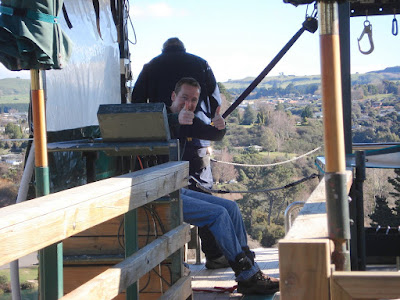
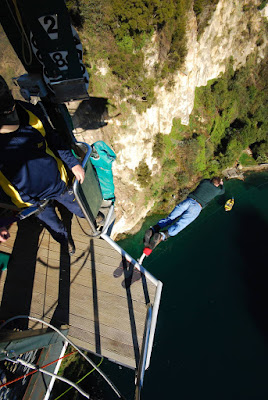
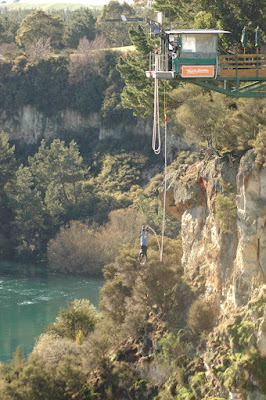
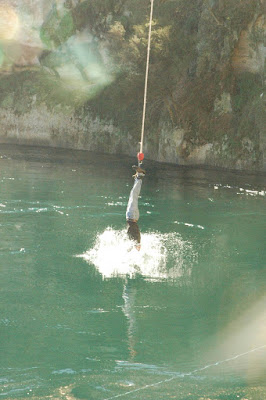
I had no intention of doing a bungy jump. If I was going to do anything it would have been a parachute jump. But then I saw the Taupo Bungy location. It's a huge cantilevered platform that stretches 30 metres out, high above the blue-green Waikapo river. It looks like an enormous diving board - and I suppose that's exactly what it is. Hell - I can parachute back home.

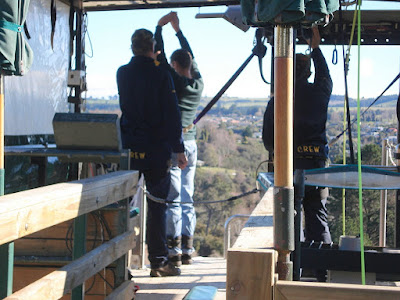
I went through a phase of reading about capital punishment a few years back, and one of the titles was The Executioner's Protocol that details the routine followed on US death rows. Every detail of inmate preparation is codified in elaborate detail. Everyone in the execution team knows what they must do at every stage of the procedure. Giving every step a sense of quasi-religious ritual takes everyone's mind off the less palatable goal to which they are all working. As I watched Charlie and his assistant haul back up the bungy, fasten my leather ankle-straps (Velcro? you've got to be kidding!), check and cross-check the various carabiners, cords and catches that made up the bungy kit, I felt I was watching the Film of the Book. Was it possible that the only way these guys could bring themselves to chuck a perfectly polite and otherwise healthy customer off their lovely cantilevered platform, was by playing mind games with themselves? I thought that was MY job?

"Do you want to touch the water?"

I looked down the 47 meters (that's not much change from 150 feet folks) to the river.

That water down there? Em, OK. I'll dip my hands, I said, thinking that they could use a little rinse given how sweaty my palms had become. My nerves still were serviceable though. I was no more anxious than I might be before a speaking engagement (perhaps where the topic is freedom of conscience and the audience is a pickup full of Kalashnikov-wielding Taliban). I was invited to walk to the edge and toe the white line that marked the boundary between platform and void. I shuffled over. Dead Man Walking!

Here's are the rules for jumping off a high platform:
1) Fool yourself with steps: Driving there; Getting out of the car; Paying your money; Walking to the preparation area; Let them strap you in; Fall. Take these steps in perfect sequence, forgetting each one as it passes, only thinking about the one in hand.
2) Abstract the height (easy for Abstracto!) in a cartoon fashion. Think canyons, coyotes and delayed applications of the law of gravity.
3) Obey. Do not think. (There'll be plenty of time for logical regret later). When the man says stand on the white line, do it. When the man says wave at the camera, give a nice rigid-with-fear arm quiver. When the man says fall forward, remember that he might seem nice and calm now, but if you piss him off he will beat you to a pulp with that clipboard. And then he'll push you off anyway. Especially if you are the weeping Japanese girl that was up just before me.

So I obeyed. I really, really didn't want to do it. The moment I had toed the white line, the coyote disappeared and all I was left with was the canyon. I didn't have the will to take the step for myself, and so I entrusted myself to Taupo Bungy's fear of litigation, secure in the knowledge that if anything went wrong it would be ALL THEIR FAULT. So there! I leaned out.

My recollection of what happened next is fogged by physical violence and adrenalin. I was mugged. Gravity mugged me. It scooped me off that ledge with the tenderness of a metal claw, and dragged me towards the water. I didn't feel like I was falling 47 meters (well - what experience would I base it on?), just that I was travelling very very fast. I think I had the presence of mind to scream on the way down, something I'm obviously very proud of. And I remember reaching out with my hands to see if I would really touch the water as promised, only to get my head and shoulders completely ducked. I wouldn't like to guess how long I was submerged - it wasn't long enough to inhale, luckily. But it was long enough for me to form the classical facial expression of the slightly irked customer. Head cocked, one eyebrow raised, what part of 'dip my hands' do you not you understand? But the thought was immediately erased by the realisation that I was still alive and I couldn't fall any further. (Wrong again - there's quite a fall left in that second bounce).

"That was the stupidest thing I've done all day" I said to the boat crew who untied me and ferried me to the shore. In truth, it wasn't. I'm glad I did it. It was a blast. But it left no lasting effect, except for an ugly insight into the last moments of suicide jumpers (a decidedly terrible way to go).

If you are going to New Zealand, and you are thinking of a bungy jump, I can recommend Taupo Bungy to you as a good starter, better in my opinion than the better-known but over-trafficked A.J. Hackett jump in Queenstown. It's slightly higher, it offers the option of a dunk in the water, the setting is much more beautiful, you won't have to wait as long, and the crew there are terrific. It's right in the town of Taupo as well, so you can go have a beer or a bite to eat afterwards. Just don't do it before.


And the evidence (Mam, Dad - you might not want to watch this)...

Thursday, June 26, 2008

Bubble Boy


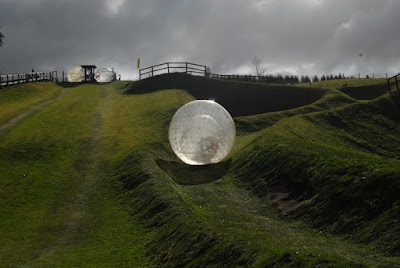
Don't know what the guy on the left is so excited about - I was the one who rolled down the hill in the big plastic bubble.


It's called Zorbing. Extreme? Not really. Extremely silly for sure. And well worth the 44 bucks.

Wednesday, June 25, 2008

Walking on Fire, but not on Air. Yet.

When Nina was celebrating one of her earlier birthdays - probably fourth - she and her friends were running round the front garden when it started to rain. Letizia called from the house - "It's raining out there!!". Nina responded by rounding up her friends "It's raining out the front garden. Quick. Everyone round to the back garden."

We laughed at the time of course, but we've been playing a larger scale trick for the last month or so on the South Island. "It's raining East of the Alps - quick - let's head West". And it has by and large worked. We've seen a bit of rain, but nothing sustained, and nothing that didn't clear up about 100km into any given trip. Our luck has finally run out.

The last 4 nights - 2 in Taupo and 2 here in Rotorua have been rainy. Though we've dodged the worst of the showers (more though luck than planning) and succeeded in getting out and about, there was no getting around the fact that this was not jumping weather. Certainly not with a parachute, and probably not even a bungy. But don't count us out quite yet. The bungy site in Taupo is gorgeous. It's so beautiful that I've been overtaken by the desire to do it myself. It's only an hour back down the road, and if the Sunday weather forecast is what it promises (and we don't chicken out) we'll celebrate our 11th wedding anniversary by chucking ourselves off a cliff. Can you think of a better way?

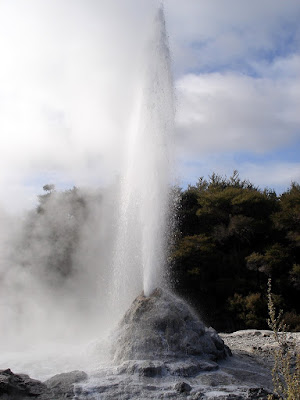
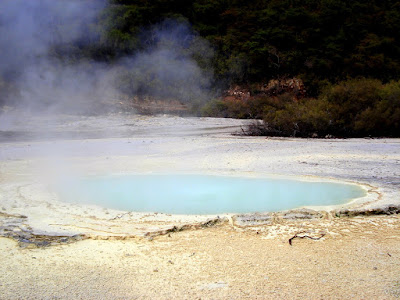
In the meantime, our South Island glacial walk is being tidily balanced with a series of North Island geothermal experience. New Zealand lies, tectonically speaking (ahem), right along the line between the Australian plate and the Pacific Plate. As the Pacific pushes under the Australian it formed the Southern Alps and so indirectly the glacier we walked along. The action that has generated so much ice in the South Island creates fire in the North. Taupo, and even more so Rotorua, are bubbling, steaming, sulphurous centers of seismic, geothermal and volcanic instability. Every town we've visited since leaving Wellington has experienced some cataclysmic event thanks to the fault lines that lie below. Napier was wiped out by a 1931 earthquake, an eruption deleted an entire Maori town just over a hundred years ago near Rotorua, and Lake Taupo itself fills in a dormant caldera that when it last exploded about 1800 years ago, left its stroke in the writing of the Chinese and Romans, by means of a global ashen mark in the sky.

The signs of this volatility are everywhere. When you drive outside of Taupo, steam pours out of the greenery and across the road near the geothermal electricity generation station (7% of NZ's electricity is generated this way). Nearby, the Craters of the Moon Geothermal Walk offered us a way to get a closer look, and smell. But far more spectacular is the Wai-o-Tapu (Sacred Waters) site, 30km outside of Rotorua. We visited this today, luckily without getting rained on, and enjoyed scenery that until now I would not have said belongs on Earth. Letizia has taken some fantastic pictures, a few of which I've nicked. Don't tell her! Mind you, what's she gonna do? Chuck me off a cliff...? Oh.


Thursday, June 12, 2008

I Got the Paua

We have a flair, it would appear, for reaching southernmost points. Today we drove to Cape Palliser for almost no other reason than it was in a corner we could easily reach - my travel strategy is the same as my tooth brushing technique. We were expecting to find a lighthouse, and a seal colony there. Or would that be a seal dominion now? Or a constitutional monarchy of seals, perhaps? In any case, we found ourselves traveling a one-way road, that finished in Cape Palliser itself and frayed quite a bit towards the end. The road seemed far too close, and at too similar a height, to the waves of Cook Strait which thrashed menacingly on one side with high mountains just a hundred meters inland of us. One big wave would have sorted us out. But we made it to the Cape, and we could see the lighthouse alright (it wouldn't be much of a lighthouse if we couldn't, now would it) but there wasn't a seal in sight.

This was supposed to be one of NZ's largest colonies. I thought we'd be deafened with the noise of barking (and the odd rendition of Crazy). But when we stepped from the car, and began to walk along the verge that separated the barren soil from the stony beach, there was nothing but the wind and the waves pushing back at us, asking us what the hell we wanted anyway.

Good question, actually. A seal, perhaps? We had driven for 2 hours to get here so a New Zealand fur seal would be nice. We've seen one or two before, but we we don't have any back home so we're not ready turn up our noses at them quite yet. We looked out upon the stones and the waves, and implored the Maori spirit of the sea to reward us for our trip but all he did was blow Letizia's beanie off (yes - that beanie) and along the beach. We gave chase and eventually caught the beanie just before it was lost to us forever. Incredibly (in the sense that it sounds made up, and probably is) the flyaway headwear led us to a treasure, a collection of paua shells just lying there on the grass, unclaimed. We had already paid 12 bucks a pop for a lot of these mother-of-pearl shells back in Christchurch, so we obviously took a few as, er, consolation for the missing seals.

As we started to make our way back to the car, Letizia managed to hear the call of nature over the noise of the wind and waves, and made her way towards the nearest bit of scrub at the edge of the shore. The girls and I prepared ourselves for a wait, but we needn't have bothered. Letizia had barely disappeared from view when suddenly, there she was again, running towards the car at a speed that was all the more impressive for the headwind she had to content with.

She had found the seals.

Saturday, June 7, 2008

Wellington for the Rugby

We're in Wellington, on the North Island, where it's Ireland vs All-Blacks (that's rugby, for readers from the US) tonight at 7:30 local time. We don't have tickets of course (and even if we had, Nina and Sara would have spat the dummy at the prospect of being forced to watch the game from the windswept terraces), but we are living around the corner from the very lively Cuba Street, and will probably take this opportunity to go to the nearest Irish bar and watch the match on the big screen. That's assuming we don't get kicked out or deported for bringing minors to the pub.

In 100 years of playing the New Zealand team, Ireland has a perfect record. We've never beaten them. When Munster beat a visiting All-Black some time back in the 1950's, the euphoria was such that somebody wrote a play about it. But all is not well in the NZ camp. Eight months ago, they lost to Wales, and judging by the tone of sports commentators you'd think it happened yesterday. To Kiwis, rugby is more, much more, than a game. It is a symbol of national pride, and the very idea of losing is something that perhaps due to a lack of practise, they are not comfortable with.

If there is an upset tonight, then I suspect that any advantage my Oirish accent has given me up till now will vanish. I suspect I'm very safe though.