Showing posts with label sydney. Show all posts

Sunday, March 16, 2008

Melbourne to Sydney via the coast

Our first stop was Bega. They make cheese there, but it doesn't smell. Neither the cheese nor the town. It was just somewhere to stay to break up the journey to Depot Beach further North. There's not much else I can tell you about the place other than it was an 8 hour drive from Melbourne. Despite the name of the route, you don't see a whole lot of coast for most of the time. Actually it's really called Princes Highway, but you don't see any of them either.


It's a great drive though, much more interesting than the more direct Hume Highway. The landscape changed from red earth to dairy pasture as we moved though towns along the way, stopping every 150km or so for coffee or a meal: Yarragon, Lake's Entrance, and Cann River, before finally pulling up outside the Grand Hotel in Bega. Now the word 'hotel' in Australia usually means 'pub, with some rooms upstairs'. And we knew that and had no inflated expectations. But in this case the word 'grand' was not intended to mean 'Large and impressive in size, scope, or extent; magnificent'. It carried the more Irish meaning, as in 'ah feck it, it'll do grand'. I don't think I even took the car out of gear (let alone the gear out of the car) - we headed back to the motel we saw as we entered the town, the Southtown Motor Inn, a family-run operation, where we were very well looked after. The hundred dollar family room included the ability to watch videos, so the girls settled in to watch George of the Jungle, a truly abysmal movie which the girls duly gave the thumbs up.(I spent most of it trying to remember where else I had seen the actor who played the vain and stupid bad guy Kyle - before remembering that he played the vain and stupid trying-to-be-good guy Jack in the truly excellent Sideways).


The morning we checked out, I was sharing a joke with the lady of the house. She told me that she was from the New South Wales outback, near the dish in Parkes. They packed in everything to start up the hotel in Bega. She was clearly getting itchy feet again, but wasn't sure that she could convince her husband and son to make another move. "Have you seen any snakes?" she asked. Before I could answer, she presented me with a jam-jar containing a baby snake - dead and floating in meths - to show Nina and Sara. The cat had killed it recently. It was a Brown Snake, which despite the innocuous name is a highly venomous killer. When Letizia heard the story she was well impressed with the cat.


From Bega, we had a very short drive of about 120km to Bateman's Bay, and than beyond to Depot Beach, where Jamie had organized two nights in a beachside cabin. The drive was entertaining. I'm used to winding roads from back home in Cork, but here there were two extra elements: the up and down of the hills, and road cambers angled like the Indianapolis racetrack. It had everything that air travel can offer: pitch, roll and yaw.


Depot Beach has a great far-away feel to it, without actually needing to go the the GAFA (see glossary). It's run by the National Park which means that during the week, and outside of school holidays, the two-bedroom chalet only cost 100 dollars (70 euro) per night. We arrived to discover that our front garden was where all the roos like to sun themselves during the day. There were 10 or so of them, in various stages of languid indifference to the surroundings. The sight of a carload of pouchless, tiny-footed omnivores (ahem, that's us) didn't change anything.


During our stay in Depot Beach we played a game of Monopoly (a 'discovery' made by Nina and Sara in the Threadbo Youth Hostel) which lasted for 2 nights and finished with Letizia and I going bankrupt. I hope this doesn't presage our financial position when this trip is over (I don't think so - we are still on budget). Even if we do go bust, based on Nina and Sara's property speculation skills, and ruthless business practices, we should at least get a reasonably comfortable senior citizens' home.


We collected shells on Depot and Pebbly Beaches, when the rock pools are stunning. On either side of these sandy beaches lie flat tables of sedimentary rock (see Letizia's post for pictures). At least I think that's what you'd call this fruit-cake rock with currents of gravel and large stones, embedded into a dark substrate. The tide has been steadily undoing the stone so that now, the table is run through with fissures and pocked with holes, some perfectly circular, that hold on to the seawater when the tide is out. Each rockpool is decked out in its own way - some seem like carefully arranged compositions - and they all contain their own miniature landscapes. While the girls mostly searched for shells, I allowed myself to become transfixed by one rockpool after another, taking my time on each one. We weren't going anywhere in any hurry and I could spend as much time as I liked, almost in a trance. It had the advantage of being cheaper and less risky than using controlled substances.


We met or spoke to nobody during out time in Depot Beach, but at mealtimes on the veranda we did have company: the kangaroos came even closer, and the parrots joined us for dinner. They landed on my shoulders and wandered down my arm in search of food. Nina and Sara eventually hand-fed them crackers. The party was broken up by the local ruffians: three kookaburras buzzed us, flying across our table, wingtips in our faces, taking up positions on the railings of the veranda, centimeters away. The parrots legged it (well, winged it really). Kookaburras are big buggers, and carnivores too. They couldn't give a damn about the crackers and were more interested in the beef lasagne. There was a very uneasy standoff for a while - just picture big hairy bikers turning up at the vicar's village fete. I finally took the situation in hand by wielding my trusty foil - actually a roll of tinfoil - in the beaks of the gatecrashing birds. It was pathetic. Despite timourous nudging, the beasts remained unfazed, perhaps even a bit emboldened. I tried a different approach. According to Billy Connelly, the one thing in the jungle that lions fear is the chair. That's why lion tamers are seldom seen in the cage without them. I applied the same pristine logic to the kookaburras with moderate success. I was able to give the girls enough cover ("back, back I tell you") to clear the dishes indoors. We closed the sliding doors to the veranda and continued our meal inside. The birds watched us in our glass cage for a while, unlaughing, before getting bored, and presumably hungry, and flying off. I, in my role as indignant vicar, began to smoothen my ruffled feathers.


Princes Highway rolls through the highways, mercifully bypassing Wollongong (current home to a sordid financial and sexual political scandal), and traffic-lighting its way though Sydney's Southern suburbs, before finishing up in Newtown and leading onto King's Road, where Duncan had previously given us a tour. We had a coffee at Duncan's local there (texting him a thumbed nose as he was working in Melbourne that day) and continued to Rozelle where we were staying with Ludi and Gary (later to be joined by the previously insulted Duncan, fresh from the airport) for our Sydney last supper. Our last evening in Sydney was passed in the best possible way - in the warm glow of friendships that have survived time and distance. And not a kookaburra to be seen.

Thursday, March 6, 2008

Sydney, looking back.

(This blog entry is dedicated to my good friend Darragh Ballesty, who met up with us in Melbourne, and took the opportunity to point out how pretentious my blog was getting. As it happens, pretentious is precisely the tone I am aiming for, but it was great to get confirmation in person from a devoted reader. Darragh, this note's for you... ;)


Travelling at the stern of a boat, you get a blinkered view of what's about you. New scenery arrives fully formed and out of nowhere, rather than slowly evolving from a distant speck. You are granted time to sit and consider what you see as it moves gently away from you. There is a certain thrill of course, of standing at the bow instead, with the wind in your face and 180 degrees of possible directions, but it leads to the irisistably tempting belief that you have some control over your destination.

We sat on the back of the ferry a couple of Mondays ago on our way to Manly, on Sydney's North Shore. Manly was famously named by Arthur Phillip himself, on seeing some particularly virile looking Aboriginal standing there. Looking to the other bank, this position is helping me confirm my feel for Sydney's Southside geography. The city is a gently rolling low-rise disc with the Central Business District acting as the centre and skyscraping axis that holds it all together. This is the great unsettling confusion I feel in Sydney. I don't know whether I'm in a city or a small town, or a beach resort, or a great port. The skyscrapers live easily alongside the spectacular harbour, and the gardens and parks. The small villages of Newtown and Rozelle still have an urban atmosphere - that unmistakeable mix of self-confidence, and relaxed openness. Bronte and Coogee beaches are teeming with surfers, swimmers and posers, generating an ambiance of their own. Enormous cruiseliners pull into the very heart of the city, towering above the quayside buildings, but dwarfed by the harbour itself. All of these Sydneys are linked by buses and trains that bind this spinning disk together, and allow it to remain as one.


Once you head too far south, west or north, I imagine the city life loses much of its appeal. The energy and expense required to sample the delights I've mentioned above become prohibitive, and you make do with your own local amenities. The cost of property with even a glimpse of water is enormous and so those who live in the real Sydney still have to make great sacrifices for that pleasure. But I can't think of a city in the world to match it. "Ah - but it's so far away from everywhere else!" people say. No. Everywhere else is so far away from it.

In Manly, we strolled down the pedestrian street that links the harbour beach to the ocean beach, and settled down for lunch next to a Scotish couple who had made Sydney their home a long time ago. Like almost all Sydneysiders we met, they were very happy with the place, other than the high rent. They used to live in Manly itself, but moved up North to get a bigger living space. How did they deal with the presence of creepy-crawlies, I wondered, given that they were not born into it. "It's the lizards I can't stand" said the lady, much to my surprise. I told her how even in Europe we had lizards (thinking of the gekkos in Sardinia) and then went on to boast about how they didn't bother me at all. Surely I was prime Aussie material. "Well these lizards ate my pet rabbit" she mentioned (get back in your box, Paddy).

At the end of our day in Manly, we took the ferry South and West towards Circular Quay, still at the back of the boat (actually, the boat had bows on either end, a water-going pushme-pullyou). Looking back, North Head and Watson's Point at the mouth of the harbour seemed to converge from opposite shores, and eventually join. Nostalgia, that unrequitable love for a time and place gone by, is the other great Irish disease. I couldn't help but interpret the effect as a last embrace from the city we were about to leave.


How's that for being up myself, Darragh ;-)

Friday, February 22, 2008

Annnnnd cut!

After 5 weeks of a stability of sorts, this morning we move on from Sydney. We're heading for Melbourne, but stopping off in Canberra, the Snowy Mountains, and Rutherglen along the way.

Sydney is a terrific city that we leave with regret - especially for our friends here. I'll write a post later on to try to cover our experience of the place - not an easy thing to do given the many different Sydneys there are.

Nina and Sara are excited about the fact that we have our own car (AUS$500 for 2 weeks from Apollo Car Rentals) - me too a little, though I really enjoyed using a reliable bus service while we were here. Nina, when she saw her mother packing our bags again, asked what was going on, forgetting that we were on a bigger trip. She and her sister really do take things one day at a time (when Gary asked her last night what she was looking forward to, she relied 'having a swim in the pool' - the one here at our Randwick apartment).

Yesterday evening we drove through the city, listening to the CDs that Ludi lent us for the road. There was something odd about watching Sydney pass by, all dressed up for Friday night, with our music as a backing track. Odd, but familiar. The it clicked: it felt like the closing credits of a film.

Saturday, February 16, 2008

Guess who came to dinner...

Especially for the folks in DSI. Two prodigals join up in Sydney:


"Mr. Goulding I presume?"

(We only realised when it was too late that it was Valentine's Day.)

Tuesday, February 12, 2008

Cinderella and the Didgeridoo

In keeping with lessons learned in China, we ddi a lot of shopping around before making a decision on where to buy a didgeridoo for Letizia's birthday. In the process, we learned a number of interesting things:


Didgeridoos are tree trunks hollowed out by the action of termites, but then sealed by the artisan to make them less susceptible to rotting when the players' saliva runs through them (a feature of wind instruments I learned the hard way by sitting in front of the brass section in a band a long time ago).


They possibly originate in the North of Australia - Arnhemland - but nowadays each region has its own distinctive style of decoration.


Although they produce single clear notes, the art of playing the didgeridoo lies in the timbre that you can extract, the rhythms you produce, and the variety of special noises, animal imitations for example, that you can create.


The deeper the note, the softer the wood, or the straighter the instrument, then the harder it is to play - in other words the more air you have to physically push through. A higer-pitched, harder didgeridoo, with a bit of a bell at the end is a good one to get started on.


There's no bloody point in trying to haggle down prices here. I'm gutted. After 3 weeks of China, I have to hold myself back from arguing over the price of a pint of milk in the supermarket, so I find the deadpan "No mate - that's the price" reaction in an outdoor market very hard to accept. Oh well - there's always South America.


The didgeridoo was for Letizia, and her requirements were purely aesthetic. I wanted the salesmen to demonstrate the musicality of their goods, something they all did happily (note the different kinds of requirements: one Italian, one Irish).


Getting a sound from a didgeridoo is as easy as getting a promise of lifelong friendship from a drunk. It's a simple matter of blowing in such a way as to let your lips flap (I know I know). But actually playing properly requires a technique used by bagpipe players, and other sadists, called circular breathing. This involves filling your cheeks with a reserve of air, to keep the instrument going for the split second it takes you to refill your lungs through your nose. This can be practiced without any instrument, and in public, and results in long unending farting noises - the kind which your daughters find hilarious when they make them in bed an hour after they are supposed to be asleep, but which they find embarassing coming from their Dad while walking along Elisabeth street. Odd. The fact is that I can't even do it properly. Getting air into or out of my lungs quickly through my nose is not easy. My nose curves with aerodynamic sleekness to the right, and as a result, partially closes off one airway. The same trait makes swimming difficult - not just for the breathing, but also because it tends to pull me slightly to starboard.


I digress.


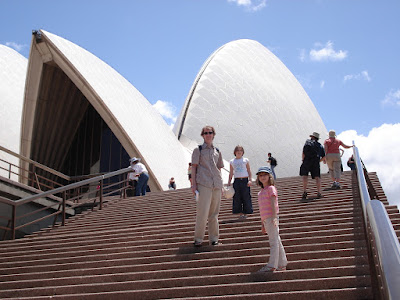
From the point of view of pitch, the didgeridoo is less musical than a kazoo. Aboriginal music is all about timbre and rhythm. Interestingly, given the huge variety of chords, notes, scales cadences and keys available to the Western musician, pop rock and especially dance music is also, relatively speaking, mostly about timbre and rhythm. Last week, we went to Sydney Opera House to see Rossini's Cenerentola (Cinderella). I haven't been to very many operas, and this was the girls' first. It was a fantastic experience, especially given the venue. The production was very funny, with a lot of physical and choreographical comedy. And the music - well that was at a level of musical conplexity that made most rock sound primitive, never mind aboriginal music. But the structure of the opera was formulaic and the timbre was precisely what any orchestra and chorus could be expected to produce (my ignorant ear heard nothing particularly different or special in the soloists' voices). I was entertained, impressed, but only very occasionally moved.


It's polically incorrect to use the work 'primitive' when talking about other cultures, but there's little choice in the matter when comparing the musical scope of the Chinese or Europeans, with that of the Australian aboriginals. This is where the comparison between language and music (see earlier blog entry) falls apart. There's no such thing as a primitive language, but there is such thing as a primitive culture and its music. You cannot compare the beating of sticks to the nuances of a jazz drumkit, nor the hypnotic pulse of the didgeridoo with the voice of the erhu. At least not in sophistication. But in terms of emotional impact, there's no distance between them. All you have to do is know the code.


The code? What code? I bought a book the other day: The Flamingo's Smile by Stephen Jay Gould (my first book by this author despite reading about him for years). My decision to buy was based almost entirely on the following line that I found while browsing the book: "The jolt is direct and emotional - as powerful a feeling as anything I know. Yet the impetus is purely intellectual - a visceral disproof of the romantic nonsense that abstract knowledge cannot engender deep emotion". He wasn't talking about music, but he might just as well have been - the principle holds. We react emotionally to music, at least in part, based on our intellectual expectations of it (after being brought up listening to standard patterns belonging to our culture). I found Cenerentola unmoving because it presented nothing new to my ear - either because I didn't understand what I was hearing or because the work wasn't particularly musically surprising. Similarly, I couldn't tell the difference between one didgeridoo 'song' and another, when played in the New South Wales Gallery last week by Adam Hill, because they were using rhythmic codes that regular listeners and players are familiar with, but which mean nothing to me. Years of playing bad guitar means that I know the rock code, and I can tell when some band goes off the beaten track (npi) in an interesting or imaginative way. The ability to react emotionallyto music can probably be learned.


Much the same as circular farting.

(My 100th post, by the way)

Friday, February 8, 2008

Wardrobe Malfunction

In the spirit of adventure inspired by the Australian way of life and my distance from home, I decided to try something new. I decided to embrace the thong.


A lot of people wear them and think nothing of it. They enjoy the freedom, the extra ventilation, the chance to extend their tan even further. But it was with some amount of trepidation that I first slipped into a pair in Clothes Encounter, Belmore Road, Randwick. The staff there were very understanding of my concerns, very supportive. They explained that the brand I had chosen - top quality apparently - was Brazilian. I was convinced. I decided to wear them out of the store.


I have to say that the novelty began to wear off before I was even halfway up Belmore Road. Put simply, I just wasn't used to have anything rubbing along, well, there, and it was beginning to have an effect on the way I was walking. I asked the girls to slow down at first, but then, to run ahead to hold the bus - I just wasn't up for it. Later, as we neared our apartment, I even considered taking them off there and then. But decorum prevailed and I made it back inside before frantically wriggling out of them and sighing with relief. But, as the Germans say 'Einmal ist keinmal', once doesn't count. before I could give up on 'Brendan the thong-wearer' I had to give it one more go. I decided to wear them the next day for a walk with Gary and Ludi between Bronte and Bondi.


Letizia had the excellent idea of putting preventitive bandaids on strategic friction points, and I have to say that the ploy seemed to be working, as Gary and I set a blistering pace, manfully striding ahead of the girls. But as the plasters came undone in the early afternoon heat and humidity, I found myself in trouble again. Of course, I could hardly complain to our hosts about my predicament. Real Australians open beer bottles with their eye sockets for God's sake. I could hardly stop every two minutes in order to adjust myself to relieve the thong-enduced weals that I could feel rising. The experiment was clearly over - I was not ever, ever going to be so foolish again. But we had another good hour to go before I finally conceded defeat and applied the necessary balms in the privacy of our apartment.


The wounds have almost healed now, and in any case I would never post anything so graphic as an image of the abrasions and blisterings that I suffered. I will, however, add a picture of the offending pair:


Scroll down...


Well what did you think I meant?!

Tuesday, February 5, 2008

Like two ships passing in the, er, early afternoon

"Is this the right way to put in the ticket?"


The question came from a tall thin gentleman in his late fifties, on the 373 bus. He was holding up his ticket and looking directly at me. The tickets here have big red arrows on them, indicating which way they should be inserted into the stamping machine. And I had a big red face on me, that should have indicated that I'm not from around these here parts, and so shouldn't be relied on for local information (or much else, for that matter).


I was confused by the question. I knew the answer alright, but I was still having trouble dealing with the fact that he had decided that I was the authority on that subject. In fact given the bloody great red arrow, I was having trouble dealing with the fact that the question was posed at all.


When I nodded in the affirmative (though in a wrinkle-browed, open-mouthed kind of way - I must have looked like a Barrystown pony boy) my new ticket-wielding friend looked very pleased with himself and went off to stamp it. When he came back, he saaid "Not bad eh? It's been 6 weeks since I rode a Sydney bus. The ol' memory hasn't let me down eh?"


Now when it comes to poor memory, I'm in no position to be casting first stones. But I have yet to find myself getting excited about remembering how buses work, or which way arrows point. There's time of course - as I mentioned, the gentleman had a good 20-year lead on me. But in the meantime, I reserve the right to be confused and slightly disturbed by this kind of misplaced triumhalism.


I just couldn't get my head around this conversation and it must have shown. I think at this point, the veil of stupidity that I sometime wear must have fallen suddenly and heavily over my features, and prompted the gentleman to explain further.


"I'm from the Bush", he said and sat back smiling, as if everything should now be clear.


It wasn't of course. I was now moving from general confusion on the content of this conversation, and how I might appropriately respond, to the more specific question about why anyone would describe themselves - much less excuse themselves - in these terms. "The Bush", as I understand it, means pretty much anywhere that isn't city, and correlates pretty closely with "down the country" - a phrase that Dubliners use when referring to any place in Ireland, at whatever compass bearing, that isn't Dublin. I can't imagine apologising for example, for not having exact change on a Dublin Bus by pleading "Sorry boy - mucksavage. Only up for the day."


As I sat there, teetering on the brink of this new confusion and unable to reply, he struck again.


"Canberra" he said.


I didn't know if he was elaborating on the previous answer, offering me an alternative one, or starting a whole new conversation. But I knew one thing for sure. If I didn't say something quick, he'd just keep going, and I'd have to do something that I'd never done before - ignore a perfect stranger attempting to strike up a conversation on a bus. If my mother ever found out, I wouldn't be able to come back home. I had to act.


"Canberra!" I shouted, with completely inappropriate enthusiasm. "We're thinking of going there!"


This, as it happens, is true. But I was in verbal defense mode, desperately aiming for a draw, and keeping one eye on the clock. I was capable of saying anything. Canberra - my uncle played silly mid quarterback half stop for the local cricket team between the wars. Or Canberra! Great town. I was born there - no no not in this life of course. But I resisted the rising panic.


"You must drop in!" he parried, without adding any further useful detail like an address, or for that matter, a motive.


I fumbled terrbily now. My bus stop was approaching. I gathered together my grocery bags, mumbled "Er, right" and headed for the exit. I may, or may not, have waved and shouted back "See you there" just before getting off the bus.


Sorry Mam - I tried.

Monday, February 4, 2008

Randwick Residents, Part 2

The weather has turned bad - really bad - and will remain so for the rest of the week. This is Jesus and the saints' way of keeping pale Irishmen out of the midday sun. It will have the unhappy effect, for readers of this blog, of increasing my output while at the same time reducing my sources of inspiration. Welcome to silly season.


Sydney is a city of villages, each with its own style, reputation and demographic. Randwick, where we are based, is half way between Coogee Beach and the Central Business District. We're on Alison Road, pinned between the racecourse in front of us, and Centennial Parklands behind. Three bus stops away is Belmore Road, and further away again is The Spot - two shopping areas of Randwick.


The pace here is laid back, and the buildings vary from the gently crumbling but well-do-do houses, to the more recent characterless apartment blocks - but nothing too big.


The shopping streets are higgeldy-piggeldy lowrise, with the occasional supermarket but mostly specialist shops and a disproportionate number of cafes, eateries and realtors/estate agents. The eateries are all small and cover everything from The Lebanon, Thailand, China, Vietnam, Italy, England, India and more. The prices are low enough that eating out does not require you to consult the monthly budget, and I think that 's why the local economy can support so many small restaurant businesses.


Neither the cars that file past in orderly fashion, nor the locals who traffic the footpaths show any obvious signs of wealth. This makes an enormous - and welcome - change from Ireland. This is a prosperous area, a much sought after address, it just doesn't care to shout about it. How can I describe the locals? There is such variety that it's hard to talk about a typical look. But let's give it a go, hey?


There is, it would appear, a Dame Edna Everage lookalike contest running in perpetuity on Randwick's thoroughfares, and it's organised alongside permanent auditions for the next Ang Lee movie. (If I don't get my damn hair cut soon, I could end up winning the former).


Oh - there's another architype that Letizia has just reminded me about. Let's call him Thor. He has the body of a Nordic myth, and the conversational repertoire of a street-bred tweenie (50% of which is either printed on his t-shirt or tattooed on his shoulder - presumably as an aide-memoire for awkward silences, or perhaps as a substitute for conversation entirely. Mind you I have to remind you, as I have again been reminded by Letizia, that conversation is not what you got to Thor for).


I'm knackered after that long parenthetic effort. (I tend to hold my breath when I open a bracket, and keep holding it until I close again, just to stop me from overdoing what Katharine has correctly diagnosed as flashbacks from Lisp programming in college, taught, as it happens by an Australian with both the appearance and menace of Nosferatu, oh dear god I'm going to faint...

Sunday, February 3, 2008

Adrift in Australia

My sense of place is floating.


When the blinds are closed in the Randwick apartment I hear a noise that my instinct insists is the wind slamming the side gate to the garden of my home in Cork, until my reason intervenes and dismisses the notion with a sneer. Later on, the sound of an aircon fan on the balcony becomes the ticking over of the ferry engines on Circular Quay (or is it the Victoria Star - are we back on the Yangtze?)


Sydney floats.


Pontoons, boats, ferries: We move between them so often that even when on solid ground I sometimes have the impression that I'm afloat and I almost need to stamp my foot to prove to myself that it isn't so.


Time floats.


Last night, we watched Bee Movie in the open air, in a section of the centennial parklands off the Woollahra end of Oxford street. Duncan got there before us and picked a great 'posie' (position). Duncan hasn't changed since Letizia and I first got to know him in Paris, back in the day when we were still getting to know each other. Last night's picnic in the park could have been a trip to the Champs de Mars 13 years ago.


As the light began to fade, I realised that the stretch of water I could see in the distance was Botany Bay. Botany Bay! If you're Irish, you do not associate Botany Bay with beanbags, beers, or cartoon bees voiced by Jerry Seinfeld. Australia seems to live right up alongside its own history, and its todays and yesterdays don't always make sense when seen together.


Or maybe after a month on the road, and despite the normality of our Sydney routine, I've finally come unstuck. In exactly the way I had hoped. The certainty that our current routine will be uprooted in weeks, that the scenery and the people will be swapped, that we will have to say some goodbyes, that we will make some re-aquaintences - the certainty that things will keep changing, is exactly what I wanted. I hope it's what I need.

Wednesday, January 30, 2008

Dad - You'd Love it Here

My dad likes to swim - but only in the sea, he's not a big fan of swimming pools. And he especially likes swimming off rocks rather than beaches. The problem is that these days some of his favourite places are less accessible to him (one bionic hip down, perhaps one to go?)


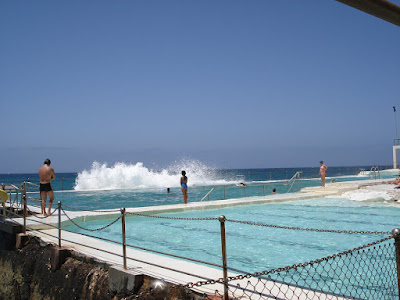
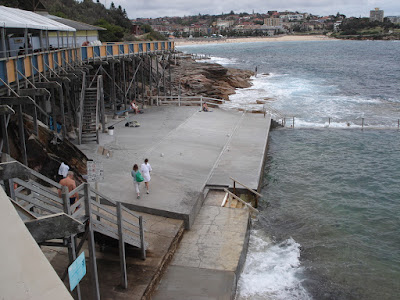
Well Dad, you have to check out Bondi and the other little beaches that are dotted southward from the mouth of Sydney Harbour, and open onto the Pacific (OK - it's the Tasman Sea, but to an Irishman, that's the Pacific). On almost every beach, Bronte, Coogee, possibly Maroubra, Bondi itself, there is a saltwater pool, filled by the tide with seawater. During high tide, waves break over the thick walls of the pool, creating sea-swells for the swimmers. At lower tides, the surface of these pools are smooth and calm, independent of the waves around.


Access is a piece of cake (or more accurately a slice of toasted banana bread - seems to be the local favourite), so it offers the best of both worlds: saltwater waves, with steps.


Other the the 10,000 airmiles it took us to get here, it's the ideal spot for you Dad. The girls and I are swimming a few lengths on your behalf.


Bondi


Wylies Baths, Coogee

Saturday, January 26, 2008

Australia Day


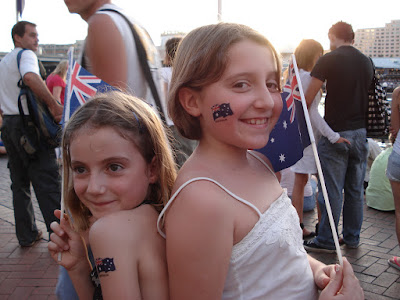
Yesterday we spent the entire day in the city centre, to celebrate Australia day with Sydneysiders. On the trip back to the apartment, we overheard - well everybody in the bus couldn't help but overhear - three self-appointed cultural attache's from Ireland having a beer-fuelled debate with some of their equally inebriated Sydneysider counterparts on the nature of a Republic. The Irish lads were probably in their early 20s, but that didn't stop them from banging on about the Union Jack on the Australian flag and '800 years of oppression' etc etc. These lads weren't brought up listening to nightly news reports of atrocities in the name of Republicanism, or Unionism, so I suppose they had the advantage of considering the whole matter from the comfort of an unsullied, theoretical perspective. Whatever their motives (which I'm assuming were at least in part getting into the pants of their female opponents) I found their attitude irritating, and surprisingly arrogant. Is his tthe New Irish abroad?


The Republican debate in Australia is complex, and I don't pretend to understand it. It defies party lines, and motives for either supporting or opposing a break with the UK throne can often sound similar to each other. Even defining what it means to be Australian is famously difficult. The recently removed Prime Minister Howard spoke of 'matesmanship'. The voice-over to the Darling Harbour festivities talked about a place where discrimination had no place. There is definitely a sense of nationalism here, but it is understated. Lots of folks were wearing or waving the flag around the city yesterday, but when the hosts for the evening tried to create a chant of 'Australia' around the harbour they failed repeatedly and embarrassingly. Embarrassing for them: it takes more than a TV and a microphone to distract the locals from their conversations with their mates. The crowd seemed immune to jingoistic manipulation. I loved it. The moment that inspired the most applause, and it was spontaneous, was when a boat carrying 4 new Australians (there were citizenship ceremonies all over the country on the day) did a lap of the harbour.


At the edge of Darling Harbour lies the Maritime Museum. There is a wall on the outside where the names of Australia's official immigrants are being added. When all names go up there, there will be 6 million of them. A third of the population. Inside the museum there is an exhibition about those immigrants, in the form of the personal stories of a number of families. Mostly, they were people fleeing poverty or political upheaval and oppression in their own countries, or indeed people who didn't have a country anymore. This museum is the mirror image of the museum in Cobh, in County Cork - about 20 minutes drive from our house. The Cobh museum records the heartbreaking departure of hundreds of thousands of impoverished Irish, both before and after the foundation of the Free State and later the Republic. The Darling Harbour museum records their arrival to the other side of a months-long voyage.


The three mugs on the bus would have done well to remember that it was places like Australia that provided a home for thousands of Irish with no hope and no future in their own native Republic, instead of trying to rub the locals' noses in it, about symbols and figureheads that have less and less meaning either here or back in Ireland.

Thursday, January 24, 2008

Sara the Jellyfish Magnet

I swore I wouldn't do this, but 'events, dear boy, events'. There are two things about Australia that you need to know, and luckily for you, somebody else has already gone to the trouble of hammering these things home for you. If you read Bill Bryson's hilarious and sometimes accurate Down Under, you will remember for the rest of your life that Australia is
  1. Huge!
  2. Full of things that not only want to kill you, but have every possible evolutionary advantage imaginable to see this ambition through.


I promised myself solemnly (I wasn't smirking or anything) that I would simply refer once to Mr Bryson and never mention anything about vast deserts or inconceivable concentrations of venom.


Then we went to Coogee.


Sara has been stung by jellyfish in the past - Sardinian ones. She didn't exactly enjoy it, but Mediterranean jellyfish don't have the same work ethic as their South Pacific counterparts. Like the gentle waters of the Med itself, the jellyfish that Sara previously attracted were just making a bit of a show of being nasty - their heart just wasn't in it.


Coogee Bluebottles (for that is the local vernacular) on the other hand, are nasty little bastards who take this whole stinging business very seriously indeed. We arrived at Coogee beach at about 11:45, and by 11:50 or so I was carrying the inconsolable Sara for first aid at the lifeguard station just behind us. You have to understand my state of mind at this point: I was calm, but I was working under the assumption that my youngest daughter was in danger of meeting a horrible end if she wasn't whisked away pronto in something with sirens. We were in Australia, Sara had just been stung by something with an innocuous Aussie slang term, therefore I assumed death was imminent. Thank you Bill Bryson.


Matters weren't helped by the fact that the lifeguard didn't share my sense of urgency on the matter. This brings me to two things that one can say about the Australians: Lifeguards are, as a group, greatly respected. Seems fair, considering the number of lives they save each year - very often those of tourists who didn't heed Bryson's many warnings. I was all primed to show deference, and to be awed by their derring do. The other thing about Australians is their tendency towards understatement. Take our friend Gary here in Sydney. Last night over dinner (thanks again Ludi and Gary - it was excellent catching up) Gary explained the difference between saltwater and freshwater crocs. While the salties are viscious monsters and therefore should be afforded some respect, freshies are harmless and you'd have to practically stand on one to force it to give you a 'bit of a nip'. It was news to me that crocs did 'nips'. Pekinese dogs do 'nips'. A terrapin, if handled inexpertly, will give you a 'bit of a nip'. Crocs do not nip. At least not in Hiberno-English, or indeed just about any dialect of the English language. Except Australian.


So when I presented poor Sara to the lifeguard, I expected him to manfully take over and burst into action. Instead he offered me directions to the showers, and told me to come back for some ice packs. He did, in fairness, also pluck off one of the remaining tentacles from Sara's right leg, protecting his fingers with his sleeve - something I should have done myself. But as far as first aid was concerned, we were getting nothing but water. A shower and some ice.


Compare this to what happened on the beach in Santa Margherita di Pula in Sardinia when Sara last got stung by a jellyfish. The 50 or so people on either side of us went straight into action, organizing themselves wordlessly into teams:

  • One team dived into their beachbags and retrieved every form of medicine that can be legally purchased over the counter in Italy (which is a lot, by the way) - and given the number of doctors on the beach, we also had a choice of prescription-only products. Ammoniac, antihistamines, cortisone creams, pain-killers - you name it, somebody was running towards us holding fistfuls of it.
  • Another team moved swiftly towards the part of the sea where the offending creature was presumed to be, armed with buckets, nets and, most probably, more drugs.
  • A third team, lets call them the 4th estate, set up an impromptu incident centre through which all information related to the 'attack' was relayed, compared to similar incidences, and analysed based on severity, age of the victim, profession of the parents, and of course the likely efficacy of the drugs being used.


I'm not saying that the Italian approach is necessarily the correct one, but I must confess I would have preferred it to the stoic 'No worries mate, a bit of ice and she'll be apples' attitude that I was getting. I'm all for being stoic, taking it on the chin, grinning and bearing etc. I'm not so keen on it being expected of my 6-year-old baby girl.


This all happened more than 24 hours ago now, and in the meantime, Sara is just, well, 'apples' (she did get the ammoniac and anti-histamine treatment from her mother's mobile pharmacy, mind). We visited the superb Sydney Aquarium today where we read, apropos bluebottles, that the best course of action is rinsing with fresh water and applying ice-packs. I didn't have a felt-tip pen to hand, so I couldn't add some extra helpful hints or pharmaceutical product names.


It might have been worse. Gary told us that when he was just a few years older than Sara, and visiting Sydney from his native Melbourne, he got stung right across the chest. His uncle proved even more rugged (and unhelpful) than our Coogee lifeguard: "Just rub sand into it and you'll be right". You just know how that particular 'cure' came about: Gotta do something - now what have we got to hand? I mean when you stung yourself with nettles as a child, and instantly grabbed a fist of 'Doc' leaves and rubbed them into the sting, did you ever stop to think that 1) they never NEVER made the slightest difference and 2) they were always growing next to the nettles. No? Me neither.


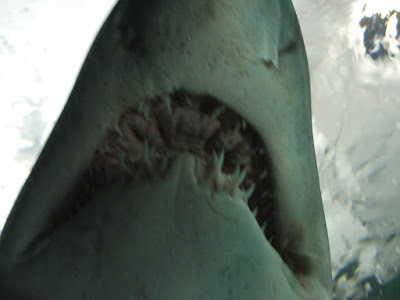
Anyhow, all's well and tomorrow we'll return to Coogee, though we'll stick to Wylies' saltwater pool there. Below is a photo from today's trip to the aquarium. Look our for these buggers - apparently they can give you a 'bit of a nip'.


Tuesday, January 22, 2008

Sydney: First Fleeting Views

Almost exactly 220 years ago, the First Fleet commanded by Arthur Philip sailed into Port Jackson, and according to their own records of the event, decided that it was the most magnificent harbour they had ever set eyes on. They had spend a number of disappointed days anchored a little further south in Botany Bay, wonder where were the lush meadowlands, and safe landings Captain Cook had described. Although it looked a great deal more promising than Botany Bay, this new location proved to be a purgatory of disease, famine and mutiny for a number of years, until a dependable agricultural base took hold and the future of the city that was to be known as Sydney was assured.


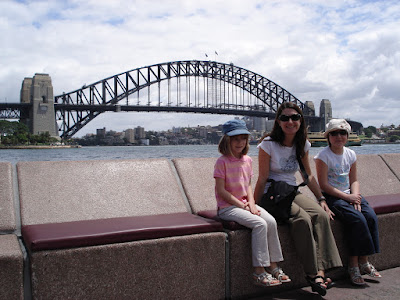
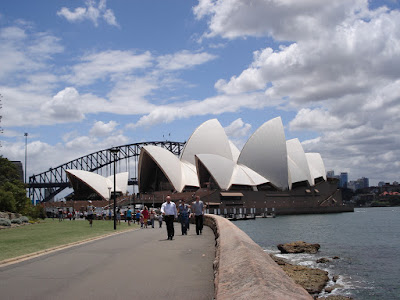
Maybe it was because I has read up a little on the subject of the founding of Sydney (or maybe because I'm a pretentious git who can't just shut up and take in the sights) but the emotional impact of seeing Sydney Harbour Bridge and then immediately afterwards the Opera House, was on a different scale to anything so far on the trip. Much more intense, for example, than Tiananmen gate and the Forbidden City, though these have a longer and more powerful history. Perhaps it's precisely because the story feels so recent and so far away from the seats of power of the time, that it also feels so human and personal.


I tried to imagine (unsuccessfully) how the place would have looked back then to the sailors, and how the ships might have been observed from the perspective that I now occupied, Bennelong Point (named after the first of the Eora to befriend the arriving English - though they did have to kidnap the poor sod first in order to make the necessary introductions and initiate the relationship).


And then I found myself conjuring up the image of that same First Fleet sailing into present-day Sydney. Arthur Philip left the place in 1792 and never returned. He felt, with some justification, that he had done everything possible and necessary to sow the seeds of a successful outpost of the British empire. But what he left behind was still very fragile, and had a long struggle ahead of it. What would he have thought if he too had caught sight of Sydney Harbour Bridge for the first time today, springing out as it does from the location of his first settlement? He'd have seen ferries and jetboats churning up the water, skyscrapers stacked up in the background, and of course, if the view were not alien enough to his 17th century experience, the Opera House reflecting the sun from many points at once.


It'd be nice to think that after a nice warm cocoa, and a bit of a lie down (during which someone would have been kind enough to mention to the poor chap that not only was the British monarch still head of state of New South Wales, but had extended its power to cover the entire continent of Australia) he would have taken a deep satisfaction in the role he played in making the 'Botany Bay Experiment' into such a spectacular city.


Australia Day is on Saturday. The whole country - with the probable and understandable exception of Bennelong's people and the other Australian aboriginal groups - celebrates the landing of the First Fleet 220 years ago in Sydney Cove (named after Lord Sydney who was the Home Secretary at the time - though apparently nobody is quite sure why the man himself chose the name for the peerage which died with him). Officially sanctioned activities include BBQing and talking ill of British cricket. I'm up for a bit of that!


Monday, October 29, 2007

Sydney: We're going to be Randwick residents

We've made our first big decision on where to stay, and our first big payment after the tickets themselves. We've put a deposit down on a one-bed apartment in Randwick, a southern suburb about 20 minutes bus ride from the city centre.


We're on the edge of the Centennial Parklands where I really want to learn how to rollerblade with the kids. They already can, of course, and Letizia will probably take to it very easily.


We're also 10 minute bus ride from Coogee Beach which, as I'm told by many Aussie friends, is much nicer and family-oriented than nearby Bondi.


It's great to have this detail sorted out now. We can start to plan what we're actually going to do, and what kind of lifestyle and living pattern we can expect in Sydney. We've also decided to extend the stay to almost 5 weeks, and we've agreed our first (of hopefully many) rendez-vous with friends along the way (Giangi and Carla will join us for the last week in Sydney, and our road trip to and from Melbourne).


We've also made another decision with regard to Australia. We've gone over budget a little on the tickets to allow us an extra flight: to Cairns. After we return to Sydney from Melbourne, we'll bid arrivaderci to our Sardinian friends and get on a flight to Cairns. From that point we'll allow ourselves a week or so to get down to Brisbane where we'll torment Simon and Leah for 4 weeks.


It's finally starting to feel real.

Sunday, March 4, 2007

This Time Next Year: Sydney Gay Pride

I've been indulging in "this time next year" thoughts - much to the discomfort of my superstitious wife. By now, China will be behind us and we'll be half way through our 4 weeks in Sydney. Hopefully we'll get to see the Gay Pride march which looks fantastically outlandish and has been going since 1978.

You definitely don't see much of this round these here parts, and it should be an interesting eye opener for the kids.