Showing posts with label cusco. Show all posts

Thursday, August 28, 2008

Navel Gazing

If you ask Nina what were her favourite places we visited, she would answer Sydney and Cusco. Nina and I are very alike.

It's been two weeks since we left Cusco, and I haven't yet blogged on the town itself, even if I have mentioned it obliquely a number of times. Time and distance, if I give them the chance, are waiting to rob me of my memories of this wonderful town, and so before that happens I'd like to take you on a walk.

When you turn left at the door to the Hospedaje San Blas, you walk downhill on the narrow and impossibly slippery footpaths of Cuesta San Blas. The cobbled road is wide enough for one car, and it's rarely free of traffic. At the end of the road, you cross to the pedestrianised route that leads past the famous 12-cornered stone, expertly set in place by the Incas and now supporting the Archbishop's Palace.
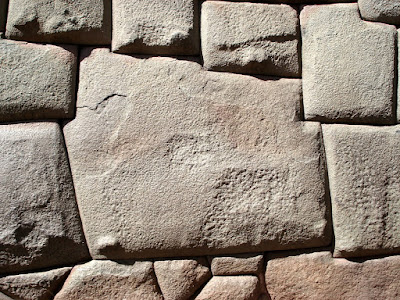


That's the story of Cusco: It was the capital city of the Inca Empire (its name means navel in Quechua - it was the bellybutton of their world) and most of it was torn down by the Spanish and used as a platform to built the city that you see today. At this corner you might see a very tall gringo, smiling and holding up a copy of a small magazine.

In his US accent he might call out something like:"Cusco Times*. Summer edition. Get it while it's hot!"

You may want to intervene at this point. I certainly did.

Short Frowning Gringo (Me): "That's a bit Northern Hemisphere of you isn't it? Summer Edition? It's the middle of Winter here!"

Tall Smiling Gringo: "Yeah - but it's so warm and sunny here that it just feels like Summer".

This seemed like a weak pretext on which to attempt to impose - once more - Northern Hemisphere order on a Southern Hemisphere people. But the Tall Smiling Gringo really did have a nice smile and my frown was starting to falter.

SFG: "Hmm. How long have you been here?".

TSG: "I got here 8 months ago, but now Cusco is my home. We're putting this magazine together in English and Spanish, and the proceeds are going toward helping out some of the poorer locals."

I had promises to keep and I had no change to buy the magazine so I promised the Tall Smiling Gringo that I'd buy the next time I passed by.

Walk past the TSG and the Archbishop's Palace and you will arrive at the prettiest plaza I have seen in South America. It's big but not vast. It's beautiful but not imposing. It's green, but not overgrown. Lively, but not overrun. Each side has its own character, but they all seem to get on with each other.

If you are lucky, to your left you will find somebody selling tamales. You can buy both sweet and savoury versions of this delicious street food - just make sure you try at least one.
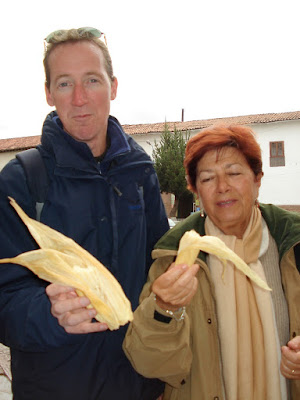


Oh go on then - have three:
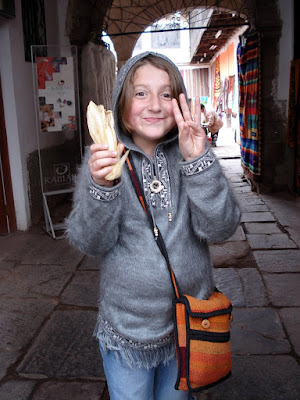


To your right stand three churches all attached to each other, the central and biggest of which is the cathedral. Inside, you will find more gold and silver than any European church you have ever seen. The tour guide will point out what you otherwise probably won't be able to see for yourself - that the artwork in these churches, created by indigenous artists commissioned by the clergy, contains hints of the religion that preceded christianity in these parts: the worship of the Sun, of the moon, but above all, of Pachamamma. In Cusco, most of what's on the surface is Spanish, but underneath, it's still Inca.

Around the main plaza (yes, called Plaza de Armas) there are many other plazas and streets worth visiting, especially to the north where a little road leads up to the Plaza Nazarene where the famously luxurious Hotel Monesterio is located. We could afford to have an aperitivo of Pisco Sours here, but not to stay. (One night in their junior suite costs the same as the 12 nights we spent in our modest hostel). On the way up, you'll pass a little street called Purgatorio - it would appear that Purgatory is a pedestrianized street (which makes sense given the relative hell of Peruvian traffic).

Heading east of here, we do a loop on our way back to Cuesta San Blas (that was a short walk, wasn't it? but with the lack of oxygen and the upward slope on the return journey, you're still puffed out I bet).

One one such return trip that I took, it was actually raining lightly. As I approached the Cuesta, there again was my tall smiling friend, still selling his magazines.

Me: "Summer edition my ass" I offered.

TSG: "Yeah! I know. Now I'm telling folks 'Get it while it's wet!'"

Nothing got this guy down. And I think that some of this must have rubbed off on me. I've been back for over a week now, and the routine of moving from place to place has washed right off us like it was never there. And I still feel great. I know the trip is over, but it'll never be gone.

(*I can't actually remember what the name of the magazine is, as I forgot the copy that I bought.)

Friday, August 15, 2008

Cusco and the Bambini di Peru

Remember the Black Babies? If you are of a certain age (and perhaps Irish) then you will remember being told as a child that the Black Babies were starving in Biafra and you should be ashamed of yourself not eating the delicious meal that your mother slaved over for hours (taste that guilt). You might have come back with the priceless retort that the Black Babies were welcome to your cabbage and tapioca pudding, if somebody would be so kind as to provide a serviceable postal address and a grease-proof envelope.

My point is (yes, I have one) that other people's suffering and deprivation is largely a matter for our brains, while our own tribulations are projected in technicolour detail against our hearts. Especially if those other people live a long way away. Like Tipperary for example (distance from Cork = 104.6 km). Or Biafra (no longer on the map). Or Peru.

For many years, Nina and Sara have heard about the Bambini di Peru from their maternal grandmother. Sometime she would simply relate a detail or a story. Like the time her camera got nicked on a trip to one of Cusco's outlying villages, but was quickly 'found' again once Padre Nicanor told the villagers that he wouldn't say mass in the place until the camera was returned. (It was returned, complete with the original film which when developed showed pictures of the ragged young culprits with mischevious smiles. Now that's innocence.) Other times, I have heard her use the Bambini di Peru in the same way the Biafran Babies were used against my generation. The circle was completed when one of my children offered to post their tagliatelle alla matriciana to the appropriate Peruvian address.

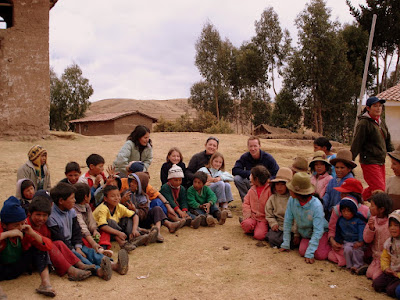
It is very hard for some - especially those of us who spend our working lives so much in our heads, both protected and demented by abstractions - to appreciate the harshly different reality of lives lived far away from us. In fact, even when you bounce up the barely-passable track of their remote town, trying desperately to keep up with the much more expertly driven pickup ahead of you, and pull into the turd-covered grassy area that passes for a village plaza, the concept of living like a child of Akorakai is a fuzzy one.


In a village of 150 people, these kids seem to make up a third of the population. Many of them were born in the 21st century, but most of them suffer from some effects of malnutrician. Their main food source is the crops that their parents tend: Maize, potato and beans. The bananas and bread that we brought (and Nina and Sara distributed) were rare variations to their diet. A great many of them are harbouring intestinal parasites and suffer from other problems that betray an absence in basic hygiene. Nobody tells the kids to wash their hands before they eat - only the doctors that pass through twice a month. And that message just doesn't stick.

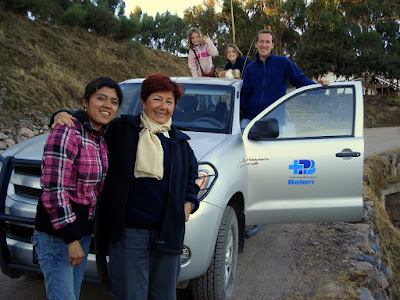
But the effort goes on. The pickup ahead of me was driven by José (not the same one I've recently written about) and his passengers were the most important - a team of one doctor, two nurses (including Hermana Mathilde) and one psychologist, all based in the Centromedico of the Parish of Belén. This was one of their twice-monthly trips to Akorakai, a small but vital contribution to the general health of those living there. Their only alternative is a 2 hour walk (nobody has a car here) cross-country to the nearest town.

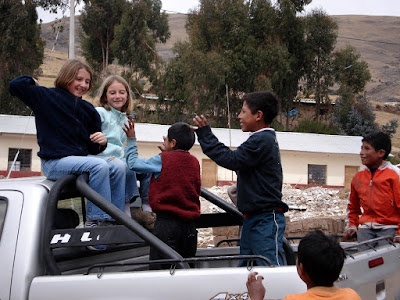
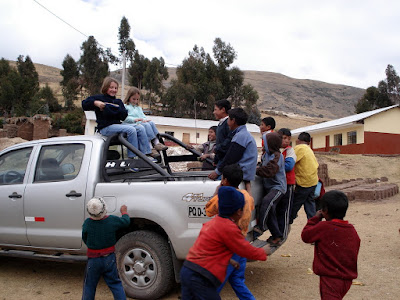
As I write from the luxury of a Buenos Aires hotel, it's hard to place myself again in the atmosphere of Akorakai, much less recall my thoughts on the place. I more or less stood out of the way, occasionally interacting with the kids in my terrible Spanish, and only occasionally understanding their answers. Most of the interaction was between Nina, Sara and the village kids. There wasn't much difference between how they got on with those kids and how they play out on the green at home, given the language barrier. The first, and entirely predictable stage was that all the young boys of the village gathered around the back of the pickup where Nina and Sara were sitting (while Daddy kept a watchful eye). This developed into a game of fling-the-hat, a game where some poor unfortunates hat would be nicked, flung at Nina and Sara, who would then toss it further. This continued for a while until the boys got bored and scattered around the various parts of the village. Then the smaller and quieter group of girls approached. Some kind of communication took place (the standard tweenie exchange of vital statistics like name and age), with Letizia acting as moderator.


I asked a couple of the boys - two particularly active ones who were jokingly asking for injections from me, assuming I was a doctor - if they planned to be doctors when they grew up. The answer was a clear no, with an overtone that to me sounded like "what kind of a stupid question is that, gringo?" I don't think many of these kids have any concept of what else life can offer, despite the fact that there was a fulltime school, even if little else, in the village (the Peruvian state seems to be putting a priority on education, even above health, for its most isolated communities). I found out later that these villages are effectively dying off - anyone with any ambition wants to move to Cusco. Those left behind are typically trapped by their own apathy.

There was still a distance between the European girls and the Peruvians, and it was maintained by both sides. The blonde girls belonged on the top of the pickup, and the locals belonged on the ground. Those positions were occasionally exchanged, but balance and order was always restored. This happened entirely by itself.

Nobody had any pretentions that this was a normal encounter. But at the end of the afternoon, after we had made our goodbyes and started to bounce down the hill again toward our completely modern existance in Cusco, Nina and Sara had at least some faces to recall when next dealing with the concept of the Bambini di Peru.

That said, I haven't noticed any new appetite for either cabbage or tapioca.

Wednesday, August 13, 2008

Pisac Ruins (the Budget)

Since arriving in South America, every time the girls have been tempted to buy something, we've told them to keep their powder dry until Cusco. We've picked up small things here and there on the way, but generally managed to keep our Pesos and Soles in our pockets. For Nina and Sara, the second day of our use of Padre Nicanor's pickup truck (Sunday before last) was the only one that counted: we were heading to Pisac.

Every now and then, Livia would point out a feature of the landscape, or a town that we could see in the distance, and hazard a guess at its name. No dottora, Natalie would reply from the front passenger seat, sometimes but not always following up with the correct name and never taking her eyes off the road ahead. This happened so often that by the end of the day Nina and Sara were shooting back no dottora to everything their grandmother said.

Pisac lies about one hour drive north-east of Cusco, and on Sundays the entire centre of the town hides under the combined canopies of hundreds of market stalls selling every kind of artisanal product you could associate with Peru. But before we unstrapped our wallets and unleashed ourselves on the town, we had a little walk to do first. At least that's how Natalie described it. Rising above the town of Pisac, there is another monumental reminder of the culture that dominated here before the Spanish. By now, we were becoming familiar with the layout of Inca cities. The steep slopes that rose above the town were tamed with ancient terraces, and above those again lay the remains of Inca dwellings and temples. The scale of these gravity-defying towns never fails to impress, even more so when you're scaling them. In the constant heat of Cusco's so-called Winter, our hour's jaunt turned into a three-hour hike. The path was reminisent of our walk to the edge of Fox Glacier, in that it was narrow and fell away on one side in dramatic fashion (no sign of the the red-bearded Malcolm anywhere). I don't like heights (or to be more precise I love heights but I hate the idea of falling from them) but I've learned during this trip just how much Nina and Sara are affected by my adverse reactions and fears (thanks Leah ;-) ). Armed with this knowledge, Nina and I walked confidently along the precipice, neither allowing the other to give in to the fear.

Treats are best enjoyed when they are earned, and by the time we got back down from the Pisac ruins to the modern (so to speak) town we had earned both our lunch and our subsequent abandon to the marketplace. Another taste that I've acquired over the trip is haggling. What used to be an embarrassment is now something that I look forward to, and it's interesting to see the difference between haggling in China compared to that in Peru. Here it's harder. The vendors don't seem to enjoy it so much, and will too easily let a sale slip by rather than engage for a little longer. The Chinese vendors typically would never let you walk away without coming back with a counter-offer. Many Peruvian marketeers will just shake their head at your offer, and look at you with the same kind of disappointment as one looks at an errant child. Then again, in China the real price can be ten times less than the starting price. In Peru the maximum drop I've seen is about 30%. In China, a vendor will defend his inflated price with protestations of quality and originality. Here, you are more likely to see just a pained expression in reaction to your offer, and a plea for a lower price.

We spent more than 2 hours pinballing from one stall to the next. Every time we thought we were finished, one of the girls (and in this I include Letizia and Livia) would remember somebody else that they wanted to buy a gift for. The only thing that made the experience interesting for me was the haggling, the search for a charrango, and the knowledge that this would be our last shopping expedition before returning home.

And do you think this was the end of our shopping for the rest of our trip?

No dottora!

Tuesday, August 12, 2008

Heidi, the Carmelites and the Potion of Happiness


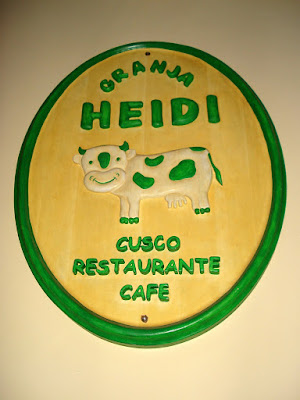
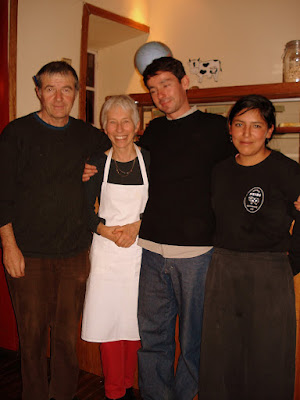
Livia, my mother-in-law, thanks to her good works and excellent connections in Cusco, was given free bed and breakfast with the Carmalite nuns on Plazoleta San Blas, less than 5 minutes walk from our hotel. Every evening would begin with Livia joining us in our hotel, before the five of us would journey out to eat. The journey didn't take long: Of 12 nights in Cusco, we spent 8 of them dining in La Granja de Heidi, a restuarant run by Karl-Heinz from Ulm, across the road from our hotel on Cuesta San Blas (it would have been 10 nights, but Karl-Heinz and crew are closed on Sunday). I know this sounds very unadventurous of us, but let me remind you that less than 24 hours into Peru, I had become, in the words of Brian Friel, tethered to the toilet. Bound by the bowels. Anchored by the ass. Karl-Heinz and Gudrun, over the course of our time in Cusco, gave back to me that which I missed the most: my good health. Thank you Karl-Heinz, Gudrun and staff, from the bottom of my, er, bottom.


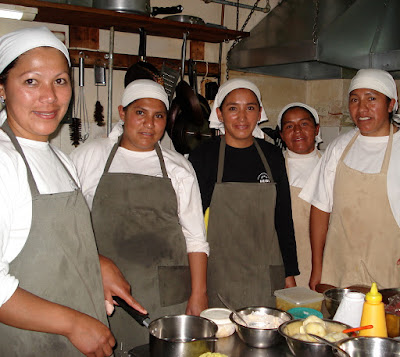
Not only is their kitchen dependable, it is delicious. Their menu combines European, Peruvian and even some Asian influences, and for those who hanker after some Southern German specialities you will even find spaetzle. All of this is served in a warm and welcoming atmosphere which is made all the more beguiling by the Tower-of-Babel variety of languages you'll hear around you. The staff hails from Germany, Peru and France, and given our own familial linguistic confusion, we weren't sure any more either what to speak, or indeed in what language we were spoken to. It made cotton wool our of our brains - and all to the good. The effect worked well with the beer and wine, and plumped the cushions of our already relaxed mood.

At the end of each meal, instead of dessert, we would take things one step further by ordering a one last round of drinks: Mate de la Felicidad. Infusion of Happiness. Nobody is fully sure what combination of herbs Karl-Heinz and Gudrun put into this tea (other than they themselves, presumably). It is part of the mystery and magic of an evening in La Granja de Heidi. There is for sure some Cammomile, and surer still the ever-present Peruvian coca leaf. The rest is conjecture and speculation. While I am not normally adverse in this blog to indulging in both, it seems pointless when it comes to the Mate de la Felicidad. Nothing I could write could imitate the pleasure, the release, the undoing of mental and physical knots that this potion unfailingly effected.

And so the evening would end, sated, fluffy and softened further by a modest bill. But there was one last element to our predictable routine that lifted the experience from mere happiness into the realm of bliss. The dream of every married man: I accompanied my mother-in-law back to the large wooden door of her convent and said goodnight.

(No familial relationships have been injured in the writing of this blog)

Saturday, August 9, 2008

Driving the Parish Priest's Car

I was named after my uncle the priest. At the time, Father Brendan was blazing an ecclesiastical trail in the US, hotly tipped (at least within our family) to be the first Irish pope. The reasoning behind my name was that I would inherit the fortune of the parish priest (at least). But shortly after being honoured with a namesake, with not a thought for the future of his nephew, Father Brendan left the priesthood, and all of a sudden I had to make my own way in the world.

Now, many many years later, Father Brendan is once more a priest (you can take the boy out of the God, but...) and finally the fortune of the parish priest is starting to faintly show its lustre. Last weekend, again through Livia's good offices, Padre Nicanor gave us the use of one of the Medical Centre's 4-wheel-drive pickups and we took to the countryside around Cusco.


The new face in the picture above is Natalie, tour guide and niece of Señora Paulina from the Medical Centre (nothing here is done without contacts - I feel like I'm back in Italy). It's all very well having your own wheels, but they're not much good if you don't know where to point them. Natalie guided us around the area that can roughly be described as the Sacred Valley for the entire weekend, helping us work out a good itinerary and giving us her insights into the history of the Inca. In some sense it was a magical mystery tour. Our ambitions in Cusco centred entirely around the city itself and Machu Picchu, and we had little or no research done on what else there was to see. Idiots. The land around Cusco is rich in magnificant historic remnants of the Inca Empire, and with Natalie's guidance we took in some of the more important ones.

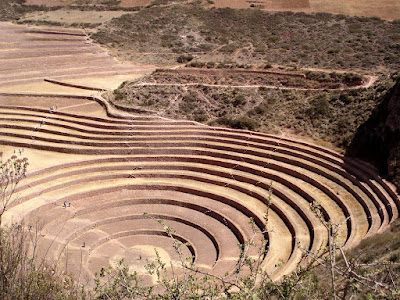
First stop was a place called Moray which won't show up on many maps, and in effect doesn't have much of a road. We crawled our way up the gravel track, having already spent over an hour on sealed roads, stopping off to pick up locals who flagged us down for a lift. We parked (some of our passengers offered to pay for the lift - a humbling experience given their clearly meagre resourses) and walked to the edge, to where the ground seemed to fall away, still not sure exactly what awaited us...


These beautifully executed and wonderfully restored concentric circles, leading down to a depth of 30 meters or so, formed the world's first greenhouse according to Natalie. What you are looking at is an experiment in agriculture. A system that created different micro-climates, allowing Inca society to grow various crops all year round, and even to develop different varieties. Most importantly, this was the larder that filled the stomach on which the Inca army marched. During the phase of imperial expansion, this experiment was undertaken to help build up the surplus of food that must precede every military advance.

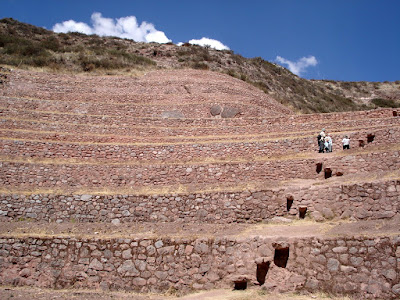
Nowadays it has another function. This site is considered by some as an important point of energy on the Earth's surface. When I hear the word 'energy' being used in this loose context, often by practicioners of alternative healing, I become immediately suspicious. But after climbing down to the very centre, still dealing with the altitude and heat, I was too breathless to put up a fight when Natalie suggested that we make a family offering to Pachamama. We didn't have coca leaves, we weren't inclined to sacrifice either of our daughters (given that they were well behaved that day) so we settled for one of the sweets that I constantly carry around in my pocket (we get them with the bill in Karl-Heinz's wonderful restaurant La Granja de Heidi across the road from our hotel - more on that in a later post). The Inca preferred even numbers apparently, so Natalie excluded herself from our offering. We buried the sweet, made a collective wish (which will remain as buried as the sweet itself until such time as it comes true), and struggled back to the edge of this enormous and breath-taking structure. Using steps like this...


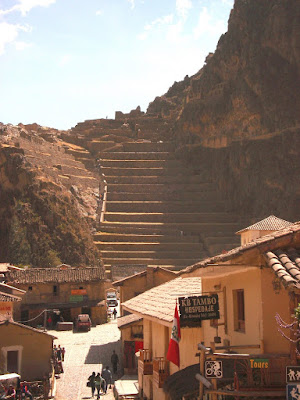
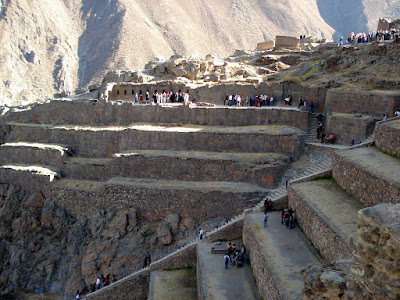
Next on the itinerary was Ollantaytambo, another hours drive away. Guide books will often describe this as a fortress on the edge of a town, but Natalie began to show herself to be something of a maverick when it comes to interpreting Inca history. This time, the road was more civilised. We drove over the cobbles of the town and parked in the main plaza. So far it looked like a pretty, lively place. It's where the train to Machu Picchu leaves from, so there was quite a bit of tourist activity about. It wasn't until we left the plaza and walked north to the edge of the town that the vast ladder of terraces that characterized these ruins suddenly came into view. It took our already faint breath completely away. Twice in one day we had been ambushed by the Inca, despite the fact that they were swept away 500 years ago. Imagine the impression that this civilization must have made on those who lived in it, and those who came to conquer it.

We had lunch first, to prepare for the climb upwards, during which Natalie continued to give us her particular views on the nature of the Inca. She was slow to even use the word 'empire', and portrayed the way of life as a golden age for Peruvians. Nobody went hungry, the empire itself was build up by good example rather than at the end of the sword, everything was just dandy until the bloodthirsty Spaniards turned up. In our trip so far, we have seen the stamp of imperialism in every country we visited, and I feel I can say that the imprint is the same regardless of culture. The rationale behind empire, and many of its methodologies, are distinctly human and shared by British, Spanish, Papal, Mandarin, Mongol and Maori. I have learned to mistrust historical explanations that insist on exceptions to normal human behaviour. (In case this sounds fatalistic, and too pessimistic of human nature itself, I will try to give a fuller picture of what I mean in a later blog. I like to spread the pain - your pain that is - over time.)

Nina and Sara, faced with another climb, spat the dummy. So Livia volunteered to stay with them (quite happily, as she has seen all this before) while Letizia, Natalie and I hiked upwards.


In fairness to Natalie, it is hard to see the Ollantaytambo ruins as a fortress, given the lovely unguarded set of steps that run right up the middle of the terraces. The terraces themselves hold historical record of agriculture, just like back at Moray. Natalie's depiction of the site as a mixture of temple, agriculture and normal habitation made sense as she guided us up and across the structure. Always in the back of my mind, however, is the thought that only a centralized and powerful state, with endless cheap labour at its disposal, and methods of enforcing its will, can hope to construct edifices like this and Moray.

But I remain an ignoramus on all South American history and cultures, so I will have to wait until I read much, much more and compare what I have read to what I have seen, before offering anything other than these generalized and broad-sweep opinions.


Padre Nicanor has something of a reputation as a fast driver. Livia calls him Il Pirata (the pirate). Given that this was my first Peruvian driving experience, I was taking it nice and handy. I made sure, on returning the car at the end of the day, to apologise to the Padre, thorugh Livia, for destroying his reputation by tootling around the Cusco countryside like a pensioner, in a car marked with the Centro Medico de Belen. He laughed out loud and beamed at me. But there was something unpredictable and flammable about his glee, like an American caricature of a mafia godfather. I handed back the keys nervously and promised to do better the following day.

Friday, August 8, 2008

Ojo la Mierda

I can say three things in Spanish:
  1. I would like to rent a car. Completely useless as I have no plans to hire one in South America.
  2. May I pay with a credit card? Completely pointless as almost nobody accepts them in Peru.
  3. Look out for the shit. Well, I've used it once.
It's a start. These phrases are varied, though a little too utilitarian. In a social context, there's not much there by way of conversation openers, though the last one can bring a conversation to a swift end. Communication is still possible across the language barrier, providing you find the right person. José is just such a person.

I met José and his family on the confetti-strewn evening of our arrival. Livia worked with his wife Concepción in the medical centre, and even though Conceptión no longer works there, they have remained the best of friends. Their two daughters Ana and Guadalupe are slightly older than Nina and Sara but have been such good friends to the girls, and friends is what they miss the most from home. Since that first evening, we've had the pleasure of the Cruz family's company on two occasions; one day trip in the countryside around Cusco, and a meal in José's home.

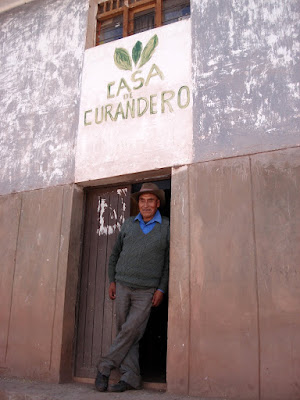
The day trip to Huasau was supposed to coincide with a festival of thanks to the Pachamama, the god of the earth, fertility and prosperity. But when we arrived, the main plaza was empty. We were out by one day. Undeterred, José used the downtime to introduce me to the ancient and widespread practice of visiting the curandero, to have my fortune told using coca leaves.


In the name of journalistic enquiry, and because there was clearly bugger all else going on in downtown Huasau, I jumped at the chance. When I was led through the door into Señor Reimundo's clinic, it didn't take long for my eyes to adjust to the darkness. It took my brain a great deal longer to adjust to the strangeness of my situation. While the curandero normally permits only those seeking consultation to enter, it was clear that some translation would be required (unless of course the details of my future consisted entirely of rented cars, credit cards and turds) so Hermana Mathilde was allowed in too - she could understand my Italian and I could just about understand her Spanish. If being in a dark room with a witchdoctor and a nun weren't enough, it became clear that the curandero's Spanish was almost as limited as mine. José was called in to translate from Quechua to Spanish. Letizia joined us as well - I'm not sure under what pretext but I expect that she wanted to hear about my future first-hand, rather than hear my version of it (it's interesting that with all the potential for mistranslation in this situation, the widest semantic gap lay between male and female modes of communication).

So with an amphitheatre of spectators present, and at least three channels of communication in place, the consultation began. Señor Raimundo uncovered his selection of coca leaves, handed me one and got me to breathe on it. According to the real-time translation committee, I was going to hear about my work, my most significant relationship and my health. Work was looking good apparently, which struck me as odd given that I haven't written a line of code in 8 months. Perhaps this was Raimundo's way of telling me that my absense from the office was increasing productivity there (a tenable suggestion, I have to admit). Then, in a cruel blow for Letizia, all assembled were told that she was pretty much stuck with me for life. When it came to my health, things started to go a little less to plan. Raimundo had been cheerfully tossing coca leaves onto the table and rattling off the good news (good, unless you are married to me that is). When it came to my health, he slowed down and put his hand on his chin. There ensued a long conversation in Quechua between José and Raimundo, José's normally jocular expression giving way to concern. When the exchange finally finished, I looked at José. Está bien, he said. She'll be apples.

Balls to that, I thought, though I offered a more diplomatic version out loud. How do 2 minutes of brow-furrowing Quechua translate into 'you're fine'? Either the language is somewhat inefficient, or something was being held back. José finally came clean. Health-wise I am actually doing fine, apparently (so Letizia's life sentence is without parole). I have a certain amount of supressed anger however, that I need to keep an eye on. I was a bit taken aback, I have to say. Not by the news that I have hidden anger - I'm quite comfortable with that (I look forward to meeting the catholic-raised Irish male who doesn't have many hectares of rancour ploughed into his soul). What surprised me was that this was considered news at all. I found it a little bit Oprah for such a rustic setting. I wasn't expecting such sensibility from a curandero, and I was beginning to fear that he might prescribe a good cry for myself there and then, in that dark room that seemed to be getting fuller all the time.

I need not have worried. I didn't have to do a thing. The diagnosis was discussed in Quechua, Spanish, Italian and occasionally English by everyone but myself, and with very little need for any intervention on my part. I fished out twenty soles, thanked Raimundo, and headed for the crack of light that I correctly interpreted as the way out.

Despite, or perhaps because of, my anger issues, José invited us around for dinner a few nights later. By this stage, Nina and Sara had become great friends with Ana and Lupe. Any limitations in the intersection between my daughters' Italian and José's daughters' Spanish were more than compensated for by exchanges of gifts and mischiveous grins. So by the time we hit dessert, the kids had disappeared upstairs and I was left to fend off endless bottles of beer from José.

There is something very special about being invited to somebody else's house for dinner. The breaking of bread can put a budding friendship onto a different level, or nourish an old friendship - especially if the food is as good as what Concepción prepared for us. Around a table you can take your time - nobody grows old there according to one Italian saying. When language threatens to stand in the way of understanding, a shared meal, a clinking glass and an exchange of smiles can smoothen the way. It helps to have your wife on one side and your mother-in-law on the other to translate your gems of wit to your hosts as well. And two bottles of Cusceña beer can bring out the ability to speak Quechua as well as Spanish.

There isn't a credit card in the world that can pay for a night like that.

Thursday, August 7, 2008

Meet the Cast

We are not alone. For the first time since saying goodbye to Giovanna waaaaay back on the South Island of New Zealand, we find our family unit once more broken open. It's not just because Letizia's mother Livia is with us. Our cast of characters has expanded much further. Before I begin to introduce you to them, let me explain a little further.

Cusco has become a home from home for Livia over the last 10 years. Back then, she was introduced to Padre Nicanor, the mercurial parish priest of Belen in Cusco. In a ramshackle building, this man had managed to put together by sheer force of will and strength of personality, a medical center for his flock. The Peruvian economy is rapidly improving now, but back then the state was woefully absent when it came to public health. Livia is a doctor, with a strength of personality all of her own. The combined personalities of Padre Nicanor and Livia Rosetti have driven forward a project right here in Cusco that has improved the quality of life for many hundreds of Cusceños. The Medical Centre of the Parish of Belen is like no other institution in Cusco. Spread across three floors, it boasts a pharmacy, dental health suites, psychological services, gynacological services, alternative herbal medicine and much more. For those who can pay there is a small fee. For everyone else it is free. And it would never have happened had my mother-in-law not dedicated so much of her time and energy, collaborating with German colleagues, cajoling money from many different charitable fonts, and simply being there herself.

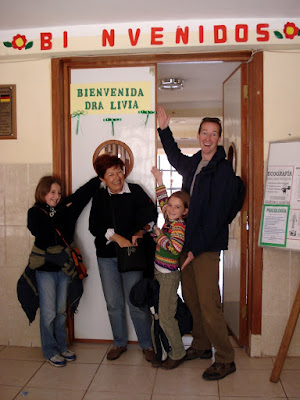
I've heard about this place for quite some time, obviously. I have to admit that while I admired what Livia had achieved, it was all so very abstract. Even when Livia collaborated with my mother's circle of friends back home in Carrigaline to raise money for the centre, it remained a distant and vague concept to me. I really had no idea of the importance of what had been achieved until I got here. When we stepped down from the train in Cusco, Livia was already there to meet us. She was accompanied by Señora Paulina, one of the administrative staff of the medical centre, who covered all four of us in confetti. Minutes after our arrival into our hotel/hostal in the San Blas district, another car load of new faces arrived, armed with even more confetti, as well as flowers and flags for the girls. By the time the fuss died down, and we were left to settle into our room, the lobby was strewn with petals, confetti, and emptied cups of coca tea. We were left to contemplate this whirlwind of welcome.

I have done nothing, not a damn thing, to help towards the creation of the Medical Centre here. The only reason I was afforded such a welcome was because I am Livia Rosetti's son-in-law. The intensity of this reflected glory gives an idea of the esteem in which Livia herself is held by the Belen Parish community. Since that first evening, I have seen much more with my own eyes. As well as the very intense tourist activities we've been submerged in (my lame excuse for such a poor rate of blogging this past week) we've visited the Medical Centre and gone in-country with some of the doctors as they visited remote villages around Cusco. The sight-seeing, and the first-hand view of the Medical Centre and its work, have replaced the abstraction that was Cusco with a flesh-and-blood reality that I will take back home with me and never lose.

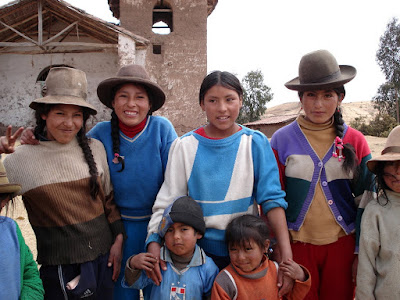
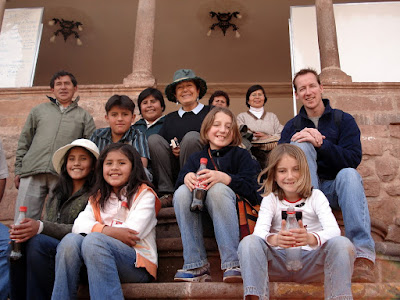
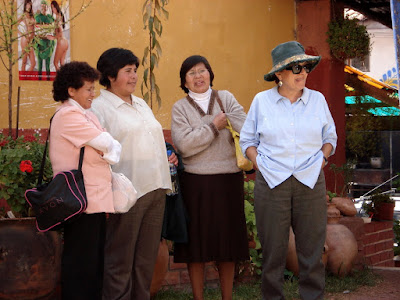
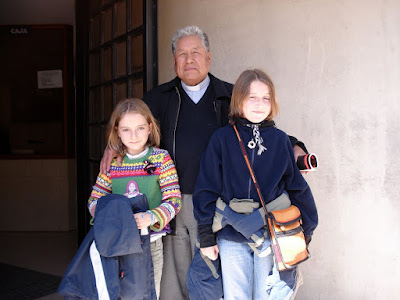
I'll blog on both of these aspects of our Cusco experience in the coming days, but for now, I'd like you to see some of the faces that appear regularly in our day-to-day lives. I wish I could somehow make these photographs appear more than a collection of faces. I wish you could somehow be here and get to know La Hermana Mathilde, or José and Concepción and their wonderful daughters. I'd like you to know what it feels like to be in a room with the explosive Padre Nicanor, or wander through the floors of the Medical Centre of the Parish of Belen and feel the pulse of activity that pervades like an Andean drumbeat. Maybe, if I do my job right, over the next few blog entries you will get to know these people a little better, and get a sense of this place. In the meantime, here are some of the faces that populate my waking hours during this very special time in Cusco.


Sunday, August 3, 2008

End of the Line


Cusco is not our last stop on this 8-month journey, but in many ways it is our ultimate destination. After here, we have Lima and Buenos Aires to look forward to, but in both cases they are necessary stopping points on the way home. Cusco (and Macchupicchu) have been in our sights since the start. As a destination, it was all the more meaningful because waiting for us at Cusco train station was Livia, Letizia's mother. She's been coming here for 10 years or so, working on a very special project. But more on that in a later blog.

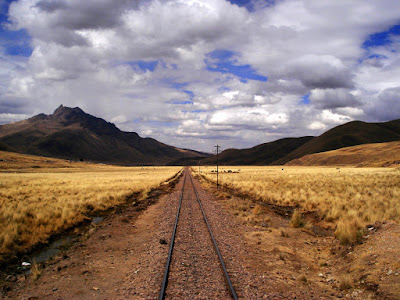
Being such a significant point in our trip, we travelled to Cusco in style. There is a train service operated by PeruRail called the Andean Explorer, which runs three or four times a week from Puno to Cusco. We booked it while we were still in Chile, and while it came in at almost 300 euro for a oneway trip, it was money well spent. For a number of reasons, it was the most spectacular train journey of my life. Never have 10 hours of any form of transport gone by with such ease.

The Andean Explorer is a colonial Gentleman's Club on wheels, trundling across an Andean wilderness, where the seats are real armchairs placed on the carpeted floors, the bathroom is a welcoming environment of dark wood and marble, and the table service is performed in a synchronised swirl of black and white uniforms. We were in the second-last car, and behind us lay the train car to end all train cars - a bar and observation deck. The elegant bar served Pisco Sours to window-side tables. The observation deck was almost completely enclosed in glass, except for the very last section - a brass rail in the open air.

Trains in Europe are hermetically sealed high-speed tubes that bullet through the landscape and skirt around cities. The Andean Explorer lets you breathe the air of the land you are passing through and instead of bypassing towns it runs right through them. When we first pulled out of Puno, I was leaning against the brass rails, ready to enjoy the receding lakeside scenery. Instead I found myself in a traffic jam in the city centre, cars on either side of me, kids and adults alike looking up at the spectacle of a badly-dressed gringo leaning out the back of the train. (Just think of the last scene from Dumbo, but with a less endearing cast). At first we just grinned at each other. Then the kids started to wave. Naturally I waved back. Nina and Sara joined me for a while, and the three of us waved at anything that moved. The girls got bored and left, but I was just getting warmed up. After 15 minutes or so I had the hang of things. Men prefered a dignified nod and a respectful smile. Adolescent males were to be saluted with a single raised hand ONLY if they initiated. Adolescent females - actually all women - appreciated a vigourous wave and a cheekily raised eyebrow. These rules applied not just for Puno but for Juliaca and every other town we passed through. My jaws were sore from smiling after the first 4 hours.

In many of the towns we passed through there were markets. It appeared that the markets formed either side of the rail and the railway line itself acted as the main thoroughfare through the stalls. Or it did until our train arrived. Business was suspended as we slowed down and squeezed past stalls selling everything from fruit to car-parts, never further away from the market tables than then length of a 20 soles note. The waving, nodding and smiling continued unabated. The relationship between those on board the train and those looking from the ground was one of mutual curiousity, neither party quite believing what was happening. I'm convinced that I saw more of Peruvian Altiplano life in those few hours than I had in the previous five days spent in Peru.

Another aspect of our train ride that made the day especially memorable for me was the company. Imagine that you're sitting on a luxury train, fresh from experiences of deprivation and sleeplessness. You've paid top dollar to be there, and just as you start to settle in, you watch a family of four lurch towards your table and proceed to surround you. Hell, right? Well Kim from Ottawa suffered exactly this fate as the four of us piled into the Andean Explorer and took up postions all around her that pretty much excluded all chance of escape. A lesser woman would have taken refuge in a book or a tall alcoholic drink, notwithstanding the hour. Kim, and her friend Janet (who was an entire merciful car away but who occasionally came to comfort Kim) handled our 'company' with the tolerance and good humour for which Canadians are deserved respected. (Kim: May there be many, many mountains. Your stories kept us on the edge of our, erm, seats.)

The reception we received in Cusco train station, and afterwards in the lobby of the Hospedaje San Blas, involved flowers, confetti and much shaking of hands and kissing. We deserved none of it, but were instead basking in the reflected glory of Livia Rosetti, my mother-in-law, who has helped to make a real difference to the lives of the people of the parish of Belen here in Cusco. I'll tell you exactly what I mean by that over the next couple of blogs.

It's been 5 days since we arrived here in Cusco, and the experience has been so full-on that it's only now that I'm catching up with the blog. I'll introduce you to a whole host of new characters over the next few days, and tell you about what we've seen since we got here. In the meantime, I should have been asleep an hour ago. Goodnight.