Wednesday, January 30, 2008

Dad - You'd Love it Here

My dad likes to swim - but only in the sea, he's not a big fan of swimming pools. And he especially likes swimming off rocks rather than beaches. The problem is that these days some of his favourite places are less accessible to him (one bionic hip down, perhaps one to go?)


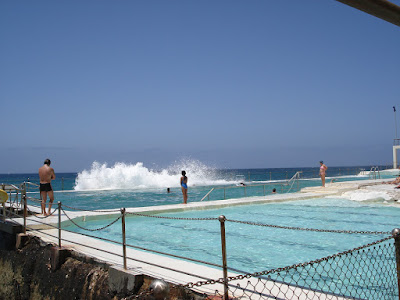
Well Dad, you have to check out Bondi and the other little beaches that are dotted southward from the mouth of Sydney Harbour, and open onto the Pacific (OK - it's the Tasman Sea, but to an Irishman, that's the Pacific). On almost every beach, Bronte, Coogee, possibly Maroubra, Bondi itself, there is a saltwater pool, filled by the tide with seawater. During high tide, waves break over the thick walls of the pool, creating sea-swells for the swimmers. At lower tides, the surface of these pools are smooth and calm, independent of the waves around.


Access is a piece of cake (or more accurately a slice of toasted banana bread - seems to be the local favourite), so it offers the best of both worlds: saltwater waves, with steps.


Other the the 10,000 airmiles it took us to get here, it's the ideal spot for you Dad. The girls and I are swimming a few lengths on your behalf.


Bondi


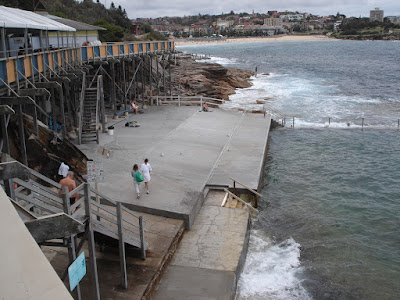
Wylies Baths, Coogee

Tuesday, January 29, 2008

Home Schooling on the Move

It was Sunday night. The girls were already tucked into their pull-out sofa bed, but not yet asleep.


"Tomorrow's Monday", I whispered to Sara after kissing her Goodnight.


"Yes", she replied sleepily, "That means lessons".


Lessons are the hour-long exercises in Maths or English that we do on weekday mornings, but sometimes allow ourselves to skip. Everything else can be learned in the museum/zoo/gallery/shop/street.


Letizia picked up some advice about home schooling: on any given day, ask the kids what they'd like to do. When they ask for Maths, we take out their workbooks that we brought along and see how they cope. If something new turns up that appears to create confusion then we might need to work on that. If they want to do English lessons, then we get them to work on a blog entry. This entails a rough draft, just to get ideas out on to paper. We don't care too much about spelling or neatness of writing until the second draft. In the background, every day they are reading from Enid Blyton or JK Rowling.


This is the routine we have settled into since our arrival in Sydney (the spells on the road are more ad hoc) and it seems to be working out. if anyone else out there (including Nina and Sara's teachers) hae any advice, we'd love to hear it.


This

Saturday, January 26, 2008

Australia Day


Yesterday we spent the entire day in the city centre, to celebrate Australia day with Sydneysiders. On the trip back to the apartment, we overheard - well everybody in the bus couldn't help but overhear - three self-appointed cultural attache's from Ireland having a beer-fuelled debate with some of their equally inebriated Sydneysider counterparts on the nature of a Republic. The Irish lads were probably in their early 20s, but that didn't stop them from banging on about the Union Jack on the Australian flag and '800 years of oppression' etc etc. These lads weren't brought up listening to nightly news reports of atrocities in the name of Republicanism, or Unionism, so I suppose they had the advantage of considering the whole matter from the comfort of an unsullied, theoretical perspective. Whatever their motives (which I'm assuming were at least in part getting into the pants of their female opponents) I found their attitude irritating, and surprisingly arrogant. Is his tthe New Irish abroad?


The Republican debate in Australia is complex, and I don't pretend to understand it. It defies party lines, and motives for either supporting or opposing a break with the UK throne can often sound similar to each other. Even defining what it means to be Australian is famously difficult. The recently removed Prime Minister Howard spoke of 'matesmanship'. The voice-over to the Darling Harbour festivities talked about a place where discrimination had no place. There is definitely a sense of nationalism here, but it is understated. Lots of folks were wearing or waving the flag around the city yesterday, but when the hosts for the evening tried to create a chant of 'Australia' around the harbour they failed repeatedly and embarrassingly. Embarrassing for them: it takes more than a TV and a microphone to distract the locals from their conversations with their mates. The crowd seemed immune to jingoistic manipulation. I loved it. The moment that inspired the most applause, and it was spontaneous, was when a boat carrying 4 new Australians (there were citizenship ceremonies all over the country on the day) did a lap of the harbour.


At the edge of Darling Harbour lies the Maritime Museum. There is a wall on the outside where the names of Australia's official immigrants are being added. When all names go up there, there will be 6 million of them. A third of the population. Inside the museum there is an exhibition about those immigrants, in the form of the personal stories of a number of families. Mostly, they were people fleeing poverty or political upheaval and oppression in their own countries, or indeed people who didn't have a country anymore. This museum is the mirror image of the museum in Cobh, in County Cork - about 20 minutes drive from our house. The Cobh museum records the heartbreaking departure of hundreds of thousands of impoverished Irish, both before and after the foundation of the Free State and later the Republic. The Darling Harbour museum records their arrival to the other side of a months-long voyage.


The three mugs on the bus would have done well to remember that it was places like Australia that provided a home for thousands of Irish with no hope and no future in their own native Republic, instead of trying to rub the locals' noses in it, about symbols and figureheads that have less and less meaning either here or back in Ireland.

Thursday, January 24, 2008

Sara the Jellyfish Magnet

I swore I wouldn't do this, but 'events, dear boy, events'. There are two things about Australia that you need to know, and luckily for you, somebody else has already gone to the trouble of hammering these things home for you. If you read Bill Bryson's hilarious and sometimes accurate Down Under, you will remember for the rest of your life that Australia is
  1. Huge!
  2. Full of things that not only want to kill you, but have every possible evolutionary advantage imaginable to see this ambition through.


I promised myself solemnly (I wasn't smirking or anything) that I would simply refer once to Mr Bryson and never mention anything about vast deserts or inconceivable concentrations of venom.


Then we went to Coogee.


Sara has been stung by jellyfish in the past - Sardinian ones. She didn't exactly enjoy it, but Mediterranean jellyfish don't have the same work ethic as their South Pacific counterparts. Like the gentle waters of the Med itself, the jellyfish that Sara previously attracted were just making a bit of a show of being nasty - their heart just wasn't in it.


Coogee Bluebottles (for that is the local vernacular) on the other hand, are nasty little bastards who take this whole stinging business very seriously indeed. We arrived at Coogee beach at about 11:45, and by 11:50 or so I was carrying the inconsolable Sara for first aid at the lifeguard station just behind us. You have to understand my state of mind at this point: I was calm, but I was working under the assumption that my youngest daughter was in danger of meeting a horrible end if she wasn't whisked away pronto in something with sirens. We were in Australia, Sara had just been stung by something with an innocuous Aussie slang term, therefore I assumed death was imminent. Thank you Bill Bryson.


Matters weren't helped by the fact that the lifeguard didn't share my sense of urgency on the matter. This brings me to two things that one can say about the Australians: Lifeguards are, as a group, greatly respected. Seems fair, considering the number of lives they save each year - very often those of tourists who didn't heed Bryson's many warnings. I was all primed to show deference, and to be awed by their derring do. The other thing about Australians is their tendency towards understatement. Take our friend Gary here in Sydney. Last night over dinner (thanks again Ludi and Gary - it was excellent catching up) Gary explained the difference between saltwater and freshwater crocs. While the salties are viscious monsters and therefore should be afforded some respect, freshies are harmless and you'd have to practically stand on one to force it to give you a 'bit of a nip'. It was news to me that crocs did 'nips'. Pekinese dogs do 'nips'. A terrapin, if handled inexpertly, will give you a 'bit of a nip'. Crocs do not nip. At least not in Hiberno-English, or indeed just about any dialect of the English language. Except Australian.


So when I presented poor Sara to the lifeguard, I expected him to manfully take over and burst into action. Instead he offered me directions to the showers, and told me to come back for some ice packs. He did, in fairness, also pluck off one of the remaining tentacles from Sara's right leg, protecting his fingers with his sleeve - something I should have done myself. But as far as first aid was concerned, we were getting nothing but water. A shower and some ice.


Compare this to what happened on the beach in Santa Margherita di Pula in Sardinia when Sara last got stung by a jellyfish. The 50 or so people on either side of us went straight into action, organizing themselves wordlessly into teams:

  • One team dived into their beachbags and retrieved every form of medicine that can be legally purchased over the counter in Italy (which is a lot, by the way) - and given the number of doctors on the beach, we also had a choice of prescription-only products. Ammoniac, antihistamines, cortisone creams, pain-killers - you name it, somebody was running towards us holding fistfuls of it.
  • Another team moved swiftly towards the part of the sea where the offending creature was presumed to be, armed with buckets, nets and, most probably, more drugs.
  • A third team, lets call them the 4th estate, set up an impromptu incident centre through which all information related to the 'attack' was relayed, compared to similar incidences, and analysed based on severity, age of the victim, profession of the parents, and of course the likely efficacy of the drugs being used.


I'm not saying that the Italian approach is necessarily the correct one, but I must confess I would have preferred it to the stoic 'No worries mate, a bit of ice and she'll be apples' attitude that I was getting. I'm all for being stoic, taking it on the chin, grinning and bearing etc. I'm not so keen on it being expected of my 6-year-old baby girl.


This all happened more than 24 hours ago now, and in the meantime, Sara is just, well, 'apples' (she did get the ammoniac and anti-histamine treatment from her mother's mobile pharmacy, mind). We visited the superb Sydney Aquarium today where we read, apropos bluebottles, that the best course of action is rinsing with fresh water and applying ice-packs. I didn't have a felt-tip pen to hand, so I couldn't add some extra helpful hints or pharmaceutical product names.


It might have been worse. Gary told us that when he was just a few years older than Sara, and visiting Sydney from his native Melbourne, he got stung right across the chest. His uncle proved even more rugged (and unhelpful) than our Coogee lifeguard: "Just rub sand into it and you'll be right". You just know how that particular 'cure' came about: Gotta do something - now what have we got to hand? I mean when you stung yourself with nettles as a child, and instantly grabbed a fist of 'Doc' leaves and rubbed them into the sting, did you ever stop to think that 1) they never NEVER made the slightest difference and 2) they were always growing next to the nettles. No? Me neither.


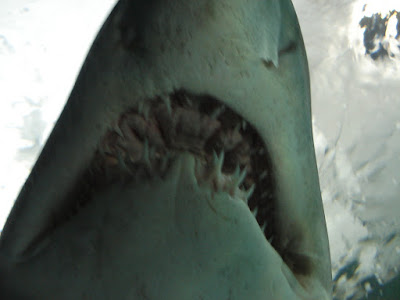
Anyhow, all's well and tomorrow we'll return to Coogee, though we'll stick to Wylies' saltwater pool there. Below is a photo from today's trip to the aquarium. Look our for these buggers - apparently they can give you a 'bit of a nip'.
Tuesday, January 22, 2008

Sydney: First Fleeting Views

Almost exactly 220 years ago, the First Fleet commanded by Arthur Philip sailed into Port Jackson, and according to their own records of the event, decided that it was the most magnificent harbour they had ever set eyes on. They had spend a number of disappointed days anchored a little further south in Botany Bay, wonder where were the lush meadowlands, and safe landings Captain Cook had described. Although it looked a great deal more promising than Botany Bay, this new location proved to be a purgatory of disease, famine and mutiny for a number of years, until a dependable agricultural base took hold and the future of the city that was to be known as Sydney was assured.


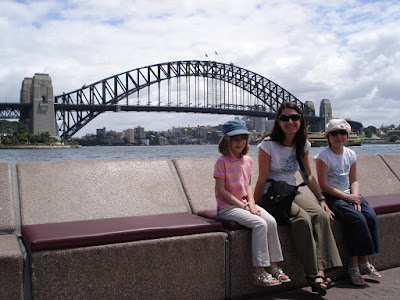
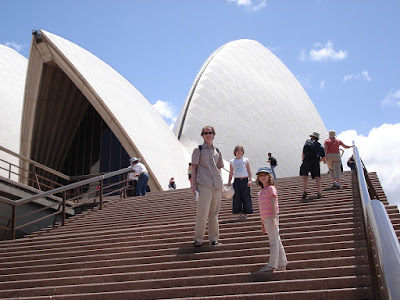
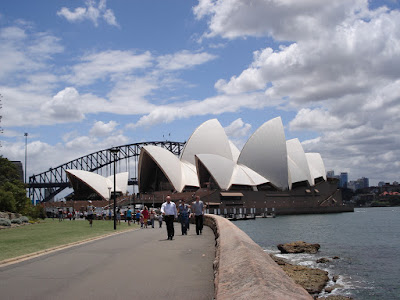
Maybe it was because I has read up a little on the subject of the founding of Sydney (or maybe because I'm a pretentious git who can't just shut up and take in the sights) but the emotional impact of seeing Sydney Harbour Bridge and then immediately afterwards the Opera House, was on a different scale to anything so far on the trip. Much more intense, for example, than Tiananmen gate and the Forbidden City, though these have a longer and more powerful history. Perhaps it's precisely because the story feels so recent and so far away from the seats of power of the time, that it also feels so human and personal.


I tried to imagine (unsuccessfully) how the place would have looked back then to the sailors, and how the ships might have been observed from the perspective that I now occupied, Bennelong Point (named after the first of the Eora to befriend the arriving English - though they did have to kidnap the poor sod first in order to make the necessary introductions and initiate the relationship).


And then I found myself conjuring up the image of that same First Fleet sailing into present-day Sydney. Arthur Philip left the place in 1792 and never returned. He felt, with some justification, that he had done everything possible and necessary to sow the seeds of a successful outpost of the British empire. But what he left behind was still very fragile, and had a long struggle ahead of it. What would he have thought if he too had caught sight of Sydney Harbour Bridge for the first time today, springing out as it does from the location of his first settlement? He'd have seen ferries and jetboats churning up the water, skyscrapers stacked up in the background, and of course, if the view were not alien enough to his 17th century experience, the Opera House reflecting the sun from many points at once.


It'd be nice to think that after a nice warm cocoa, and a bit of a lie down (during which someone would have been kind enough to mention to the poor chap that not only was the British monarch still head of state of New South Wales, but had extended its power to cover the entire continent of Australia) he would have taken a deep satisfaction in the role he played in making the 'Botany Bay Experiment' into such a spectacular city.


Australia Day is on Saturday. The whole country - with the probable and understandable exception of Bennelong's people and the other Australian aboriginal groups - celebrates the landing of the First Fleet 220 years ago in Sydney Cove (named after Lord Sydney who was the Home Secretary at the time - though apparently nobody is quite sure why the man himself chose the name for the peerage which died with him). Officially sanctioned activities include BBQing and talking ill of British cricket. I'm up for a bit of that!


Sunday, January 20, 2008

Now I know why they're called 'Samsonite'

'Cos you need to be Samson to carry the buggers.


Travel light, me arse.

Saturday, January 19, 2008

Being There

You can read all the books and watch all the TV you want, but there are some views that can only be appreciated in the round, and some experiences can only be had in person. You just have to be there.


I didn't manage to hear the erhu played well (I heard it played, alright). I didn't get around to tasting snake either. But as far as my three themes for this trip are concerned, I can tick two of the boxes. I did learn a lot about my wife and daughters in these three weeks. They are quite an amazing band of fellow travellers. They are flexible, positive, patient and funny. We drive each other daft regularly, and there is a lot being asked of the kids in terms of endless walking, eating and uprooting. But they seem genuinely happy and at ease within the newly mobile family unit, and extremely adaptable to the new conditions. Letizia, who went along only reluctantly with my desire to see China, embraced the experience fully. I couldn't have asked for better company.


On the topic of 'Collapse' I've seen some things with my own eyes that previously I had only read about: on the Yangtze, in the countryside and in the cities. Diamond's 'Lurching Giant' is indeed a colossus. The scale of the country and the speed of its journey from poverty to prosperity is hard to take in. The Irish government, in their own little way, have been doing a fairly patchy job of managing growth for the benefit of the many, over the last two decades. And that has been with all the advantages (yes, they are advantages) of a free press, and independant judiciary and centuries of growing up as a part (albeit neglected or abused) of Britain's modern economy and society.


China is trying the same thing on a scale that is three orders of magnitude greater than Ireland's, with a political history of unbending autocracy for 3 millennia. I would put money on the wheels coming off within a decade or so, though I hope it will be a temporary setback.


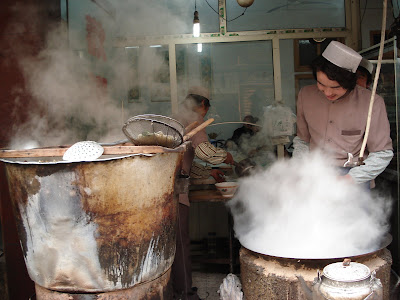
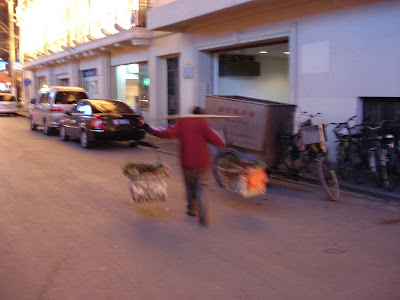
This trip has changed the face of China for me. It was an iconic abstraction before, defined in terms of numbers, names and dates. Now it has a human face. It's not always pretty, but I can relate to it. I can see the young ambitious faces of people working in tourism, the kind smiling faces of grandparents looking at Nina and Sara, cheeky teenage grins and shouts of 'Laowei' from behind steaming pots on Xi'an streets, earnestly attentive taxi drivers trying to figure out where the hell this foreigner wants to go, unctuous salesmen and saleswomen of overpriced tat, the haughty countenances of young Shanghainese women on the Huaihai Lu, and the openly curious expressions of Chinese children.


Sting only wrote one decent lyric after the Police broke up (monkeys, typewriters etc.): "I hope the Russians love their children too". However closed the Chinese government remains to international scrutiny and censure, much less to democratic reforms, the Chinese people as a group are open and welcoming, curious and interested. Yes, they love their children too, and you, if you are reading this from outside this fascinating country, have to come and meet them.