Wednesday, June 25, 2008

Walking on Fire, but not on Air. Yet.

When Nina was celebrating one of her earlier birthdays - probably fourth - she and her friends were running round the front garden when it started to rain. Letizia called from the house - "It's raining out there!!". Nina responded by rounding up her friends "It's raining out the front garden. Quick. Everyone round to the back garden."

We laughed at the time of course, but we've been playing a larger scale trick for the last month or so on the South Island. "It's raining East of the Alps - quick - let's head West". And it has by and large worked. We've seen a bit of rain, but nothing sustained, and nothing that didn't clear up about 100km into any given trip. Our luck has finally run out.

The last 4 nights - 2 in Taupo and 2 here in Rotorua have been rainy. Though we've dodged the worst of the showers (more though luck than planning) and succeeded in getting out and about, there was no getting around the fact that this was not jumping weather. Certainly not with a parachute, and probably not even a bungy. But don't count us out quite yet. The bungy site in Taupo is gorgeous. It's so beautiful that I've been overtaken by the desire to do it myself. It's only an hour back down the road, and if the Sunday weather forecast is what it promises (and we don't chicken out) we'll celebrate our 11th wedding anniversary by chucking ourselves off a cliff. Can you think of a better way?

In the meantime, our South Island glacial walk is being tidily balanced with a series of North Island geothermal experience. New Zealand lies, tectonically speaking (ahem), right along the line between the Australian plate and the Pacific Plate. As the Pacific pushes under the Australian it formed the Southern Alps and so indirectly the glacier we walked along. The action that has generated so much ice in the South Island creates fire in the North. Taupo, and even more so Rotorua, are bubbling, steaming, sulphurous centers of seismic, geothermal and volcanic instability. Every town we've visited since leaving Wellington has experienced some cataclysmic event thanks to the fault lines that lie below. Napier was wiped out by a 1931 earthquake, an eruption deleted an entire Maori town just over a hundred years ago near Rotorua, and Lake Taupo itself fills in a dormant caldera that when it last exploded about 1800 years ago, left its stroke in the writing of the Chinese and Romans, by means of a global ashen mark in the sky.

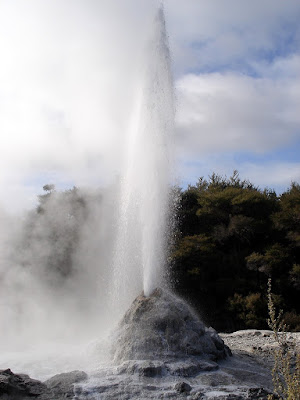
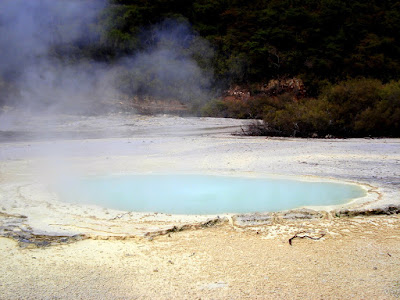
The signs of this volatility are everywhere. When you drive outside of Taupo, steam pours out of the greenery and across the road near the geothermal electricity generation station (7% of NZ's electricity is generated this way). Nearby, the Craters of the Moon Geothermal Walk offered us a way to get a closer look, and smell. But far more spectacular is the Wai-o-Tapu (Sacred Waters) site, 30km outside of Rotorua. We visited this today, luckily without getting rained on, and enjoyed scenery that until now I would not have said belongs on Earth. Letizia has taken some fantastic pictures, a few of which I've nicked. Don't tell her! Mind you, what's she gonna do? Chuck me off a cliff...? Oh.


Monday, June 23, 2008

The Best Day So Far (Apparently)

"That was the best day of the trip so far" said Nina, with the typical exaggeration and amnesia of a nine-year-old. With so many UNESCO World Heritage sites under our belt, with Beijing, Sydney, Fraser Island and Fox Glacier still bearing 'Wet Paint' signs in my own mind, why in god's name did she choose Napier, pretty though it is, as The Best? You tell me.
Out of the various options Napier had to offer, Nina nad Sara chose the playground and Marine World. Letizia and I chose a self-guided tour of the Art Deco buildings, and the Earthquake Museum (Napier was flatted in 1935 by an 8.6 quake and subsequently rebuilt in an almost uniform Art Deco style).

The playground turned out to be what Italians call a 'pacco' - a waste of time, something that doesn't deliver on its promise. A disappointment. It was relatively new, wit a quirky design that looked well against the Art Deco backdrop of the town. But it was ill-concieved and badly maintained. The girls squeezed what they could from it, but left knowing that, given the glowing reports we had received, it should have been better.

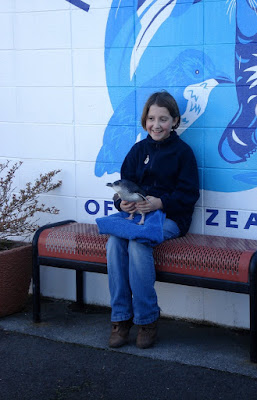
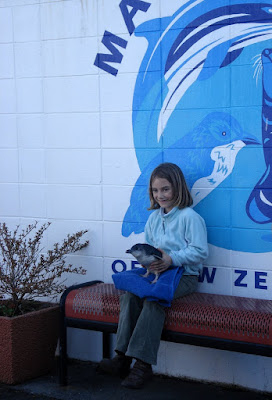
They endured the Art Deco tour before falling gratefully upon Marine World, fuelled with stories of being able to hold penguins. These girls have fed wild dolphins in Tangalooma, and seen dozens of them surf the bow waves of the catamaran on Milford Sound. They've seen truely spectacular synchronized dolphin shows in the Gold Coast. Napier's Marine World, on the face of it, should have been a let down. But that same childhood amnesia and fixation with the here and now prevailed. They loved the tricks of the single, ancient dolphin called Kerry. And although they've seen fur seals in the wild on at least 3 occasions here in New Zealand, they still adored the pup that was taken for walkies around the thin Winter crown that lay scattered about the small poolside terraces. The half-hearted applause sounded like piss dribbling out of a bucket onto concrete, but that didn't diminish their enthusiasm. And at the end of the show, they did get to hold a penguin; a Little Blue called Alfred who was missing one eye and blind in the other. An admission-paying parent might mistake this for a 'pacco', and a pathetic one at that. But Nina and Sara, as they posed with the shivering bundle (penguins, the girls reminded me, shiver from warmth rather than cold) just felt how good the moment was.

We duely visited the museum where the girls remained unmoved by an old lady's filmed testimony of the earthquake, whereas I was close to tears. But they were just words from an old lady with a lot of makeup. Words are rarely enough for kids.

After our relatively busy day, we relaxed in the hostel for a few hours. I tried to read but failed; I was dragged to the pool table where my daughters found themselves in unquestionable need of help (this was their first time playing pool) but unwilling to properly accept it. "We'll just use our own rules, Daddy". When I challenged Letizia to a game, and discovered that it was also her first time, Nina and Sara looked on, in open-mouthed thrall of their father's consummate skill. I'm a below-average player of pool. Well below average. I should have been a 'pacco'. I know that I'm a 'pacco'.

We ate dinner in a Mongolian BBQ, where most appealing characteristic for the girls was the unlimited supply of icecream and soft drinks that came with the meal. Letizia and I are unashamed hard-asses when it comes to eating healthily, but every now and then we ignore our own rules. Afterwards, we walked back to the hostel joking about all the funny made-up words the girls used by mistake just a few years ago (they love stories about when they were younger). And this was the contented atmosphere in which Nina proclaimed this to be The Best Day So Far.

More often than not, I don't respond in the positive to my daughters' requests to play. I'm stuck in a book, talking to Letizia, or worse - working on this stupid blog. Too often, I am missing one eye, and blind in the other. But not today. Today I played pool, joined in, laughed - I might even have skipped at one point. I did enough today for my amnesiac daughters to forget the fact that their father is often something of a 'pacco', and they just felt how good the moment was.
If it's this easy, this inanely, embarassingly easy to make them happy, why the hell can't I manage to do it every day?


Thursday, June 19, 2008

Micro Blogging

I've finally given up and signed up for Twitter. To those who already know about Twitter and just don't get it - I know! Me neither! For those who don't know what twitter is, consider it like a micro-blog, where you can send a small message (140 characters) just to let your friends/colleagues/wardens know where you are and what you are doing. The limited size and format of the messages means that you can send text messages from your mobile phone to twitter's number and so keep your friends updated even when you are far from a computer.

In the spirit of intrepid exploration that defines this trip (ahem), I've decided to try it out. To the right of this blog you'll see a little window that shows the last five entries I've made on Twitter. My Twitter page is here.

To complete the picture, Facebook has an application that channels my tweets (for that is the noun employed to describe a Twitter message) into my Facebook micro-feed.

And to those of you who know what Facebook is, and just don't get it....I know! Me neither!

Wednesday, June 18, 2008

Flying Kites

It was our third time going to Te Papa, Wellington's famous museum. We were late getting there and Nina was stressed in an understated way visible only to her parents. We were supposed to be attending a Maori kite-making session, but Letizia and I had dawdled over our morning lattes - at least that's how Nina would have it (If only her respect for time-keeping extended to things that her parents cared about - like bedtime, for example).

To their great credit, Nina and Sara can amuse themselves for many hours with nothing but scissors, stickytape and cardboard foolishly discarded from the Adult World. These are the basic elements and implements in the Junior Alchemy Set. From these, all Art springs forth. The transformation of base cardboard to precious artifact is unstoppable when catalysed with enough self-belief, perseverance and Pritt-Stick. This is the core dogma of the religion of Make and Do, to which my daughters fervently adhere. Deep indeed is their conviction in redemption through the transformative power of handicraft. The very thought of a creative opportunity lost to the whims of their parents (an unhurried breakfast, for example, or an irreverent haste in disposing of beer cartons) weighs heavily on their tender hearts.

In the name of this religion, we have left a trail of cut-out houses and paper hats across two continents and three countries. For this have our generous hosts found, after our departure, tell-tale traces of paper clippings on their carpets, leading to mutilated egg-cartons and water-bottles stuffed hastily into shallow-grave cupboards. And for this did we race to the fourth floor of Te Papa, and elbow ourselves a place at the altar of Arts and Crafts.

I never knew that the Maori made kites, but apparently it was an important part of celebrating Matariki, or Maori New Year. Not that I knew this at the time. The Te Papa staff probably explained this at the start (when we were still looking for space in the car park) but even if they had told us on our arrival I probably wouldn't have been very receptive. All I knew was that I was perspiring like a pig, breathing like an ill-hinged bellows and surrounded by a confusion of sticks, crepe-paper and strangers. And all because of Nina and Sara's fundamentalist and irrational beliefs vis-a-vis Making Things With Paper. This is not a state of mind that lends itself to making new friends.

And yet that's exactly what happened. That new friend was an Aussie woman with a broad smile, a disarming openness, and a positive attitude made of reinforced concrete. Di, and her beautiful daughter Trinity, had the misfortune to share not only the table but the only serviceable roll of stickytape with us, and it cost her dearly. Di has done her fair share of traveling, and living beyond her native borders and explained that as a result, she feels a certain solidarity with travellers. It's one thing to feel sorry for strangers (and god knows that our demeanour evoked pity), but it's another matter entirely to do what Di did next: to invite those strangers to dinner. To make such a leap of faith in your fellow man takes something special. When we got over the initial shock, we of course accepted the invitation.

Di, thanks for your kindness. If one day back in Cork I scare the bejeezus out of some unsuspecting backpackers by inviting them home for dinner, it will be entirely your fault.

Tuesday, June 17, 2008

Bachelor no more!

Some Facebook buddies were already a little concerned to see the message "Brendan Lawlor and Letizia Aresu are now friends", given that Letizia and I will be 11 years married in a week or so. Well, it gets stranger. I have learned that I am no more to be a bachelor. In 1990 I became a Bachelor of Science and never thought I'd look back. But all that is to change. No longer a Bachelor, I am to become a Master of Science (at this rate of backwards titles, I'll be a Sonny-Jim of Science in a few years, and then an Infant of Engineering). The exam board of the Cork Institute of Technology met today to consider, amongst many other things, my meagre thesis. I've just this it has been accepted.

It's about time I became a Master of something, and I can't think of anything I'd prefer to be a master of more than science. I owe my brother Stephen a great deal for suggesting that I do this in the first place (and taking care of the printing in my absence), Letizia for her helping me see it through, and this trip, whose looming departure date basically scared me into finishing on time. Well - kinda on time. I owe at least one more thank-you: to Simon and Leah, who as well as giving us somewhere to stay, and excellent company (which we still miss), also offered me a Real Computer to complete some necessary corrections to the thesis during our stay with them.

Monday, June 16, 2008

Troublesome Treaties

Since we've left Ireland almost 6 months ago, the Irish people gave Bertie Aherne an early bath, albeit indirectly, and now have rejected the Lisbon Treaty as well. The best political commentator I know (that's you Jim if you're reading) predicted a year ago or more that Bertie would finally have to go if and when the economy started to splutter, and I'm in no doubt that he was right on this. I wonder if the fact that it continues to splutter, belch and occasionally fart is partly responsible for the treaty's rejection as well. In any case, the Irish had the opportunity to decide whether the Treaty was a good idea or not, and their voice was duly heard, even it it's hard to tell what it's saying.

The Lisbon treaty was negotiated and redrafted over years by expert civil servants and lawyers, translated into every official European language by dedicated teams of polyglots, and debated for months by various national parliaments and the Irish electorate. The Treaty of Waitangi (1840) by contrast was drafted in 4 days by three men (and not one of them a lawyer), translated badly by a missionary, and debated by a subset of Maori chiefs, none of whom really had the authority to sign it on behalf of their people, and for whom many of the concepts of modern statecraft meant nothing. But sign it they did, and in so doing transferred sovereignty of the islands of New Zealand, considered at that point to lie in the hands of the United Tribes of New Zealand, to Queen Victoria of England.

That the United Tribes of New Zealand was non-existent in any functional sense didn't seem to matter. There was no political union under Maori - the Maori name for New Zealand (Aotearoa) was unlikely to have been used by Maori, and was probably a romantic invention of European missionaries. The very word Maori was only coined by Maori as a way to distinguish themselves from the Pakeha (Europeans), and means simply 'ordinary' or 'normal'.

That key words from the treaty like, em, sovereignty for example, were translated badly (and inconsistently with previous English/Maori documents), was overlooked or ignored.

British motives behind the treaty are interesting to look at. It's easy to imagine the Treaty as the product of rapacious imperialism, but the kind of people behind its creation (James Stephen, Lord Glenelg) were those who pushed successfully for an end to slavery in the British Empire. Conditions for the Maori had become particularly difficult since whalers had started operating from New Zealand's shores, and it was felt that something had to be done to protect and conserve New Zealand for the Maori. But the unseemly haste, which made the treaty such a flawed document, was driven by baser motives: a race against time to prevent The New Zealand Company from seeing though its plans of 'Systematic [private] Colonisation' of the islands. And the way in which colonisation was seen through was far from the 'New Zealand for the Maori' sentiments nurtured by the Treaty's creators and sponsors. Settlers and Crown authorities often interpreted the treaty in ways that favoured Pakeha over Maori, or else disregarded the provisions of the Treaty entirely.

The very fact that there was a treaty at all is another indication of the difference between the fates of Australian aboriginal and Maori societies (no - I'm not through with this topic yet). A treaty was required because New Zealand, unlike Australia, was not deemed to be Terra Nullius by the British. It was occupied and defended in a way that Europeans could related to. Farming was well established, and a continuous state of war between tribes, with alliances chopping and changing regularly, meant that the technology and organisation available to Maori for their first contacts with Europeans was enough to keep them at arms length for quite a while.

Tasman arrived in 1642, lost four sailors to Maori spears, and buggered off. A full 127 years passed before the next European explorer, James Cook, passed by, and despite his famous ability to negotiate with locals, and the advantage of a Polynesian language speaker on board, still managed to get into several skirmishes. Although the Maori came off worst in these clashes, the belligerence of the natives was reported back to London and surely had some influence on the selection of New South Wales over New Zealand as a suitable place to set up a penal colony. And that relative proximity of a British outpost in Sydney just 10 years after Cook's voyage allowed the Maori to build up a relationship with London gradually. Sixty years passed between the settlement of Sydney and the Treaty of Waitangi, during which there was much trade and exchange of people, and the gradual establishment of private whaling stations on New Zealand coasts.

For the first New Zealanders, almost 200 years passed between first contact with Europe and final colonisation. Compare that with 10 years for the Eora people of Sydney, and consider also that Australian colonisation took place without a treaty, and with complete and total disregard for the First Owners of Australia. No provision was made for the protection of their rights or property, as happened in New Zealand. Although technically subjects of the Crown, those who attempted to repel the invasion of their lands were officially considered on a par with enemies of the state. This ambiguity in law left the Aboriginals to the tender mercy of settlers, by whom they were considered at best competition, and at worst, vermin. I've already mentioned the fact that Australian aboriginals were still hunter-gathers, given Jared Diamond's reasons for why this was so, and outlined how this left the Aboriginal less prepared, technologically and socially, for invasion and sustained warfare. This lack of preparedness, the speed of colonisation, and its ferocity, meant that Aboriginal societies in Australia (and in the case of Tasmania, even the population itself) were destroyed. And it's not at all clear to me if they will ever recover. It was an exact analogue of what happened to the Moriori of the Chatham islands, except in this case the both the aggressors and the vanquished were Polynesians. The Maori suffered terribly but were able to defend themselves better and their society was not dealt quite the same killer blow and in the case of Australian aboriginals.

Through a mixture of base and noble purposes, the Treaty of Waitangi was more or less thrust upon the Maori, but I wonder what would have happened if it had not? The fates of other Polynesian peoples, under the "broad sweep of history" that Jared Diamond describes in Guns, Germs and Steel which I blogged about recently, was varied and ranged from absolute annihilation to a retained and functioning independence. There's no safe assumption that things would have been any better for the Maori without Waitangi.

The unity of Europe was conceived with noble reasons - to end the wars that had raged between the constantly switching alliances of European tribes, to protect itself from external aggression, and to create and environment suitable for mutual prosperity (some of which seems remarkably similar to the situation that pertained amongst Maori before Waitangi). Europe has rejected unity attempted in the past by horse, sword and panzer, until it's more recent acquiescence to the pen. The Treaty of Lisbon, written in dense legalese and referring to many other previous treaties, may have been effectively just as open to misinterpretation (and misrepresentation) to Irish voters as Waitangi was to the Maori. It might have been put in force over the heads of all EU countries other then Ireland. I'm happy we had our opportunity to vote on it, but I think that the arguments for the treaty was made very badly indeed, and I'm not sure sure that we'll be any better off for having rejected it.
Thursday, June 12, 2008

I Got the Paua

We have a flair, it would appear, for reaching southernmost points. Today we drove to Cape Palliser for almost no other reason than it was in a corner we could easily reach - my travel strategy is the same as my tooth brushing technique. We were expecting to find a lighthouse, and a seal colony there. Or would that be a seal dominion now? Or a constitutional monarchy of seals, perhaps? In any case, we found ourselves traveling a one-way road, that finished in Cape Palliser itself and frayed quite a bit towards the end. The road seemed far too close, and at too similar a height, to the waves of Cook Strait which thrashed menacingly on one side with high mountains just a hundred meters inland of us. One big wave would have sorted us out. But we made it to the Cape, and we could see the lighthouse alright (it wouldn't be much of a lighthouse if we couldn't, now would it) but there wasn't a seal in sight.

This was supposed to be one of NZ's largest colonies. I thought we'd be deafened with the noise of barking (and the odd rendition of Crazy). But when we stepped from the car, and began to walk along the verge that separated the barren soil from the stony beach, there was nothing but the wind and the waves pushing back at us, asking us what the hell we wanted anyway.

Good question, actually. A seal, perhaps? We had driven for 2 hours to get here so a New Zealand fur seal would be nice. We've seen one or two before, but we we don't have any back home so we're not ready turn up our noses at them quite yet. We looked out upon the stones and the waves, and implored the Maori spirit of the sea to reward us for our trip but all he did was blow Letizia's beanie off (yes - that beanie) and along the beach. We gave chase and eventually caught the beanie just before it was lost to us forever. Incredibly (in the sense that it sounds made up, and probably is) the flyaway headwear led us to a treasure, a collection of paua shells just lying there on the grass, unclaimed. We had already paid 12 bucks a pop for a lot of these mother-of-pearl shells back in Christchurch, so we obviously took a few as, er, consolation for the missing seals.

As we started to make our way back to the car, Letizia managed to hear the call of nature over the noise of the wind and waves, and made her way towards the nearest bit of scrub at the edge of the shore. The girls and I prepared ourselves for a wait, but we needn't have bothered. Letizia had barely disappeared from view when suddenly, there she was again, running towards the car at a speed that was all the more impressive for the headwind she had to content with.

She had found the seals.