The Southern Cross bar on Abel Smith Street is large - it must hold as many as 200 drinkers when full, and many of them sit outside when the weather permits or (in the case of smokers) when the law insists. It's the outdoor voices that you can hear the most from our apartment. But from six floors up, the distance is sufficient to filter out all content, just leaving the carrier signal, a white noise that is distinctly human in its cadence but devoid of even a single recognisable word. Tomorrow morning, that's how these conversations will be remembered even by those who are engaged in them now. I'm hearing 8 hours into their future.
I love the noise. I love being back in the city. The only thing you could hear in our Christchurch house was Willard the cat occasionally mewing and the canary next door whistling the first two lines of Happy Birthday To You. That was very peaceful and welcome for a while, but by the end it was the constantly murmured rosary of city life that I was praying for.
I love Wellington. I love the fact that we exit our apartment practically onto Cuba Street which feels a bit like Newtown in Sydney. Undeniably smaller, but unmistakeably urban and confidant. Using my recently developed Index of School Uniform Skirt Length (which I recognize is borderline perv, but I am a Man of Science, dammit, and data are data) I can report that the atmosphere in Wellington is much less austere than Christchurch. I love the fact that there are too many museums and places of historical and political interest here, and that I will have to choose carefully the ones I plan to visit. I love that at the end of every day here so far I feel I've seen something worthwhile and only added to the list of things to be seen before we leave.
Let me give you an example of a day well spent. Letizia went to get her hair done today, something that ladies (and especially Italian ladies) will know is the kind of service that one can only safely look for in a town that you either know very well, or trust based on its appearance of sophistication. Together with Nina and Sara, I toured the parliament house and executive wing and then crossed the road to see the decomposed remains of an original Maori version of the Treaty of Waitangi (the 1840 'agreement' between Queen Victoria and the collected heads of the various Maori tribes that brought New Zealand into the British Empire as a colony - a document held in such disdain by Maori that the National Archive provides a wooden bowl of water outside the Constitution Room where it is displayed room, so visiting Maori may symbolically decontaminate themselves after viewing it).
This evening, after chilling out at home for an hour, we went to the Opera House to see a superb performance of Cats. Well I'm assuming it was superb. A man can only be expected to devote a minimum of attention to the appreciation of music, when he is watching a troupe of lithe actresses, dressed in figure-hugging body stockings, crawling around the stage on all fours. Oh look, people clapped a lot. I clapped a lot. It was all good.
And this was a typical day for us here in Wellington. Not every day involves leotard-clan feline impersonation of course, but at the end of the day, when we relax back 'home', there is generally a feeling of having seen something worthwhile. Accompanied as ever by the satisfying background music of people with more stamina and fewer responsibilities than us having a good time into the wee hours.
In point of fact, as I write this I've noticed that the noise has faded away. It must be damn late. And there's lots more to do tomorrow. Goodnight, and pleasant dreams (purrrrr).
Wednesday, June 11, 2008


Learn Italian (then read my wife's blog)
The folks who have helped me learn Chinese have now started a similar service to learn Italian. It's Europe's most beautiful language, all the more pleasing as it offers no commercial advantage whatsoever. So check it out, and then check out Letizia's blog to see how much you've learned!
Monday, June 9, 2008
How not to be a Racist
When Europeans first went sailing around the globe, and bumped into (or more accurately, collided with) other more primitive societies, they asked themselves the question "How is it that we have the ships, guns, horses, writing and all the other trappings of civilization that allow us to conquer those others who have little of none of these advantages?". In the absence of any scientific explanation of how Man came to spread himself over the earth, Europe explained its success in terms of racial superiority, or believing in the 'right' God, or both. Five hundred years later, the same science that developed the ships and guns finally delivered the answer to that question.
It has been the consensus for some time now, and expressed in an accessible way by writers like Stephen Jay Gould and Luigi Luca Cavalli-Sforza, that all currently living members of the genus Homo are, genetically speaking, brothers. We are Homo Sapiens sapiens, distinguished from our ancestors (say some) by our faculty for language, and we probably first appeared in Africa about 100,000 years ago. If you read Jared Diamond's Guns, Germs and Steel you'll find a patiently paced description of the "broad sweep of history": the initial many colonizations of the globe by Homo Sapiens sapiens, and the more recent one that led to the Eurasian conquest of the rest of the planet (the result of which is clearly visible both here in New Zealand and back in Australia).
If you don't read Diamond's book, let me try to lay out its thesis in a nutshell. It was Europeans' guns, ships, germs, horses and political/societal size and sophistication that led to its victory over North- and South-Americans, SE Asians, Polynesians, Africans and Australian Aboriginals. These are the self-evident proximate causes of conquest. The ultimate causes lie in Eurasia's early transition from a hunter-gatherer lifestyle to farming. The production of excess food created a positive feedback loop with increased population densities - the more food, the more people, the more labour, the more food. This led to a necessary stratification in society: chiefdoms and kingdoms - a means by which strangers living in close proximity could co-exist more or less in peace, with the kingdom acting as arbiter, and central point of trade. (Smaller societies, based around the tribe structure, kept the peace and managed trade through personal ties and reputation: Everyone knew everyone else, perhaps even related.) Stratification led to a specialised craftsman class, freed from the direct production of food, able to invest energy inventing better tools, methods, metallurgy and so on. This was the initial vector whose trajectory finally brought literacy, science and technology.
The domestication of animals, and their subsequent living in close quarters with man (very close, according to what Australians say about New Zealanders ;-) ) led to the co-evolution of epidemic diseases, and partial human immunity in farming populations. Most of the fatalities in subsequent collisions between Old and New Worlds were due to disease rather than warfare.
So that's a very basic description of the connection between the switch to farming and its consequences in terms of the proximate causes of Eurasian conquest.
So the question now can be reduced to: how and why did Eurasians switch to farming earlier than their global cousins? Those disposed to race-based answered will have the opportunity here to insist that Eurasians were simply smarter than their cousins. This is an easy solution but there is no reputable evidence for this. Diamond's gives an extremely comprehensive answer that can be reduced to one word: luck. Culo. Bald, unearned fortune. The more extended answer, in three words, is location, location, location. The fertile crescent and the Yangtze and Yellow rivers where agriculture first began, were home to the great bulk of those wild cereals, roots fruit and animals that firstly lent themselves to domestication and secondly provided enough calories in a single 'package' to compete with and displace hunter-gatherer modes of existence. While Man experimented globally with farming, Eurasia was by a wide margin the best-equipped laboratory (and also has a geographical axis that was best disposed to a transmission of newly domesticated crops, animals and techniques).
Maori vs Australian Aboriginal
Some peoples suffered more than others during the Eurasian conquest. Few fell apart quite as much as the Australian Aboriginal. In a later post, I'll finally try to make a comparison between what happened here in New Zealand to the Maori, and what happened in Australia, based on what I've seen in both places and what I've been reading since hitting the road. This much is clear to me: there's no need to lean on race as an explanation.
If some day, science finds that Europeans are genetically so different from Australian Aboriginals as to indicate that we do not come from the same stock - that we are effectively different species - then the government of Australia will have a very difficult ethical issue on its hands. How can you apply Man's law and confer human rights on a race other than the human one? But it would make some things simpler for the likes of you and me. It would give rational expression to that part of us that looks at the state of the Aboriginals today and asks "what the hell is wrong with them anyway?".
Luckily for moral philosophers and Aussie lawmakers, there is no such challenge to face. The rest of us have to get our heads around a more complex, but ultimately more satisfying, answer to silence that persistent suspicion that they are not like us.
It has been the consensus for some time now, and expressed in an accessible way by writers like Stephen Jay Gould and Luigi Luca Cavalli-Sforza, that all currently living members of the genus Homo are, genetically speaking, brothers. We are Homo Sapiens sapiens, distinguished from our ancestors (say some) by our faculty for language, and we probably first appeared in Africa about 100,000 years ago. If you read Jared Diamond's Guns, Germs and Steel you'll find a patiently paced description of the "broad sweep of history": the initial many colonizations of the globe by Homo Sapiens sapiens, and the more recent one that led to the Eurasian conquest of the rest of the planet (the result of which is clearly visible both here in New Zealand and back in Australia).
If you don't read Diamond's book, let me try to lay out its thesis in a nutshell. It was Europeans' guns, ships, germs, horses and political/societal size and sophistication that led to its victory over North- and South-Americans, SE Asians, Polynesians, Africans and Australian Aboriginals. These are the self-evident proximate causes of conquest. The ultimate causes lie in Eurasia's early transition from a hunter-gatherer lifestyle to farming. The production of excess food created a positive feedback loop with increased population densities - the more food, the more people, the more labour, the more food. This led to a necessary stratification in society: chiefdoms and kingdoms - a means by which strangers living in close proximity could co-exist more or less in peace, with the kingdom acting as arbiter, and central point of trade. (Smaller societies, based around the tribe structure, kept the peace and managed trade through personal ties and reputation: Everyone knew everyone else, perhaps even related.) Stratification led to a specialised craftsman class, freed from the direct production of food, able to invest energy inventing better tools, methods, metallurgy and so on. This was the initial vector whose trajectory finally brought literacy, science and technology.
The domestication of animals, and their subsequent living in close quarters with man (very close, according to what Australians say about New Zealanders ;-) ) led to the co-evolution of epidemic diseases, and partial human immunity in farming populations. Most of the fatalities in subsequent collisions between Old and New Worlds were due to disease rather than warfare.
So that's a very basic description of the connection between the switch to farming and its consequences in terms of the proximate causes of Eurasian conquest.
So the question now can be reduced to: how and why did Eurasians switch to farming earlier than their global cousins? Those disposed to race-based answered will have the opportunity here to insist that Eurasians were simply smarter than their cousins. This is an easy solution but there is no reputable evidence for this. Diamond's gives an extremely comprehensive answer that can be reduced to one word: luck. Culo. Bald, unearned fortune. The more extended answer, in three words, is location, location, location. The fertile crescent and the Yangtze and Yellow rivers where agriculture first began, were home to the great bulk of those wild cereals, roots fruit and animals that firstly lent themselves to domestication and secondly provided enough calories in a single 'package' to compete with and displace hunter-gatherer modes of existence. While Man experimented globally with farming, Eurasia was by a wide margin the best-equipped laboratory (and also has a geographical axis that was best disposed to a transmission of newly domesticated crops, animals and techniques).
Maori vs Australian Aboriginal
Some peoples suffered more than others during the Eurasian conquest. Few fell apart quite as much as the Australian Aboriginal. In a later post, I'll finally try to make a comparison between what happened here in New Zealand to the Maori, and what happened in Australia, based on what I've seen in both places and what I've been reading since hitting the road. This much is clear to me: there's no need to lean on race as an explanation.
If some day, science finds that Europeans are genetically so different from Australian Aboriginals as to indicate that we do not come from the same stock - that we are effectively different species - then the government of Australia will have a very difficult ethical issue on its hands. How can you apply Man's law and confer human rights on a race other than the human one? But it would make some things simpler for the likes of you and me. It would give rational expression to that part of us that looks at the state of the Aboriginals today and asks "what the hell is wrong with them anyway?".
Luckily for moral philosophers and Aussie lawmakers, there is no such challenge to face. The rest of us have to get our heads around a more complex, but ultimately more satisfying, answer to silence that persistent suspicion that they are not like us.
Saturday, June 7, 2008
Some News from Sichuan
I mentioned a few weeks back that I had contacted what few people I knew or had met who live in and around Chengdu in the Sichuan province, to see how they were faring since the earthquake. This evening I got an email from Sim's Cozy Guesthouse in Chengdu. Since the crackdown in Tibet and the earthquake centred in Wenchuan county, Chengdu tourism is seeing a dramatic fall off (Chengdu is a launching pad for travelers to Tibet). Here's what Sim has to say:
I'm just passing on the message to anyone interested in visiting Sichuan. Inform yourself as to the real situation before discounting it out of hand. And if you do decide to visit Chengdu, you can do no better for cheap, confortable friendly accommodation than Sim's Cozy Guesthouse.
Recently, some of our guests called us to ask if Chengdu is safe to come, and others just skipped or cancelled to come to Chengdu (or Sichuan ). Here one thing we would like to announce to everyone is that you are safe at Chengdu , so please come to visit us! We luckily did not affected by this earthquake, and except some people who are afraid to sleep in their apartment buildings are sleeping in tents in parks, but the city is operating properly. You are able to visit Panda Center , Mt. Emei , Leshan Grand Buddha, Yibin Bamboo Forest and so on.
...
If your friends want to come but going to skip Sichuan because of the disaster, we really hope that you can tell them to get the accurate information from us and judge if it’s worth to visit. Please do not just be away from Sichuan . Disaster area is recovering everyday, and situation is changing all the time. Also, if there is anyone interested in volunteer work, we know some groups who are in actions and we try our best to make it work out.
Best WishesSim and MakiP.S. According to the latest notice, Tibet is going to be open for foreigners in the end of June after the torch relay finished in Lhasa .
Wellington for the Rugby
We're in Wellington, on the North Island, where it's Ireland vs All-Blacks (that's rugby, for readers from the US) tonight at 7:30 local time. We don't have tickets of course (and even if we had, Nina and Sara would have spat the dummy at the prospect of being forced to watch the game from the windswept terraces), but we are living around the corner from the very lively Cuba Street, and will probably take this opportunity to go to the nearest Irish bar and watch the match on the big screen. That's assuming we don't get kicked out or deported for bringing minors to the pub.
In 100 years of playing the New Zealand team, Ireland has a perfect record. We've never beaten them. When Munster beat a visiting All-Black some time back in the 1950's, the euphoria was such that somebody wrote a play about it. But all is not well in the NZ camp. Eight months ago, they lost to Wales, and judging by the tone of sports commentators you'd think it happened yesterday. To Kiwis, rugby is more, much more, than a game. It is a symbol of national pride, and the very idea of losing is something that perhaps due to a lack of practise, they are not comfortable with.
If there is an upset tonight, then I suspect that any advantage my Oirish accent has given me up till now will vanish. I suspect I'm very safe though.
In 100 years of playing the New Zealand team, Ireland has a perfect record. We've never beaten them. When Munster beat a visiting All-Black some time back in the 1950's, the euphoria was such that somebody wrote a play about it. But all is not well in the NZ camp. Eight months ago, they lost to Wales, and judging by the tone of sports commentators you'd think it happened yesterday. To Kiwis, rugby is more, much more, than a game. It is a symbol of national pride, and the very idea of losing is something that perhaps due to a lack of practise, they are not comfortable with.
If there is an upset tonight, then I suspect that any advantage my Oirish accent has given me up till now will vanish. I suspect I'm very safe though.
Friday, June 6, 2008
How much for the whale?
If you get into a boat in Kaikoura and head East for just a few minutes, you will go over the edge of a vertical cliff with a drop of about 800 meters. The drop leads down further to a canyon 1300m at its deepest point. Within easy sight of the shore, you are off the continental shelf and into deep ocean water. The combination of the deep canyon and the intersection of two opposing ocean currents in these waters, brings nutrient rich deep-water closer to the surface, creating an ecosystem all of its own. The krill and plankton attract the fish, the fish attract the squid, the squid attract the whales and the whales attract the tourists.
They used to attract the whaling industry of course, but in New Zealand that all came to an end at the end of the 1970s. Apart from the ecological considerations behind the decision to ban whaling in NZ waters, the economic results are interesting. Whales in Kaikoura are like the trees on Fraser Island in Queensland, in that they are worth more alive than dead. The tourist industry here in New Zealand isn't just about bungy jumping and tequila slamming. It's about hiking through nature reserves and observing wildlife in its natural context. Conservation-based tourism is big business. Just about every reserve or animal encounter we have seen on the South Island is in private hands, and in each case the result of tourism is increased stocks and greater understanding of the creatures in question. The inclusion of wildlife in the global money-go-round seems to be working to the mutual benefit of economy and ecology alike. Economic pressures tend to operate in favour of conservation at the moment, but what happens in the case of a downturn?
Take the yellow-eyed penguins we saw on the Otago Peninsula. They are the rarest penguins in the world and their fate is now inextricably linked to the bottom line in the privately-owned Penguin Parade, and by extension to the global human economy. In this case, Penguin Parade isn't just an organization that brings you to see the animals in their natural environment, they are the animals' landlords. They own the patch of land that is the Yellow-Eyed Penguins' remaining breeding colony. Any number of international conservation charities would happily contribute towards the stabilization of Yellow-Eyed Penguin numbers, but Penguin Parade prefers NOT to take their money in order to continue running the business as they see fit. To be fair, they put their money into replanting the tree and shrub cover whose loss originally led to the dwindling number of this rarest of penguins. But if Penguin Parade ever goes out of business (perhaps tourist numbers will drop in the future thanks to increasing costs in flying?) then the penguins are on their own again. Or worse - evicted from their only remaining habitat in order for that land to realise a greater economic value. Many want to see the environmental cost of flying reflected in the cost of airfares. But economies can be as complicated as ecologies, and one side-effect of this move might be the collapse of global wildlife-based tourism, with consequent collapses in conservation efforts. I have no idea of course - I'm just speculating.
But I wasn't thinking any of these things on Thursday morning as we motored out of South Bay, and off the edge of the continental shelf, with the privately-owned Kaikoura Whalewatching company. All I was interested in was seeing some whales, and I got what I wanted. In two hours on the water we had three close encounters with Sperm Whales. The way we used to find them was the same hunting technique as formerly used by whalers. These mammals are deep divers, resting at the surface to breathe for 10-15 minutes, re-oxygenating their muscles, before diving for 30-40 minutes. They announced ithemselves with 2-meter spumes from their blowholes, giving us time to race over to them to watch their heads and torsos bob above the surface for a short while. Then finally, as they began their next dive, they lifted their powerful tails gracefully above the waterline, sinking out of sight and leaving a growing circle of flat water known as the whale's footprint.
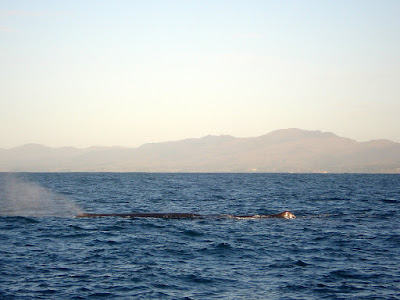
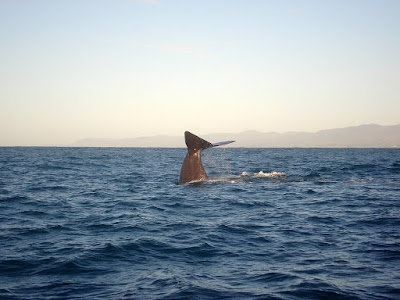
When we drive along a coast road, we mistake the sea for its surface, and consider the waves and swell to be all there is. For the Sperm Whale, the surface is the place where it spends the least time, the place where it comes by necessity rather than choice. It's nothing more than a filling station. A necessary but inconvenient stop to fuel its deeper activities. It is also the interface where man and whale interact, where the whale becomes an agent in the human economy. I hope that its market as a target for the camera-shutter rather than the harpoon remains viable.
They used to attract the whaling industry of course, but in New Zealand that all came to an end at the end of the 1970s. Apart from the ecological considerations behind the decision to ban whaling in NZ waters, the economic results are interesting. Whales in Kaikoura are like the trees on Fraser Island in Queensland, in that they are worth more alive than dead. The tourist industry here in New Zealand isn't just about bungy jumping and tequila slamming. It's about hiking through nature reserves and observing wildlife in its natural context. Conservation-based tourism is big business. Just about every reserve or animal encounter we have seen on the South Island is in private hands, and in each case the result of tourism is increased stocks and greater understanding of the creatures in question. The inclusion of wildlife in the global money-go-round seems to be working to the mutual benefit of economy and ecology alike. Economic pressures tend to operate in favour of conservation at the moment, but what happens in the case of a downturn?
Take the yellow-eyed penguins we saw on the Otago Peninsula. They are the rarest penguins in the world and their fate is now inextricably linked to the bottom line in the privately-owned Penguin Parade, and by extension to the global human economy. In this case, Penguin Parade isn't just an organization that brings you to see the animals in their natural environment, they are the animals' landlords. They own the patch of land that is the Yellow-Eyed Penguins' remaining breeding colony. Any number of international conservation charities would happily contribute towards the stabilization of Yellow-Eyed Penguin numbers, but Penguin Parade prefers NOT to take their money in order to continue running the business as they see fit. To be fair, they put their money into replanting the tree and shrub cover whose loss originally led to the dwindling number of this rarest of penguins. But if Penguin Parade ever goes out of business (perhaps tourist numbers will drop in the future thanks to increasing costs in flying?) then the penguins are on their own again. Or worse - evicted from their only remaining habitat in order for that land to realise a greater economic value. Many want to see the environmental cost of flying reflected in the cost of airfares. But economies can be as complicated as ecologies, and one side-effect of this move might be the collapse of global wildlife-based tourism, with consequent collapses in conservation efforts. I have no idea of course - I'm just speculating.
But I wasn't thinking any of these things on Thursday morning as we motored out of South Bay, and off the edge of the continental shelf, with the privately-owned Kaikoura Whalewatching company. All I was interested in was seeing some whales, and I got what I wanted. In two hours on the water we had three close encounters with Sperm Whales. The way we used to find them was the same hunting technique as formerly used by whalers. These mammals are deep divers, resting at the surface to breathe for 10-15 minutes, re-oxygenating their muscles, before diving for 30-40 minutes. They announced ithemselves with 2-meter spumes from their blowholes, giving us time to race over to them to watch their heads and torsos bob above the surface for a short while. Then finally, as they began their next dive, they lifted their powerful tails gracefully above the waterline, sinking out of sight and leaving a growing circle of flat water known as the whale's footprint.
When we drive along a coast road, we mistake the sea for its surface, and consider the waves and swell to be all there is. For the Sperm Whale, the surface is the place where it spends the least time, the place where it comes by necessity rather than choice. It's nothing more than a filling station. A necessary but inconvenient stop to fuel its deeper activities. It is also the interface where man and whale interact, where the whale becomes an agent in the human economy. I hope that its market as a target for the camera-shutter rather than the harpoon remains viable.
Sunday, June 1, 2008
Plans and their Enemies
"No plan of battle ever survives contact with the enemy". I've heard this quote a number of times and it makes sense to me. I thought we would learn how to roller-blade together in Sydney, ice-skate in Christchurch, and ski in Queenstown. But once we got to these places, things took their own course. But that's OK. The adage is meant to reassure that it's not so much the plan as the planning that really prepares you for the fight.
But what fight? What is the enemy in a round the world trip? It's the same one we all fight back home. Time. Eight months sounds like a long time, but it's not. It ambushes you each time you look at the calendar. Eventually you ask, so much time has passed already, and what do we have to show for it?
When we started traveling in China I was expecting chaos without, and turmoil within. But it wasn't like that. Despite our strange and sometimes chaotic surroundings, it was still us. We were still the Lawlors, operating as ever we did, dealing with new situations. And that was a good thing. Now, with two-thirds of the trip-of-a-lifetime behind us, living in a city that is similar (too similar?) to what we left behind, we are still the same family. And somehow that feels not so good anymore.
I was as certain as I could be about anything that this journey would change us as individuals and as a family. And yet I see no evidence of it. Perhaps we will only see the full picture in the rear-view mirror when this trip is behind us. Sometimes I think I catch a glimpse of fragments of that picture here and there, scattered along the road we are traveling, blurred by the speed at which we're moving. But probably it's just the product of a mind that demands signs and patterns even where there are none.
We're leaving Christchurch first thing tomorrow morning. It has been the perfect base from which to visit the rest of the island, and thanks to the home swap (which included the use of a car) we're slightly under budget, for a pleasant change. We're taking two days to get up to Wellington, and we expect to find a very different city there. It would be reasonable to say that Christchurch is more like a very big suburb than a city, and a conservative one at that. (One of the things that caught my attention here was - don't laugh - the length of school uniform skirts. The poor unfortunate girls of Christchurch have to wear ankle-length tartan curtains that to me seem practically Taliban. The length and the pattern give away the Scottish influence that I think lies behind this conservatism.)
Museums here in Christchurch were not up to much (especially the Science Museum), whereas Wellington is home to the famous Te Papa museum - walking distance from our apartment. For the first time since Shanghai we'll be living in the centre of a city, and the idea is very appealing.
There are some great cafes and restaurants here. Tonight, for example, we will have our last meal in a Sichuanese restaurant called Ginkgo, where we can enjoy the same dishes that we had in Chengdu: Kungpo Chicken, Mapo Tofu and 'fish-flavoured pork' (!).
Despite my various misgivings about the town itself, I'm still experiencing some pathetic sentimentality leaving it behind. This house has been a good home for us, and we will surely miss Willard and Satie, the two cats of the house, whose very different personalities mirror to some extent the differences between Nina and Sara.
Inevitably, the fact that we are already leaving another place behind serves as another irritating reminder of how quickly time is going by. In the end, time is all we really have, and that just makes it harder to watch it flow though our fingers.
But what fight? What is the enemy in a round the world trip? It's the same one we all fight back home. Time. Eight months sounds like a long time, but it's not. It ambushes you each time you look at the calendar. Eventually you ask, so much time has passed already, and what do we have to show for it?
When we started traveling in China I was expecting chaos without, and turmoil within. But it wasn't like that. Despite our strange and sometimes chaotic surroundings, it was still us. We were still the Lawlors, operating as ever we did, dealing with new situations. And that was a good thing. Now, with two-thirds of the trip-of-a-lifetime behind us, living in a city that is similar (too similar?) to what we left behind, we are still the same family. And somehow that feels not so good anymore.
I was as certain as I could be about anything that this journey would change us as individuals and as a family. And yet I see no evidence of it. Perhaps we will only see the full picture in the rear-view mirror when this trip is behind us. Sometimes I think I catch a glimpse of fragments of that picture here and there, scattered along the road we are traveling, blurred by the speed at which we're moving. But probably it's just the product of a mind that demands signs and patterns even where there are none.
We're leaving Christchurch first thing tomorrow morning. It has been the perfect base from which to visit the rest of the island, and thanks to the home swap (which included the use of a car) we're slightly under budget, for a pleasant change. We're taking two days to get up to Wellington, and we expect to find a very different city there. It would be reasonable to say that Christchurch is more like a very big suburb than a city, and a conservative one at that. (One of the things that caught my attention here was - don't laugh - the length of school uniform skirts. The poor unfortunate girls of Christchurch have to wear ankle-length tartan curtains that to me seem practically Taliban. The length and the pattern give away the Scottish influence that I think lies behind this conservatism.)
Museums here in Christchurch were not up to much (especially the Science Museum), whereas Wellington is home to the famous Te Papa museum - walking distance from our apartment. For the first time since Shanghai we'll be living in the centre of a city, and the idea is very appealing.
There are some great cafes and restaurants here. Tonight, for example, we will have our last meal in a Sichuanese restaurant called Ginkgo, where we can enjoy the same dishes that we had in Chengdu: Kungpo Chicken, Mapo Tofu and 'fish-flavoured pork' (!).
Despite my various misgivings about the town itself, I'm still experiencing some pathetic sentimentality leaving it behind. This house has been a good home for us, and we will surely miss Willard and Satie, the two cats of the house, whose very different personalities mirror to some extent the differences between Nina and Sara.
Inevitably, the fact that we are already leaving another place behind serves as another irritating reminder of how quickly time is going by. In the end, time is all we really have, and that just makes it harder to watch it flow though our fingers.
Subscribe to:
Posts (Atom)