When we were on the road, 10 years ago, I wrote almost every day. As a consequence, most times I sat down in front of the laptop, the sentences flowed naturally and easily. So please bear with me as I restart this cold engine, and blog for the first time in many years.
On this day, in 2007, Letizia, Nina, Sara and I began an 8-month adventure/risk/psychotic break (delete as appropriate). I know that this happened not just because I was there (this is in fact my weakest evidence), not just because there is documentary evidence on this blog, but also because every day I am living downstream of its effects. Last night, the four of us sat around the kitchen table in Cagliari to eat dinner, and Letizia asked the girls if it had been a good experience. This might seem like a pointless question with an obvious answer, but if you read the blog entry from 10 years ago, describing the night before we left, you'll note that the girls' cousins tried to hide Nina and Sara under their beds when the time came to say goodbye to everyone. Having more or less the same age, and very much the same perspective on the whole round-the-world undertaking, they all arrived naturally to the same question: Why?
Being a parent is an exercise in failure. It's too complex a role for anyone to do right the first time around. Or the fifty-first. And just when you think you've learned something useful, the role changes and you are instantly demoted from expert to idiot. I'd like to say that Letizia and I knew the answer to the question 'Why?'. We certainly had theories, which we followed with a certainty they didn't deserve. We would have told Nina and Sara that we wanted to show them a little more of the world they had (recently!) been born into. That there was much to see, learn and experience. But really, we didn't know. The phrase that comes to mind would sit better on a headstone than on an inspirational poster: It seemed like a good idea at the time. But was it?
So back to the kitchen table. Nina is now 18 - an adult for goodness sake!! Sara is 16 and is probably more entitled to be called an adult than her dad ever will be. Be aware that these young people are careful with their words, and they have a view on the world that is significantly different from mine or their mother's. They don't give points away for free. Did they think it was a good experience? Emphatically yes. Why? Well, even they aren't sure. They point to some of their own traits and ascribe them at least in part to our travels. A certain openness to other ways of being. A suspicion of national stereotypes. Now that they are coming of age, the fact that so many of their friends are dotted around the planet seems less of an obstacle now. They are ready for more travel. Nina feels like she barely knows Europe, and is hatching plans for an Interrail. Sara is toying with the idea of university in various European countries.
Maybe these traits would have developed even in the absense of The Trip. As Robert Plant sang in Led Zeppelin's 'Ten Years Gone':
Though the course may change sometimes
Rivers always reach the sea
I don't know why. Ask me when another 10 years have gone.
Friday, December 29, 2017


Saturday, May 1, 2010
Foreign Objects Part I: The Bidet
This is the first in a series of who knows how many (probably one) that highlights everyday objects that one might find here in Italy but not where I come from (or vice versa).

There are two kinds of people in the world: those who suffer from a classical education, and those who suffer from the lack of one. Being a member of the second group, every now and then I pick up a book that looks like it might fill in these kinds of gaps (erm, lacunae?), in some vague and vain attempt to upgrade my quiz level from Blockbusters (I'll have 'p' please, Bob) to University Challenge (Here's your starter for 10). The Consolations of Philosophy by Alain de Botton was just such a book, but it had the most unexpected of side-effects. It made me fall in love with a French man. Not De Button himself (who is actually Swiss-born and English-educated) but a certain Michel de Montaigne, an important figure in philosophy of whom I was completely ignorant. Falling in love with a man - and a French one at that - is inconvenient for a married heterosexual father of two. That the chap has been dead for over 400 years makes the whole situation more difficult to resolve - though easier to ignore.
So why did I fall in love with Montaigne? Well for one, because this particular philosopher wrote about farting. He wrote about a great deal more of course, but he considered no subject that was relevant to humans to be out of bounds. On the ceiling of his study, amongst the dozens of other quotes, was a motto from Terence (whoever he is) "Homo sum, humani nihil a me alienum puto": I am a man. I consider nothing that is human alien to me. In writing about every intimate angle of our existence, Montaigne has given us all permission to be fully and unashamedly human, and has freed us from the ugly suspicion that our private lives and thoughts are often beyond the bounds of what is permitted - or worse - what is 'normal'.
And if that wasn't enough, he also gives me the permission to write about that most worrisome of Southern European household fixtures: the bidet. The mere word has enough echoes of titillation and disgust in the Anglo-Saxon world to render it almost taboo. Certainly not a subject for polite conversation. Besides its base function, the main sin of the bidet that it is foreign, and therefore automatically deserving of suspicion. Which brings me straight back to Montaigne.
This was a man who refused to be bound by the narrow confines of nationality. He lived in France but his mind had been influenced from the beginning by the teaching and writings of a host of others from far and wide. "Everyone calls barbarity what he is not accustomed to". For him, the human experience was too vast and too varied to be contained by the laws and morals of any one country. That's not to say that he was a cultural relativist either: Everything could be judged, but should only be judged on its own merits and not one what national borders contained it.
So to my fellow non-Italians, and all other readers who might have acquired a firm though unarticulated mistrust of the bidet, I would like to try to rehabilitate this particular foreign object. Not because it is foreign, but because it is, in and of itself, an item of great and universal value to hairy-arsed humans everywhere.
Consider the problem, and its known solutions.
The problem (and one rather impractical solution) can best be considered through an old joke that I first heard when I was around 10:
A bear is in the woods, doing what bears are famous for doing in the woods, when a rabbit hops by. By way of making conversation, the bear asks the bunny "So. Does the shit stick to your fur when you go for a dump?"The rabbit, in an understanding tone, answers "Oh yeah man, all the time".So the bear picks up the rabbit and wipes his ass with it.
I apologise. Not for the crudity but because I'm sure you've heard the joke already.
Where I come from, there is one and only one socially acceptable solution to the above problem (I will spare you another joke about a Kerryman who goes to the city to buy a toilet brush). And we are all the poorer for it. We consider it somewhat louche and Mediterranean to want to transfer, post-poop, from the toilet to the bidet. But we see nothing wrong with scrubbing ritually for minutes, adhering to the long-disproved myth that this will actually result in a clean backside. I am a scientist by both inclination and training and I have a lifetime of control experiments, erm, behind me. I am here to tell you that nothing, but nothing, beats a bidet for that 'fresh feeling'. And all the multi-ply, extra long, fluffy labradors in the world will never change that fact.
So take a lesson from Montaigne, the philosopher who ridiculed the tiny differences in national custom that we like to exalt into profound philosophical divides. He, it must be admitted, knew his shit.
A match made in heaven...

(Somebody's bidet - certainly not mine)
Monday, April 12, 2010
Where was I?
It's been so long since I've blogged here that it's pointless picking up from where I left off. It's been more than eight months since our move to Cagliari, so I'm going to jump straight in and try to give you a feel for the place over the next few posts.
Titles
There's something that I've come to understand after years of moving around: it's easy to like a place enough to want to live in it; it's quite another matter liking it enough to want to die there. There's a cemetery not far from where we live, and absurd as it may sound to some, it's a beautiful place to take a walk. They don't bury folks there any more - it's more of a monument than a functional graveyard - but it contains enough generations of cagliaritani to be considered a museum of personal histories.
The trees and tombs form orderly ranks and files stretching away from the main gate, and upwards along the slopes to the right. In the lower terraces, simple plaques set into uniform walls mark the final resting place of most of Bonaria Cemetary's residents. Further up the south-facing slopes, above the tree line and warmed by the year-round sun, mausoleums and miniature chapels hoist important surnames high above the hoi-polloi.
Italy is considered by many to be a nation of individualists, and I think this is more or less correct. The general disdain in which Italians (as a group) hold other Italians (as a group) is evident in everything from the polemic nature of public discourse to the no-prisoners-taken attitude on the roads here. But Italy is also a place where deference to one's social 'superiors' is evident. Titles and positions are not only prominently on display on letterboxes, business cards - and gravestones - but almost piously observed in communications. It's practically an insult to refer to somebody simply as signore (sir) when you know damn well he's a lawyer and should be addressed as avvocato. The titles can get humourously out-of-hand. Onorevole, meaning honourable, is used to refer to members of the lower house of parliament and is used regularly on TV and in public without any irony whatsoever. My personal favourite, which I discovered only recently, is the title accorded to the dean of a university: rettore magnifico - Magnificent Rector. If you write to the head of your university, it is with this absurdity that you must begin your letter.
Deference and individualism might seem like opposites at first glance, but they can co-exist quite easily when you remember that deference only requires the appearance of respect. Geert Hofstede (hat-tip to Dale Wyttenbach) has compiled country-by-country values of something called a Power Distance Index, which attempts to measure the degree to which people at the bottom of the social heap accept and expect that power is not shared equally. In other words, it is an indication of how willingly those with little power accept their lot.
(In fact if I do a comparison between my own native culture in Ireland, and that of Italy, I find that we are not terribly well suited from the point of view of risk aversion or deference to authority.)
Però
I've had countless animated conversations with Italians in general, and Sardinians in particular, about the many and varied problems facing this region and this county. The dynamics of such conversations follow a consistent pattern. My Italian friends begin by slamming complaints on top of each other, books of evidence piled up against the criminal state of affairs here. Then the pace quickens and the anger deepens into a downward spiral that can sometime end up in absurd or paranoid claims about how this is the worst place in the world to live and how it will never change. And then, in the end and when you least expect it, the diatribe pivots on a single word: però. (But. However. All the same.)
"Però ci si sta bene". (It's a nice place to live all the same.)
I don't know if Bonaria Cemetary (Cimitero di Bonaria) appears on any guide books, but if you find yourself in Cagliari and in need of some respite - and a great view of the city - then you could do worse than to spend some time here. Me, I could happily spend an eternity there.
Però...
Saturday, August 22, 2009
Badly Behaved Children
No less than 6 weeks have passed since we rolled off the ferry in Porto Torres and officially began to call Sardinia 'home'. The last 2 of those weeks I've spent back in Cork for work. My complete inability to blog in the 4 weeks in Sardinia is an indication of how completely and quickly I've settled in. I find that I can blog when I'm on the road (I'm writing this from Cork airport on my way back, erm, home, to Cagliari), but I haven't yet found a place in my normal life's routine for this activity. I will, though. Promise. In the meantime, I'll catch up where I left off.
We left peaceful Brittany and made the 4-hour drive (in five-and-a-half hours) to Paris, a place that by contrast manages to make an awful lot of noise. New York might be the city that never sleeps, but Paris is the city that never shuts up. It even snores. Certainly the Quartier Latin where we were based, has a variety of auditory expressions that would rival a philharmonic orchestra. The morning is announced by rubbish trucks and delivery vans, emptying the detritus of the previous night's excesses, and stocking up for the reprise. They are kept company by the bells of nearby churches, each with a slightly different opinion as to when the hour strikes, and how it should best be announced. The Greek restaurants start their plate-smashing from around 6 in the evening, competing with all the other tourist restaurants for the cobble-weary, knapsacked footfall. The buskers kick in on every corner with a different instrument and genre, which mixes into perfect dissonance by the time it reaches our window on the second floor of Rue Saint Severin. The final movement of the day's symphony includes a clutch of beer-soaked choristers, shouting instructions to each other from distance of 1 meter or less, before rolling in to passing taxis, or passing out in hotel foyers. The curtain goes down. You may sleep now. You have 4 hours before the garbage collection begins again.
Paris was our first city together. Letizia and I met in Dublin, but shared our first address in Paris. We stayed there long enough to know it as a living city rather than a collection of monuments. Paris is one of our horcruxes - we embedded a little splinter of ourselves here. Every time we come back, we experience a familiarity that disarms the foreboding of its features and facades. But we know its disadvantages too. I associate Paris with fatigue. It is a place that sucks the energy out of you - though of course you may enjoy the experience. Paris (within the peripherique) is a relatively small city when compared to say London, and it has a public transport system that works well. But somehow, inexplicably, everything you want to do takes a lot of time, and every joule of energy you spend seems to attract a hefty tiredness tax. (This isn't just me showing my age - I remember the very same effect 15 years ago as a - sigh - young man.) The street drains you with every footstep. It surely didn't help that for our three days there, most of those steps led from one clothes shop to the next or from one Disney attraction to the next.
For those readers who followed us around the world on this blog, I can tell you that my duties as a shopping companion correspond very closely with those of Assistant to Official Tour Photographer. In both roles, the most frequent instruction (by now unspoken, but completely understood) is 'hold my bag and keep out of the way'. Such is my expertise on the matter, I can offer tours of Paris' most authentic shopping experiences, complete with an explanation of where to find a place to sit down in even the most minimalist of shop interiors.
One thing that surprises a lot of visitors is how well and how *cheaply* one can eat in Paris. The high price of beer no longer leaves the Post Celtic Tiger Irishman breathless, but the low price of food - if you go to the right place - still has the power to shock. One of the most enjoyable was a fresh noodle restaurant recommended to us by our Sardinian friend Silvia who came to live in Paris around the same time we did and lives there still. Paris isn't the only thing Silvia and we have in common. Silvia also has a daughter called Nina - though much younger than our own. When dining together with friends and their children, sometimes a little patience is called for from all parties, and the younger the child, the more patience is required. In such circumstances, I would not normally complain about the behaviour of a friend's offspring, and certainly not on such a public forum as this (Silvia is a reader of this blog). But I have to make an exception in little Nina's case, when we met up with Silvia for noodles one lunchtime. Perhaps it was the heat of the day, perhaps the noise of the waiters shouting at each other in French and Mandarin, but this young lady did nothing but irritate her mother from the dumpling starter to the final sip of coffee. At one stage - I'm not making this up - she actually kicked Silvia. I did my best to look the other way, and pretend that nothing had happened, but obviously it was a very awkward moment. All I can hope for is that her behaviour gets better after she is born.
Thursday, July 9, 2009
Afloat Again, Happily
We have just spent our 5th night on the road: one night on the ferry to France, one night in Brittany with our friends the Crowleys (who we believe might still be our friends after our departure - though I might be misinterpreting the nature of their enthusiasm on the morning of our departure as something more substantial than relief), and three nights in my sister-in-law's apartment in Paris (one of which the said sister-in-law was brave enough to spend with us before leaving for the South). Now is as good a time as any to recount some of our travels so far. But in keeping with tradition, it's late and incomplete.
Perros-Guirec is a beautiful resort town on the Northern end of Brittany. It's where Parisians come to unwind, and where our friends Elizabeth and Andrew and their two beautiful and delightful daughters came to live after many years in Cork (Elizabeth is a Breton - or should that be Bretonne?). We woke them up at some unspeakable hour which my watch doesn't even register, and instead of hurling insults and other, heavier, items from their upper windows, they called us in, fed us, and even listened to me drone on and on about how the world was still bobbing up and down after the boat trip. We had driven for an hour to get from the ferry to Perros-Guirec, passing through some very sleepy towns along the way, one of which had a name that demands some attention: Saint-Michel-en-Greve. I happen to know for a fact that this means "Saint Michael on Strike"*. If this kind of stereotypical town-naming is allowed to continue, what's next? An Irish town called Saint Patrick Goes On The Piss. Or somewhere in Essex called Saint George Pines After The Empire?
I digress.
Andrew and Elizabeth took us down to the beach that is the focus of Perros-Guirec, where the girls began to play together in that happily un-selfconscious way that kids of that age still manage. The sun was pleasingly warm without actually hurting, an occasional passing cloud bringing some welcome shade. It was almost perfect. The fly in the ointment was the coefficient, which stood at a disappointing 55 - very low for this time of year, I think you'll agree.
What's that? You don't know what coefficient I'm referring to!? Well, if you ever come to France, and in particular Brittany, you'll want to bone up on this matter, as apparently it forms the basis of some 82% of all conversation you are likely to have with the locals. In fact the best thing you can do, pretty much as soon as you get off the ferry, is make your way to the whiteboard that will be on display somewhere near whatever beach you find yourself on, and memorize the 8 or so meteorological statistics that will be written there. Time of high tide, low tide, air and water temperatures, and of course, the coefficient. It is a very French thing, you will find, to encode all possible facets of daily life into Cartesian co-ordinates. I suspect that the meaning of most of these numbers is immaterial - it is the mere fact that they exist that gives them a sense. They give comfort in an unpredictable world. They tell you that somebody somewhere has a formula, that measurements are being taken at regular intervals, and that answers are being arrived at which eventually find their way onto whiteboards on Breton beaches. And that surely means that the rest of us can relax, or at least restrict our worrying to those results that lie outside seasonal expectations. The other 18% of the time, we can find something else to worry, and converse, about.
After Perros-Guirec we drove to the nearby Ploumanach, a gorgeous coastal town with a particularly unusual setting thanks to the pink granite that forms its border with the sea. Andrew and I settled into an easy dialogue where I would bang on about how, even now, the scenery continued to bob about thanks to my sea-legs, and he would keep mentioning the pink granite. This is the kind of conversational direction that can take hold when two men who don't know much about sports, or indeed tidal coefficients, attempt small talk. As the day wore on, we were forced to abandon the shallow-end chit-chat, and head for the deeper waters of philosophy, software and comparing the Irish with the Bretons. I fear that it is the lot of the ex-pat to continuously compare his homeland and its people with the adopted country of residence. No matter how urbane and well travelled we think we might be, there are some things that will be forever foreign. For Alan, it might be the stuborn French habit of pronouncing 'j' like 'g' and vice versa. For Andrew, the irrational absence of pub-quizes will probably always offend his Irishness. For me? Well, I have my suspicions about what the pebbles on my windscreen will be as I drive towards a new life in Italy. But let's just wait and see, shall we?
Despite their early start the next day, Andrew and Elizabeth kept us company until late, when we all retired to the utter silence of the Breton night. I fell asleep instantly, and slept deeply, rocked to sleep by the last internal eddies of the Atlantic tide.
*Alright - not entirely true. A greve, as well as being a strike, is also the word for a stoney beach. This blog will never let the truth get in the way of a mediocre story, but will at least endeaver to present it as a footnote.
Friday, July 3, 2009
Casting Off
It's our last evening in Ireland.
Yesterday, the cut-rate courier arrived at our address to relieve us of 8 boxes of our worldly goods. He arrived late - hours late - emitting, as one English politician famously said of another, "something of the night about him". It appears that his journey was taking him to West Cork after our house so it may very well be that our 8 boxes, packed and prepped for their new Mediterranean home, will make it no further south than Bantry. This is the risk you run when you go for the cheapest bidder - the suspicion, no, the expectation, of disappointment.
And if we lose the boxes? What of it! According to Nina, we'll just go look for them. It will be an excuse for another round-the-world trip, hunting down the boxes. A global treasure hunt where the prize is a few copper pots, cookery books, stuffed toys, jigsaws, and the occasional old friend.
In managing the move, we have done a triage: What do we need on the road or immediately on arrival? (Packed in car.) What do we need soon after arriving? (Boxes by courier.) What do we need once we have established ourselves in Cagliari? (Removal company.) There is a fourth category, into which I suspect most of our 'stuff' belongs. But it has been years now that making bonfires on one's own back garden has been against the law, so it'll just stay here indefinitely. Perhaps I can get NAMA to take it on?
The trip itself can be broken into three sections (and easily reassembled, one hopes). Brittany, where we impose ourselves for the night with our friends Andrew and Elizabeth, formerly of this parish. Paris, where we impose ourselves for 3 nights with Letizia's sister Giovanna (our New Zealand fellow traveller). And Piedmont in North Italy, where we will impose ourselves on the Biaggi family, who we are accustomed to meet on the beaches of Sardinia (I wonder if we'll recognize each other with our clothes on). If this trip had a theme it could be "How to travel long distances without forking out for a hotel room". Simon and Leah in Brisbane will attest to our ability to make ourselves at home in a place that somebody else already made theirs (guys - I wish your place was on the way too - I could really do with an evening on your couch, drinking your beer, and hogging your conversation.)
In total, we're looking at around 1600km of driving - that's a little less than Santiago de Chile to Iquique, or a little more than Canberra to Melbourne and back (raising the obvious question, why would you go back to Canberra?) But I can't wait to get on the road. The emotion of motion is already clouding my thoughts, to the point where I almost don't care where we end up. A wrong turn could take us anywhere. And that's OK by me. All roads lead to Home.
Even if it turns out to be Bantry.
Thursday, July 2, 2009
Cardboard Boxes and Metal Hearts
Over the last few weeks, I've been asked 'Are you packing?' more often than a buyer at a drug deal. The answer until now has always been 'no' (leading naturally to a quick frisk, just to make sure). And now, all of a sudden, 8 cardboard boxes are waiting silently in the hall this morning, ready for collection and transport. Tomorrow we'll prepare what is to go in the car with us. The day after, we sail.
Nina and Sara are on a disturbingly even keel. They've had their last day at school, their last art class, and a few other 'lasts', and so far they have kept their heads (when many others around them were losing theirs). I'd like to think that this indicates they are emotionally balanced young ladies, but I have to allow for the possibility that Letizia and I have reared two titanium-hearted sociopaths. Or perhaps more tellingly, that Letizia and I are two titanium-hearted sociopaths, and the two girls never really stood a chance.
The last 2-3 months since Easter have been probably the most socially active time we've had in 9 years in Ireland. There wasn't a weekend where we didn't have somebody to see or something to do. And the weekdays weren't slack either. But this oddly enough makes it easier to say goodbye to Ireland (and the mid-Summer rain that's been dampening spirits over here last week doesn't hurt either). Decorum would demand some regret, some sense of loss. But the only effect that the packing has had on me is to give me bags under my eyes.
It might just be that though we've lived here for 9 years now, we never really unpacked.
Friday, May 29, 2009
Life Part II: Back on the Bus
I'll regret this. Probably not as much as you, but I will regret this. I'm going to open this blog up again.
It has been more than eight months since we got back from our around the world trip. That is, we've been back in Ireland longer than we were ever away. The memory of those times is cataloged with all the others of our family life. They weave through the fabric of our family life as easily as we dip in and out of them. Unexpectedly, the memories are sometimes painful. No feelings of regret, just the bruising that comes with seeing how quickly time has gone by. Things happen quickly.
Since our return, I've been to three funerals, one christening and a Holy Communion (that's a lot of church for a heathen like me). My boss nearly got wiped out mountaineering in the Italian Alps (one of his climbing buddies didn't make it). Two uncles, an adoptive grandmother, and a primary school contemporary are no more. And I have finally hit 40. What can I tell you. If mortality were any more in my face, I'd be holding my nose.
But while I am officially in the second half of the game, there is still everything to play for. If there is one thing I know how do well, it's change. Moving. Starting again. (Running away?) And so we're getting back on the bus. We are leaving Ireland and moving to Letizia's home town of Cagliari, Sardinia. (My long-suffering employers have agreed to let me continue working for them from there.)
This move is the excuse I've been looking for to open fire again on this blog. Sardinia is a place I know well, but have never really lived in. It is a place that I have loved and hated for different reasons and in very unequal measure (on balance it is a place that I believe we can safely call home - for a while at least). For what it is worth to you, and for as long as it might last, I propose to offer a view of life on another island, a diary of a relocated family, and whatever else a brewing midlife crisis will provide. I will avoid, unless humour and a good story demands otherwise, the cliche'd rants on overpaid Italian bureaucrats, crazy driving and endemic gangsterism (in any case, my Irish readers won't find anything novel enough in that).
If truth be told I'm not sure where this blog is going. But if you enjoyed following us around the world, tune in and follow our latest attempt to escape from reality.
Monday, September 15, 2008
In Defense of Optimism
The first political idea I ever remember absorbing, when I was very young, was that history moves in cycles. The idea came straight from my mother, and because it became so deeply ingrained, I've looked at both history and current affairs though that assumption ever since. When you look at particular episodes of human history, they really do come across as variations on eternal themes. In fact I'd go as far as to say that theories to explain our past are only credible if they take into account these themes. Human history is, after all, build on human nature. And since history began, human nature has changed very slowly, if at all.
I blogged about this while in Arequipa, comparing the Incas' ambitions of empire with those of the Spanish. Later in Cusco I returned to the theme, trying to explain why I couldn't trust our guide Natalie's portrayal of an entirely benign Inca culture. It occurred to me then that what I was saying about human nature probably came across as fatalistic, and even pessimistic. I'm neither of those things, and so for my own peace of mind I can't leave it there. I need to explain myself a little better. For your own peace of mind, you are better off ignoring me.
Fine - stay. But I did give you fair warning.
I said that I was damn glad that Nina and Sara were not born into Juanita's time, or the time of the Santa Catalina nunnery. I am happy that they will have the chance to live beyond a brutal and premature end as a human sacrifice (assuming they behave), and beyond the confines of the cloisters. Of course I should have said time and place. There are parts of this planet where humans, and especially female ones, have strict limits imposed on their aspirations. In the small villages of Peru, like Akorakai, adolescents depend on missions like the Medical Centre of Belen for sexual education, but they are usually delivered, unfortunately, without any reference to artificial contraception because of the Catholic sensibilities of those staffing and running those missions. Early pregnancy is, unsurprisingly, very prevalent in such communities. Today, girls in places like North-East Africa are more likely than not to have their genitalia mutilated in the name of religion or culture. Child labour and soldiery are rampant, and make a mockery of all our fine century's worth of legislation. Nothing has changed.
Nothing has changed. The incubus of medieval superstition and faith-driven barbarism seems to sit on the chest of our pretenses to progress in the industrialised world. We continue to make the same historical mistakes. Today's empires use different instruments to achieve the same ends as
Cortes, Pizzaro, the British admiralty and the Sons of Heaven. And yet - here am I writing about this from the comfort of my kitchen table, with my un-firewalled access to the internet and my uncensored bookshelf to refer to, in a country that less that a century ago was a dominion and now enjoys autonomy. A country that a century ago was ruled as much from Rome as from London, but now respects the necessary gap between church and state. Sitting at the edge of a continent that a century ago was about to descend into bloody civil war, but now has learned the error of its ways. Something surely has changed.
Something has changed, but what? Not human nature. The situation has changed. According to Philip Zimbardo, designer of the Stanford Prison Experiment and author of The Lucifer Effect (how good people turn evil), the situations in which we find ourselves have more of an influence over our behaviour than the kind of person we are. It's obvious that the situations in which we find ourselves are dictated by the systems in which we live, and those in turn are built by history. The way we live today is shaped by the memory of the accumulated mistakes and successes of our planet's past, and as such, it has the capacity to improve.
If you want to fall asleep how do you go about it? (Try to get to the end of this blog entry, I hear you say). You close your eyes, lie down and breathe deeply. In short, you pretend. Sooner or later, depending on how much coffee you've swilled that day, your pretence turns to reality. How does a society shape itself into what it wants to be? It pretends. It makes laws that may or may not be well enforced, may or may not be well supported, perhaps representing merely a cynical ploy from cynical legislators. Give that law a generation or two to bed in, and it becomes the norm, the starting point for the generation of legislators. The abolition of slavery, the introduction of universal suffrage, the abolition of capital punishment (where that has happened) are examples of building society from the facade inwards.
It's ironic that the central argument in the Zimbardo's book, which at first blush seems pessimistic, is actually a great relief. We don't all have to be heroes or saints - this would be impossible. As a group, we just need the right structures in place to keep us civilised. (The subtitle of the book could just as easily be how evil people turn good.) It's possible to see this aspect of our human nature as a reason in itself to be downbeat, and point out that civilization is just a veneer over the beastly truth. But what a veneer! Nobody scoffs at Everest because it's just part of a thin Earth's crust. Nor should they undervalue the veneer of human civilisation. It did not have to come into being. It didn't come about by accident. It arose from our nature as a species. And while we do keep repeating the same mistakes, as our civilisation gets older, and our our various national histories get woven into one international story, we are getting just a little better.
I blogged about this while in Arequipa, comparing the Incas' ambitions of empire with those of the Spanish. Later in Cusco I returned to the theme, trying to explain why I couldn't trust our guide Natalie's portrayal of an entirely benign Inca culture. It occurred to me then that what I was saying about human nature probably came across as fatalistic, and even pessimistic. I'm neither of those things, and so for my own peace of mind I can't leave it there. I need to explain myself a little better. For your own peace of mind, you are better off ignoring me.
Fine - stay. But I did give you fair warning.
I said that I was damn glad that Nina and Sara were not born into Juanita's time, or the time of the Santa Catalina nunnery. I am happy that they will have the chance to live beyond a brutal and premature end as a human sacrifice (assuming they behave), and beyond the confines of the cloisters. Of course I should have said time and place. There are parts of this planet where humans, and especially female ones, have strict limits imposed on their aspirations. In the small villages of Peru, like Akorakai, adolescents depend on missions like the Medical Centre of Belen for sexual education, but they are usually delivered, unfortunately, without any reference to artificial contraception because of the Catholic sensibilities of those staffing and running those missions. Early pregnancy is, unsurprisingly, very prevalent in such communities. Today, girls in places like North-East Africa are more likely than not to have their genitalia mutilated in the name of religion or culture. Child labour and soldiery are rampant, and make a mockery of all our fine century's worth of legislation. Nothing has changed.
Nothing has changed. The incubus of medieval superstition and faith-driven barbarism seems to sit on the chest of our pretenses to progress in the industrialised world. We continue to make the same historical mistakes. Today's empires use different instruments to achieve the same ends as
Cortes, Pizzaro, the British admiralty and the Sons of Heaven. And yet - here am I writing about this from the comfort of my kitchen table, with my un-firewalled access to the internet and my uncensored bookshelf to refer to, in a country that less that a century ago was a dominion and now enjoys autonomy. A country that a century ago was ruled as much from Rome as from London, but now respects the necessary gap between church and state. Sitting at the edge of a continent that a century ago was about to descend into bloody civil war, but now has learned the error of its ways. Something surely has changed.
Something has changed, but what? Not human nature. The situation has changed. According to Philip Zimbardo, designer of the Stanford Prison Experiment and author of The Lucifer Effect (how good people turn evil), the situations in which we find ourselves have more of an influence over our behaviour than the kind of person we are. It's obvious that the situations in which we find ourselves are dictated by the systems in which we live, and those in turn are built by history. The way we live today is shaped by the memory of the accumulated mistakes and successes of our planet's past, and as such, it has the capacity to improve.
If you want to fall asleep how do you go about it? (Try to get to the end of this blog entry, I hear you say). You close your eyes, lie down and breathe deeply. In short, you pretend. Sooner or later, depending on how much coffee you've swilled that day, your pretence turns to reality. How does a society shape itself into what it wants to be? It pretends. It makes laws that may or may not be well enforced, may or may not be well supported, perhaps representing merely a cynical ploy from cynical legislators. Give that law a generation or two to bed in, and it becomes the norm, the starting point for the generation of legislators. The abolition of slavery, the introduction of universal suffrage, the abolition of capital punishment (where that has happened) are examples of building society from the facade inwards.
It's ironic that the central argument in the Zimbardo's book, which at first blush seems pessimistic, is actually a great relief. We don't all have to be heroes or saints - this would be impossible. As a group, we just need the right structures in place to keep us civilised. (The subtitle of the book could just as easily be how evil people turn good.) It's possible to see this aspect of our human nature as a reason in itself to be downbeat, and point out that civilization is just a veneer over the beastly truth. But what a veneer! Nobody scoffs at Everest because it's just part of a thin Earth's crust. Nor should they undervalue the veneer of human civilisation. It did not have to come into being. It didn't come about by accident. It arose from our nature as a species. And while we do keep repeating the same mistakes, as our civilisation gets older, and our our various national histories get woven into one international story, we are getting just a little better.
Wednesday, September 10, 2008
Half a World Away
Today I was trading notes with a friend who spent some time in New Zealand. Before ever we left, he and I had talked a little about his time there, spent exclusively on the South Island. Interested though I was back then, it was an entirely different conversation this second time. Once again, being there makes all the difference. The abstract concept that I had mentally filed and labelled 'New Zealand' a year ago has been erased, and in its place are memories of a real country.
I never did find the time in South America to come back to the topic of New Zealand on this blog, so I hope you'll indulge me in a little reverie and soapboxing now.
Two images come immediately to mind when I think back on our time in NZ - especially on the South Island - that were constants in an otherwise ever-changing landscape. Firstly, the braided river systems. Wide stretches of rockstrewn flatlands through which trickled a few inches of water. Every time we drove over a bridge, we saw another one. The second, was the permanent company of birds of prey which hovered over every road we travelled like an Unholy Spirit. Both of these images bring me back immediately to the sensation of motoring though thousands of kilometers of breath-taking New Zealand beauty, and I once again experience the sense of mission and common purpose that seemed to travel with us during those weeks and months.
I'm happy to say, once more, that nostalgia plays no part in these memories, because nostalgia suggests some element of regret. And we regret nothing about NZ - not even saying goodbye when the time came. We had an unforgettable time there, made some new friends (I will email Dee - I really will!), and in 12 weeks we got to almost every angle of those amazing islands. We got, if I can be so mercenary, what we came for.
That said, I can't pretend to really understand New Zealand in any profound way, because I didn't get to understand any New Zealanders very well. They are a welcoming, hospitable people who nevertheless retain a degree of reserve that differentiates them from Australians. This is emphatically not a criticism, just an observation from somebody who has acquired the Irish habit of assuming everybody wants to be his best friend. 'Reserve', to an Irishman, is something one does to a hotel room.
It could be that the difference between Australians and New Zealanders (and in a very tenuous way the difference between the treatment meted out to the Aboriginals and the Maori) can be partly explained by the kind of people who travelled from these islands to those ones, around 150 years ago, to populate the new colony. If Australia was the dumping ground for the criminal class, New Zealand was the Ark that would carry those who wished to leave the iniquities of Britain and found a new Better Britain in the south seas. Christchurch, for example, was founded by an association presided over by the Archbishop of Canterbury and whose advertising...
...sought diligent labourers who could be vouched for by their local clergy. It was altogether a different way of making up the numbers than the policies that were been pursued in Australia. And this goes some way towards explaining why the percentage of Irish in New Zealand has always been much lower in New Zealand than in Australia, English and Scottish being the two dominant colonising cultures. Many generations have come and gone of course, and gold rushes in particular must have changed the composition of the population, but I feel that something of that original conservative and religious character remains around the South Island in general and Christchurch in particular (remember those absurdly long school uniform skirts!?).
But here's the kicker: I suspect that it was because of that streak of religious conservatism that New Zealand established practices that today would be considered the work of liberals. New Zealand was famously the first country in the world (yes, the whole world) to give women the vote. It was also the first, as far as I know, to set up something like social security. It was, in short, a great big open-air social experiment, and Kiwis knew it and were proud of it. They were driven not by a modern radical spirit, but out of a modern application of widely-shared christian values. That coin's other face showed itself too, for example in a relatively late acceptance of legalized homosexuality (1986) - seven years before Ireland, it should be noted, but still tardily at odds with NZ trail-blazing in other matters.
And of course I can't help but wonder whether this deliberately worthy approach to social mores, informed as it was by christian charity, might not have shielded the Maori from some of the worst excesses seen in Tasmania and mainland Australia. Don't get me wrong - the Maori had it bad and for a while it looked like they and their culture wouldn't last. But since 1867 New Zealand provided for Maori representation in parliament. It was only four seats to be sure, a sop with little political power, but it was four more than in any Australian colony, and these crumbs were enough to feed the political ambitions of certain sections of the Maori community, Apirana Ngata perhaps the most famous of these, his bust on prominent display in the foyer of the House of Parliament in Wellington. Mere gestures like those four seats, even if made cynically and in a paternalistic spirit, are made in any case because there is public support for the ideals that they feign. And once institutionalized, they can grow in significance over generations until they finally become what they first only pretended to be.
Today in New Zealand Maori culture is strong. There are problems for sure, but the situation is incomparable to that of the Australian Aboriginal. Anne, whom we met at a Wellington Bookcrosser meeting, told me that Maori in Australia (and there are many) find communicating with Aboriginals there to be as hard as talking with Martians. Some Maori idealists of Anne's acquaintance returned from missions in the Oz outback bitter and even racist.
As I suggested in an earlier blog entry, the Maori themselves were certainly better prepared for Europe's arrival, thanks to their agriculture and all that it led to in terms of social structures and complexity. This social and cultural similarity with Europeans meant that in times of war the Maori were able to fight back and in times of peace there was a great deal of intermarriage. But it was the nature of those who came to settle their lands too, which had an influence on the fate of the Maori, cushioning what might have been a mortal blow.
Back in Europe now, and trying to cushion the blow of returning to normal life (a term I can't take seriously), we can't help but look for signs of change and growth in ourselves but especially our kids. Yesterday, Sara demonstrated her new ability to pick things out on our globe here at home. She found all the countries we had been to with relative ease, immediated heading south of the equator, and generally showing a certain ease with the planet that she simply didn't have before we left. Letizia told her to put one index finger on New Zealand and the other on Ireland. Wow! She couldn't get over how far away these two points were from each other - they couldn't possibly be further. It's half a world away. And yet for as long as those braided rivers continue to trickle through my thoughts, and the birds of prey haunt my memory, it will always feel very, very near.
Now, before I disappear up my own artistry, here's a demonstration of how NOT to perform the haka, which I made to the collective embarassment of my family and the combined ridicule of three tables of Japanese tourists in a Rotorua hotel:
Em - that's me on the right, in case you weren't sure.
I never did find the time in South America to come back to the topic of New Zealand on this blog, so I hope you'll indulge me in a little reverie and soapboxing now.
Two images come immediately to mind when I think back on our time in NZ - especially on the South Island - that were constants in an otherwise ever-changing landscape. Firstly, the braided river systems. Wide stretches of rockstrewn flatlands through which trickled a few inches of water. Every time we drove over a bridge, we saw another one. The second, was the permanent company of birds of prey which hovered over every road we travelled like an Unholy Spirit. Both of these images bring me back immediately to the sensation of motoring though thousands of kilometers of breath-taking New Zealand beauty, and I once again experience the sense of mission and common purpose that seemed to travel with us during those weeks and months.
I'm happy to say, once more, that nostalgia plays no part in these memories, because nostalgia suggests some element of regret. And we regret nothing about NZ - not even saying goodbye when the time came. We had an unforgettable time there, made some new friends (I will email Dee - I really will!), and in 12 weeks we got to almost every angle of those amazing islands. We got, if I can be so mercenary, what we came for.
That said, I can't pretend to really understand New Zealand in any profound way, because I didn't get to understand any New Zealanders very well. They are a welcoming, hospitable people who nevertheless retain a degree of reserve that differentiates them from Australians. This is emphatically not a criticism, just an observation from somebody who has acquired the Irish habit of assuming everybody wants to be his best friend. 'Reserve', to an Irishman, is something one does to a hotel room.
It could be that the difference between Australians and New Zealanders (and in a very tenuous way the difference between the treatment meted out to the Aboriginals and the Maori) can be partly explained by the kind of people who travelled from these islands to those ones, around 150 years ago, to populate the new colony. If Australia was the dumping ground for the criminal class, New Zealand was the Ark that would carry those who wished to leave the iniquities of Britain and found a new Better Britain in the south seas. Christchurch, for example, was founded by an association presided over by the Archbishop of Canterbury and whose advertising...

...sought diligent labourers who could be vouched for by their local clergy. It was altogether a different way of making up the numbers than the policies that were been pursued in Australia. And this goes some way towards explaining why the percentage of Irish in New Zealand has always been much lower in New Zealand than in Australia, English and Scottish being the two dominant colonising cultures. Many generations have come and gone of course, and gold rushes in particular must have changed the composition of the population, but I feel that something of that original conservative and religious character remains around the South Island in general and Christchurch in particular (remember those absurdly long school uniform skirts!?).
But here's the kicker: I suspect that it was because of that streak of religious conservatism that New Zealand established practices that today would be considered the work of liberals. New Zealand was famously the first country in the world (yes, the whole world) to give women the vote. It was also the first, as far as I know, to set up something like social security. It was, in short, a great big open-air social experiment, and Kiwis knew it and were proud of it. They were driven not by a modern radical spirit, but out of a modern application of widely-shared christian values. That coin's other face showed itself too, for example in a relatively late acceptance of legalized homosexuality (1986) - seven years before Ireland, it should be noted, but still tardily at odds with NZ trail-blazing in other matters.
And of course I can't help but wonder whether this deliberately worthy approach to social mores, informed as it was by christian charity, might not have shielded the Maori from some of the worst excesses seen in Tasmania and mainland Australia. Don't get me wrong - the Maori had it bad and for a while it looked like they and their culture wouldn't last. But since 1867 New Zealand provided for Maori representation in parliament. It was only four seats to be sure, a sop with little political power, but it was four more than in any Australian colony, and these crumbs were enough to feed the political ambitions of certain sections of the Maori community, Apirana Ngata perhaps the most famous of these, his bust on prominent display in the foyer of the House of Parliament in Wellington. Mere gestures like those four seats, even if made cynically and in a paternalistic spirit, are made in any case because there is public support for the ideals that they feign. And once institutionalized, they can grow in significance over generations until they finally become what they first only pretended to be.
Today in New Zealand Maori culture is strong. There are problems for sure, but the situation is incomparable to that of the Australian Aboriginal. Anne, whom we met at a Wellington Bookcrosser meeting, told me that Maori in Australia (and there are many) find communicating with Aboriginals there to be as hard as talking with Martians. Some Maori idealists of Anne's acquaintance returned from missions in the Oz outback bitter and even racist.
As I suggested in an earlier blog entry, the Maori themselves were certainly better prepared for Europe's arrival, thanks to their agriculture and all that it led to in terms of social structures and complexity. This social and cultural similarity with Europeans meant that in times of war the Maori were able to fight back and in times of peace there was a great deal of intermarriage. But it was the nature of those who came to settle their lands too, which had an influence on the fate of the Maori, cushioning what might have been a mortal blow.
---
Back in Europe now, and trying to cushion the blow of returning to normal life (a term I can't take seriously), we can't help but look for signs of change and growth in ourselves but especially our kids. Yesterday, Sara demonstrated her new ability to pick things out on our globe here at home. She found all the countries we had been to with relative ease, immediated heading south of the equator, and generally showing a certain ease with the planet that she simply didn't have before we left. Letizia told her to put one index finger on New Zealand and the other on Ireland. Wow! She couldn't get over how far away these two points were from each other - they couldn't possibly be further. It's half a world away. And yet for as long as those braided rivers continue to trickle through my thoughts, and the birds of prey haunt my memory, it will always feel very, very near.
Now, before I disappear up my own artistry, here's a demonstration of how NOT to perform the haka, which I made to the collective embarassment of my family and the combined ridicule of three tables of Japanese tourists in a Rotorua hotel:
Em - that's me on the right, in case you weren't sure.
Saturday, September 6, 2008
Family Recreation
I'm a man of my word - a few too many words if truth be told. Back in Chile I promised the kids that on our return to Cork I would invest in a game of table soccer (or taca-taca as the Chileans had it). Yesterday, already a bit ragged from my first week's work, I stopped off in Lidl supermarket to buy their special offer. That Lidl had table soccer as a special offer was in itself a sign. It was meant to be. This sport of kings, now our official family sport, was destined to work its way into our home.
Who would have thought that the buggers weighed so much, though. Even with a strapping Pole by the name Piotr helping me to carry it out of the shop, I nearly became the first fatality ever recorded in the annals of the sport of taca-taca, almost flattened by a flatpack. It would have been an honourable exit to be sure, but somewhat premature in my table-soccer career (ah yes I remember Lawlor, they would say, full of promise but never made it out of the carpark).
It seems that fragments of our journey are trying to make their way back to us. After I finished putting together the table, I headed out to buy some beer. What should wink at me from the shelf but a six-pack of James Boag - a fine and flavourful Tasmanian beer which kept us good company on many's the evening in Oz. Let me tell you now that there are very few things as satisfying as a good beer to wash down a resounding taca-taca victory over people half your size and a quarter your age.
This isn't just recreation, it's a recreation of our journey. The fastest, most chaotic way to play taca-taca is in four - the speed is a multiple of a two-person game. When the four of us are around the table we are suddenly back on the road, back in our Fiji sandals or our Chilean boots, screaming our heads off.
It's not that I'm suffering from nostalgia for the road - at least not yet. The only thing I really miss since we came back - and especially since I returned to the office - is my girls. They were the stars of this show. It wasn't perfect - there were many problems along the way. But it was real. By the time our journey was over we had a slightly different way of communicating - a better one. A number of people have asked us, since our return, how we coped with the logistics of travelling with children for so long. The truth is that logistics is what we do at home. During what little time that I can afford each day with Nina and Sara, I typically spend it managing them. Telling them what to do. Mealtimes, tidying up, bedtime - family life can be very regimented. Of course we had to do these things on the road as well, but there was always loads of time left over. Time to explore together places where none of us know what we would see. Time to talk through problems and disagreements rather than to just issue parental diktats on the way out the door. Time to just hang out and begin to actually enjoy each other's company, and learn a little more about each other as people.
These are things that cannot survive the return home in their entirety. There's too much competition. The girls want to spend time with their friends, and I'm missing 40 hours a week. But we've noticed some changes. Since we got back, Nina and Sara are willing to spend a little more time with us, forgoing time with their mates. And with the memory of the trip as a reference point, a living example, we can reach for other, better ways of communicating rather than the rushed staccato set-pieces of the past.
So when it is just the four of us, around the taca-taca table, screaming, twisting, punching the air in triumph or burying our faces in our hands - we could be anywhere. It doesn't really matter where we are. The spirit of the trip returns with a speed and strength that makes me think that it will never be far from the surface.
Who would have thought that the buggers weighed so much, though. Even with a strapping Pole by the name Piotr helping me to carry it out of the shop, I nearly became the first fatality ever recorded in the annals of the sport of taca-taca, almost flattened by a flatpack. It would have been an honourable exit to be sure, but somewhat premature in my table-soccer career (ah yes I remember Lawlor, they would say, full of promise but never made it out of the carpark).
It seems that fragments of our journey are trying to make their way back to us. After I finished putting together the table, I headed out to buy some beer. What should wink at me from the shelf but a six-pack of James Boag - a fine and flavourful Tasmanian beer which kept us good company on many's the evening in Oz. Let me tell you now that there are very few things as satisfying as a good beer to wash down a resounding taca-taca victory over people half your size and a quarter your age.
This isn't just recreation, it's a recreation of our journey. The fastest, most chaotic way to play taca-taca is in four - the speed is a multiple of a two-person game. When the four of us are around the table we are suddenly back on the road, back in our Fiji sandals or our Chilean boots, screaming our heads off.
It's not that I'm suffering from nostalgia for the road - at least not yet. The only thing I really miss since we came back - and especially since I returned to the office - is my girls. They were the stars of this show. It wasn't perfect - there were many problems along the way. But it was real. By the time our journey was over we had a slightly different way of communicating - a better one. A number of people have asked us, since our return, how we coped with the logistics of travelling with children for so long. The truth is that logistics is what we do at home. During what little time that I can afford each day with Nina and Sara, I typically spend it managing them. Telling them what to do. Mealtimes, tidying up, bedtime - family life can be very regimented. Of course we had to do these things on the road as well, but there was always loads of time left over. Time to explore together places where none of us know what we would see. Time to talk through problems and disagreements rather than to just issue parental diktats on the way out the door. Time to just hang out and begin to actually enjoy each other's company, and learn a little more about each other as people.
These are things that cannot survive the return home in their entirety. There's too much competition. The girls want to spend time with their friends, and I'm missing 40 hours a week. But we've noticed some changes. Since we got back, Nina and Sara are willing to spend a little more time with us, forgoing time with their mates. And with the memory of the trip as a reference point, a living example, we can reach for other, better ways of communicating rather than the rushed staccato set-pieces of the past.
So when it is just the four of us, around the taca-taca table, screaming, twisting, punching the air in triumph or burying our faces in our hands - we could be anywhere. It doesn't really matter where we are. The spirit of the trip returns with a speed and strength that makes me think that it will never be far from the surface.
Sunday, August 31, 2008
Another Point of View
I've started translating Letizia's Italian blog into English. She started out trying to maintain two blogs, one in each language, but this didn't survive the demands of packing and travel. If you are interested you can check out Why Bother and see our journey in replay though the eyes of my partner.
Friday, August 29, 2008
Cooney's World Adventure
I posted a couple of months back about another family, based in the US, that planned to sell up and travel the world for a year. Well, the Cooney family have taken off, just 5 days after the Lawlors returned. They are currently in Mexico. You can follow them here.
I'd like to wish Mike and his family every good wish as they begin a journey that they will never forget, never regret.
I'd like to wish Mike and his family every good wish as they begin a journey that they will never forget, never regret.
Thursday, August 28, 2008
Navel Gazing
If you ask Nina what were her favourite places we visited, she would answer Sydney and Cusco. Nina and I are very alike.
It's been two weeks since we left Cusco, and I haven't yet blogged on the town itself, even if I have mentioned it obliquely a number of times. Time and distance, if I give them the chance, are waiting to rob me of my memories of this wonderful town, and so before that happens I'd like to take you on a walk.
When you turn left at the door to the Hospedaje San Blas, you walk downhill on the narrow and impossibly slippery footpaths of Cuesta San Blas. The cobbled road is wide enough for one car, and it's rarely free of traffic. At the end of the road, you cross to the pedestrianised route that leads past the famous 12-cornered stone, expertly set in place by the Incas and now supporting the Archbishop's Palace.
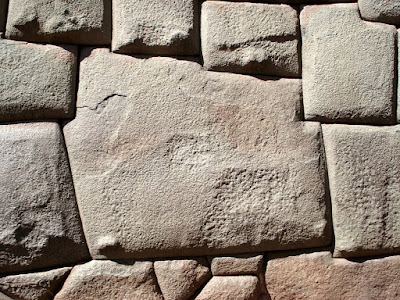
That's the story of Cusco: It was the capital city of the Inca Empire (its name means navel in Quechua - it was the bellybutton of their world) and most of it was torn down by the Spanish and used as a platform to built the city that you see today. At this corner you might see a very tall gringo, smiling and holding up a copy of a small magazine.
In his US accent he might call out something like:"Cusco Times*. Summer edition. Get it while it's hot!"
You may want to intervene at this point. I certainly did.
Short Frowning Gringo (Me): "That's a bit Northern Hemisphere of you isn't it? Summer Edition? It's the middle of Winter here!"
Tall Smiling Gringo: "Yeah - but it's so warm and sunny here that it just feels like Summer".
This seemed like a weak pretext on which to attempt to impose - once more - Northern Hemisphere order on a Southern Hemisphere people. But the Tall Smiling Gringo really did have a nice smile and my frown was starting to falter.
SFG: "Hmm. How long have you been here?".
TSG: "I got here 8 months ago, but now Cusco is my home. We're putting this magazine together in English and Spanish, and the proceeds are going toward helping out some of the poorer locals."
I had promises to keep and I had no change to buy the magazine so I promised the Tall Smiling Gringo that I'd buy the next time I passed by.
Walk past the TSG and the Archbishop's Palace and you will arrive at the prettiest plaza I have seen in South America. It's big but not vast. It's beautiful but not imposing. It's green, but not overgrown. Lively, but not overrun. Each side has its own character, but they all seem to get on with each other.
If you are lucky, to your left you will find somebody selling tamales. You can buy both sweet and savoury versions of this delicious street food - just make sure you try at least one.
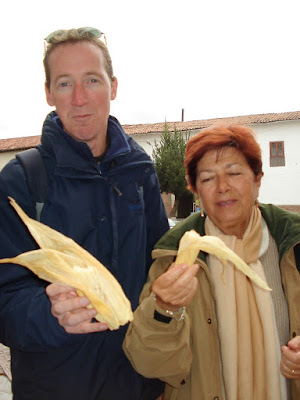
Oh go on then - have three:
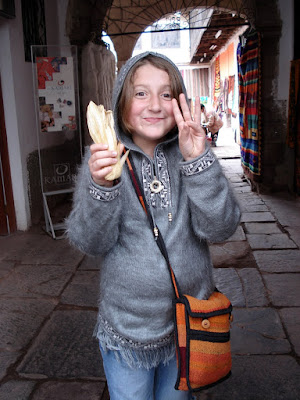
To your right stand three churches all attached to each other, the central and biggest of which is the cathedral. Inside, you will find more gold and silver than any European church you have ever seen. The tour guide will point out what you otherwise probably won't be able to see for yourself - that the artwork in these churches, created by indigenous artists commissioned by the clergy, contains hints of the religion that preceded christianity in these parts: the worship of the Sun, of the moon, but above all, of Pachamamma. In Cusco, most of what's on the surface is Spanish, but underneath, it's still Inca.
Around the main plaza (yes, called Plaza de Armas) there are many other plazas and streets worth visiting, especially to the north where a little road leads up to the Plaza Nazarene where the famously luxurious Hotel Monesterio is located. We could afford to have an aperitivo of Pisco Sours here, but not to stay. (One night in their junior suite costs the same as the 12 nights we spent in our modest hostel). On the way up, you'll pass a little street called Purgatorio - it would appear that Purgatory is a pedestrianized street (which makes sense given the relative hell of Peruvian traffic).
Heading east of here, we do a loop on our way back to Cuesta San Blas (that was a short walk, wasn't it? but with the lack of oxygen and the upward slope on the return journey, you're still puffed out I bet).
One one such return trip that I took, it was actually raining lightly. As I approached the Cuesta, there again was my tall smiling friend, still selling his magazines.
Me: "Summer edition my ass" I offered.
TSG: "Yeah! I know. Now I'm telling folks 'Get it while it's wet!'"
Nothing got this guy down. And I think that some of this must have rubbed off on me. I've been back for over a week now, and the routine of moving from place to place has washed right off us like it was never there. And I still feel great. I know the trip is over, but it'll never be gone.
(*I can't actually remember what the name of the magazine is, as I forgot the copy that I bought.)
It's been two weeks since we left Cusco, and I haven't yet blogged on the town itself, even if I have mentioned it obliquely a number of times. Time and distance, if I give them the chance, are waiting to rob me of my memories of this wonderful town, and so before that happens I'd like to take you on a walk.
When you turn left at the door to the Hospedaje San Blas, you walk downhill on the narrow and impossibly slippery footpaths of Cuesta San Blas. The cobbled road is wide enough for one car, and it's rarely free of traffic. At the end of the road, you cross to the pedestrianised route that leads past the famous 12-cornered stone, expertly set in place by the Incas and now supporting the Archbishop's Palace.
That's the story of Cusco: It was the capital city of the Inca Empire (its name means navel in Quechua - it was the bellybutton of their world) and most of it was torn down by the Spanish and used as a platform to built the city that you see today. At this corner you might see a very tall gringo, smiling and holding up a copy of a small magazine.
In his US accent he might call out something like:"Cusco Times*. Summer edition. Get it while it's hot!"
You may want to intervene at this point. I certainly did.
Short Frowning Gringo (Me): "That's a bit Northern Hemisphere of you isn't it? Summer Edition? It's the middle of Winter here!"
Tall Smiling Gringo: "Yeah - but it's so warm and sunny here that it just feels like Summer".
This seemed like a weak pretext on which to attempt to impose - once more - Northern Hemisphere order on a Southern Hemisphere people. But the Tall Smiling Gringo really did have a nice smile and my frown was starting to falter.
SFG: "Hmm. How long have you been here?".
TSG: "I got here 8 months ago, but now Cusco is my home. We're putting this magazine together in English and Spanish, and the proceeds are going toward helping out some of the poorer locals."
I had promises to keep and I had no change to buy the magazine so I promised the Tall Smiling Gringo that I'd buy the next time I passed by.
Walk past the TSG and the Archbishop's Palace and you will arrive at the prettiest plaza I have seen in South America. It's big but not vast. It's beautiful but not imposing. It's green, but not overgrown. Lively, but not overrun. Each side has its own character, but they all seem to get on with each other.
If you are lucky, to your left you will find somebody selling tamales. You can buy both sweet and savoury versions of this delicious street food - just make sure you try at least one.
Oh go on then - have three:
To your right stand three churches all attached to each other, the central and biggest of which is the cathedral. Inside, you will find more gold and silver than any European church you have ever seen. The tour guide will point out what you otherwise probably won't be able to see for yourself - that the artwork in these churches, created by indigenous artists commissioned by the clergy, contains hints of the religion that preceded christianity in these parts: the worship of the Sun, of the moon, but above all, of Pachamamma. In Cusco, most of what's on the surface is Spanish, but underneath, it's still Inca.
Around the main plaza (yes, called Plaza de Armas) there are many other plazas and streets worth visiting, especially to the north where a little road leads up to the Plaza Nazarene where the famously luxurious Hotel Monesterio is located. We could afford to have an aperitivo of Pisco Sours here, but not to stay. (One night in their junior suite costs the same as the 12 nights we spent in our modest hostel). On the way up, you'll pass a little street called Purgatorio - it would appear that Purgatory is a pedestrianized street (which makes sense given the relative hell of Peruvian traffic).
Heading east of here, we do a loop on our way back to Cuesta San Blas (that was a short walk, wasn't it? but with the lack of oxygen and the upward slope on the return journey, you're still puffed out I bet).
One one such return trip that I took, it was actually raining lightly. As I approached the Cuesta, there again was my tall smiling friend, still selling his magazines.
Me: "Summer edition my ass" I offered.
TSG: "Yeah! I know. Now I'm telling folks 'Get it while it's wet!'"
Nothing got this guy down. And I think that some of this must have rubbed off on me. I've been back for over a week now, and the routine of moving from place to place has washed right off us like it was never there. And I still feel great. I know the trip is over, but it'll never be gone.
(*I can't actually remember what the name of the magazine is, as I forgot the copy that I bought.)
Wednesday, August 27, 2008
How much did it cost?
Now that we're back, and we know how much we actually spent (as opposed to what we had budgeted for) I can publish the finances for the trip. I've taken out some details - in particular the home running costs which vary for everyone (and in any case are none of your business thank you ;-) ). Before clicking on the link, which will bring you to a Google spreadsheet, there are a few things to note about how we organized the budget.
The first page of the spreadsheet is the most interesting one. The main section shows our predicted breakdown of costs by country and category. Then to the right there are the more sobering columns: actual expense and difference between it and the budgeted amount.
The bottom line? We spent EUR 58,400 (US$85,700/GBP46,800), not including costs of keeping things ticking over back home. It was 14% more than we had budgeted, but comfortably within our contingency plans (If we were to do it again, knowing what we know now, we could probably have come in on budget at 51k.)
Let's put this in perspective. For that same amount of money we could have bought:
Spreadsheet here.
The first page of the spreadsheet is the most interesting one. The main section shows our predicted breakdown of costs by country and category. Then to the right there are the more sobering columns: actual expense and difference between it and the budgeted amount.
The bottom line? We spent EUR 58,400 (US$85,700/GBP46,800), not including costs of keeping things ticking over back home. It was 14% more than we had budgeted, but comfortably within our contingency plans (If we were to do it again, knowing what we know now, we could probably have come in on budget at 51k.)
Let's put this in perspective. For that same amount of money we could have bought:
- A second-hand 2007 5 Series BMW.
- Converted the attic (with sauna/gm) and landscaped the garden (complete with gnomes).
- 19 days in the Paris Ritz (not including breakfast).
Spreadsheet here.
Tuesday, August 26, 2008
8 Months in 4 Minutes
A 4-minute tour of the world, to the music of New Zealand band Shihad (the song is called Vampires and it was playing a lot when we were there). It might take a while to load - best to let it load and watch it all at once.
Sunday, August 24, 2008
Was it worth it?
I spent the first 24 hours back in Cork debating with myself whether I was dreaming I was home, or whether the last 8 months had all been a dream. Five days later, I have not yet come to any firm conclusion, but for the sake of not looking nuts to my neighbours (be they real or imagined) I have decided to put this issue to one side in the hope that it will resolve itself one way or the other in due course.
The flight back was not as terrible as we all thought 15 hours in an aeroplane would be. Take note: 15 hours with British Airways is easier than 10 hours with LAN. It helped that we stopped off in Sao Paolo. This not only broke up the time into more humane chunks, it also added a third language to the list of announcements. And nothing beats listening to Portuguese for straight-up entertainment value. I can make absolutely no sense of it whatsoever (Letizia can). To me it's a string of noises ending in sh or aaau, and seems to require that you speak as if you had a runny nose and no paper tissues (Sara should be fluent).
I couldn't sleep much - a condition that continues to the present moment - so I wandered about the aisles regularly, or sat listening to the beautiful voice and enchanting humour of the late Peter Ustinov reading his own autobiography (Dear Me).
15 hours is a long time to think, and an even longer time to feel. I did plenty of both, though I can't vouch for the quality of either. It occurred to me that in my life, despite the handicap of truly awful financial judgement, I have made three investments (in incrementing amounts) of which I can be justly proud and unwaveringly sure:
On one of my extra-seat excursions, after the sky had begun to turn dark but before we had crossed the equator, I glanced out a porthole and fancied I saw the pointer stars that indicate the Southern Cross. I felt a sudden rush of excitement, but also shock, and followed the stars to see if I could make out the Cross itself. But I couldn't. There was still too much light in the sky and in any case, the two stars themselves were probably not even the pointers. I settled back in my seat for a while, dissatisfied for not having seen, for one last time, the stars that had watched over us for almost all of our journey. Worse. I felt angry and maybe even a little guilty, as if I had forgotten to say goodbye to a friend.
The flight back was not as terrible as we all thought 15 hours in an aeroplane would be. Take note: 15 hours with British Airways is easier than 10 hours with LAN. It helped that we stopped off in Sao Paolo. This not only broke up the time into more humane chunks, it also added a third language to the list of announcements. And nothing beats listening to Portuguese for straight-up entertainment value. I can make absolutely no sense of it whatsoever (Letizia can). To me it's a string of noises ending in sh or aaau, and seems to require that you speak as if you had a runny nose and no paper tissues (Sara should be fluent).
I couldn't sleep much - a condition that continues to the present moment - so I wandered about the aisles regularly, or sat listening to the beautiful voice and enchanting humour of the late Peter Ustinov reading his own autobiography (Dear Me).
15 hours is a long time to think, and an even longer time to feel. I did plenty of both, though I can't vouch for the quality of either. It occurred to me that in my life, despite the handicap of truly awful financial judgement, I have made three investments (in incrementing amounts) of which I can be justly proud and unwaveringly sure:
- A German latex mattress that cost me what I was sure was a fortune at the time, but which I know now to be a fair price for the most comfortable sleeping surface available to man or beast. This same poor creature remained faithful to us over the 8 months away, despite our philanderings with no less that 50 other beds. (We fell into its embrace on our return home full of the same unreliable emotions and untenable promises that a womaniser offers on repenting to his wife.)
- An Alfa Romeo 156. We chose it because it looked amazing, and we should have been punished for our superficiality with a lifetime of mechanics clicking their tongues and making sharp intakes of breath. Instead, it has never given us a cause for complaint after 8 years.
- This trip. Was it worth it? Hand on my heart, a thousand times yes. Why? I have not the faintest idea. Many reasons, most of which remain, for now, completely hidden to me, but I fully expect to be revealed over the next few years. I know in the bottom of my mortal soul that this was a life-changing experience, even if I feel entirely the same person I was when I left. I can see hints of change in my daughters, perhaps, because their characters are still being formed. But they too are very much the same girls who left Cork last December (though their dentists would have a hard time matching them to their records, given how many teeth have been both lost and grown). Time (the bastard) will tell exactly why this trip was the right thing for us to do now. I can tell you now that it was worth every cent.
On one of my extra-seat excursions, after the sky had begun to turn dark but before we had crossed the equator, I glanced out a porthole and fancied I saw the pointer stars that indicate the Southern Cross. I felt a sudden rush of excitement, but also shock, and followed the stars to see if I could make out the Cross itself. But I couldn't. There was still too much light in the sky and in any case, the two stars themselves were probably not even the pointers. I settled back in my seat for a while, dissatisfied for not having seen, for one last time, the stars that had watched over us for almost all of our journey. Worse. I felt angry and maybe even a little guilty, as if I had forgotten to say goodbye to a friend.
Monday, August 18, 2008
Last Tango in Buenos Aires
Tonight is the last night. I can scarcely believe it. I know that I have said in previous posts that I was ready to come home, but it seems we have barely arrived in Buenos Aires and now it is already time to leave. This time tomorrow, all going well, we will be on board a British Airways flight to London, and with a connecting Aer Lingus flight we'll be in Cork at about 11am on Wednesday morning. The level of anticipation, and disbelief that the moment is here, is almost equivalent to that of our first flight, almost 8 months ago, to Beijing.
If you have enjoyed reading this blog, please stay tuned as I will be posting for a few weeks to come. I have memories of Cusco, Lima and BA that are still to be recorded, and of course even the homecoming itself and the effect it will have on all of us is a subject that might interest you. Especially if you are thinking of doing something similar yourself.
About halfway though our trip, when we got to New Zealand, it started to dawn on me that 8 months isn't very long at all. Time is the enemy, marching imperiously on without a backward glance upon the destruction it leaves behind. We did this trip now, as opposed to being sensible and waiting until the kids were older, because we had no idea of how long this life, this planet, or our freedom to travel around in it, might last. It's a cliche, but a fine one, that the right time to do something that you need to do is probably right now (adding on a year or two for planning!). While stocks last. But now our stock of eight months has been used up.
Time always wins.
But in two ways, we might have pulled the wool over its eyes for a while. Firstly, the memories of this trip will last me and Letizia for the rest of our lives. I hope that the same is true for Nina and Sara. And more: I hope that what they have experienced over the last 8 months will serve them forever. Not just to give them a taste for travel, but so that they might always remain certain that whatever life shows them, there is always something else out there. That they should never feel that they have seen everything. That they should not assume that what they see around them is the only way to live. That they should never feel trapped by illusary limits.
Secondly, even if time is the enemy, the greatest gift we had during these 8 months was the time we spent together. It is unlikely (though not impossible) that the four of us will ever share quarters in quite so intense a fashion as during this trip. I spent about 3 years worth of free time with my children, when compared to the time that I would normally have had with them at home. While this has been challenging at times - above all for Nina and Sara - it has also helped me to understand a little better who they are and what I need to do to be a better parent. The trip hasn't been about seeing the world as much as it has been about living a more intense family life, with China and much of the Southern Hemisphere as the backdrop. I should be clear about this: I am no better a father now than I was when we started. In many ways Nina and Sara got to see some aspects of my character that they might have been better off shielded from. (For example, I swear a lot. I normally offload my daily dose of profanity in the office, and I'm ueber-careful at home. Not on the road, though.) But I think we understand each other a little better, and even if that doesn't automatically lead to a better relationship, it can pave the way. We simply wouldn't have had this time together, and this opportunity to see more of each others' personalities, if it weren't for the trip.
A number of readers have suggested that there is a book in this blog. I'm inclined to agree, if for no other reasons than a vanity on my part to think I might be able to write one, but also for the fact that the experience can be best understood and appreciated in retrospect, as a whole, rather than in this diary form. Writing the blog has helped me digest our experiences as we've travelled along, to untangle at least in an initial way, the many threads that were spun each day. To write a book, to see the entire 8 months from the more stable platform of so-called normal life, would be a way of securing the memories, and of giving the trip some enduring meaning for my family. Writing is one thing, and publishing another entirely. If anyone out there knows of or can recommend either a publisher or a literary agent that would be willing to take us on, please let me know.
Tonight over dinner in the beautiful and big-hearted city of Buenos Aires, the four of us toasted our trip and our return home. To those of you who have followed, once or regularly, especially to those who have commented or emailed; to those of you who helped make this trip possible with help or understanding; and to those of you who showed us hospitality along the way; I raise my glass and drink to your health.
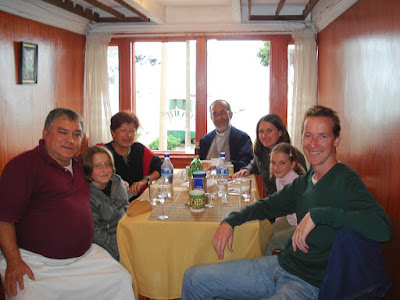
(Picture taken in Lima, but as you might tell from my big red face, plenty of Pisco Sours were drunk to many healths).
If you have enjoyed reading this blog, please stay tuned as I will be posting for a few weeks to come. I have memories of Cusco, Lima and BA that are still to be recorded, and of course even the homecoming itself and the effect it will have on all of us is a subject that might interest you. Especially if you are thinking of doing something similar yourself.
About halfway though our trip, when we got to New Zealand, it started to dawn on me that 8 months isn't very long at all. Time is the enemy, marching imperiously on without a backward glance upon the destruction it leaves behind. We did this trip now, as opposed to being sensible and waiting until the kids were older, because we had no idea of how long this life, this planet, or our freedom to travel around in it, might last. It's a cliche, but a fine one, that the right time to do something that you need to do is probably right now (adding on a year or two for planning!). While stocks last. But now our stock of eight months has been used up.
Time always wins.
But in two ways, we might have pulled the wool over its eyes for a while. Firstly, the memories of this trip will last me and Letizia for the rest of our lives. I hope that the same is true for Nina and Sara. And more: I hope that what they have experienced over the last 8 months will serve them forever. Not just to give them a taste for travel, but so that they might always remain certain that whatever life shows them, there is always something else out there. That they should never feel that they have seen everything. That they should not assume that what they see around them is the only way to live. That they should never feel trapped by illusary limits.
Secondly, even if time is the enemy, the greatest gift we had during these 8 months was the time we spent together. It is unlikely (though not impossible) that the four of us will ever share quarters in quite so intense a fashion as during this trip. I spent about 3 years worth of free time with my children, when compared to the time that I would normally have had with them at home. While this has been challenging at times - above all for Nina and Sara - it has also helped me to understand a little better who they are and what I need to do to be a better parent. The trip hasn't been about seeing the world as much as it has been about living a more intense family life, with China and much of the Southern Hemisphere as the backdrop. I should be clear about this: I am no better a father now than I was when we started. In many ways Nina and Sara got to see some aspects of my character that they might have been better off shielded from. (For example, I swear a lot. I normally offload my daily dose of profanity in the office, and I'm ueber-careful at home. Not on the road, though.) But I think we understand each other a little better, and even if that doesn't automatically lead to a better relationship, it can pave the way. We simply wouldn't have had this time together, and this opportunity to see more of each others' personalities, if it weren't for the trip.
A number of readers have suggested that there is a book in this blog. I'm inclined to agree, if for no other reasons than a vanity on my part to think I might be able to write one, but also for the fact that the experience can be best understood and appreciated in retrospect, as a whole, rather than in this diary form. Writing the blog has helped me digest our experiences as we've travelled along, to untangle at least in an initial way, the many threads that were spun each day. To write a book, to see the entire 8 months from the more stable platform of so-called normal life, would be a way of securing the memories, and of giving the trip some enduring meaning for my family. Writing is one thing, and publishing another entirely. If anyone out there knows of or can recommend either a publisher or a literary agent that would be willing to take us on, please let me know.
Tonight over dinner in the beautiful and big-hearted city of Buenos Aires, the four of us toasted our trip and our return home. To those of you who have followed, once or regularly, especially to those who have commented or emailed; to those of you who helped make this trip possible with help or understanding; and to those of you who showed us hospitality along the way; I raise my glass and drink to your health.
(Picture taken in Lima, but as you might tell from my big red face, plenty of Pisco Sours were drunk to many healths).
Friday, August 15, 2008
Cusco and the Bambini di Peru
Remember the Black Babies? If you are of a certain age (and perhaps Irish) then you will remember being told as a child that the Black Babies were starving in Biafra and you should be ashamed of yourself not eating the delicious meal that your mother slaved over for hours (taste that guilt). You might have come back with the priceless retort that the Black Babies were welcome to your cabbage and tapioca pudding, if somebody would be so kind as to provide a serviceable postal address and a grease-proof envelope.
My point is (yes, I have one) that other people's suffering and deprivation is largely a matter for our brains, while our own tribulations are projected in technicolour detail against our hearts. Especially if those other people live a long way away. Like Tipperary for example (distance from Cork = 104.6 km). Or Biafra (no longer on the map). Or Peru.
For many years, Nina and Sara have heard about the Bambini di Peru from their maternal grandmother. Sometime she would simply relate a detail or a story. Like the time her camera got nicked on a trip to one of Cusco's outlying villages, but was quickly 'found' again once Padre Nicanor told the villagers that he wouldn't say mass in the place until the camera was returned. (It was returned, complete with the original film which when developed showed pictures of the ragged young culprits with mischevious smiles. Now that's innocence.) Other times, I have heard her use the Bambini di Peru in the same way the Biafran Babies were used against my generation. The circle was completed when one of my children offered to post their tagliatelle alla matriciana to the appropriate Peruvian address.
It is very hard for some - especially those of us who spend our working lives so much in our heads, both protected and demented by abstractions - to appreciate the harshly different reality of lives lived far away from us. In fact, even when you bounce up the barely-passable track of their remote town, trying desperately to keep up with the much more expertly driven pickup ahead of you, and pull into the turd-covered grassy area that passes for a village plaza, the concept of living like a child of Akorakai is a fuzzy one.
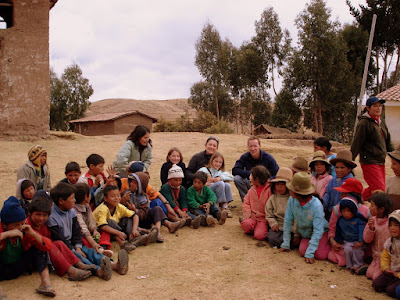
In a village of 150 people, these kids seem to make up a third of the population. Many of them were born in the 21st century, but most of them suffer from some effects of malnutrician. Their main food source is the crops that their parents tend: Maize, potato and beans. The bananas and bread that we brought (and Nina and Sara distributed) were rare variations to their diet. A great many of them are harbouring intestinal parasites and suffer from other problems that betray an absence in basic hygiene. Nobody tells the kids to wash their hands before they eat - only the doctors that pass through twice a month. And that message just doesn't stick.
But the effort goes on. The pickup ahead of me was driven by José (not the same one I've recently written about) and his passengers were the most important - a team of one doctor, two nurses (including Hermana Mathilde) and one psychologist, all based in the Centromedico of the Parish of Belén. This was one of their twice-monthly trips to Akorakai, a small but vital contribution to the general health of those living there. Their only alternative is a 2 hour walk (nobody has a car here) cross-country to the nearest town.
As I write from the luxury of a Buenos Aires hotel, it's hard to place myself again in the atmosphere of Akorakai, much less recall my thoughts on the place. I more or less stood out of the way, occasionally interacting with the kids in my terrible Spanish, and only occasionally understanding their answers. Most of the interaction was between Nina, Sara and the village kids. There wasn't much difference between how they got on with those kids and how they play out on the green at home, given the language barrier. The first, and entirely predictable stage was that all the young boys of the village gathered around the back of the pickup where Nina and Sara were sitting (while Daddy kept a watchful eye). This developed into a game of fling-the-hat, a game where some poor unfortunates hat would be nicked, flung at Nina and Sara, who would then toss it further. This continued for a while until the boys got bored and scattered around the various parts of the village. Then the smaller and quieter group of girls approached. Some kind of communication took place (the standard tweenie exchange of vital statistics like name and age), with Letizia acting as moderator.
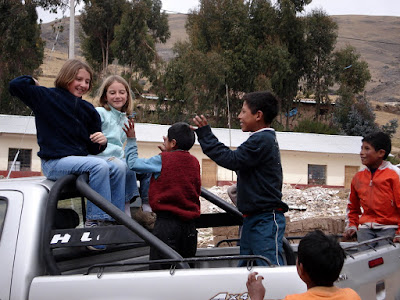
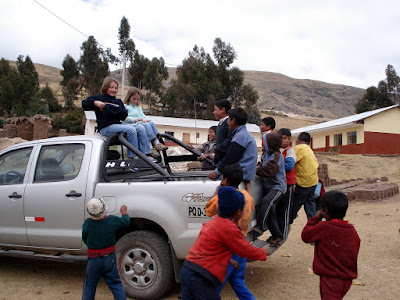
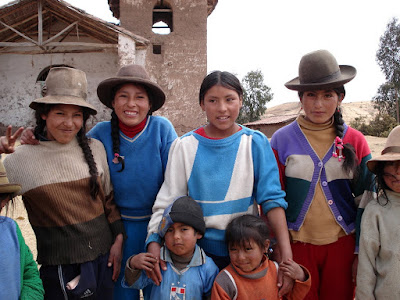
I asked a couple of the boys - two particularly active ones who were jokingly asking for injections from me, assuming I was a doctor - if they planned to be doctors when they grew up. The answer was a clear no, with an overtone that to me sounded like "what kind of a stupid question is that, gringo?" I don't think many of these kids have any concept of what else life can offer, despite the fact that there was a fulltime school, even if little else, in the village (the Peruvian state seems to be putting a priority on education, even above health, for its most isolated communities). I found out later that these villages are effectively dying off - anyone with any ambition wants to move to Cusco. Those left behind are typically trapped by their own apathy.
There was still a distance between the European girls and the Peruvians, and it was maintained by both sides. The blonde girls belonged on the top of the pickup, and the locals belonged on the ground. Those positions were occasionally exchanged, but balance and order was always restored. This happened entirely by itself.
Nobody had any pretentions that this was a normal encounter. But at the end of the afternoon, after we had made our goodbyes and started to bounce down the hill again toward our completely modern existance in Cusco, Nina and Sara had at least some faces to recall when next dealing with the concept of the Bambini di Peru.
That said, I haven't noticed any new appetite for either cabbage or tapioca.
My point is (yes, I have one) that other people's suffering and deprivation is largely a matter for our brains, while our own tribulations are projected in technicolour detail against our hearts. Especially if those other people live a long way away. Like Tipperary for example (distance from Cork = 104.6 km). Or Biafra (no longer on the map). Or Peru.
For many years, Nina and Sara have heard about the Bambini di Peru from their maternal grandmother. Sometime she would simply relate a detail or a story. Like the time her camera got nicked on a trip to one of Cusco's outlying villages, but was quickly 'found' again once Padre Nicanor told the villagers that he wouldn't say mass in the place until the camera was returned. (It was returned, complete with the original film which when developed showed pictures of the ragged young culprits with mischevious smiles. Now that's innocence.) Other times, I have heard her use the Bambini di Peru in the same way the Biafran Babies were used against my generation. The circle was completed when one of my children offered to post their tagliatelle alla matriciana to the appropriate Peruvian address.
It is very hard for some - especially those of us who spend our working lives so much in our heads, both protected and demented by abstractions - to appreciate the harshly different reality of lives lived far away from us. In fact, even when you bounce up the barely-passable track of their remote town, trying desperately to keep up with the much more expertly driven pickup ahead of you, and pull into the turd-covered grassy area that passes for a village plaza, the concept of living like a child of Akorakai is a fuzzy one.
In a village of 150 people, these kids seem to make up a third of the population. Many of them were born in the 21st century, but most of them suffer from some effects of malnutrician. Their main food source is the crops that their parents tend: Maize, potato and beans. The bananas and bread that we brought (and Nina and Sara distributed) were rare variations to their diet. A great many of them are harbouring intestinal parasites and suffer from other problems that betray an absence in basic hygiene. Nobody tells the kids to wash their hands before they eat - only the doctors that pass through twice a month. And that message just doesn't stick.
But the effort goes on. The pickup ahead of me was driven by José (not the same one I've recently written about) and his passengers were the most important - a team of one doctor, two nurses (including Hermana Mathilde) and one psychologist, all based in the Centromedico of the Parish of Belén. This was one of their twice-monthly trips to Akorakai, a small but vital contribution to the general health of those living there. Their only alternative is a 2 hour walk (nobody has a car here) cross-country to the nearest town.
As I write from the luxury of a Buenos Aires hotel, it's hard to place myself again in the atmosphere of Akorakai, much less recall my thoughts on the place. I more or less stood out of the way, occasionally interacting with the kids in my terrible Spanish, and only occasionally understanding their answers. Most of the interaction was between Nina, Sara and the village kids. There wasn't much difference between how they got on with those kids and how they play out on the green at home, given the language barrier. The first, and entirely predictable stage was that all the young boys of the village gathered around the back of the pickup where Nina and Sara were sitting (while Daddy kept a watchful eye). This developed into a game of fling-the-hat, a game where some poor unfortunates hat would be nicked, flung at Nina and Sara, who would then toss it further. This continued for a while until the boys got bored and scattered around the various parts of the village. Then the smaller and quieter group of girls approached. Some kind of communication took place (the standard tweenie exchange of vital statistics like name and age), with Letizia acting as moderator.
I asked a couple of the boys - two particularly active ones who were jokingly asking for injections from me, assuming I was a doctor - if they planned to be doctors when they grew up. The answer was a clear no, with an overtone that to me sounded like "what kind of a stupid question is that, gringo?" I don't think many of these kids have any concept of what else life can offer, despite the fact that there was a fulltime school, even if little else, in the village (the Peruvian state seems to be putting a priority on education, even above health, for its most isolated communities). I found out later that these villages are effectively dying off - anyone with any ambition wants to move to Cusco. Those left behind are typically trapped by their own apathy.
There was still a distance between the European girls and the Peruvians, and it was maintained by both sides. The blonde girls belonged on the top of the pickup, and the locals belonged on the ground. Those positions were occasionally exchanged, but balance and order was always restored. This happened entirely by itself.
Nobody had any pretentions that this was a normal encounter. But at the end of the afternoon, after we had made our goodbyes and started to bounce down the hill again toward our completely modern existance in Cusco, Nina and Sara had at least some faces to recall when next dealing with the concept of the Bambini di Peru.
That said, I haven't noticed any new appetite for either cabbage or tapioca.
Wednesday, August 13, 2008
Suspending Judgement in Lima
It's a well-known tip: when you want to see if the turbulence you've just hit really was something to worry about, you look into the face of the air staff. If they look unhappy, then you should be too. On the journey from Lima's Jorge Chavez Internation Airport to the centre of Lima, I looked into the faces of one or two pedestrians that our driver almost decorated the front of our minibus with. I could see in their expressions that this was not standard turbulance.
We had read, and been told, that Lima was not an interesting city to visit - just another big city with all the disadvanges that go along with that. But having heard the same things about Auckland, and found them not to be completely true, we were prepared to suspend our judgement for a while. That suspension of judgement almost didn't last the trip from the airport. It was hard to avoid the impression that Lima was a grime-stained, bird-shat sprawl with the manners and menace of a scene from Blade Runner. Since then, we've spent twenty-four hours trapped under a low ceiling of impregnable cloud that doesn't have the decency to rain, rain, go away, but instead remains as constant and as endless as the equally grey sea alongside us. Judgement seems imminent.
I'm OK with big cities. I'm prepared for the trade-offs. People are busier, it's harder to get around, cities can start to all look alike sometimes. But on the other hand there's often more to see, beautiful architecture and an urban sophistication that shows in the way people dress and hold themselves. In Lima I feel like we've paid our money and are still waiting for the show. The place has been shook from head to toe by earthquakes, and the surviving buildings of any significance seem mostly to be based around the Plaza Major (also known as the Plaza de Armas). That wouldn't be such a problem if it weren't for the fact that Lima measures about 100km from top to bottom, and about 50 km inland. Looking for beauty in a city that seems to be mostly made up of broken streets and sadistic traffic is a full-time job. I miss the blue skies and relative quiet of Cusco (and I owe you about 4 more blog entries on that wonderful part of the world).
But if a city lacks charm, you have to go out and make it yourself. Our approach, and again we have to thank my mother-in-law Livia for her excellent Peruvian connections, is to shun normal hotel life for 3 nights of monastic bliss. Just off Plaza Bolognesi there lies a fine but smog-stained building owned and run by the Salesian Order. Here, there is one bed per room on a long corridor of similar rooms. Cells if you will, but with the keys firmly in our own hands. The building is enormous and mostly empty, but if you find your way to the more important corners you will meet some extraordinary characters.
Padre Luigi has a long grey beard but the energy and mannerisms of a Roberto Benigni. He was born in Veneto and when he joined the order, he asked to be sent to India. The order had other plans. He has been living in the Equadorian and Peruvian jungle for the last 54 years, and is here in Lima for a while in order to complete the corrections on his translation of the entire New Testament into a language that most of us will never hear of, much less hear. Normally he lives with, and like, the people he ministers to. There is no electricity or anything else that remotely recalls civilization there. "It's a simple life" he says smiling, while I mentally conjure up images of the complexity of living without modern comforts. For 54 years.
Over in the infamous district of Callao lives another Salesian priest, also with some Italian heritage. Padre Lombardi is the director of a school for boys in an area of Lima best known for gangland murder. We went to visit him today (he sent a minivan for us, which took us into the heart of Callao and never even slowed down as it approached the large metal gate of the school, only stopping when that gate was closed behind us) and he showed us that there was more to Callao than hit the headlines. He took us to a tiny restaurant on the waterfront, owned and chefed by Señor Andreas, who specialised in ceviche. This type of dish has, as its main ingredient, raw fish. Nina (and Sara to a lesser extent) like sushi, but I wasn't prepared for the gusto with which both of them attacked the three extraordinary dishes that Andreas brought to our table, one after the other. Each dish was sublime. The first was similar to the Sardinian speciality called bottarga that I have come to love over the last 13 years, though it used the eggs of marlin or tuna rather than mullet. The second was a more standard ceviche dish, again from marlin and served with roasted maize. The last, named '20th of August' after the date of the establishment of the municipality of Callao, was spectacular. I wont try to describe it - perhaps Letizia will in a later blog (and I'll translate into English) - except to say that it was the most unique fish dish I've ever tasted and demonstrated that Señor Andreas is an artist. I'll try to pass along the name and address of this place for anyone out there interested enough in fish to brave Callao without the local priest's minivan.
We have two more nights here to see what else can be salvaged from this concrete tip. But the clock is ticking. The '20th of August', as well as marking the beginning of Callao, will mark the end of my family's journey, just a week from today as I write. Since leaving Cusco, we feel we are on the homeward track, stopping off just in Lima and Buenos Aires for rest. And yet it feels so strange to think that the 8 months have passed this quickly. During our remaining stay here in Lima and in BA I'll try to catch up with some memories and half-finished trains of thought. It might even be a case of writing from Ireland for a day or two after we get back.
After that, I'll have to decide what, if anything, to do with this blog that has been for me a very important part of this trip. Having acquired the habit of facing a blank sheet of paper on a regular basis, and somehow filling it with what I am told is occasionally entertaining details of our experiences, I will find it hard to suddenly stop. I think I'll miss the blogging as much as I'll miss the travelling.
We had read, and been told, that Lima was not an interesting city to visit - just another big city with all the disadvanges that go along with that. But having heard the same things about Auckland, and found them not to be completely true, we were prepared to suspend our judgement for a while. That suspension of judgement almost didn't last the trip from the airport. It was hard to avoid the impression that Lima was a grime-stained, bird-shat sprawl with the manners and menace of a scene from Blade Runner. Since then, we've spent twenty-four hours trapped under a low ceiling of impregnable cloud that doesn't have the decency to rain, rain, go away, but instead remains as constant and as endless as the equally grey sea alongside us. Judgement seems imminent.
I'm OK with big cities. I'm prepared for the trade-offs. People are busier, it's harder to get around, cities can start to all look alike sometimes. But on the other hand there's often more to see, beautiful architecture and an urban sophistication that shows in the way people dress and hold themselves. In Lima I feel like we've paid our money and are still waiting for the show. The place has been shook from head to toe by earthquakes, and the surviving buildings of any significance seem mostly to be based around the Plaza Major (also known as the Plaza de Armas). That wouldn't be such a problem if it weren't for the fact that Lima measures about 100km from top to bottom, and about 50 km inland. Looking for beauty in a city that seems to be mostly made up of broken streets and sadistic traffic is a full-time job. I miss the blue skies and relative quiet of Cusco (and I owe you about 4 more blog entries on that wonderful part of the world).
But if a city lacks charm, you have to go out and make it yourself. Our approach, and again we have to thank my mother-in-law Livia for her excellent Peruvian connections, is to shun normal hotel life for 3 nights of monastic bliss. Just off Plaza Bolognesi there lies a fine but smog-stained building owned and run by the Salesian Order. Here, there is one bed per room on a long corridor of similar rooms. Cells if you will, but with the keys firmly in our own hands. The building is enormous and mostly empty, but if you find your way to the more important corners you will meet some extraordinary characters.
Padre Luigi has a long grey beard but the energy and mannerisms of a Roberto Benigni. He was born in Veneto and when he joined the order, he asked to be sent to India. The order had other plans. He has been living in the Equadorian and Peruvian jungle for the last 54 years, and is here in Lima for a while in order to complete the corrections on his translation of the entire New Testament into a language that most of us will never hear of, much less hear. Normally he lives with, and like, the people he ministers to. There is no electricity or anything else that remotely recalls civilization there. "It's a simple life" he says smiling, while I mentally conjure up images of the complexity of living without modern comforts. For 54 years.
Over in the infamous district of Callao lives another Salesian priest, also with some Italian heritage. Padre Lombardi is the director of a school for boys in an area of Lima best known for gangland murder. We went to visit him today (he sent a minivan for us, which took us into the heart of Callao and never even slowed down as it approached the large metal gate of the school, only stopping when that gate was closed behind us) and he showed us that there was more to Callao than hit the headlines. He took us to a tiny restaurant on the waterfront, owned and chefed by Señor Andreas, who specialised in ceviche. This type of dish has, as its main ingredient, raw fish. Nina (and Sara to a lesser extent) like sushi, but I wasn't prepared for the gusto with which both of them attacked the three extraordinary dishes that Andreas brought to our table, one after the other. Each dish was sublime. The first was similar to the Sardinian speciality called bottarga that I have come to love over the last 13 years, though it used the eggs of marlin or tuna rather than mullet. The second was a more standard ceviche dish, again from marlin and served with roasted maize. The last, named '20th of August' after the date of the establishment of the municipality of Callao, was spectacular. I wont try to describe it - perhaps Letizia will in a later blog (and I'll translate into English) - except to say that it was the most unique fish dish I've ever tasted and demonstrated that Señor Andreas is an artist. I'll try to pass along the name and address of this place for anyone out there interested enough in fish to brave Callao without the local priest's minivan.
We have two more nights here to see what else can be salvaged from this concrete tip. But the clock is ticking. The '20th of August', as well as marking the beginning of Callao, will mark the end of my family's journey, just a week from today as I write. Since leaving Cusco, we feel we are on the homeward track, stopping off just in Lima and Buenos Aires for rest. And yet it feels so strange to think that the 8 months have passed this quickly. During our remaining stay here in Lima and in BA I'll try to catch up with some memories and half-finished trains of thought. It might even be a case of writing from Ireland for a day or two after we get back.
After that, I'll have to decide what, if anything, to do with this blog that has been for me a very important part of this trip. Having acquired the habit of facing a blank sheet of paper on a regular basis, and somehow filling it with what I am told is occasionally entertaining details of our experiences, I will find it hard to suddenly stop. I think I'll miss the blogging as much as I'll miss the travelling.
Subscribe to:
Posts (Atom)